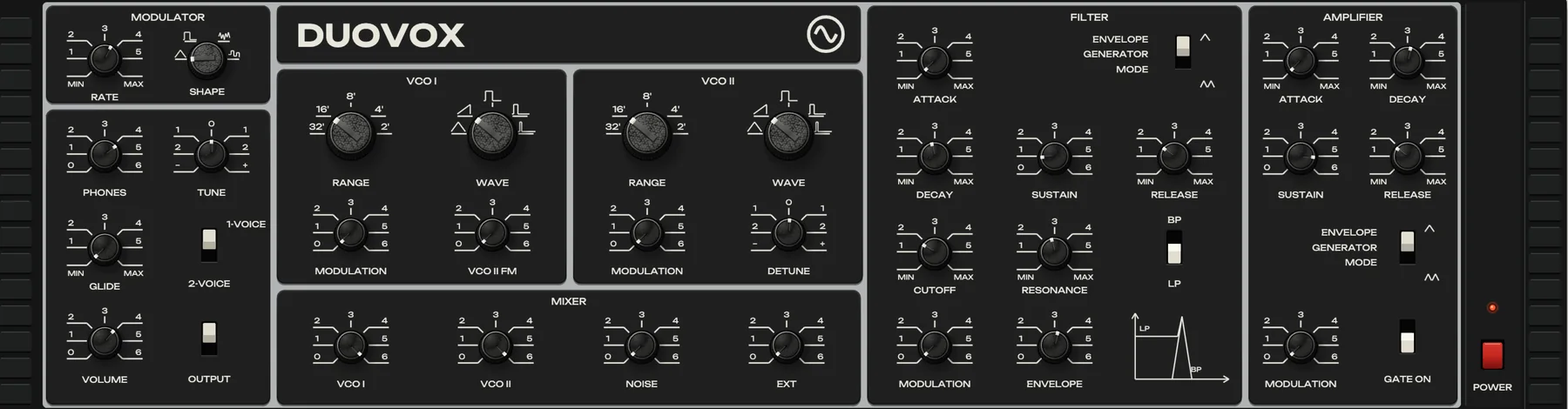
In 1982 the Formanta plant in Kachkanar, a mining town in the Urals, started building a synthesizer with a black tub of a case, ribbed side cheeks that look like tank tracks and a filter made of two op-amps doing a job they were never sold for. It was called Поливокс. In the West it is usually written Polivoks or Polyvox, and it went on to turn up on records by Goldfrapp and Franz Ferdinand and in Mick Gordon's score for DOOM.
This journal is about that instrument: the circuit, the sound, the people, the myths. It is written by the people who made Duovox, our reconstruction of it, so every screenshot is the plug-in and every sound is rendered by it. Where we sell, we say so. Where something is only rumoured, we say that too.
Each of those eight is a different trick of the same two-oscillator panel: the overdriven bass, a filter that screams without losing its bottom, envelopes that loop on their own, two keys sharing one filter, a square-wave trill that only goes up, audio-rate cross-modulation, a kick drum made from the filter and a steam train from the factory passport. The tutorials below take them apart one at a time.
Learn to program it, knob by knob
Step-by-step patches on the real panel, with screenshots and players you can turn. Start with the bass.
Turn every knob and hear it
Fewer words, more knobs. Every control on the 1982 panel with a player, and the oscillators measured against recordings of real units.
Where it came from and who played it
Vladimir Kuzmin's design, the Ural plant that built it, and the records it is on, every claim linked to its source and graded by how solid that source is.
Honest comparisons
Every Polyvox emulation we could find, the classic monosynths of its era, and whether you should buy a real one.
Why we built it, and what it is for
The selling part, kept specific: what Duovox does, which genres it suits, and what it does not do.
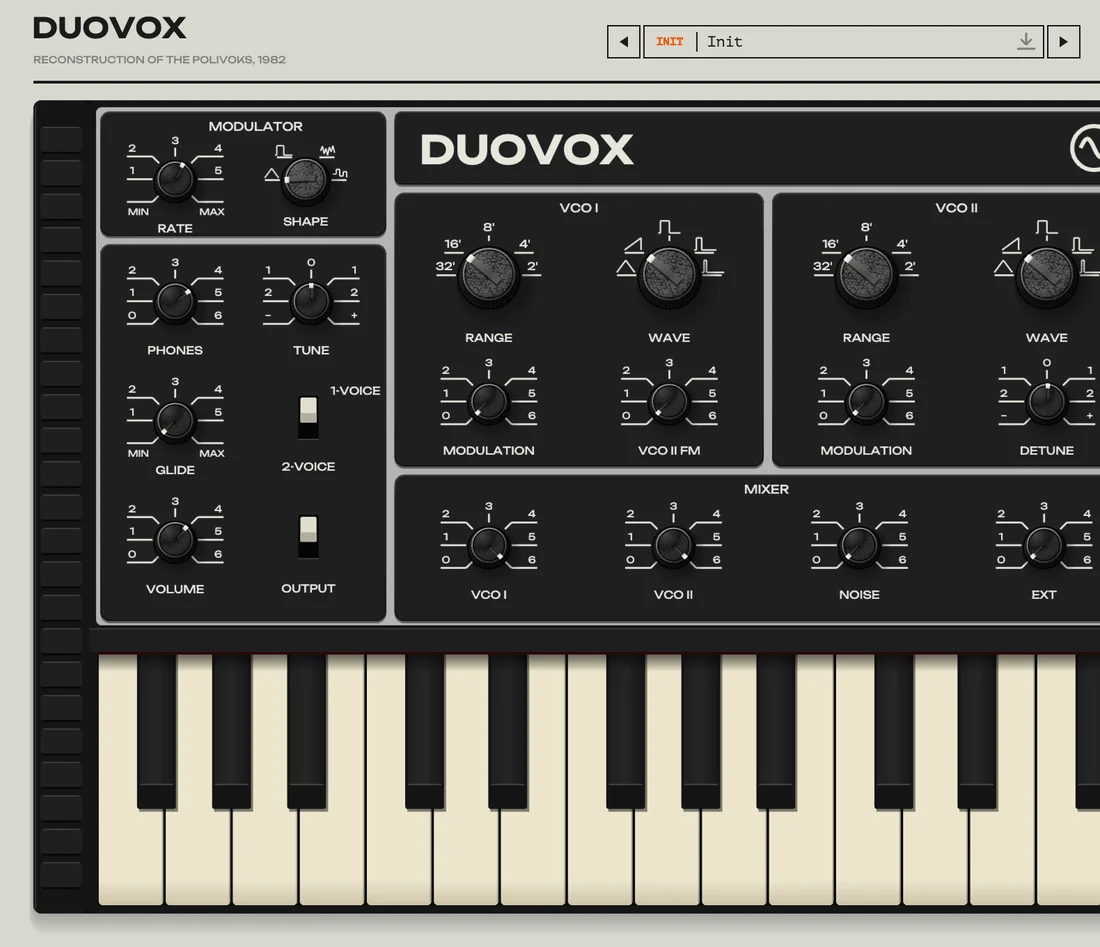
- The full Polyvox panel, control for control, with the scream, the looping envelopes and duophony
- A 4x/8x oversampled model of the two-chip filter, calibrated on recordings of real units
- 257 presets in ten banks and five packs, and a GEN button for new basses, leads and screams
- Extras the 1982 box never had: poly mode, velocity, pitch bend, drift, a rear panel