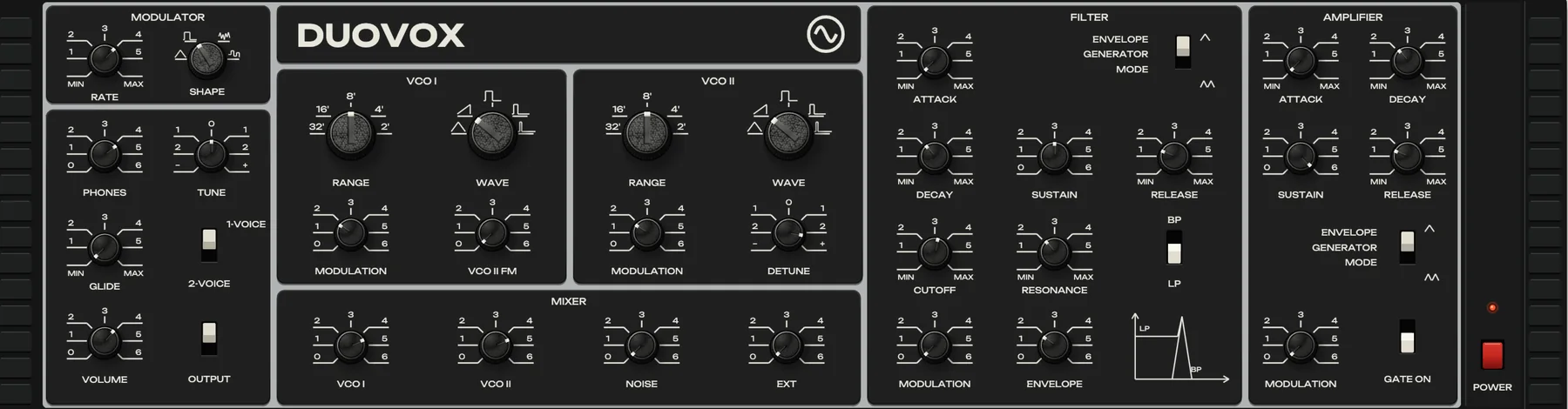
The Polyvox (Polivoks, Поливокс) has one LFO, called the modulator, and its designer Vladimir Kuzmin made a small decision about it that changes how the whole instrument plays: the square wave only goes up. Hold a key with the square on the pitch and you get a trill, not a wobble.
This page goes through the modulator plate on Duovox, our reconstruction of the instrument: the four shapes, the trill, the four-note chord Kuzmin describes in his own article about the design, the random sounds and the sirens. Every picture is the plug-in and every player is a render of it.
Two controls, and no depth knob
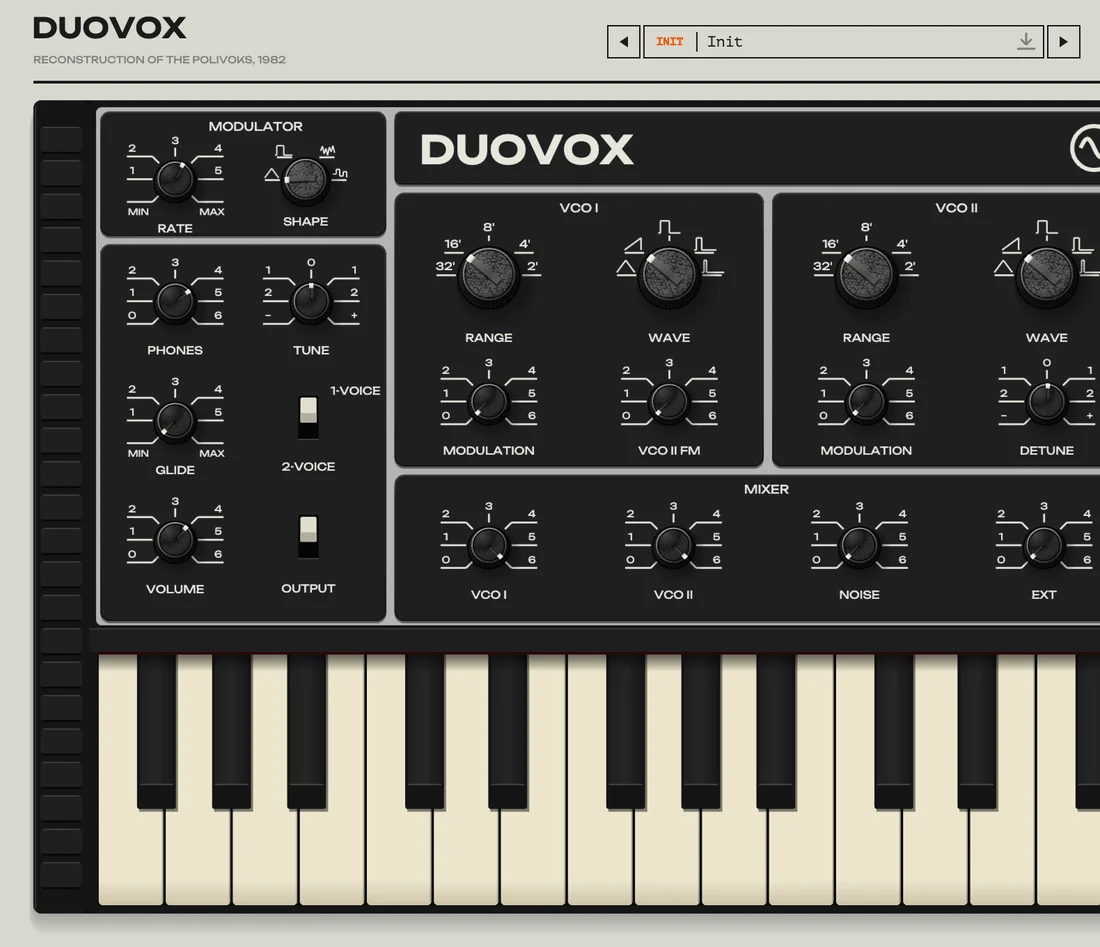
The modulator sits top left, above the master plate. It has a RATE knob (ЧАСТОТА) and a big four-position SHAPE switch (РЕЖИМ). Going clockwise the icons are triangle, square, noise and sample & hold. Kuzmin lists the same four in his article. There is no sawtooth.
What the plate does not have is a depth control. The modulator sends one signal to four places, and each destination block has its own MODULATION knob (МОДУЛЯЦИЯ) to decide how much it takes. That arrangement matters later, because it means you can send the same square to the pitch at one depth and to the filter at another.
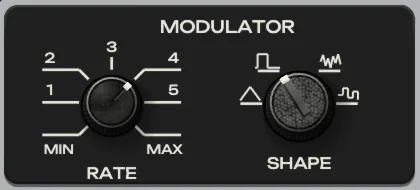 ShapeRate
Here are the four shapes on one held note. Only VCO I is in the mixer, its MODULATION knob is at 3.1 and the rate is about 4 Hz.
The triangle is a vibrato that goes below and above the note. The square is the trill. Noise and sample & hold are both random, at very different speeds: S&H picks a new value once per cycle of the rate knob and holds it, so the pitch jumps from step to step; noise changes all the time, too fast to hear as a melody.
A square that only goes up
Kuzmin describes the two periodic shapes precisely. The triangle is symmetrical around zero volts. The square is "positive pulses" with a duty cycle of 2 (the Russian way of saying 50 %): for half of each cycle the modulator adds nothing, for the other half it adds a fixed voltage. On a pitch input that is a jump from the note you hold to a note above it and back, which he calls a tremolo of two sounds.
On a modern synth with a bipolar square you would get the note above and the note below, which is a different and less useful effect. The Polyvox version keeps the key you play as the bottom note, so a trill on a melody stays in key as long as the interval is one you chose.
The MODULATION knob sets that interval. Duovox maps it so the knob reads as musical intervals across its first two thirds: about 1.2 is a semitone, 1.7 a whole tone, 2.1 a minor third, 3.2 a fifth, 4.2 an octave. At 6 the jump is two octaves.
Our pitch measurement of these clips agrees with the dial: at 1.7 the held C trills between C and D, at 3.2 between C and G, at 4.2 between C and the C above. The hardware panel has a plain 0 to 6 scale, so on a real unit you tune the trill by ear. In Duovox you can set it by number.
The modulator's square has slightly rounded edges in Duovox (a small RC on the output), so the pitch moves between the two notes in well under a millisecond instead of in zero time.
Kuzmin's four notes from one key
The best-known patch from the modulator is in Kuzmin's own text. Detune the two oscillators to an interval, trill both with the square, and each oscillator now alternates between two notes. At a rate of 5 to 7 Hz, he writes, the ear stops hearing a fast switch between pitches and hears the notes as if they were played together with some amplitude modulation on top. With both generators on, that becomes a chord of four sounds from one key.
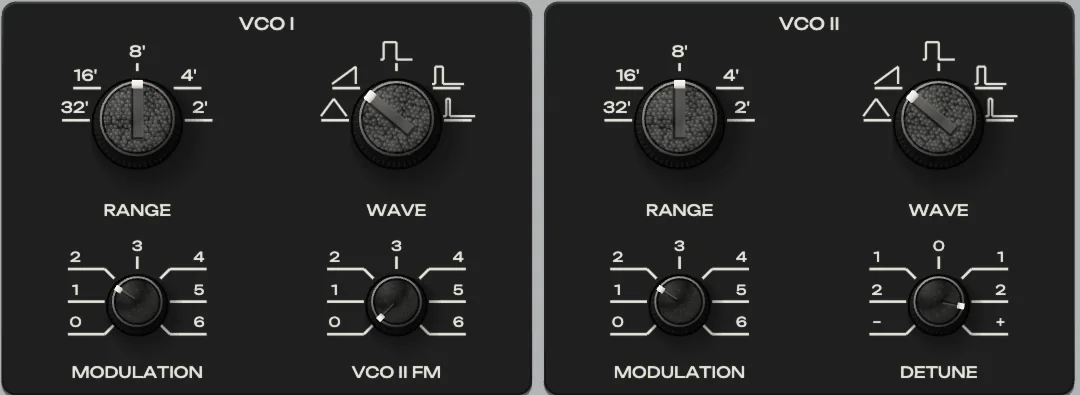 1.71.7+3 st
In Duovox that patch is Trill Chord: two sawtooth oscillators at 8', VCO II detuned 3 semitones sharp (a minor third), both MODULATION knobs at 1.7 (a whole tone), the modulator on square at about 5.7 Hz. Hold C and you hear C and D from VCO I, E flat and F from VCO II. The player builds it in three steps.
The rate knob decides whether it reads as a trill or a chord. Below 3 Hz the notes clearly take turns. Around Kuzmin's 5 to 7 Hz they blur into one ringing sound. Push it to 20 Hz and the switching is fast enough to roughen the tone itself.
Change the detune and the chord changes quality. +4 semitones (VCO II a major third up) gives C, D, E and F sharp, which sounds brighter and stranger. Change both MODULATION knobs to 2.1 and each oscillator trills a minor third instead of a tone.
One signal, four MODULATION knobs
Because the depth lives in the destination, the same square can do very different jobs at once. The four MODULATION knobs are on VCO I, VCO II, the filter and the amplifier. Turn up one and leave the others at 0, or set them all to different amounts.
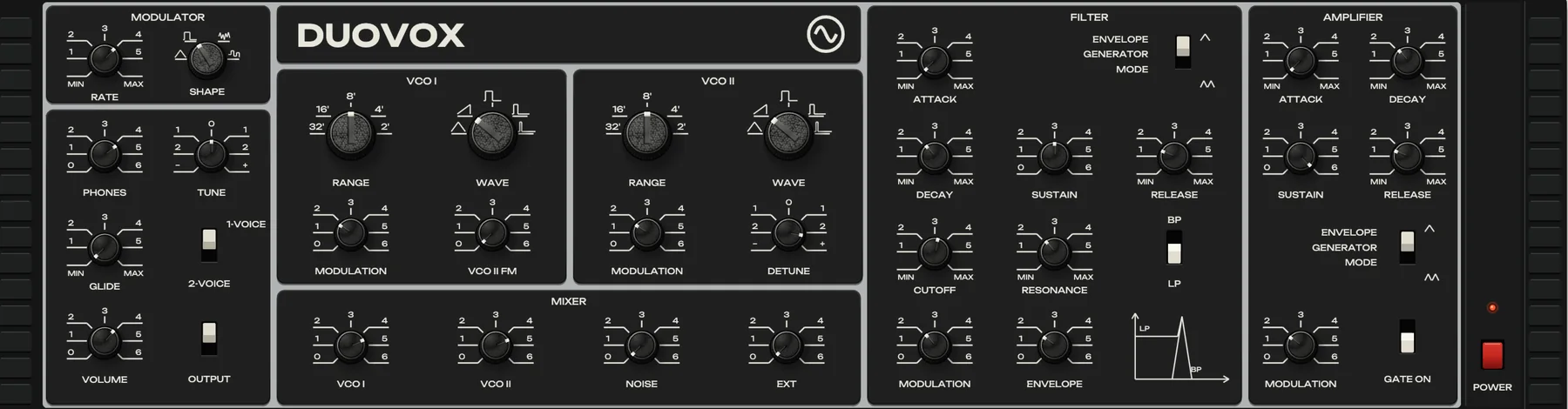 VCO IVCO IIFilterAmp
The next player keeps the modulator fixed (square, about 4 Hz) and moves it between destinations on a short melody. On VCO I alone, VCO I trills a fifth above a steady VCO II, so every note gets a hopping upper voice. On both oscillators the whole sound jumps. On the filter the square opens and closes the cutoff, and on the amplifier it chops the level.
The amplifier input deserves a note. The original has two VCAs in series: the modulator drives the first, the amp envelope the second. With the triangle you get a tremolo; the factory preset Tremolo Organ uses one on two squares at 8' and 4'. The dip is gentle for most of the knob's travel. By our reading of the Duovox engine, the trough is about 1.4 dB deep at 3.3, about 3 dB at 4.2, about 7.5 dB at 5.1, and at 6 the level falls to silence at the bottom of every cycle. The player shows the same curve: the standard deviation of the level across each clip grows from 0.6 dB at 0 to 4.8 dB at 6.
With the square on the amplifier the level is cut only during the "on" half of each cycle, for the same reason the pitch trill only goes up. That makes a choppy gate rather than a tremolo, and it is the easiest way to get a rhythmic stutter on a pad without touching the envelope.
Sample & hold and noise
Sample & hold takes a random value at every cycle of the rate knob and holds it until the next. On the pitch you get stepped random notes; on the filter, a cutoff that jumps. Gordon Reid's Sound On Sound retrospective points out the best use of it: combine S&H on pitch and filter with the looping envelopes, and the random changes either line up with the envelope rhythm or drift against it.
The factory preset Random Computer is the textbook version: a square wave at 4', S&H at about 8.6 Hz, VCO I MODULATION at 3.6 (so the steps can land up to about 8.6 semitones either side of the key) and the filter MODULATION at 2.1, so pitch and brightness change on the same clock.
The noise position is a different animal. It feeds a fast random voltage to the destination, and the rate knob does not slow it down. On a pitch it does not make a melody; it smears the note. We measured the energy sitting between the harmonics of a held G: at 0 there is none, at 1.2 about 2 %, at 2.7 about 44 % and at 3.6 about three quarters of it. In practice small amounts make a tone sound worn and unstable, and big amounts turn it into breath and grit around a pitch. The Etheroneph article on the instrument recommends exactly this for effects, combined with a little glide and careful cutoff and resonance.
Sirens, beacons and robots
Slow the triangle down, give it a lot of depth and you have the air-raid siren every synth owner finds in the first hour. Siren Lead is a triangle oscillator at 4' with the modulator triangle at its slowest (0.7 Hz in Duovox) and VCO I MODULATION at 3.6, which sweeps the pitch about 8.6 semitones either side of the key. Sputnik Beacon takes the same oscillator, switches the modulator to square at about 6.5 Hz and sets the depth to an octave. Siren Trill trills two oscillators up a fourth at about 4.3 Hz; it comes from the METAL pack, built for the nu-metal siren line.
Robot Talk puts S&H on the cutoff of a resonant band-pass, so the formant jumps like a voice made of steps. Dice Melody puts S&H on both oscillators and loops the amplifier envelope, so one held key plays a random tune in short notes.
The trill also works on a bass. Square Trill Bass lifts both oscillators a fifth at about 3.8 Hz, so one held low note pumps between the root and the fifth. It is a quick way to get a riff from a single key, and it sits better under a track than you might expect because the low note never moves.
The control the 1982 panel never had
There is no mod wheel on a Polyvox, and no pitch bender either. Kuzmin wrote that both were planned and dropped because the design team could not get them ready in time; the joystick they built later went into the Formanta Maestro instead. So on the original, vibrato is either on (a MODULATION knob turned up) or off.
Duovox keeps the front panel as it was and adds the wheel on the rear panel. The MIDI mod wheel adds the modulator's signal to both oscillators' pitch, on top of whatever the MODULATION knobs do, and the WHEEL > VIB control sets how far it goes: at 100 % a full wheel adds one semitone of modulation, at the default 50 % half that. Because it uses the same modulator, the wheel follows the shape switch: with the triangle it is vibrato, with the square a small upward trill, with S&H a random flutter.

If you want a deep trill under the wheel instead of a vibrato, leave WHEEL > VIB at 0 and automate the VCO MODULATION knobs from your DAW. They are ordinary plug-in parameters.
The modulator is only one of the instrument's three motion sources. The other two are the filter and amplifier envelopes in their looping mode, covered in the looping envelope tutorial. Audio-rate modulation, VCO II bending VCO I, is in the FM and ring-mod tutorial, and the passport's wind, rain and gunfire are in sound effects.
- The full Polyvox panel, control for control, with the scream, the looping envelopes and duophony
- A 4x/8x oversampled model of the two-chip filter, calibrated on recordings of real units
- 257 presets in ten banks and five packs, and a GEN button for new basses, leads and screams
- Extras the 1982 box never had: poly mode, velocity, pitch bend, drift, a rear panel