Most synths of 1982 needed an LFO or a sequencer to make a held note move in rhythm. The Polyvox (Polivoks, Поливокс) has a lever on each of its two envelopes that turns the envelope itself into a repeating pulse. Hold one key and the filter wobbles or the volume chops. Set the two envelopes to different speeds and they play against each other.
Below is how the periodic mode works, the one setting that stops it, and how to tune it to a track, all in Duovox, our reconstruction of the instrument. Every screenshot is the plug-in and every player is a render of it. The loop speeds quoted on this page were measured on the renders.
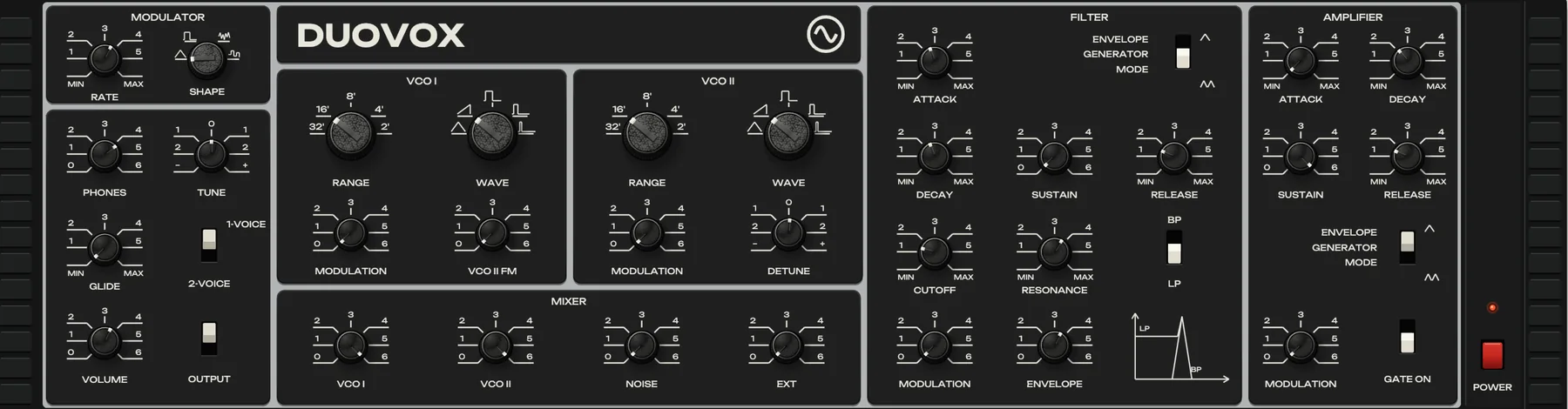 PeriodicAttackDecaySustain 0Envelope 3.6
What Kuzmin built and why
In his article about the instrument, Vladimir Kuzmin calls the envelope mode switch one of the instrument's tricks. In the one-shot position a key gives an ordinary ADSR. In the periodic position, with the sustain knob at 0, the envelope repeats with a period equal to the attack time plus the decay time, and its shape depends on the ratio of the two.
Kuzmin points out that the repetition starts at the moment the key goes down, so a note always begins with an attack and never lands in a dip, which is what happens when you chop a sound with an ordinary amplitude LFO. He counted the two looping envelopes as two extra modulation sources, one for the filter and one for the amplifier, on top of the modulator.
On the panel the lever is labelled РЕЖИМ ГЕНЕРАТОРА ОГИБАЮЩЕЙ, "envelope generator mode". The upper position has a single-peak icon, the lower one a double peak (ΛΛ). Duovox keeps both levers where the original has them: top right of the FILTER plate and in the middle of the AMPLIFIER plate.
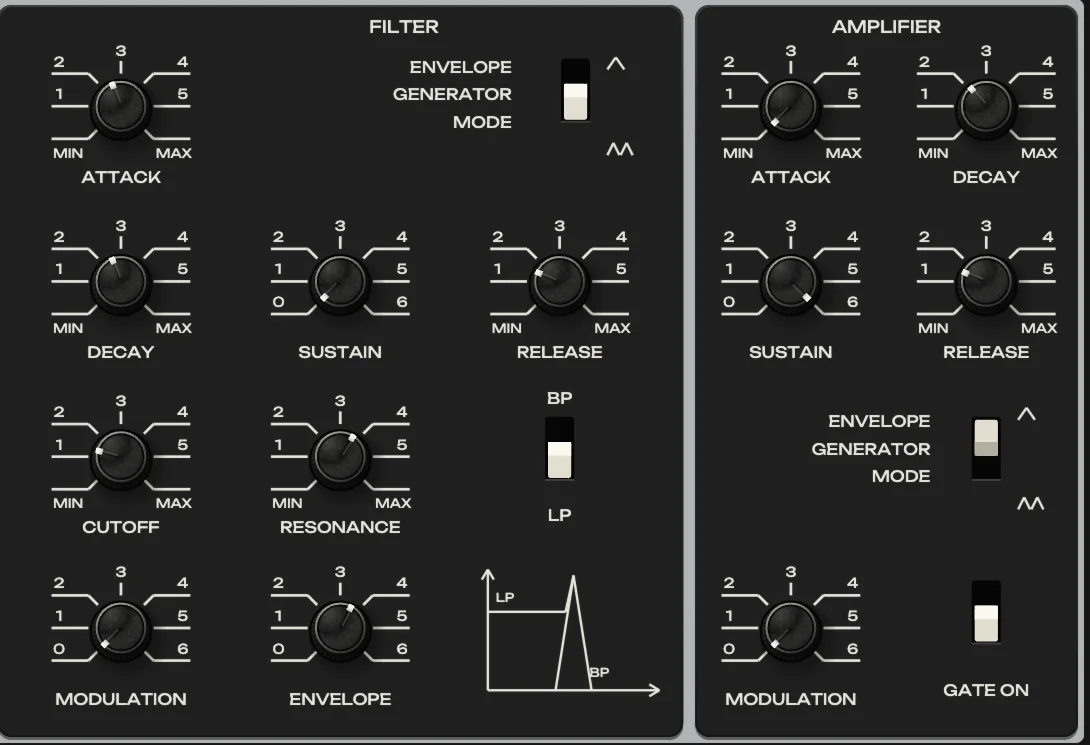 ΛΛ periodic2.52.50
Make the filter loop
Load Looping Wobble from the BASS bank, or set it up from scratch: two saws at 16', CUTOFF low (about 1.3), RESONANCE around 3.7 and ENVELOPE at 3.6. On the filter envelope, put ATTACK and DECAY both around 2.5 and SUSTAIN at 0. Then flip the filter's envelope lever down to the double peak.
In one-shot the filter opens once per key and settles. In periodic it keeps opening and closing as long as you hold the key; on these clips the average brightness goes from about 1,100 Hz to 1,600 Hz because the filter never stays closed. The amplifier envelope is still one-shot with full sustain, so the volume stays steady and only the tone moves.
Attack plus decay is the period
The speed of the loop is set by two knobs that normally shape a note. This player turns the filter envelope's ATTACK and DECAY together. Two keys are played one after the other, and the loop restarts from the attack when the second one goes down.
We measured the period on each position. At 1.5 one cycle takes 0.06 s, fast enough to sound like a rough buzz. At 1.9 it is 0.1 s, at 2.3 0.16 s, at 2.5 0.22 s (the preset), at 2.9 0.33 s, at 3.3 0.56 s and at 3.7 nearly a second. The envelope times are exponential on the knob, so the top third of the travel covers most of the range. For a wobble that sounds like rhythm, stay between 2 and 3.
The ratio of attack to decay sets the shape. Attack at MIN with a longer decay gives a sawtooth that snaps open and falls, which sounds plucked. Equal attack and decay gives a triangle, a smooth "wow". A longer attack gives a slow rise and a drop. etheroneph's retro article describes the instrument's envelopes making meowing sounds; Meow Sequence in the RHYTHM bank loops that shape, with the filter attack at 2.7.
Sustain must be zero
This is the setting that catches everyone. The envelope only fires the next attack when its decay has fallen almost to nothing. Any sustain level stops the decay above that point, the envelope sits on the sustain level, and the loop is over after one cycle. Kuzmin's article states the condition plainly: periodic mode works with the sustain knob at 0.
We measured how far the brightness of a held note swings on this patch. At sustain 0 the spectral centroid moves with a spread of about 1,100 Hz. At 0.6 the spread drops to about 120 Hz: the loop has stopped. At 3 the filter sits on the sustain level after the first cycle. In Duovox the threshold is a sustain of about 0.2 on the panel, so a knob that looks like it is at zero but is not quite there can still stop the loop. Turn it fully left.
Release still works after you let go of the key: the loop stops and the envelope falls at the release rate, so a long release gives a tail after the rhythm ends.
Filter loop, amp loop, both
Each envelope has its own lever. A looping filter envelope moves the tone. A looping amplifier envelope chops the volume, like a gate. With both looping at different speeds you get two rhythms on one note, which Gordon Reid pointed out in his 2010 Sound On Sound retrospective as a way to get polyrhythms out of the instrument.
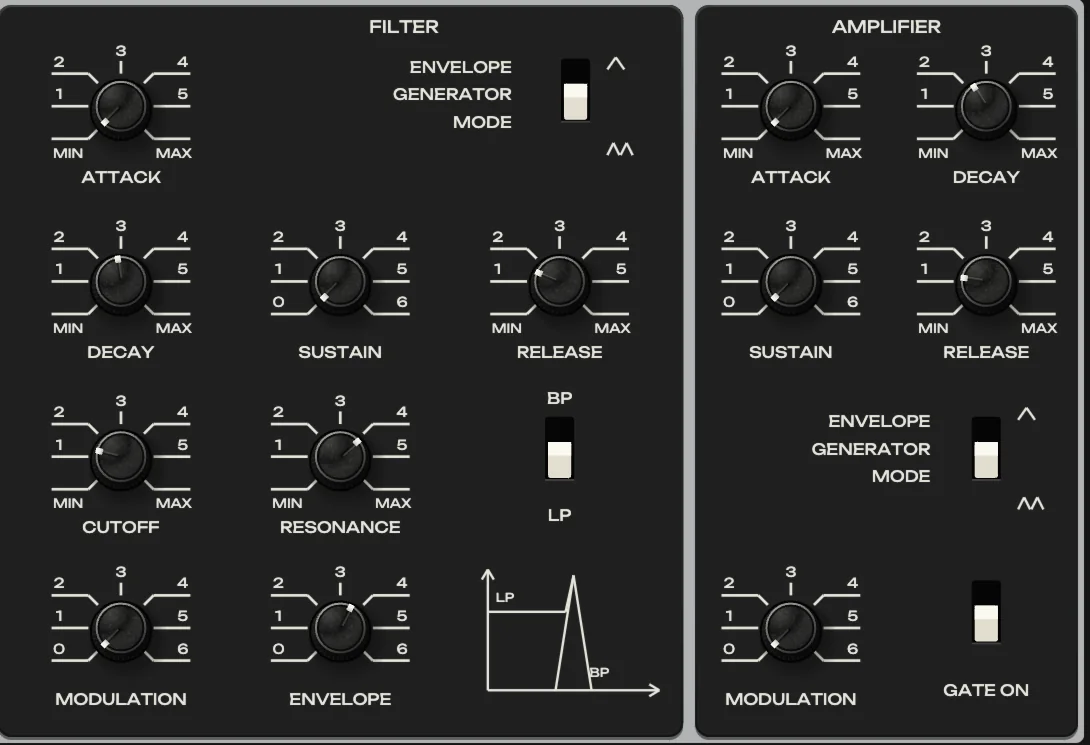 PeriodicDecay 2.3Decay 2.80Periodic
Three Against Two in the EXPERIMENTAL pack loops the filter with a decay of 2.8 and the amplifier with a decay of 2.3, both with attack at MIN and sustain at 0. The player puts one lever at a time back to one-shot so you can hear each loop alone, then both together. The two amp-loop clips are 7 to 8 dB quieter than the filter-only one, because the volume spends part of every cycle near silence.
Measured on the renders, the filter loops every 0.195 s and the amplifier every 0.108 s. Five filter cycles take 0.975 s and nine amp cycles 0.972 s, so the combined pattern comes round about once a second, with the accents moving inside it. For a strict three against two, raise the amp DECAY to just under 2.5: the amp then loops every 0.128 s against the filter's 0.195 s, a ratio of 1.52.
Every key you play restarts both envelopes from the attack, so the pattern starts in the same place on every note. Playing a bassline over a looping patch gives a riff whose rhythm resets on each note. If you want the loop to run through note changes instead, turn on LEGATO on the rear panel: new keys then change the pitch without restarting the envelopes.
Set it to the track by ear
The loop knows nothing about your DAW's tempo, on the original or in Duovox. That is part of its sound: the wobble belongs to the note, and it can sit slightly across the beat. When you need it on the grid, the amplifier decay is the control to turn. Gated Sub 16ths in the METAL pack loops only the amplifier, with attack at 0.5 and sustain at 0.
Measured periods and the tempo at which each one would be a straight sixteenth note:
| Amp decay | One cycle | Sixteenths at |
|---|---|---|
| 1.8 | 0.064 s | 234 bpm |
| 2.0 | 0.077 s | 195 bpm |
| 2.2 | 0.096 s | 156 bpm |
| 2.4 | 0.122 s | 123 bpm |
| 2.5 | 0.143 s | 105 bpm |
| 2.7 | 0.171 s | 88 bpm |
The preset ships at 2.2, which is sixteenths at about 156 bpm. For a 120 bpm track, start at 2.4 and nudge until the chops sit on the grid; for eighth notes at the same tempo, double the period by turning further. Since the loop restarts on every key, small errors do not build up across notes.
GATE ON: loops without a key
The last control on the amplifier plate is a lever marked ВКЛ. ("on") on the original and GATE ON in Duovox. Kuzmin describes it as a switch that only sends the gate signal to all the blocks, as if a key were held, so the player's hands are free for long notes and effects. He adds that musicians had often put a weight on a key to do the same job.
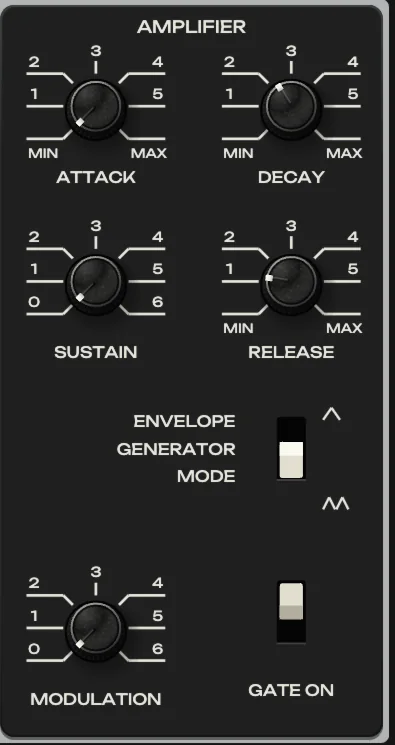 0PeriodicGATE ON
With both envelopes looping, GATE ON turns the instrument into a free-running pattern on the last note you played. The player taps a key once at the start and again four seconds later. Without the gate hold the clip is silent between the two taps; with it the pattern plays the whole time, and the second tap restarts it.
Because the pattern keeps going on its own, you can play the panel while it runs: sweep CUTOFF, change a decay, add NOISE. That is how a lot of drones and machine noises on the hardware were made.
Seven loops from the factory bank
Three held keys through seven presets that loop one or both envelopes. None of them uses the modulator or a host sequencer.
| Preset | What loops | Measured period |
|---|---|---|
| Looping Wobble | filter | 0.215 s |
| Pseudo-Arp | filter and amp | 0.093 s and 0.17 s |
| Piston Bass | filter | 0.08 s |
| Meow Sequence | filter, slow attack | 0.235 s |
| Three Against Two | filter and amp | 0.195 s and 0.108 s |
| Gated Sub 16ths | amp | 0.095 s |
| Sixteenth Gate Bass | amp | 0.081 s |
Filter lever down for a wobble, amplifier lever down for a gate, both for a pattern.
On every envelope that loops. Otherwise it plays one cycle and stops.
Around 2 to 3 for rhythm, under 1.5 for a buzz, above 3.3 for a slow sweep.
Short attack for a pluck, equal for a triangle, long attack for a meow.
If you want it to run without a key, and keep your hands for the cutoff.
A looping filter envelope pushes the filter through its whole range many times a second, so how the filter behaves at high resonance matters here: the filter tutorial covers that. The other way to get two parts out of one patch is duophony.
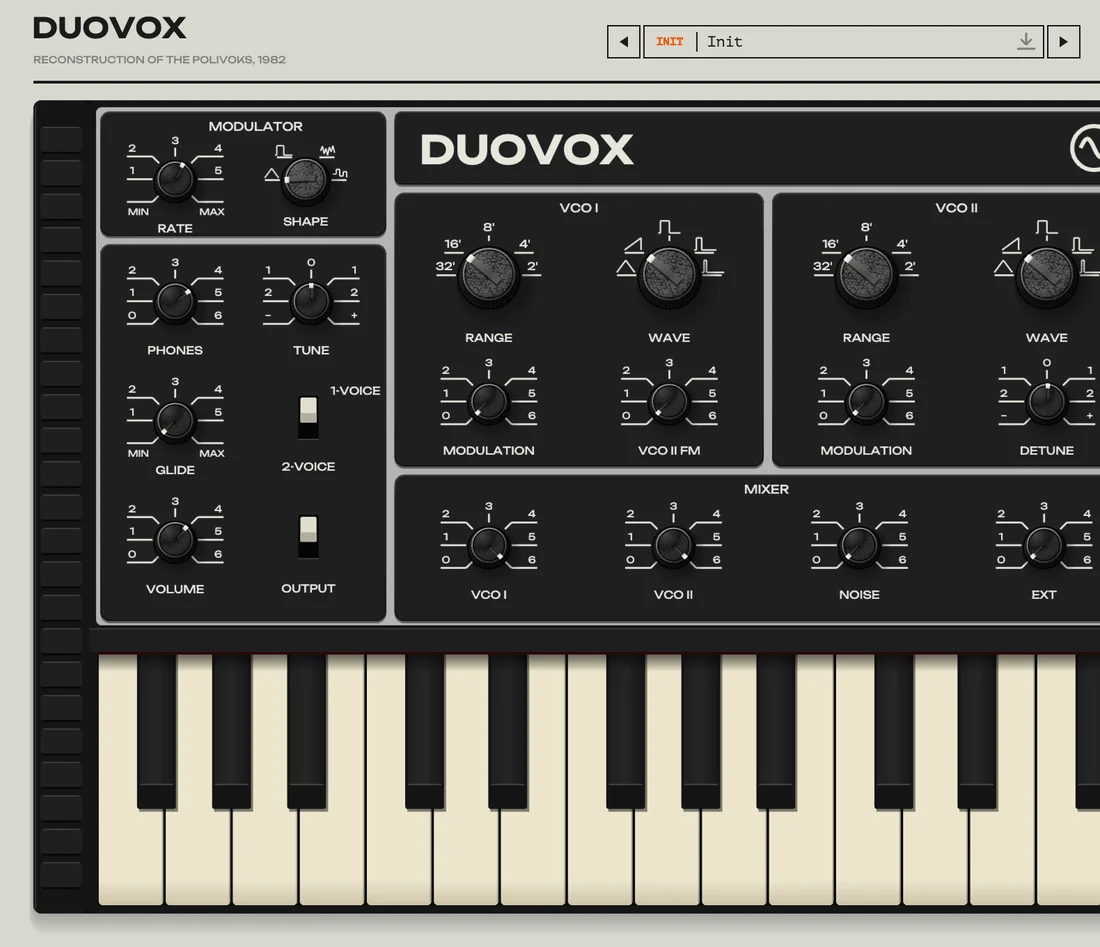
- The full Polyvox panel, control for control, with the scream, the looping envelopes and duophony
- A 4x/8x oversampled model of the two-chip filter, calibrated on recordings of real units
- 257 presets in ten banks and five packs, and a GEN button for new basses, leads and screams
- Extras the 1982 box never had: poly mode, velocity, pitch bend, drift, a rear panel