The Polyvox (Polivoks, Поливокс) has two oscillators and a switch that decides whether they follow one key or two. In 2-voice mode you can hold a bass note with the left hand and play a line above it with the right. The catch is that both notes still go through one filter and one pair of envelopes, and only one of them glides. Those limits are where the instrument's duophonic sound comes from.
This page goes through the rules, then plays them in Duovox, our reconstruction. Every screenshot is the plug-in and every player is a render of it. Two keys at once are simply overlapping notes in the render, the same as overlapping notes in your piano roll.
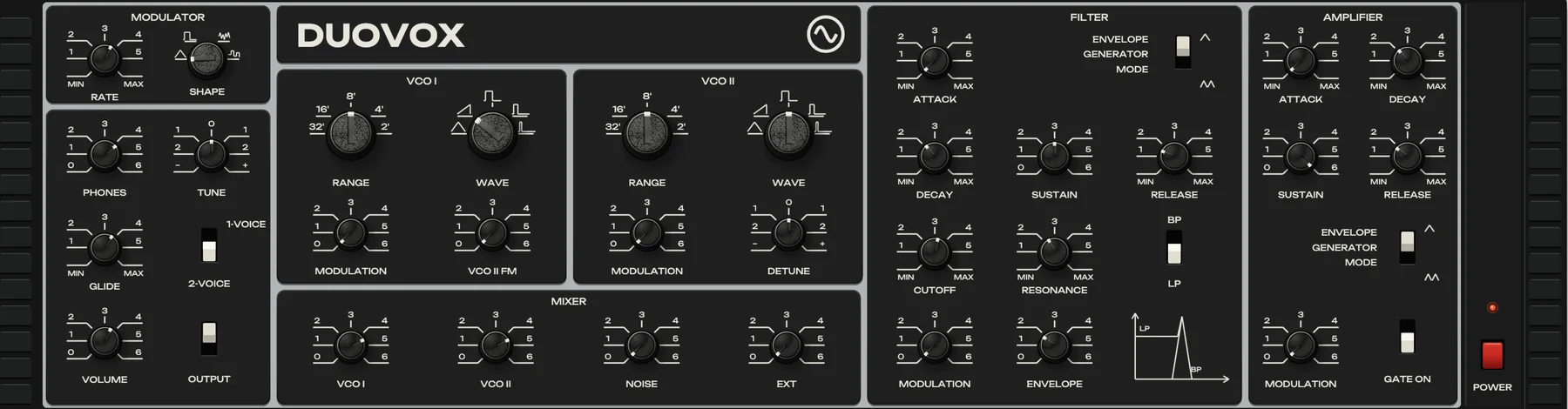 2-VOICEGlide 3.7VCO I · upper keyVCO II · lower key
Top key to VCO I, bottom key to VCO II
Vladimir Kuzmin describes the scheme in his article about the instrument: each generator follows its own note, one the upper key pressed and the other the lower one, which is why two oscillators were exactly enough. He does not say which is which. Russian Wikipedia gives the first generator the upper key, and Duovox does the same: VCO I takes the highest key held, VCO II the lowest. Hold three keys and the one in the middle is ignored.
The switch sits on the master plate. On the original it reads 1-ГОЛ. / 2-ГОЛ. (1-voice / 2-voice), which Will Gregory of Goldfrapp read as "1-Ron/2-Ron" when he told Sound On Sound in 2003 about his unit: a Latin-letter reading of the Cyrillic. In Duovox it reads 1-VOICE and 2-VOICE.
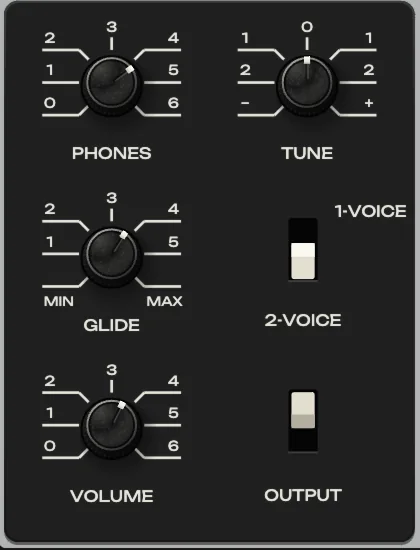 1-VOICE / 2-VOICEGlide
Everything after the oscillators is shared. Both notes go through the same MIXER, the same filter and the same amplifier, and both envelopes fire for both notes. Reid sums it up in the same article: you can play the oscillators separately, but there is one signal path, so you cannot shape the notes independently. In Duovox every new key restarts the envelopes (unless LEGATO is on in the rear panel), so a melody note also re-articulates the held bass note under it. The filter's key tracking follows the average of the two pitches.
When you let go of the upper key while the lower one is still held, VCO I drops to the lower note, as on the ARP Odyssey and 2600. With glide up, that drop is a slide.
One voice or two on the same phrase
Two-Hand Duet in the CLASSIC bank is set up for exactly this: VCO I is a square at 8' for the upper key, VCO II a sawtooth at 16' for the lower key. The phrase below is a left hand holding A3 then F3 and a right hand playing a melody above it.
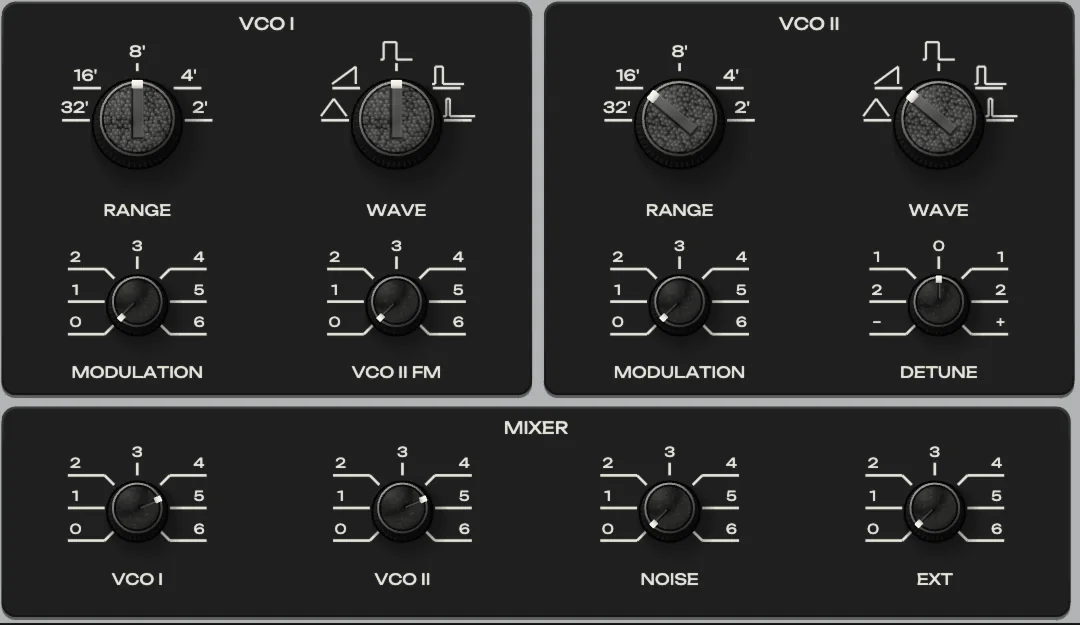 8'Square16'Saw
We tracked the pitch of each oscillator on these renders. In 1-voice mode with the default key priority, both oscillators stay on the left-hand note the whole time and the melody never sounds; you only hear the envelopes restart each time a right-hand key goes down. With priority set to the last key, both oscillators jump to the melody whenever a right-hand key is down, and the bass disappears except in the gaps. In 2-voice mode, VCO I plays the melody and VCO II the bass, both through the same filter.
The schematic does not settle which key wins when you hold two in 1-voice mode. Duovox defaults to the lowest key, which is what the duophonic scanner naturally gives, and that keeps a held bass from being cut by a passing upper note. The rear panel's LOW NOTE switch changes it to the last key played.

Only the upper voice slides
Kuzmin wrote that portamento goes to both generators in 1-voice mode and to only one in 2-voice mode, and he compared the result to pulling one guitar string up to the note of the next string. Reid noticed the same from the other side: the glide control only affects VCO1, which he says makes some unusual effects possible. Duovox follows both: in 1-voice mode GLIDE moves both oscillators, in 2-voice mode only VCO I.
Load Duo Bend Lead from the LEAD bank: 2-voice, a saw on VCO I and a square on VCO II, both at 8', glide at 3.7. In the player the left hand holds A3 the whole time and the right hand walks above it. Only GLIDE moves.
The glide is an RC curve, fast at the start and slow into the note, and a large interval takes only a little longer than a small one. We measured how long VCO I took to land within half a semitone on the first upward jump, a fifth: practically instant at MIN, 0.02 s at 1.8, 0.06 s at 2.7, 0.1 s at 3.3, 0.16 s at 3.7, a third of a second at 4.5 and 0.8 s at 5.4. Through the whole clip VCO II stayed on A3. Notice also what happens between the right-hand notes: the upper key is released for a moment, VCO I starts sliding back down to A3, and the next key pulls it up again. With long glide that dip becomes part of the line.
For bigger bends, Bent Interval in the EXPERIMENTAL pack uses glide at 4.5. In 1-voice mode the same knob gives an ordinary portamento on both oscillators, which is what the bass tutorial uses for slides.
Two notes in one resonant filter
Because both notes share the filter, a resonant filter reacts to the interval you hold. Screaming Duo has both oscillators on sawtooth at full level, resonance at 5.4 and the rear FILTER DRIVE at 90 %. The left hand holds A3, the right hand plays a fifth, a tritone, then a minor second above it.
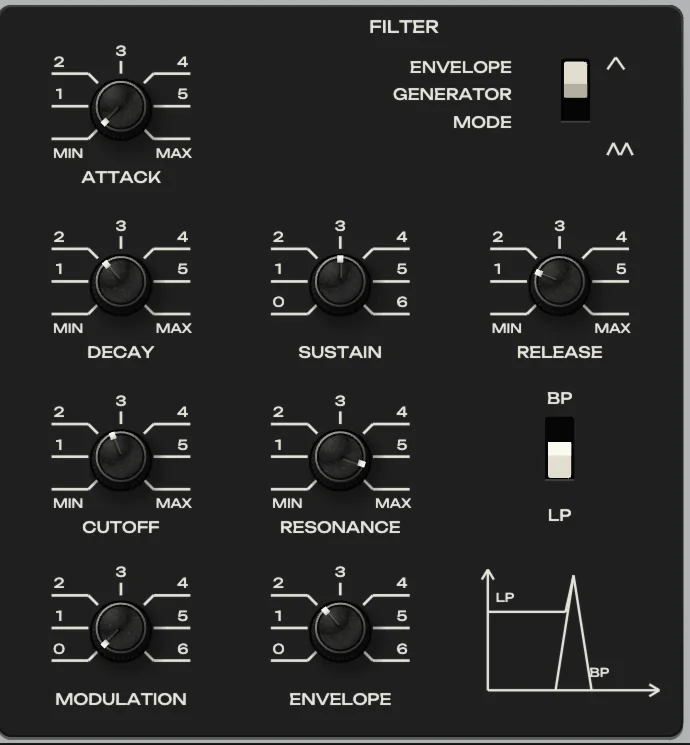 LP2.55.4
The fifth is the most stable of the three. The minor second, A3 against B flat 3, is 220 Hz against 233 Hz, and the two beat at the difference, about 13 times a second; on the render we found a periodicity of 0.073 s in the level, which is that beat surviving the saturation. The brightness falls a little as the interval narrows, from a centroid of about 2,500 Hz on the fifth to 2,300 Hz on the minor second.
Now hold the fifth and turn only the resonance. The centroid goes from about 1,250 Hz at 1.8 to 3,700 Hz at MAX while the level stays within 0.3 dB, the same self-limiting behaviour as on a single note (the filter tutorial explains why).
Phrygian Duo in the INFERNO pack does the minor second with one key: VCO II is detuned a semitone up, so a single key gives the rub. With two keys the lower one sounds a semitone sharp under the upper one, so every interval you play comes out a semitone narrower.
The filter between two keys
The filter's key tracking follows the average of the two notes, which gives one more trick. Whistle Between in the EXPERIMENTAL pack turns both oscillators off in the mixer, sets resonance to MAX so the filter rings on its own, and sets KEY TRACK on the rear panel to 100 %. In 2-voice mode the whistle then sits an octave above the midpoint of the two keys you hold.
We checked it with a pitch tracker. With C4 alone the whistle is on C5. Add C5 with the right hand and it moves to F sharp 5, an octave above F sharp 4, the midpoint. With G4 it lands a quarter tone between D sharp and E, because a fifth has no semitone in the middle; with E4 it is on D5, with A4 between E and F. Moving one hand while the other holds gives a melody that moves half as far as your finger, which is easier to hear than to explain.
Bass and lead from one instrument
The classic use is the one the hardware was built for: a bassline in the left hand and a lead in the right, from one synth. The factory bank has seven presets for it. In all of them VCO II plays the lower key; in three it sits an octave down at 16'. The player runs the two-hand phrase from section 02 through all seven.
If you need chords, Duovox has a POLY mode on the rear panel with 2 to 8 voices, each a full copy of the instrument with its own filter and envelopes. The front-panel switch stops mattering while it is on. For the loops that work well under a duophonic line, see the looping envelope.
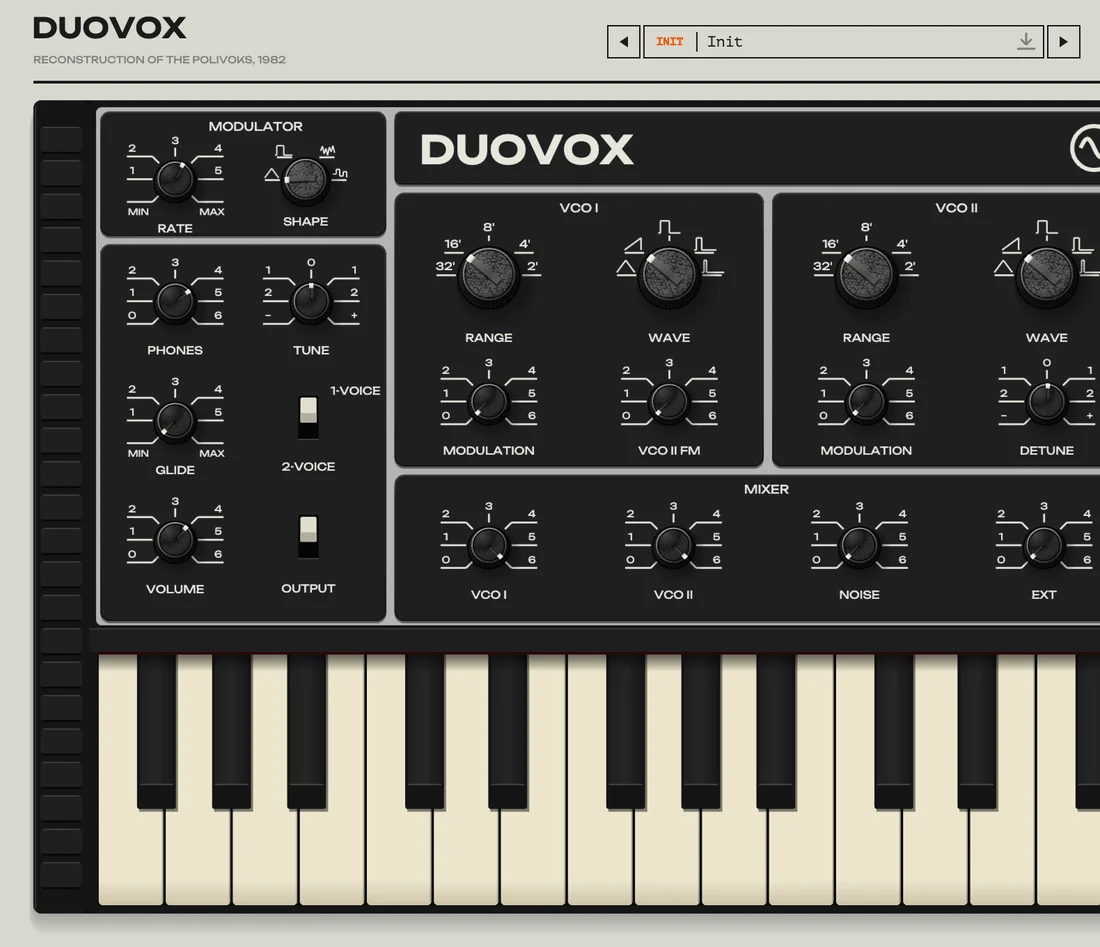
- The full Polyvox panel, control for control, with the scream, the looping envelopes and duophony
- A 4x/8x oversampled model of the two-chip filter, calibrated on recordings of real units
- 257 presets in ten banks and five packs, and a GEN button for new basses, leads and screams
- Extras the 1982 box never had: poly mode, velocity, pitch bend, drift, a rear panel