Most of what people describe as the Polyvox (Polivoks, Поливокс) sound comes from one board: the filter. It overdrives when you feed it hot, it screams at high resonance without blowing up your speakers, and with nothing going into it, it whistles in tune. All of that goes back to a detail Vladimir Kuzmin found when he read the full technical conditions of one Soviet op-amp.
This page explains what that filter is, then goes through it control by control in Duovox, our reconstruction of the instrument. Every screenshot is the plug-in and every player is a render of it. Where a player text says something got brighter or quieter, we measured it on the clips.
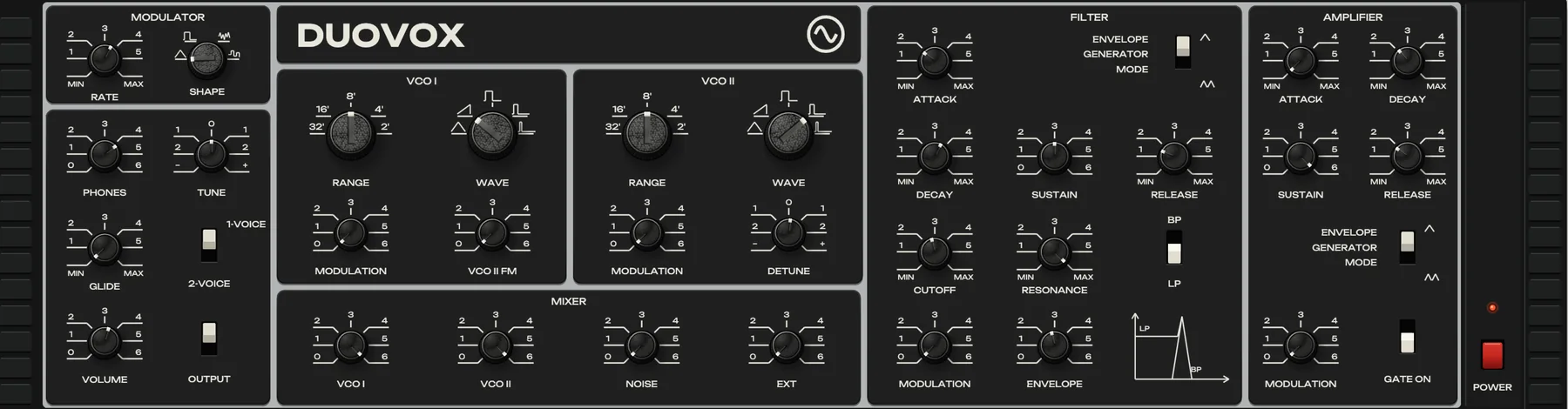 LPCutoff 2.7Resonance MAXVCO I · 6VCO II · 6
Two op-amps and no capacitors
Kuzmin tells the story in his own article about the instrument. He was looking for a filter that could be tuned across the whole audio range, and found a detail in the specifications of the К140УД12, a programmable op-amp: without feedback, its bandwidth changes in proportion to a control current. An op-amp used that way already is an integrator, and a current-controlled one. A state-variable filter needs two integrators, so two chips and a handful of resistors were enough. The integrating capacitors are the chips' own.
He showed the breadboard to a colleague, Igor Mironov, who did not believe it worked without capacitors and looked under the board for hidden ones. The simplified version gives two responses instead of the usual three: a low-pass at 12 dB per octave and a band-pass. A lever on the panel picks one of them.
Kuzmin wrote that the filter sounded a bit harsh, especially in the low frequencies, because of a small step that appears in the chip's output stage at low control currents. He added that what was a flaw then is valued now, and that the aggressive, fat sound people credit the instrument with comes largely from this filter.
Two things follow from the circuit. The inputs of the integrators sit behind a divider and overload at a few volts, while the mixer in front of them can deliver much more (the bass tutorial covers that part). And the resonance is fed back through the same overloaded chips, so the input level changes how the resonance behaves. Duovox models both inside the filter loop at 4x oversampling (8x in HQ), and its integrators include a small dead zone that widens as the cutoff falls, for Kuzmin's step.
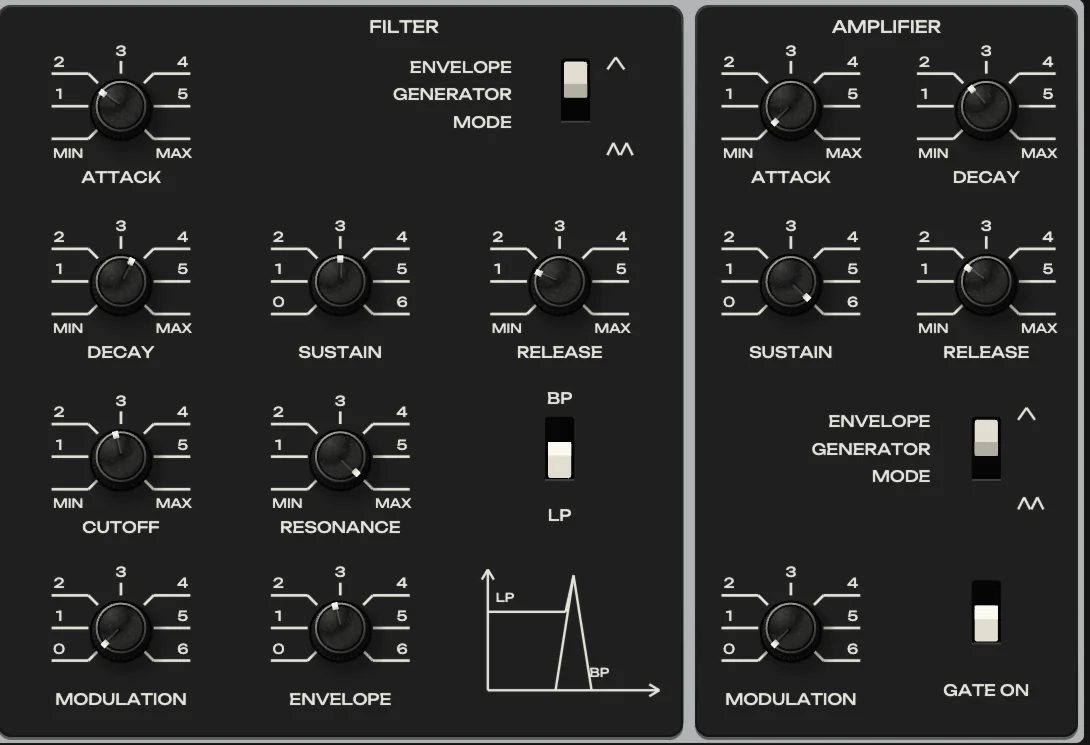 Sustain 3LP / BP2.7MAXEnvelope 2.7
Turn the resonance up on a lead
Load The Duovox Scream from the LEAD bank. VCO I is a sawtooth and VCO II a pulse, both at 8', both at 6 in the mixer. The filter sits on LP with CUTOFF near 2.7 and an envelope amount of 2.7 opening it on each note. The only control that moves in this player is RESONANCE.
On these clips the spectral centroid (a rough measure of brightness) goes from about 2,100 Hz at MIN to 6,400 Hz at MAX, while the average level changes by 0.3 dB. On most filters a resonance that strong would jump out of the mix by several decibels. Here the saturated integrators cap it: the resonance rips, then limits itself.
For a lead, the interesting range is the last quarter of the knob. Below 4 it is a brighter saw. Between 5 and MAX the filter starts to ring on its own and fights with the notes you play, and each note comes out a little different.
The scream
The classic scream is that last setting plus a fast filter envelope. Skull Splitter in the INFERNO pack starts with the cutoff lower, at about 1.8, and uses an envelope amount of 5.1 with decay at 2.7 and sustain under 1, so every note shoots the resonance up and drops it back. It also turns FILTER DRIVE on the rear panel to 100 %, which pushes the mixer harder into the filter than the default 50 %.
Why loud input tames the resonance
This is the behaviour that surprises people who know other analog filters. Harvestman, who built a Eurorack version of this filter with Kuzmin's blessing, describe its self-oscillation as "very unstable and heavily dependent on the amplitude" of the input, and their manual advises finding a sweet spot of mixer level: below it the oscillation is simpler, above it there is none.
The player below is built to show exactly that. Resonance is at MAX, the cutoff is fixed and the envelope is off. VCO II is at 0, so one sawtooth on A2 (110 Hz) goes in, and the knob is its mixer level. The clips are level-matched, so what changes is the balance between the whistle and the note.
We measured where the energy goes on each clip. With the mixer at 0 the filter rings by itself at 585 Hz and that whistle is 98 % of the output. At 3 it is still 85 %, with the saw underneath. At 4.8 it is down to about 70 %. At 6 the free whistle is gone: nothing is left at 585 Hz, and the strongest component is now 550 Hz, the saw's fifth harmonic, carrying 44 % of the energy, while the 110 Hz fundamental comes up from nothing to a clearly audible part of the sound. The resonance has stopped ringing on its own and parks on a harmonic of the note.
That parking is real behaviour of the original. On recordings of a real unit we used for calibration, the resonance sat on a harmonic of the input for most of a filter sweep. Duovox does the same in proportion to the input: about 14 % of a sweep at mixer 3, 45 % at 4.5 and 56 % at 6.
If the scream sounds choked, turn the mixer down before you turn the resonance up. Mixer 3 to 4 with resonance near MAX keeps the resonance ringing on its own against the note. Mixer 6 with resonance near MAX gives a dense, distorted tone with the resonance locked to the notes, which is often the better choice for a bass or a riff.
Play the filter as an oscillator
Turn both oscillators to 0 in the mixer and the resonance to MAX. Duovox feeds a trace of hiss into the filter so the oscillation starts by itself, and the filter becomes a sine-like oscillator with flattened tops. On the units we measured, its third harmonic sat 15 to 22 dB under the fundamental; Duovox lands at 14 to 19 dB, and its pitch stays within 1 % of where the knob points.
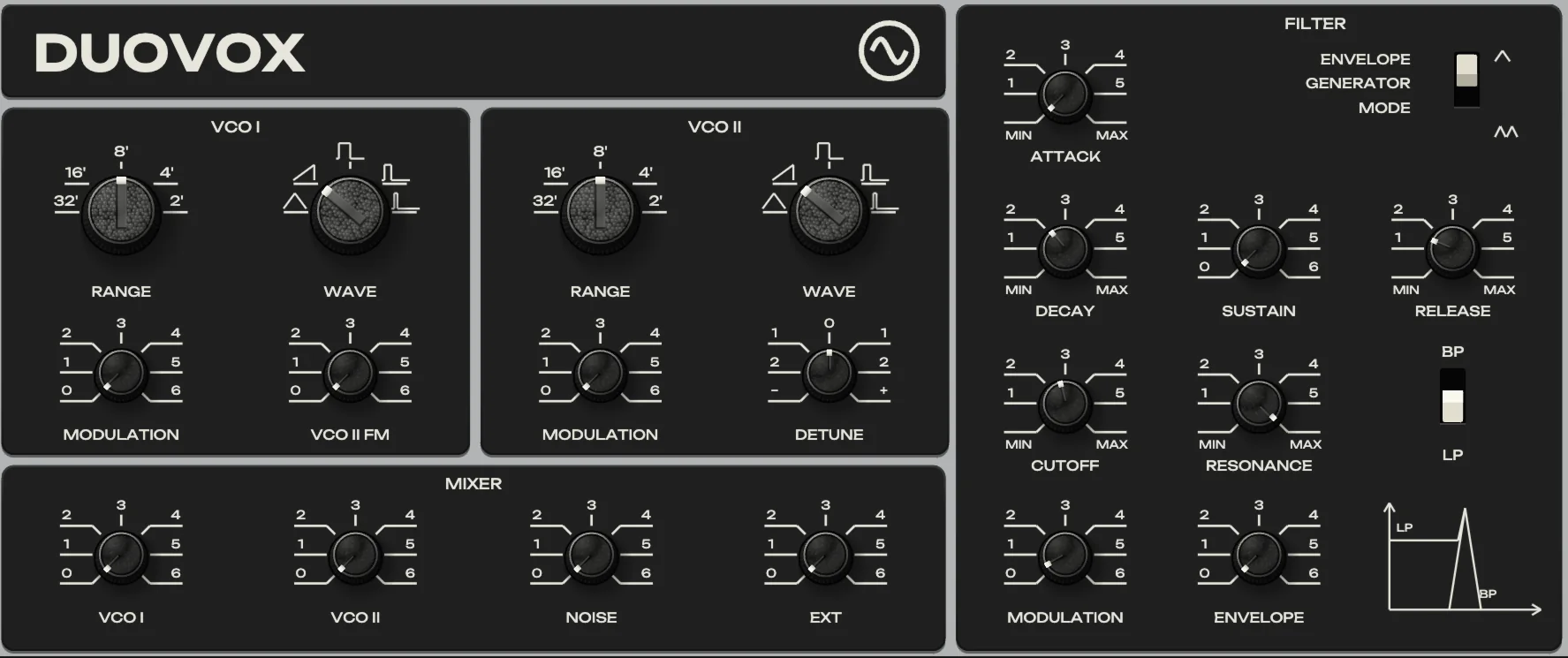 Cutoff = pitchMAX00
The original had no keyboard tracking knob for the filter; the tracking was fixed inside. Duovox puts it on the rear panel as KEY TRACK, 62 % by default, which is the median we measured across sampled units. At 62 % a whistle drifts out of tune as you play up the keyboard. At 100 % it follows the keys exactly, and that is how the whistle presets are set. Formanta Whistle keeps CUTOFF at 2.7, which puts the whistle almost two octaves above the key, about three quarters of a semitone flat. Ghost Sine uses 2.1, an octave above the key and in tune to within a few cents from C3 to G5.
The knob here works as a transpose control. From 1.8 upward, each 0.6 of travel raises the whistle by roughly an octave. Pick the setting that puts the whistle in tune with your track; around 2.1 it sits on the octave, around 2.7 near the second octave.
Glide works on the whistle as well, because in Duovox the key tracking follows the gliding pitch. Both presets use it for slides between notes. For the duophonic version, where the whistle sits between two held keys, see duophony and glide.

Low-pass or band-pass
The lever under RESONANCE chooses the output. LP keeps everything under the cutoff, at 12 dB per octave above it. BP takes the other integrator's output, which falls off at 6 dB per octave on both sides of the cutoff. On the original the label ФНЧ (low-pass) is printed under the lever, and the small response graphic next to it marks the band-pass shape ПФ.
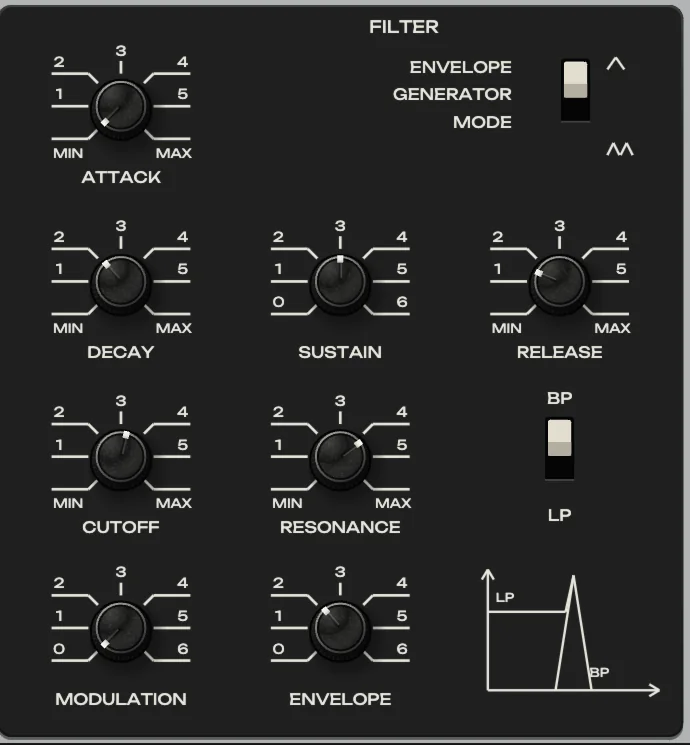 BP3.34.2
BP removes the bottom of the sound, and what is left is a nasal, vocal band around the cutoff. On the player below, flipping BP Nasal Lead from LP to BP lowers the 220 Hz fundamental from about a fifth of the energy to under 1 %, raises the centroid from 1,700 to 2,500 Hz and drops the level by 4 dB. Expect to raise the volume a little when you switch.
With the resonance between 3.5 and 5, moving the cutoff in BP sounds like vowels. The factory bank uses that in several ways: a static band for a nasal lead, a periodic envelope for a "wah" on every note, a sample-and-hold modulator for random chatter.
BP is also the setting for drums made from noise (snares and hi-hats in the factory bank use it) and for the band-limited, telephone-like leads that sit above a mix without masking the bass.
How the envelope moves the cutoff
On the original, the cutoff voltage goes through a linear voltage-to-current converter into the two chips. As far as the schematic shows, the envelope and the modulator therefore add to the cutoff in hertz, not in octaves. An octave at the bottom of the range is a few dozen hertz of envelope, an octave at the top is several thousand. So an envelope attack passes through the low octaves almost at once and spends most of its time in the top one or two, and a decay hangs high and then drops through the bottom at the end.
Duovox works this way by default: the CUTOFF knob itself has an audio taper from about 30 Hz to 18 kHz, and the envelope, modulator and velocity add on top in hertz (key tracking then scales the result). If you want the more familiar behaviour of most modern synths, flip EXPO CUTOFF on the rear panel, and the envelope and modulator move the cutoff in octaves instead.
The filter is half of what the instrument does. The other half is what drives it: the looping envelope turns the cutoff into a rhythm, and the bass tutorial uses the hot mixer from section 03 on purpose.
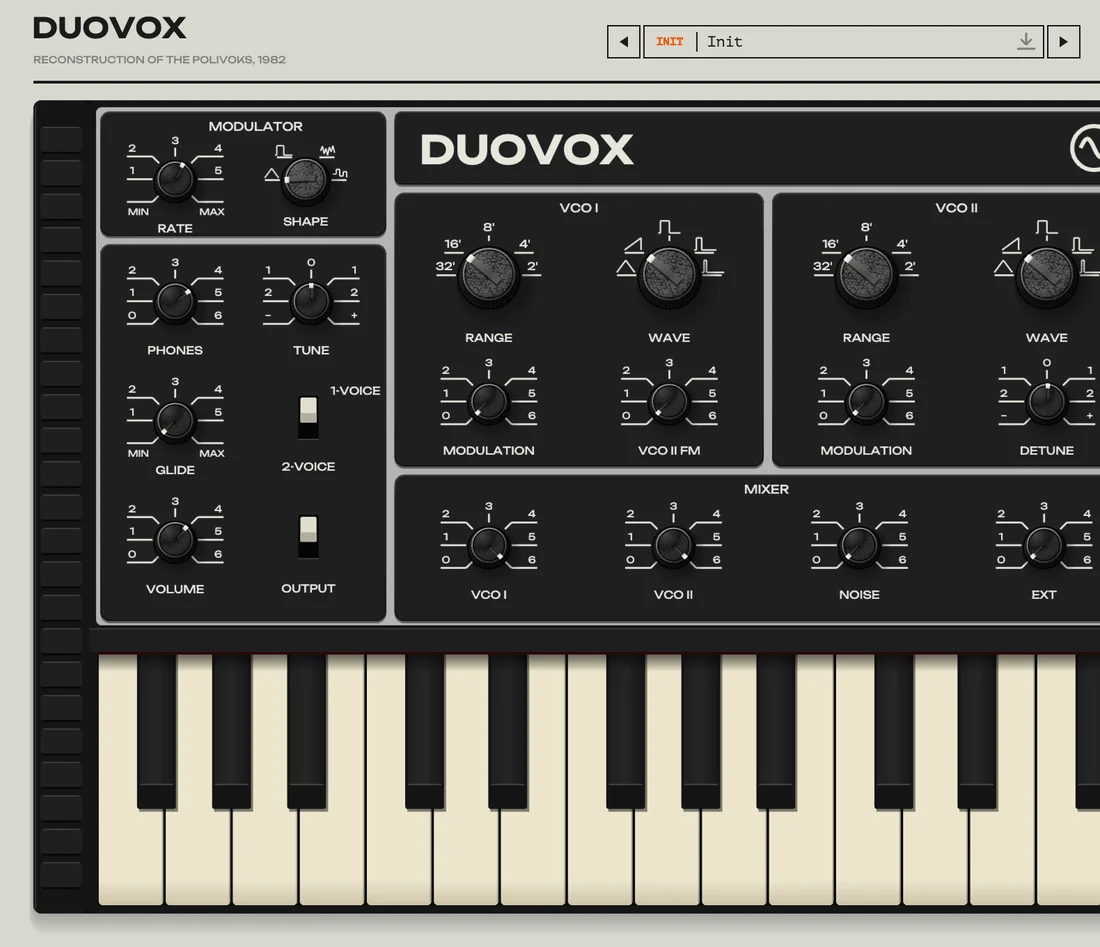
- The full Polyvox panel, control for control, with the scream, the looping envelopes and duophony
- A 4x/8x oversampled model of the two-chip filter, calibrated on recordings of real units
- 257 presets in ten banks and five packs, and a GEN button for new basses, leads and screams
- Extras the 1982 box never had: poly mode, velocity, pitch bend, drift, a rear panel