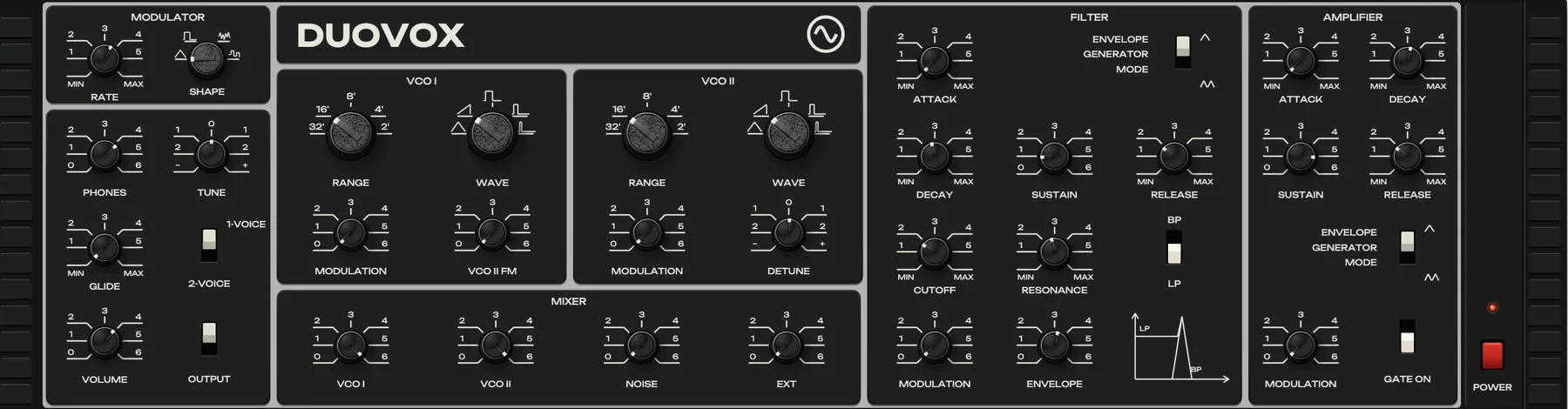
Ask anyone who has owned a Polyvox (Polivoks, Поливокс) what it is good at and the answer comes back fast: bass. A thick, slightly broken bass that sounds overdriven before any pedal or plug-in gets near it. Gordon Reid's 2010 Sound On Sound retrospective puts the recipe in plain words: both oscillators on sawtooth, levels up, low-pass filter overdriven.
That recipe works on the 1982 hardware because of one design choice in the mixer, and it works in Duovox because we modelled that choice instead of adding a drive knob after the filter. Below is the patch step by step. Every screenshot is the plug-in, every player is a render of it, and the knobs in the players turn.
Start with two saws at 16 feet
Open Duovox, pick Init from the preset bar and go to the two generator plates. Set both RANGE selectors to 16' and both WAVE selectors to the sawtooth, the second icon. Then nudge VCO II's DETUNE a hair to the right. On the panel scale that is barely past 0; in numbers it is about a tenth of a semitone.
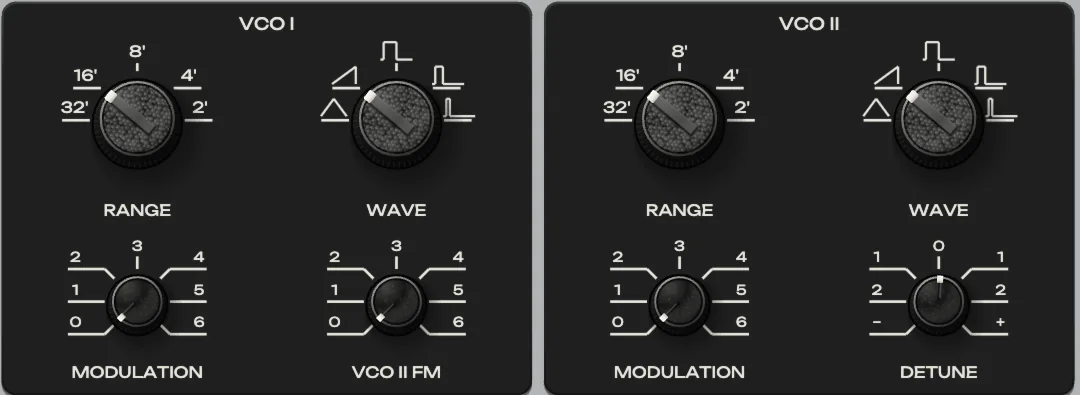 16'Saw16'Saw+0.1 st
That small detune makes the two saws drift in and out of phase, so the bass slowly thickens and thins as you hold a note. Go further and you get an audible chorus wobble, which is fine for pads and messy for a bassline. 32' is tempting for "more bass", but on the bottom keys it lands around 20 Hz, where you mostly hear the buzz of the harmonics and very little note.
This is what the oscillators sound like with the filter wide open and the mixer at a polite 3. Bright, buzzy, a bit cheap. Everything that makes the Polyvox bass happens in the next two plates.
Turn the mixer up until the filter complains
The Polyvox mixer is a plain op-amp summer. Each input has the same 22 kΩ resistor as the feedback path, so every channel passes at unity gain, and nothing limits the sum. The sawtooth leaves the oscillator at around 10 volts peak to peak. Two of them at full level hit the filter with a signal it was never sized for.
Inside the filter, Vladimir Kuzmin used two К140УД12 op-amps as current-controlled integrators, with no capacitors of their own. Their inputs sit behind a divider of about 1:48, which puts the overload point somewhere around 3 volts at the filter input. With both oscillators at 6 you are far past it. The integrators saturate, and because they are inside the filter loop, the distortion follows the cutoff and the resonance instead of sitting on top of them.
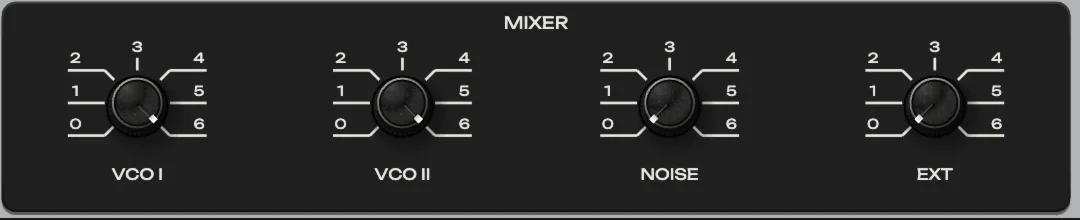 66
Set VCO I and VCO II in the mixer to 6. Keep NOISE and EXT at 0 for now. Then try the player: the knob moves both mixer levels together, and the clips are level-matched, so you are hearing the tone change.
Below 3 it is a clean synth bass with plenty of bounce. From 4 up the filter starts squashing it: the notes get denser and heavier, and the low end takes over more of the sound. We measured it on these exact clips: the gap between peak and average level shrinks from about 11.5 dB at mixer 1 to about 6 dB at mixer 6, which is what a compressor or a fuzz does. At 6 it is the sound people mean when they say "Polyvox bass". If a mix needs it tamer, back the mixer down to 4 or 5 before you reach for anything else. The mixer is the drive control on this instrument.
Close the filter, then let the envelope open it
On the FILTER plate, leave the mode switch on LP. Set CUTOFF low, around 1.7, and RESONANCE around 2.7. Then give the filter its own envelope: ENVELOPE amount 3.3, ATTACK at minimum, DECAY around 2.7, SUSTAIN 0.9 and a short RELEASE.
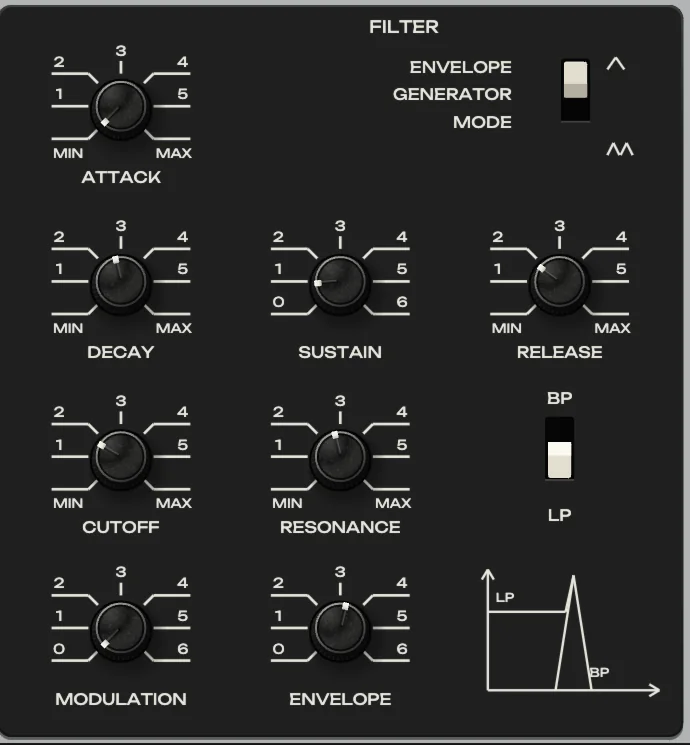 Decay0.9≈1.7≈2.73.3
The low-pass is only 12 dB per octave, half the slope of a Moog ladder. A closed Polyvox filter still lets a lot of upper harmonics through, which is why the bass stays audible on small speakers. Turn the cutoff in this player and listen to the low settings. The grit down there is real: Kuzmin wrote that the chips produce a "step" in their output stage at small control currents, a crossover distortion that gets stronger as the cutoff goes down.
Resonance
On most filters, loud input plus high resonance gives you a whistle sitting on a thin bass. Here the saturated integrators compress the resonant peak, so a hot mixer holds the resonance back. You can push it further than you'd expect before the bass loses its bottom.
For a bassline, 2 to 3 is the useful range: enough to make the notes talk, not enough to compete with a vocal. Past 5 it turns into a lead sound with a bass underneath, which is another tutorial (the scream).
Envelope amount and decay
These two decide whether the bass plucks or pushes. Envelope amount sets how far each note opens the filter. Decay sets how fast it closes again.
As far as the schematic tells, the original cutoff control is linear in hertz. A sweep from 100 Hz to 10 kHz therefore crosses the first octave in about one percent of its travel and spends most of the time in the top two octaves, so the envelope "snaps" open from the bottom and then lingers up high. Duovox uses that law by default. If you want the more familiar exponential sweep, the rear panel has a Cutoff Law switch.
Give it a short, solid amp envelope
On the AMPLIFIER plate: attack at minimum, a medium DECAY, SUSTAIN around 5, short RELEASE. Leave the envelope mode switch on the single-envelope icon. The bass now holds while you hold the key and stops when you let go, which keeps fast riffs tight.
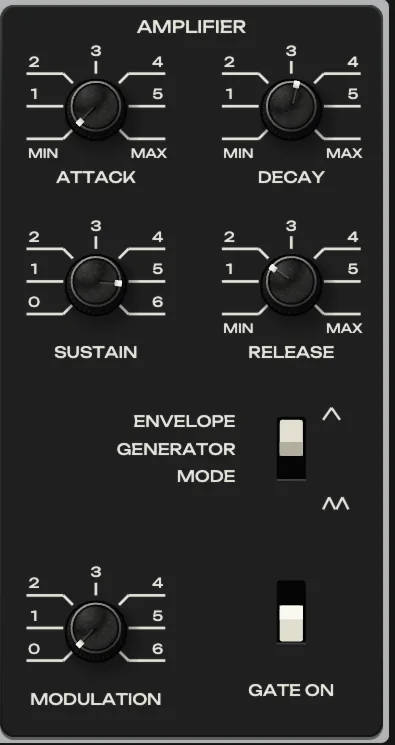 Decay5.1Release
That's the whole patch. In Duovox it ships as Soviet Monster Bass, the first preset in the BASS bank, and the screenshot at the top of this page is it.
Six basses from the same idea
Once the mixer is hot, small changes give you very different basses. Swap the saw on VCO I for a triangle at 32' and a square on VCO II and you get a round sub with grit on top. Let VCO II modulate VCO I with the VCO II FM knob and the bass growls. A little NOISE in the mixer makes it hiss like a worn tape. The player runs one riff through six presets from the factory bank.
Slides
There is no legato switch on the 1982 panel, but GLIDE on the master plate does the job: play the next note before releasing the last and the pitch slides. The original glide is an RC circuit, so the slide is fast at first and slows into the target note.
Where it sits and what to leave alone
This bass already has its distortion and its compression, so it usually needs less processing than a clean synth bass. A high-pass around 30 Hz cleans up the sub rumble from the bottom keys. If it fights the kick, shorten the amp decay rather than reaching for EQ. And because the drive lives in the mixer, a second instance with the mixer at 3 makes a clean layer you can blend underneath when a chorus needs more weight.
If you'd rather start somewhere else, the filter lesson goes into the scream, the looping envelope turns one held key into a rhythm, and the playground lets you turn every control on the panel and hear what it does.
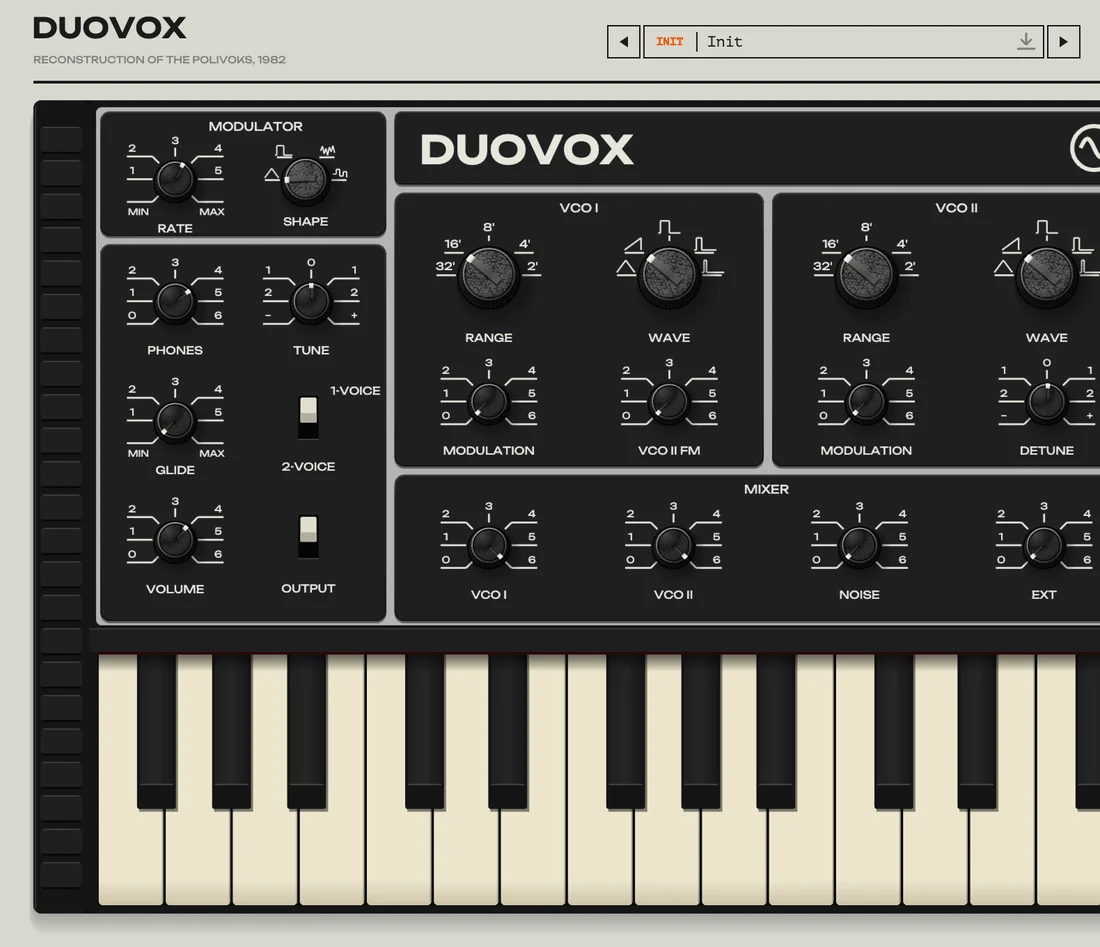
- The full Polyvox panel, control for control, with the scream, the looping envelopes and duophony
- A 4x/8x oversampled model of the two-chip filter, calibrated on recordings of real units
- 257 presets in ten banks and five packs, and a GEN button for new basses, leads and screams
- Extras the 1982 box never had: poly mode, velocity, pitch bend, drift, a rear panel