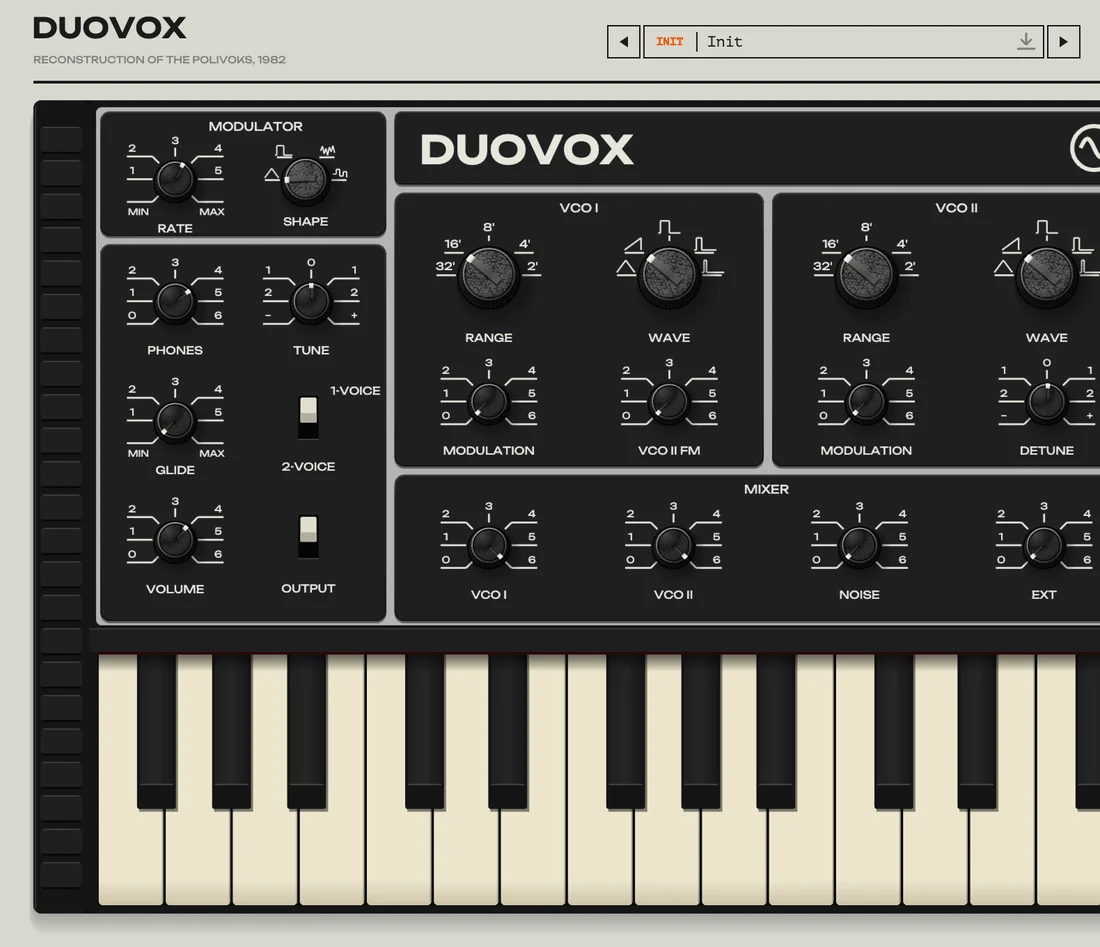
Plate by plate across the 1982 panel: the Russian name printed on it, what it does, and a player for nearly every knob and lever. Turn them and listen.
By MonosoundsUpdated 27 Oct 20266 min read
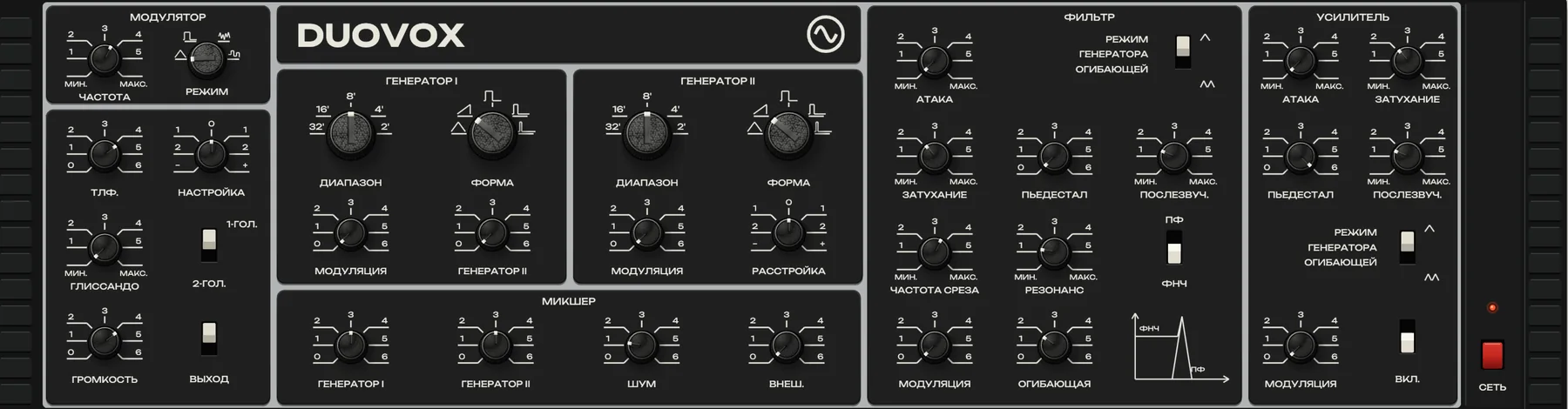
ЧАСТОТАФОРМАПЬЕДЕСТАЛЧАСТОТА СРЕЗАВКЛ.
Duovox with the Cyrillic lettering switched on (the АБВ button). These are the names printed on the 1982 panel.
The Polyvox (Polivoks, Поливокс) panel has 37 controls on seven black plates, labelled in Russian. This page walks across it from left to right with a player for nearly every one. Each player changes a single control on a patch picked so the change is easy to hear. Everything is rendered by Duovox, and the screenshots are the plug-in.
Duovox can print the panel in Latin letters or in the original Cyrillic (the ABC / АБВ button). The picture above is the Cyrillic version; the plate shots below use the Latin one, with the original names marked in red.
01МОДУЛЯТОР
The modulator
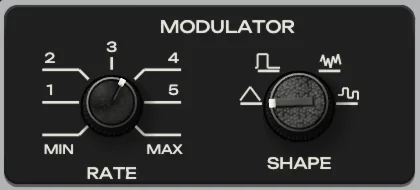
Top left: the LFO, which the panel calls the modulator. It has no depth knob of its own. Each plate it can reach (VCO I, VCO II, the filter, the amplifier) has its own «МОДУЛЯЦИЯ» knob.
РЕЖИМЧАСТОТА
MODULATOR («МОДУЛЯТОР»): RATE and the four-way SHAPE switch. The depth knobs live on the plates they modulate.
«ЧАСТОТА» means frequency. In Duovox it runs from 0.7 to 40 Hz on a bent curve: owners describe the original pot as barely moving at first and rushing at the top.
RATE («ЧАСТОТА»)Duovox · 0:04
Play
Rate
The modulator speed, here on the pitch of both oscillators. MIN is 0.7 Hz, the middle about 2.7 Hz, MAX 40 Hz, where vibrato turns into a rough buzz.
Turn the knob →
«РЕЖИМ» (mode) picks the shape. Kuzmin's description has four: triangle, square, noise, sample and hold. His square is positive pulses only, so on pitch it trills upward instead of wobbling around the note.
SHAPE («РЕЖИМ»)Duovox · 0:04
Play
Shape
The same depth on the pitch, four shapes. The triangle wobbles around the note. The square only goes up, so it trills. Noise jitters, and sample and hold jumps to random pitches at the rate.
Pick a position →
02Master plate
Phones, tune, glide, voices
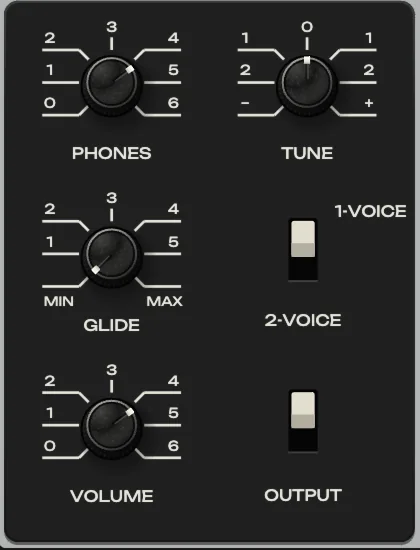
The tall plate under the modulator has no title. It holds the instrument-wide controls.
ТЛФ.НАСТРОЙКА1-ГОЛ./2-ГОЛ.ГЛИССАНДОВЫХОД
The master plate: PHONES, TUNE, GLIDE, the 1-voice / 2-voice lever, VOLUME and the OUTPUT lever.
«ТЛФ.» is short for телефон, headphones. «ВЫХОД» (output) is a lever that mutes the main output and keeps the headphones live. Kuzmin built it so a player could prepare the next sound between songs. «ГРОМКОСТЬ» is the main volume.
OUTPUT («ВЫХОД») and PHONES («ТЛФ.»)Duovox · 0:04
Play
Output
OUTPUT down mutes the main output and leaves only the phones level, so a player could set up the next sound on headphones between songs. In Duovox the PHONES knob sets what you hear while the lever is down.
Pick a position →
«НАСТРОЙКА» is tuning. It moves both oscillators by up to a whole tone either way, which matches the passport's ±12 %.
TUNE («НАСТРОЙКА»)Duovox · 0:04
Play
Tune
Master tune for both oscillators, ±1 whole tone (±200 cents on the readout). The phrase moves with it.
Turn the knob →
«ГЛИССАНДО» is glide. On the hardware it is a resistor and capacitor on the keyboard voltage, so the slide starts fast and slows into the note. In 2-voice mode it only moves one oscillator.
GLIDE («ГЛИССАНДО»)Duovox · 0:04
Play
Glide
Slides from one note to the next when they overlap. The curve is an RC: quick at first, slow into the note. The readout shows 33 ms at 1.8, 0.1 s at 3 and 0.6 s at 4.8.
Turn the knob →
«1-ГОЛ. / 2-ГОЛ.»: one voice or two. The second setting makes the Polyvox duophonic, two notes through one filter.
A low A held under a tune. In 1-voice both oscillators take the lowest key, so the tune disappears. In 2-voice VCO I takes the highest key and VCO II the lowest, through one filter and one amplifier.
Pick a position →
03ГЕНЕРАТОР I
VCO I
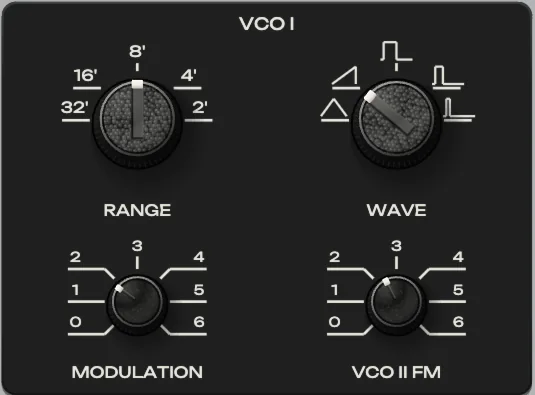
The two generator plates are nearly identical. «ДИАПАЗОН» is the range in feet (32' to 2'), «ФОРМА» the waveform, «МОДУЛЯЦИЯ» the modulator depth on pitch. VCO I's fourth knob is labelled «ГЕНЕРАТОР II»: the depth of VCO II modulating VCO I's frequency.
ДИАПАЗОНФОРМАМОДУЛЯЦИЯГЕНЕРАТОР II
VCO I («ГЕНЕРАТОР I»): RANGE, WAVE, the modulator depth, and VCO II FM.
WAVE («ФОРМА»)Duovox · 0:04
Play
Wave
VCO I alone, filter open. Triangle, saw, then three fixed pulse widths (45, 20 and 8.8 %). There is no PWM. More in the oscillators.
Pick a position →
MODULATION on VCO I («МОДУЛЯЦИЯ»)Duovox · 0:04
Play
Modulation
Modulator depth on VCO I's pitch, triangle at about 7 Hz. Small settings are vibrato; at 1.8 the swing is about ±2 semitones, at 2.7 about ±5; past that it is a siren.
Turn the knob →
VCO II FM («ГЕНЕРАТОР II»)Duovox · 0:04
Play
VCO II FM
VCO II bends VCO I's frequency at audio rate. Only VCO I is in the mixer, a triangle; VCO II is a saw detuned by 1.5 semitones. Up to about 2 the tone gets brighter and stays in tune; from 3 nearly all the energy moves off the note's harmonics, because exponential FM also shifts the pitch.
Turn the knob →
04ГЕНЕРАТОР II
VCO II
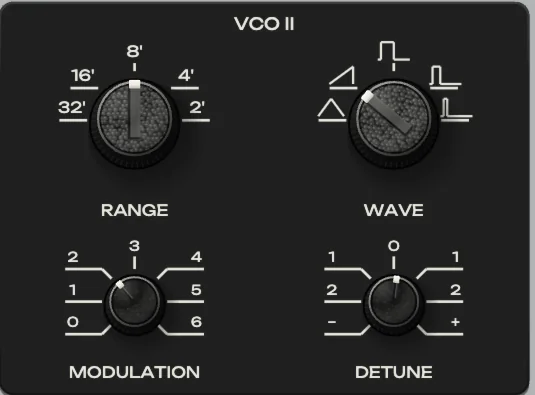
Same range and wave switches. The fourth knob is «РАССТРОЙКА», detune, the only one on the instrument. The full swing is ±2 whole tones.
ДИАПАЗОНФОРМАМОДУЛЯЦИЯРАССТРОЙКА
VCO II («ГЕНЕРАТОР II»): the same RANGE and WAVE, its own modulator depth, and DETUNE.
DETUNE («РАССТРОЙКА»)Duovox · 0:04
Play
Detune
VCO II against VCO I. A hair off 0 and the saws beat; +0.5 on the scale is a semitone, +1 a whole tone. The full range is ±2 whole tones.
Turn the knob →
Because the modulator depth is set per oscillator, you can trill one oscillator and leave the other alone. Kuzmin describes this patch: a square wave on both, detuned to an interval, gives a four-note trill.
MODULATION on VCO IIDuovox · 0:04
Play
Modulation
The square wave on VCO II only. VCO I holds the note while VCO II trills up at about 4.6 Hz: roughly 1, 2, 3, 6 and 12 semitones at these steps.
Turn the knob →
05МИКШЕР
The mixer
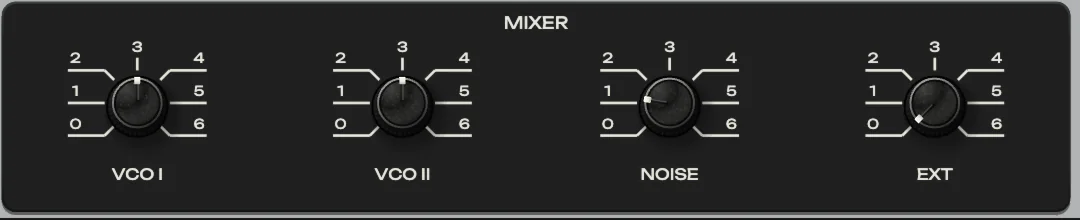
«ГЕНЕРАТОР I», «ГЕНЕРАТОР II», «ШУМ» (noise) and «ВНЕШ.» (external). The summing amplifier passes each input at unity gain with no limit, so the mixer levels also decide how hard the filter is driven.
ГЕНЕРАТОР IГЕНЕРАТОР IIШУМВНЕШ.
MIXER («МИКШЕР»): VCO I, VCO II, NOISE and EXT, each 0 to 6, summed at unity gain into the filter.
VCO I level («ГЕНЕРАТОР I»)Duovox · 0:04
Play
VCO I
VCO I alone into a resonant low-pass, level-matched. The level is also the filter drive: higher settings come out denser and more compressed.
Turn the knob →
On this player the gap between peak and average level narrows from 10.3 dB at 1 to 6.7 dB at 6, the squash of a filter running out of headroom. The bass tutorial builds a whole patch on it.
NOISE («ШУМ»)Duovox · 0:04
Play
Noise
White noise into the same filter as the bass, so it is filtered with it. Across the knob the average brightness rises from about 800 Hz to 1.8 kHz, and the clip gets about 1 dB quieter, not louder.
Turn the knob →
EXT («ВНЕШ.»)Duovox · 0:04
Play
EXT
On the 1982 unit an external input. Duovox has no audio input, so EXT hears its own output, like a patch cord from out to in: thicker at first, then from about 5 a loop that howls at pitches of its own.
Turn the knob →
06ФИЛЬТР
The filter
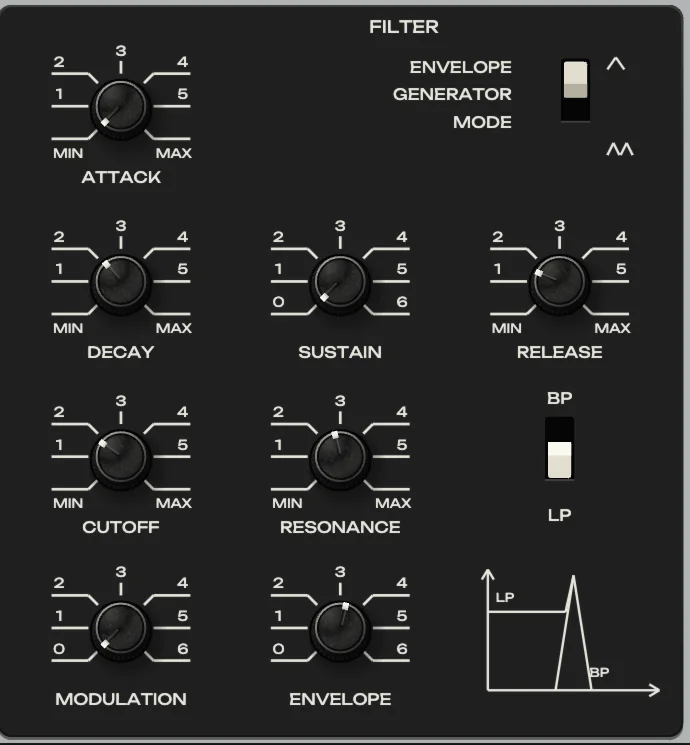
The biggest plate. Kuzmin built the filter from two К140УД12 op-amps used as integrators: a 2-pole filter, low-pass or band-pass, which distorts when pushed. Its envelope sits on the same plate and only drives the cutoff.
РЕЖИМФНЧ / ПФЧАСТОТА СРЕЗАРЕЗОНАНСОГИБАЮЩАЯ
FILTER («ФИЛЬТР»): its own envelope on top, cutoff, resonance and the LP/BP lever in the middle, modulator and envelope depths at the bottom.
«ЧАСТОТА СРЕЗА» is cutoff frequency, «РЕЗОНАНС» resonance.
CUTOFF («ЧАСТОТА СРЕЗА»)Duovox · 0:04
Play
Cutoff
The cutoff knob runs from 30 Hz to 18 kHz on the readout. Low settings are dark and gritty, the top is a bright saw bass.
Turn the knob →
RESONANCE («РЕЗОНАНС»)Duovox · 0:04
Play
Resonance
Emphasis at the cutoff. Near the top the filter oscillates on its own.
Turn the knob →
The lever is marked «ФНЧ» (фильтр нижних частот, low-pass) and «ПФ» (полосовой фильтр, band-pass).
LP / BP («ФНЧ / ПФ»)Duovox · 0:04
Play
Mode
The same patch through the low-pass (12 dB per octave) and the band-pass. BP takes the bottom out and leaves a nasal band around the cutoff.
Pick a position →
«ОГИБАЮЩАЯ» means envelope; the knob sets how far the envelope pushes the cutoff. «МОДУЛЯЦИЯ» next to it is the modulator depth on the cutoff.
ENVELOPE amount («ОГИБАЮЩАЯ»)Duovox · 0:04
Play
Envelope
How far the filter envelope opens the cutoff on each note. It only adds: the original has no inverted envelope.
Turn the knob →
MODULATION on the filterDuovox · 0:04
Play
Modulation
The modulator on the cutoff, triangle at about 2.7 Hz: a wah that keeps time by itself.
Turn the knob →
The envelope stages: «АТАКА» attack, «ЗАТУХАНИЕ» decay (literally "fading"), «ПЬЕДЕСТАЛ» sustain ("pedestal") and «ПОСЛЕЗВУЧ.» release, short for послезвучание, "after-sound". Kuzmin recalled a security clerk who flagged the word «Атака» as suspicious.
Filter ATTACK («АТАКА»)Duovox · 0:04
Play
Attack
How long the envelope takes to open the filter. MIN is a pluck; at 3.6 each note swells open over about 0.3 s.
Turn the knob →
Filter DECAY («ЗАТУХАНИЕ»)Duovox · 0:04
Play
Decay
How fast the filter closes again after the peak, down to the sustain level.
Turn the knob →
Filter SUSTAIN («ПЬЕДЕСТАЛ»)Duovox · 0:04
Play
Sustain
ПЬЕДЕСТАЛ means pedestal: the level the envelope rests on while the key is held. At 0 every note closes; at 6 it stays open.
Turn the knob →
«РЕЖИМ ГЕНЕРАТОРА ОГИБАЮЩЕЙ», envelope generator mode, is the lever with two icons: a single envelope, and ΛΛ for the periodic mode that loops.
Periodic mode with sustain at 0 repeats attack and decay for as long as the key is held: a rhythm from one key. See the looping envelope.
Pick a position →
07УСИЛИТЕЛЬ
The amplifier
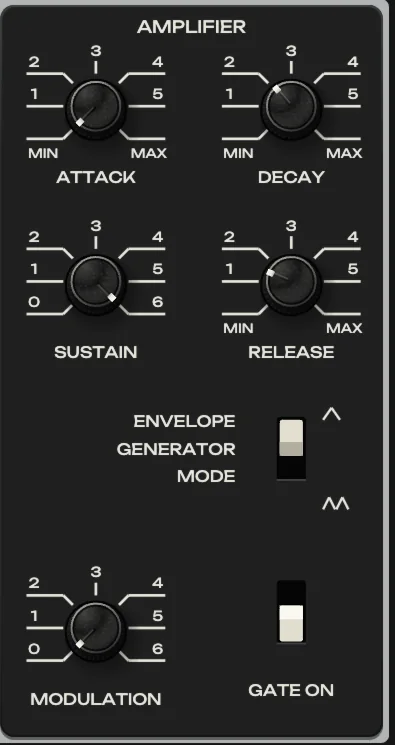
A second envelope with the same four stages and the same mode lever, wired to the volume, plus a modulator depth (tremolo) and the «ВКЛ.» lever.
АТАКАЗАТУХАНИЕПЬЕДЕСТАЛПОСЛЕЗВУЧ.ВКЛ.
AMPLIFIER («УСИЛИТЕЛЬ»): a second, identical envelope for the volume, its mode lever, the modulator depth and GATE ON.
Amp ATTACK («АТАКА»)Duovox · 0:04
Play
Attack
Fade-in time. At MIN the note starts at once; at 3.6 it fades in over about 0.3 s; at 4.5 (about 1 s) it barely arrives before the next note.
Turn the knob →
Amp SUSTAIN («ПЬЕДЕСТАЛ»)Duovox · 0:04
Play
Sustain
The held level after the decay. At 0 every note dies away even with the key down, which is how plucks and drums are made.
Turn the knob →
Amp RELEASE («ПОСЛЕЗВУЧ.»)Duovox · 0:05
Play
Release
ПОСЛЕЗВУЧАНИЕ, "after-sound": how long the note rings after the key comes up. Short keys make it obvious.
Turn the knob →
MODULATION on the amplifierDuovox · 0:04
Play
Modulation
The modulator on the volume: tremolo, here at about 5 Hz. At 6 the level dips to silence on every cycle.
Turn the knob →
«ВКЛ.» means "on". It holds the gate open with no key pressed, so drones keep sounding and periodic envelopes keep looping. The sound effects tutorial runs wind, surf and a steam train on it.
GATE ON («ВКЛ.»)Duovox · 0:02
Play
ВКЛ.
One half-second tap. With ВКЛ. on, the gate stays open after the key comes up: drones, and envelopes that loop on their own.
Pick a position →
08Off the panel
What the 1982 box did not have
Far right is «СЕТЬ», mains: the red power button. In Duovox it is a soft bypass. Everything the original lacked (pitch bend, mod wheel, velocity, polyphony, drift, key tracking, filter drive, legato) sits on a separate rear panel, so the front stays as it was in 1982. A few front-panel controls have no player of their own: VOLUME, the amplifier decay and envelope mode, and the filter release. They work like their neighbours.
For the oscillators in depth, with measurements against real units, see the oscillators.
DUOVOX
The Polivoks (Polyvox) synth as a VST3/AU plug-in
The full Polyvox panel, control for control, with the scream, the looping envelopes and duophony
A 4x/8x oversampled model of the two-chip filter, calibrated on recordings of real units
257 presets in ten banks and five packs, and a GEN button for new basses, leads and screams
Extras the 1982 box never had: poly mode, velocity, pitch bend, drift, a rear panel
The main ones: ГЕНЕРАТОР is oscillator, ДИАПАЗОН range, ФОРМА waveform, РАССТРОЙКА detune, МИКШЕР mixer, ШУМ noise, ВНЕШ. external input, ФИЛЬТР filter, ЧАСТОТА СРЕЗА cutoff, РЕЗОНАНС resonance, ОГИБАЮЩАЯ envelope, АТАКА attack, ЗАТУХАНИЕ decay, ПЬЕДЕСТАЛ sustain, ПОСЛЕЗВУЧ. release, УСИЛИТЕЛЬ amplifier, МОДУЛЯТОР the LFO, ТЛФ. phones, ГЛИССАНДО glide, ВЫХОД output, ВКЛ. on (gate hold).
What do ФНЧ and ПФ mean on the filter?
ФНЧ stands for фильтр нижних частот, a low-pass filter (12 dB per octave on the Polyvox). ПФ is полосовой фильтр, a band-pass. The lever switches the filter output between the two.
What does 1-ГОЛ. / 2-ГОЛ. mean?
One voice and two voices (голос is voice). In 1-ГОЛ. both oscillators play one key. In 2-ГОЛ. the instrument is duophonic: one oscillator takes the highest held key, the other the lowest, through one shared filter and amplifier.
Does the Polyvox have a mod wheel or pitch bend?
No. The 1982 panel has neither, and Kuzmin wrote that they were left out. Duovox responds to MIDI pitch bend and the mod wheel, with their ranges set on the rear panel.
 РЕЖИМЧАСТОТА
 ТЛФ.НАСТРОЙКА1-ГОЛ./2-ГОЛ.ГЛИССАНДОВЫХОД
 ДИАПАЗОНФОРМАМОДУЛЯЦИЯГЕНЕРАТОР II
 ДИАПАЗОНФОРМАМОДУЛЯЦИЯРАССТРОЙКА
 ГЕНЕРАТОР IГЕНЕРАТОР IIШУМВНЕШ.
 РЕЖИМФНЧ / ПФЧАСТОТА СРЕЗАРЕЗОНАНСОГИБАЮЩАЯ
 АТАКАЗАТУХАНИЕПЬЕДЕСТАЛПОСЛЕЗВУЧ.ВКЛ.