The Polyvox (Polivoks, Поливокс) was designed in Sverdlovsk and built in Kachkanar from 1982. Its filter overloads when the mixer is turned up, and the resonance compresses instead of whistling. Those are two things a heavy mix usually asks a pedal or a plug-in chain to do, and this instrument does them inside the synth.
The first part of this page is who has documented using the hardware in heavy music, with the sources. The second is practical: how to put the bass of Duovox, our reconstruction, under down-tuned guitars, and where its screams, hits and risers go in an arrangement. Every sound below is a render of the plug-in's factory presets, unprocessed.
Who has used it in heavy music
Much of what circulates about famous Polyvox users is copied between lists without a source. These are the ones with something behind them.
- Mick Gordon AThe DOOM (2016) score. He demonstrates the synth in his own behind-the-scenes video, and Game Informer quoted him saying that, not speaking Russian, "operating [it] is kind of an adventure."His video ↗ Game Informer ↗
- Marcin Przybyłowicz, P.T. Adamczyk AThe Cyberpunk 2077 (2020) score. Przybyłowicz told Den of Geek that both composers own Soviet-made units (his is from 1982) and called it a duophonic synth that is "remarkably ugly-sounding" yet unlike anything else.Den of Geek ↗
- Rammstein, Christian "Flake" Lorenz BNamed by the designer, Vladimir Kuzmin, in his own article. Flake is reported to be seen playing one in a 2012 Echo awards performance with Marilyn Manson. No studio track is attributed to it in any source we found.Kuzmin ↗ 2012 video ↗
- Bring Me The Horizon CNamed, with the song "Kingslayer", in the Russian Wikipedia article and in 2026 obituaries of Kuzmin. No interview, credit or video we could find confirms it, so treat it as reported only.Wikipedia (RU) ↗ Afisha ↗
Grade A means the musician says it in their own interview or video; B means the designer or reputable press says it; C means a list without a primary source. Other names that turn up on gear sites we left out, because we could not find a credit, an interview or a video behind them. More in famous users.
What these have in common is the job. In every case the instrument was there to sound dangerous next to guitars and drums, and that comes from the circuit. Kuzmin traced the hard, gritty low end to a step in the filter chips' output stage at low cutoff, and the mixer sums both oscillators at full level into a filter that saturates at a few volts. Duovox models both.
Sitting a bass under drop A
Start with arithmetic. A drop-A guitar's low string is A1, 55 Hz. On Duovox an oscillator at 8' plays the key you press, 16' an octave below it, 32' two octaves below. So the key A2 with VCO I at 16' sounds 55 Hz, the same note as the open string. That is where the METAL PACK basses sit.
 16'8'Cutoff66
Drop A Growl Bass puts VCO I at 16' and VCO II at 8', both saws, both at 6 in the mixer, VCO II detuned by about a tenth of a semitone. The 8' oscillator doubles the guitar's octave and gives the bass a pitch you can hear on small speakers; the 16' one is the weight.
 16'Saw8'SawDetune
The player keeps the riff and moves only the two RANGE selectors.
We measured the four clips. With both oscillators at 8' the energy below 100 Hz sits about 20 dB under the strongest band, so the bass is all upper body and fights the guitars for the same space. The preset's 16' + 8' brings the sub band up to 5 dB under the top, and 16' + 16' to under 3 dB. 32' + 16' puts most of the energy below 100 Hz, but the low oscillator is at 27.5 Hz, which you feel on a big system and lose on headphones. For most mixes 16' + 8' is the setting: it locks to the guitar's open string and still reads on a phone.
Two rear-panel settings make this preset play like a picked instrument. Filter drive is at 100 %, and velocity opens the filter, so hard notes bite and soft ones stay round.

Chug or sustain
A doubling bass either follows the palm mutes or holds under them. The next player has one of each, plus a steadier doubler.
These three are played an octave above the register player, so the differences in tone are easier to hear on small speakers. Djent Chug Bass mixes a pulse and a saw with both envelopes closing fast and no sustain, so every note is a short thump; across the riff its level swings about 30 dB between notes and gaps, against about 2 dB for the growl. Riff Double Bass, from the INFERNO PACK, holds the notes with both oscillators at 16' (a saw and a pulse), so it carries more low end and less of the guitar's octave. If the guitars are tight and gated, take the chug. If they ring, take the growl and let the drums carry the rhythm.
Subs and impacts
A breakdown leaves holes, and a synth can fill them from below. Breakdown Sub is a triangle at 16' through a nearly closed filter with medium decay. Impact Boom and Slam Boom add a burst of noise that the filter envelope opens for a moment, so the hit has a crack on top of the knock.
On these clips Breakdown Sub has almost nothing above 500 Hz (more than 40 dB down), which makes it easy to layer under a kick without touching the guitars. The two booms put real energy in the 2 to 6 kHz band from the noise. Use the sub where the guitars stop, and a boom on the first beat after a stop.
The filter as the lead
The Polyvox scream is the filter's resonance driven hard. On most synths, high resonance plus a loud input gives a thin whistle over a weak note. Here the saturated integrators compress the resonant peak, so the scream gets louder and harsher without running away. Scream Lead is one saw at 8' with the resonance just over 5 and the filter envelope pushing the cutoff up on each note.
 SustainCutoffResonance ≈ 5.3Envelope
Turning the resonance from 3 to the top moves the spectral centre of this phrase from about 1.6 kHz to 5.1 kHz, and the 2 to 6 kHz band from 17 dB under the strongest band to level with it. Above 5 the peak becomes the loudest thing in the sound. That is the range where it sits next to a guitar solo instead of under it.
Four ways to get there are in the packs.
Pinch Squeal plays a quiet square into a self-oscillating filter, so most of what you hear is the filter's own tone, around 4 to 6 kHz, with glide between keys like a pinch harmonic sliding. Skull Splitter runs saw and pulse at full drive with the resonance at maximum and a fast filter sweep down from the top. Chainsaw Rip gets its tearing from FM instead: VCO II's square modulates VCO I at audio rate, with noise under both and a square LFO on the filter.
 SquareVCO II FM 4.8Noise
A scream lead and a distorted guitar both live between 2 and 5 kHz. Play the scream an octave above the guitar line, or high-pass the guitar bus a little harder in the bars where the synth leads, before you start cutting the synth.
Walls, risers and drones
The two envelopes have long enough attacks to build a transition by themselves. Portal Riser starts with the cutoff near the bottom, then a slow filter attack pulls it up through high resonance and noise while the amp fades in.
 AttackAmp attackCutoff lowEnvelope 5.4
Over the held key both risers climb for about three seconds (their spectral centre goes from about 3.3 kHz to about 7 kHz) and then hold at the top until you let go, so time the key-down three seconds before the drop. Noise Wall does not climb: it is a saw, a narrow pulse and noise through a screaming filter, with sample-and-hold nudging the cutoff, for the last chord of a song.
For industrial and doom, the INFERNO PACK is tuned around D. Hellgate Drone is two saws at 16' a semitone apart with the filter envelope on loop, and the GATE ON switch holds the note after the key is released.
What to leave alone
These sounds come out of the plug-in already distorted and compressed, because that happens in the filter. Duovox has no built-in effects, so the chain after it is yours, and it can be short. High-pass the bass around 30 Hz if the 16' notes on the lowest keys rumble. If the bass masks the guitars, lower the mixer levels from 6 to 4 or 5 before reaching for EQ; that feeds the filter less and the bass gets cleaner. If you want more drive, the rear panel's filter drive is the place, not a distortion plug-in after the filter, because only the first changes how the resonance behaves.
For the patch these basses grew from, see the Polyvox bass tutorial. For what the resonance knob does on its own, see the filter.
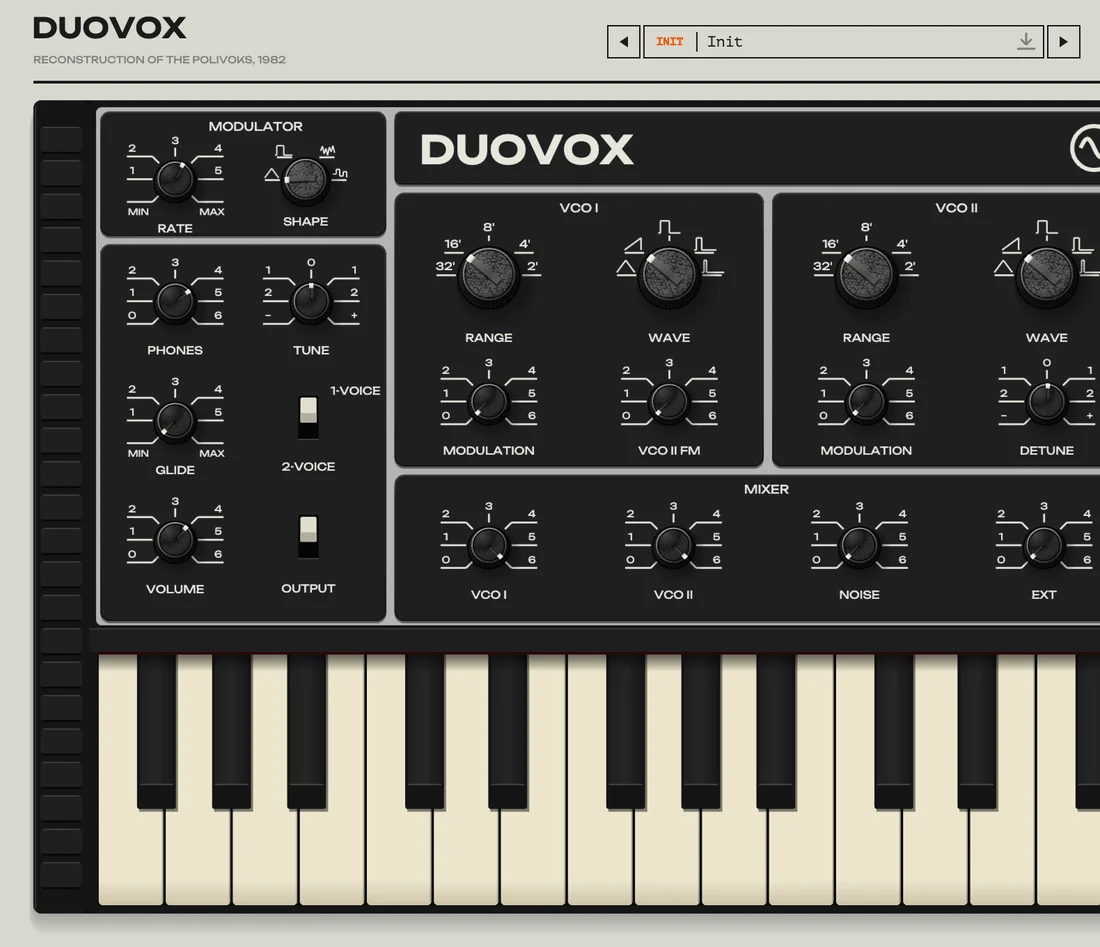
- The full Polyvox panel, control for control, with the scream, the looping envelopes and duophony
- A 4x/8x oversampled model of the two-chip filter, calibrated on recordings of real units
- 257 presets in ten banks and five packs, and a GEN button for new basses, leads and screams
- Extras the 1982 box never had: poly mode, velocity, pitch bend, drift, a rear panel