Search for a free Polyvox (Polivoks, Поливокс) VST and you will find the same two names on every page: Polyvoks Station and Polyakov. Both are real, both are free, and both are 32-bit Windows plug-ins built a long time ago. If you work on a current Mac or in a 64-bit DAW, the honest answer is that neither will load without a workaround.
We make Duovox, a paid Polivoks plug-in with a free demo, so weigh what follows with that in mind. Below is everything free we could find that has the Polivoks in it, what each one gives you and what it does not, with links. The sound players further down are all Duovox. We have no recordings of the free plug-ins we could fairly put next to ours, so we don't imitate them.
 Loop2-voiceResonanceMixer
Everything free with a Polivoks in it
Two plug-ins, one filter module that isn't free, an iOS app with a paid unlock, a sample pack and a demo. "Not documented" means we found no source either way.
| Polyvoks Station | Polyakov | Vult Vortex | Ivoks | Polivoks Live Pack | Duovox demo | |
|---|---|---|---|---|---|---|
| Maker | SyncerSoft | Music-Society | Vult | Red Rock Sound | Design the Media | Monosounds |
| What it is | Synth plug-in | Synth plug-in | Filter module | Polivoks-inspired synth | Samples, racks | Modelled synth |
| Price | Free | Free, forum sign-up | Paid (Premium pack) | iOS: free, $4.99 unlock at launch | Free, sign-up | Free demo, $29 to unlock |
| Runs on | Windows VST | Windows VST | VCV Rack | iOS (AUv3), Reason | Ableton Live | Mac VST3 / AU, Win VST3 |
| 64-bit, current Mac | No, 32-bit only | No, 32-bit only | Yes | Inside Reason, or on iOS | Yes | Yes, Apple Silicon and Intel |
| 2-voice (duophonic) mode | Not documented | Not documented (8-voice poly) | n/a | Not documented | n/a | Yes |
| Looping envelope | Not documented | Yes, "AD repeat" | n/a | Not documented | n/a | Yes, on both |
| Limits | Crashes reported | Vague manual | Filter only | Not a VST | Fixed recordings | Noise every 45 s, no saving, no offline render |
Polyvoks Station
Polyvoks Station is the older of the two and the one most search results point to. It copies the look and the functions of the Polivoks panel. The download on plugins4free is a 2.6 MB Windows VST, version 2.2, labelled Win32 and nothing else. A commenter on MatrixSynth in 2007 said it was made in SynthEdit, the modular plug-in builder that a lot of free synths of that era came from.
The comments on the download page are the useful part. In June 2021 one user wrote that it sounds good, then after a few minutes throws a loud noise burst, stops and takes the DAW down with it. In October 2021 another described CPU spikes to 100 percent and crashes, and said it was unusable on a 64-bit system even through jBridge or FL Studio's bridge. Both asked for a 64-bit version. There has not been one.
Polyakov
Polyakov came out in 2017, also built in SynthEdit, also 32-bit Windows only. Bedroom Producers Blog listed two oscillators with five waveforms and noise, low-pass and band-pass filters, an LFO on the mod wheel, velocity to filter and level, up to eight voices, and an "AD repeat" mode that loops the envelope's attack and decay. That last one is a real Polivoks feature, and it is the one thing on this list a free plug-in does that most generic synths don't.
Two catches. The EXT control only adds a little saturation, and the 1.7 MB download sits behind a free account on the Music-Society forum, which BPB described as a long sign-up that asks about your gear. BPB also found its documentation vague on some features.
Why your DAW won't load them
A 32-bit plug-in can only run inside a 32-bit host, or inside a bridge that runs it in a separate process and passes audio back and forth. Most current DAWs are 64-bit only, so the two free Polivoks VSTs hit a wall before you hear a note.
- Mac: neither has a Mac build at all, and macOS stopped running 32-bit code with Catalina in 2019. There is no free Polyvox plug-in that loads natively on a current Mac.
- Ableton Live: Live 10.1 and later load only 64-bit plug-ins. Ableton's help article points to third-party bridges and says converted plug-ins are less stable.
- FL Studio on Windows: bridges 32-bit plug-ins on its own. Image-Line's support note says bridging needs extra CPU and can make FL Studio less stable when a plug-in misbehaves, which is exactly what Polyvoks Station users report.
If you keep an old 32-bit Windows machine or a 32-bit DAW for vintage freeware, both are worth an afternoon. For a session you need to finish, we would not put either in it.
The filter, the app and the samples
A few other things come up for "free Polivoks", and each one covers part of the instrument.
VCV Rack, the free modular environment, has Vult's Vortex, a simulation of what Vult calls a famous Russian design, with low-pass and band-pass outputs that self-oscillate. It runs on 64-bit Mac and Windows, but it is part of the paid VultModules Premium pack, and it is only the filter: you patch the rest yourself. Red Rock Sound's Ivoks is a Polivoks-inspired synth for Reason and, since October 2022, for iOS as AUv3, free to download with a $4.99 unlock at launch (MusicTech). In FL Studio, Image-Line's Sawer pays homage to the Polyvox envelopes and filters with its own oscillators and up to 24 voices; you may already own it.
For raw sound, Design the Media released a free Polivoks Live Pack in 2012: more than 300 samples of a real unit, drum kits and instrument racks for Ableton Live, behind a free registration. We have not checked that the download still works. Samples give you one machine's recorded notes. They don't give you the controls.
Three things the free plug-ins don't give you
The sound people want from a Polivoks comes from three places on the panel. Here they are in Duovox, so you know what to listen for in anything you try, free or paid.
Two voices through one filter
A switch marked 1-ГОЛ. / 2-ГОЛ. turns the Polyvox duophonic: one oscillator takes the highest held key, the other the lowest, and both go through the same filter and amplifier (Sound On Sound, 2010). Neither free plug-in documents it. Polyakov goes the other way with eight-voice polyphony, which is a different instrument.
 2-voiceGlide
In 1-voice only the held bass key sounds, because the key scanner keeps the lowest note. In 2-voice the tune appears on top, and the average spectral centre of the clip rises from about 920 Hz to 1,060 Hz. It's still one filter, so the two notes behave like one instrument playing an interval.
Envelopes that loop
Each Polivoks envelope has a switch that repeats attack and decay while a key is down. Polyakov has this. Polyvoks Station does not document it.
 LoopSustain 0Sustain 0Loop
Both one-shot, the held interval opens once and settles. With the filter loop on, the filter keeps reopening and the clip's spectral centre goes from about 1.1 kHz to 1.6 kHz. With both loops on, as in the preset, the notes break into pulses with gaps between them, about 3 dB quieter on average than the one-shot version.
A mixer that overloads the filter
The Polivoks mixer sums its channels at unity gain with nothing to stop the total, and Vladimir Kuzmin's filter uses two К140УД12 op-amps that saturate early (Kuzmin's article). Two oscillators turned up overdrive the filter itself. We have not measured the free plug-ins, so we can't tell you whether they model this or add a distortion stage somewhere else.
 VCO IVCO II
These clips are level-matched, so loudness doesn't fool you. As both levels go from 1.2 to 6, the gap between peak and average level falls from about 11.4 dB to 5.4 dB: the filter squashes the bass harder the more you feed it.
Then the resonance. On Screaming Duo the clip's spectral centre moves from about 1 kHz at 0 to 1.6 kHz at 4.5, then 2.4 kHz at 5.4 and 3.6 kHz at full. Most of the change is in the top quarter of the knob, which is how the original behaves.
The Duovox demo, exactly
If you want to play a modelled Polivoks on a current Mac or in a 64-bit DAW without paying, the Duovox demo is the realistic way. It's the whole instrument, with three limits:
- Every 45 seconds of playing, it adds 1.5 seconds of white noise at about −20 dBFS. The clock only runs while Duovox makes sound, so a project left open on a silent track stays quiet.
- Presets cannot be saved, and a project does not keep your patch when you reopen it.
- Offline render, bounce and freeze come out silent. A real-time bounce works and keeps the noise bursts.

Everything else is there: all 257 factory presets, the duophonic switch, both looping envelopes, the ВНЕШ. (EXT) channel, which feeds Duovox's own output back into its mixer (the plug-in has no audio input, so it does not process your tracks), the GEN button, A/B, undo and redo, and the rear panel with poly mode, velocity, drift and the rest. It installs as VST3 and AU on macOS 11 or later, Apple Silicon and Intel, and as a 64-bit VST3 on Windows 10 and 11. There is no AAX for Pro Tools and no standalone app.
When the demo is not enough
The noise burst is meant to be impossible to ignore, so the demo is for deciding, not for releasing music. Once you know whether this sound has a place in your tracks, the full version, installed over the demo, has none of the three limits: $29 at launch, $59 after. That is a fraction of an original unit, which sells for roughly $1,000 to $2,000 in the West once it has been serviced and shipped (see real Polivoks or plug-in).
If Duovox isn't what you want, the paid alternatives are in our comparison of every Polivoks plug-in: Cherry Audio's Atomika is the bigger synth, Filtomika is the filter as an effect for your own audio, and Hideaway Studio's Polivox is a sampled Kontakt library. The free 32-bit ones are for curiosity. For a Polyvox you can play on today's computers, start with the demo.
Product names are trademarks of their owners; mentioned for comparison only.
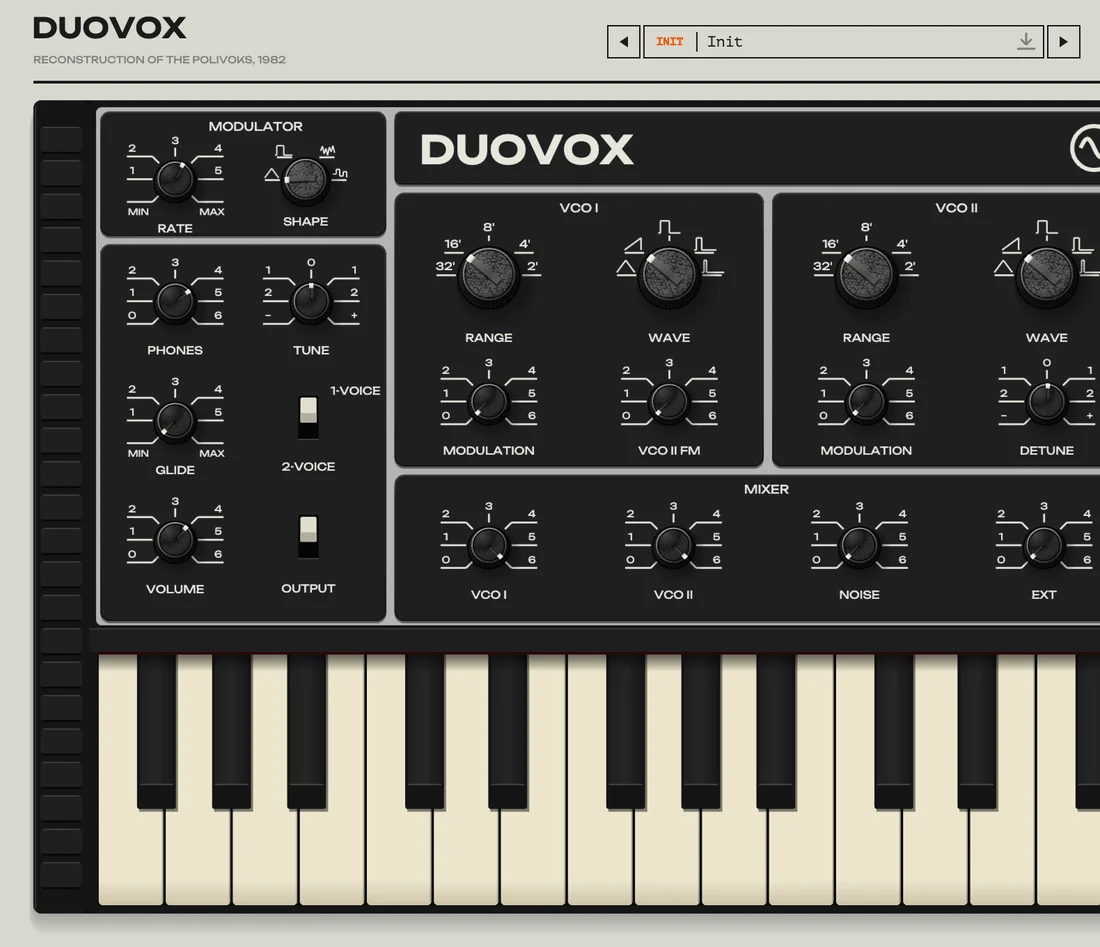
- The full Polyvox panel, control for control, with the scream, the looping envelopes and duophony
- A 4x/8x oversampled model of the two-chip filter, calibrated on recordings of real units
- 257 presets in ten banks and five packs, and a GEN button for new basses, leads and screams
- Extras the 1982 box never had: poly mode, velocity, pitch bend, drift, a rear panel