The Polyvox (Polivoks, Поливокс) was built at the Formanta plant in Kachkanar from 1982 to about 1990. Its designer, Vladimir Kuzmin, wrote that his ideal was the sound of Moog synthesizers; what came out sounded like nothing from the West. Forty years later people still pay four figures for one, which tells you the sound is doing something a modern synth does not do by default.
This page is the case for that sound in a track today, the honest cost of owning the hardware, and what our plug-in, Duovox, copies, measures and adds. Every picture is the plug-in and every player is a render of it, with nothing processed afterwards.
What it does that other synths do not
Three design decisions make the difference, and all three are on the front panel.
The filter is the first. Vladimir Kuzmin built it from two К140УД12 op-amps run open-loop as integrators, with no capacitors of their own, and he wrote that at low cutoff a small step appears in the chips' output stage, which makes the low end hard and gritty (Kuzmin's article). The mixer in front of it is a unity-gain summer with no limiting, so two oscillators at full level drive the filter into saturation. The distortion happens inside the filter loop, so it follows the cutoff and the resonance as you play. A drive pedal after a clean filter behaves differently.
The second is the envelopes. Each of the two ADSRs has a switch that makes it loop attack and decay while a key is held. One key becomes a rhythm, and with different times on the filter and amp envelopes you get two rhythms against each other, with no sequencer.
The third is duophony. A switch labelled 1-ГОЛ. / 2-ГОЛ. lets the two oscillators follow two keys through one filter and one amplifier. With glide on, one voice slides and the other holds, like bending one guitar string against another.
The tour above runs one phrase through eight factory presets, one from each of eight banks. In a mix this is what the instrument is for: basses that arrive already distorted and compressed, leads that scream and then limit themselves, rhythmic patches from one held key. Gordon Reid's 2010 Sound On Sound retrospective also lists what it does badly: brass, flutes and the creamy leads of a Minimoog. We agree, and we did not try to fix that.
What a real one costs to keep alive
Nobody builds them any more. On Reverb in 2026 stock 1980s units are listed at roughly $1,000 to $1,650, and serviced units with a MIDI retrofit at up to about $2,000 (listing snapshot). The 2016 RBMA interview gave $800 to $1,500. In Russia they sell for much less, and the difference is shipping, servicing and the MIDI conversion.
Then the upkeep. The original has no MIDI, no memory and 5-pin DIN sockets for audio, so most units in studios have been modified. Reid called the 48-key reed-switch keyboard the worst he had played. The ribbed plastic side cheeks are brittle, and when they crack the bottom of the case can come away. The pots get scratchy and crackle until they are cleaned, the oscillators drift, and six tuning trimmers sit under the name plate. Reid's own unit needed a key switch replaced and a professional repair of the filter and its envelope. Owners live with all of it because nothing else sounds the same, and a plug-in is the way to get the sound without the screwdriver.
What Duovox copies one to one
The front of Duovox is the 1982 panel: the modulator, the master plate with tune, glide, the 1-voice / 2-voice switch and the output mute, two generator plates, the four-channel mixer, the filter and the amplifier with their envelopes and loop switches, and the gate-on switch that holds a note without a key. Nothing modern was added to it. The control ranges follow the original where the factory documents give them: five footages from 32' to 2', five waves with no pulse-width knob, a detune of about ±4 semitones on VCO II, a unipolar filter envelope amount.
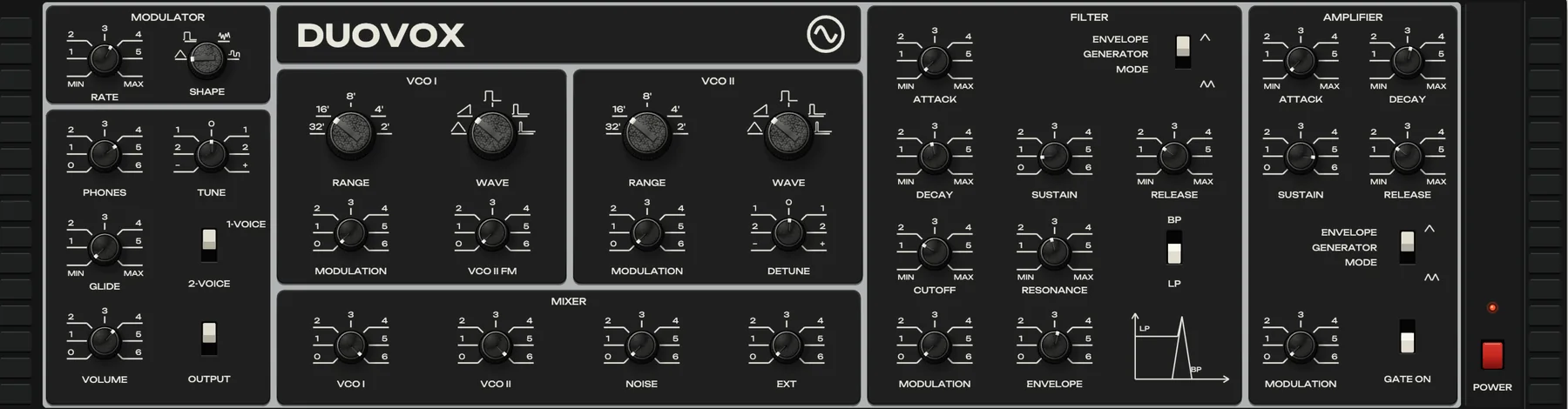 Loop1 / 2 voicesResonanceMixer at 6
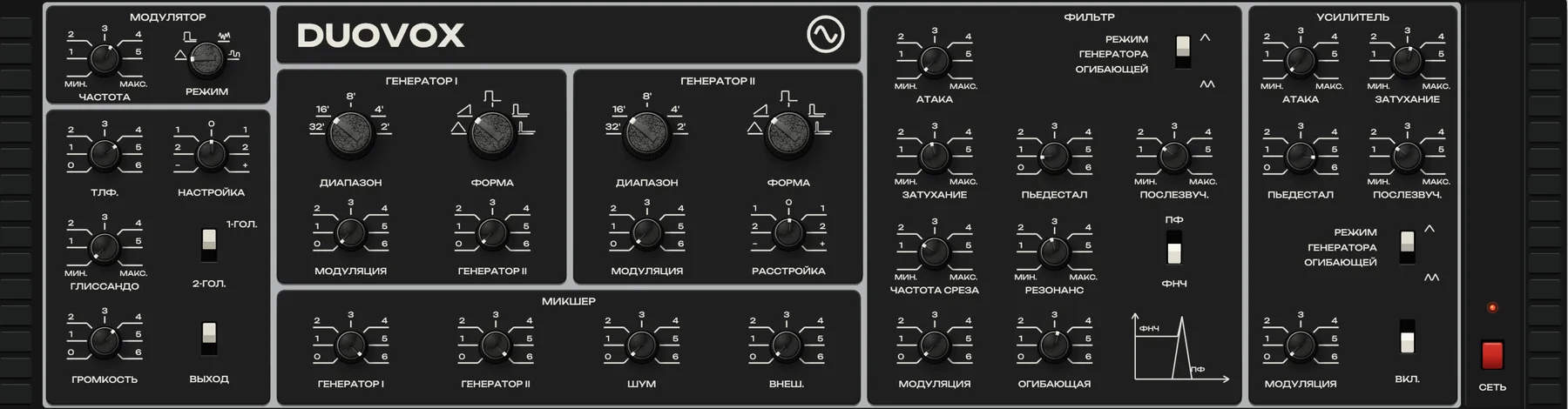
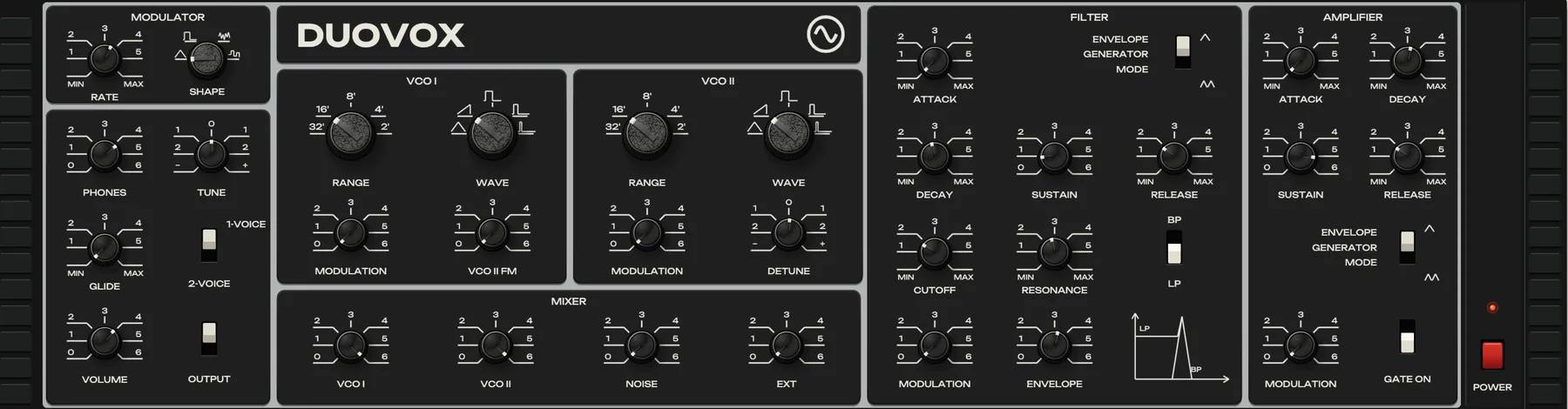
The lettering switches between Latin and the original Cyrillic with the АБВ / ABC button in the header. Here is the same patch both ways.
For the sound, "one to one" means measured. We took recordings of three original units: two videos of working instruments and a multisampled third. From each we cut single oscillator cycles, aligned and averaged them, then fitted the plug-in's waves against them. The square came out at 45 % duty, the pulse at 20 % and the narrow pulse at 8.8 %, and those are the numbers the oscillators now run on. The triangle is lopsided on the hardware (it rises for 52 % of the cycle, with rounded tops), so it is lopsided here.
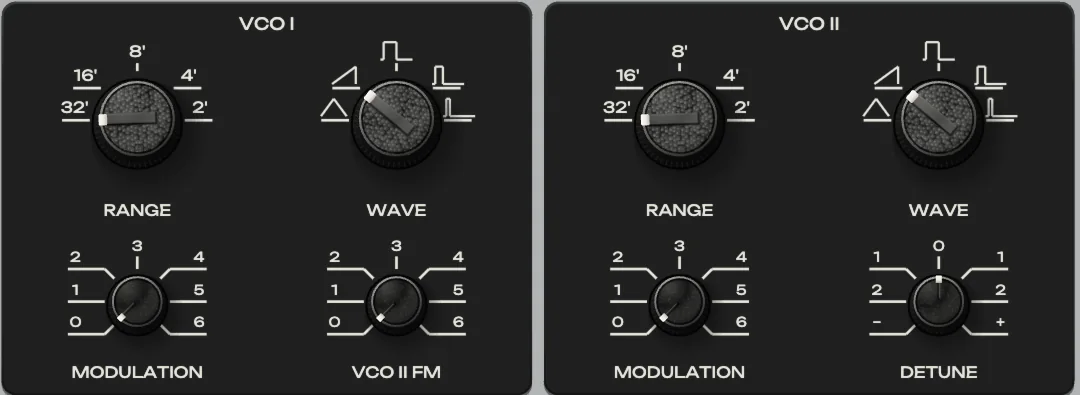 32'WaveWave
The filter got the same treatment. On the recordings the self-oscillation is a sine with its tops flattened, with a third harmonic 15 to 22 dB down; Duovox measures 14 to 19 dB down. The self-oscillation pitch follows the cutoff knob within 1 %. The filter follows the keyboard at 62 %, the median of the sampled unit's patches, and a long note wanders by about a cent, as on the samples. Some things could not be measured from recordings, such as absolute envelope times and the exact cutoff knob law, and those remain reasoned estimates from the schematics. The full notes are in our real unit vs plug-in piece.
The engine runs the oscillators, mixer and filter at 4x oversampling, or 8x in high quality mode (the default, and always on for offline renders), because the distortion lives inside the filter loop and folds back if you do not.
What a 1982 owner never had
Everything modern sits behind the REAR PANEL button, so the front stays as it was. It opens over the panel.

Poly mode turns Duovox into 2 to 8 full copies of the instrument, each with its own filter and envelopes, with a stereo spread for the voices. Velocity can open the filter and set the level. There is pitch bend with an adjustable range, mod-wheel vibrato, analogue drift, key tracking, legato (one trigger for overlapping notes), low-note or last-note priority, and a switch between the original's linear cutoff law and an exponential one.
Filter drive sets how hard the mixer hits the filter. The default is the middle of the knob, 50 %. The player turns it on the Soviet Monster Bass preset, level-matched, so you hear density rather than volume.
On these five clips the gap between peak and average level falls from about 9 dB at 0 to about 5 dB at 6. That is the filter compressing the bass, and it is the closest thing Duovox has to a drive pedal.
Poly mode matters most for chords. The next player holds three-note chords on the pad Frozen Pad. In poly every note sounds. Switch to the 1982 behaviour and 2-voice keeps the top and bottom notes, 1-voice keeps only the lowest key.
257 sounds, and a button for more
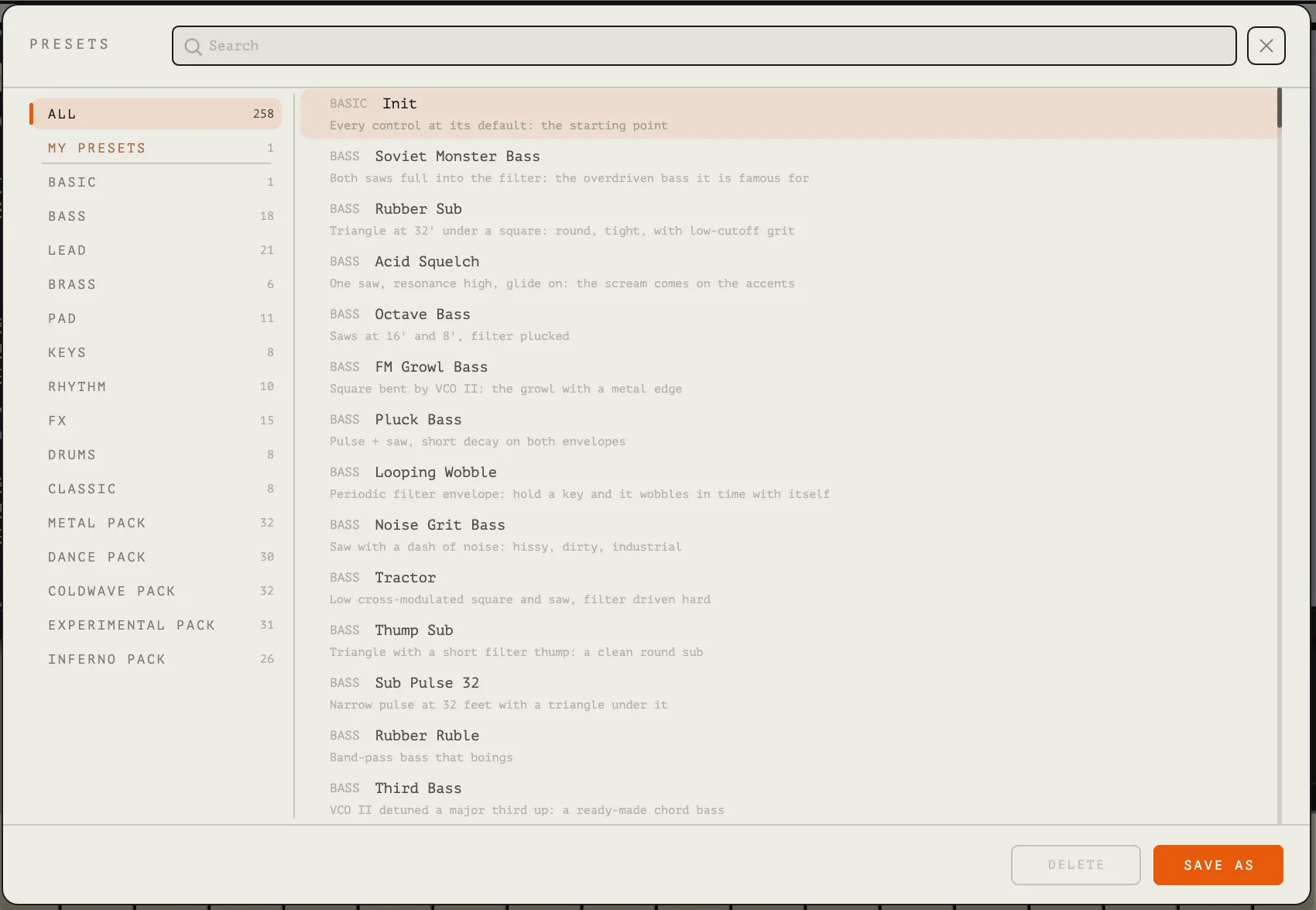
Duovox ships with 257 factory presets: ten core banks (BASIC, BASS, LEAD, BRASS, PAD, KEYS, RHYTHM, FX, DRUMS, CLASSIC) and five packs, METAL, DANCE, COLDWAVE, EXPERIMENTAL and INFERNO. Every preset has a one-line description of what it is and how to play it, and they are levelled to the same loudness, so stepping through them does not jump in volume. CLASSIC includes Manual Fig. 1, the only knob positions the factory ever printed, from Fig. 1 of the owner's manual.
GEN makes a new patch. Pick a kind (Bass, Lead, Scream, Weird, Coldwave or Sovietwave) and click. The generator knows which ranges, waves and envelope shapes make a bass on this circuit and which resonance and drive settings make a scream, builds a patch and levels it like the factory bank. It names the result (bass-005 below) and you can save it.
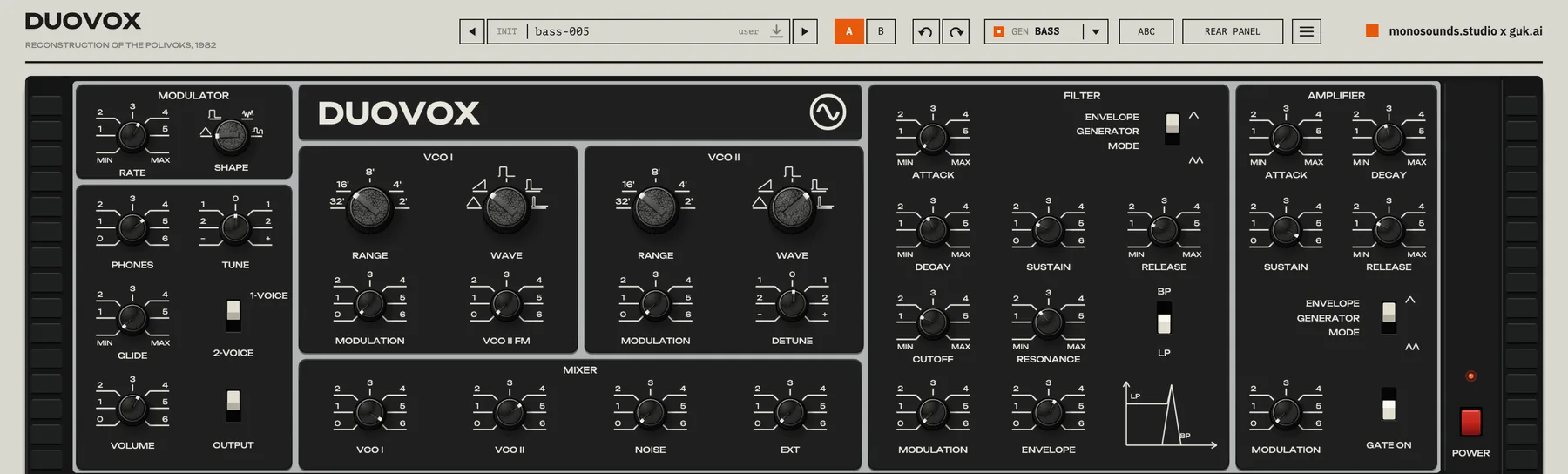
bass-005 and every control on the panel has moved to a new bass patch. The next click gives a different one, and undo takes it back.Not every result is a keeper. Of these five, two are dark triangle or square subs with almost nothing above 500 Hz, and three are brighter saw basses. Click until one fits the track, then adjust it. Undo takes a GEN result back in one step, and it covers knob moves too, 64 steps deep. The A/B buttons in the header keep two versions of a patch so you can compare them.
The panel scales from 75 % to 200 % from the menu, which helps on a laptop screen or a 4K monitor.
What it is not
- It has no effects. There is no reverb, delay or chorus, and none of the presets lean on them. Use the ones in your DAW.
- It has no audio input, so you cannot run a drum loop through the filter. The EXT knob in the mixer hears the instrument's own output, like a patch cord from the output back into the input, which gives feedback tones rather than external processing.
- It is not a pad workstation by default. Out of the box it is a 1-voice instrument like the original. Poly mode is there on the rear panel, but the sound is still two oscillators and a 12 dB filter per voice: good for cold, plain pads, not for lush ones.
- It is not a Moog. The filter is 12 dB per octave, half the slope of a ladder, and it distorts. Brass and smooth leads are what the original did worst, and we did not sweeten them.
- It is not a sample library. Every note is computed from the model, so the filter reacts to how hard the mixer drives it and to the note you play.
What it costs and how to try it
Duovox is $29 at the intro price, $59 regular, with free updates. It runs on macOS 11 or later as VST3 and AU, and on Windows 10 and 11 as VST3. The free demo is the whole instrument, every preset, GEN and the rear panel. Until you buy, it plays a burst of noise every 45 seconds, does not save presets and does not render offline; after buying you install the full version over it and click ACTIVATE.
If you want to hear what the panel does before deciding, the bass tutorial walks through the famous patch knob by knob, and the playground lets you turn every control.
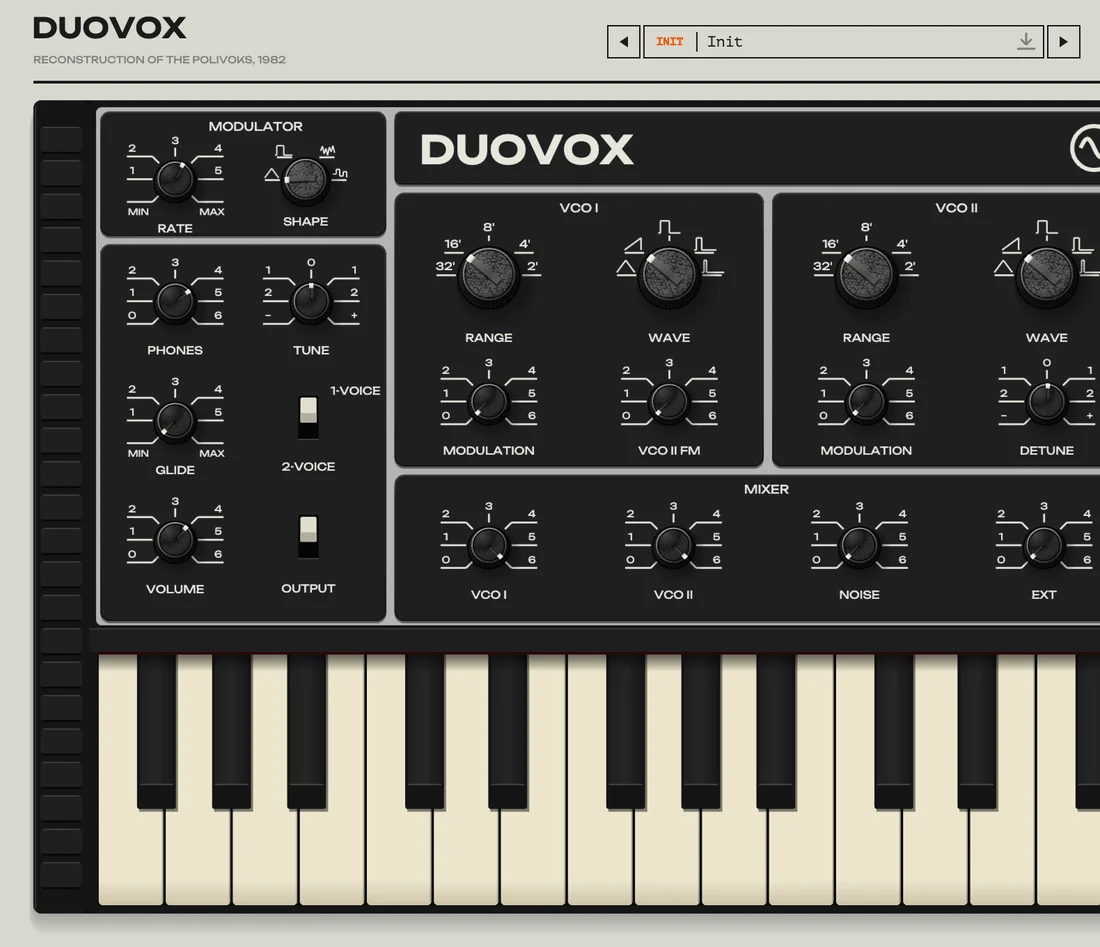
- The full Polyvox panel, control for control, with the scream, the looping envelopes and duophony
- A 4x/8x oversampled model of the two-chip filter, calibrated on recordings of real units
- 257 presets in ten banks and five packs, and a GEN button for new basses, leads and screams
- Extras the 1982 box never had: poly mode, velocity, pitch bend, drift, a rear panel