The Polyvox (Polivoks, Поливокс) was built in Kachkanar from 1982 into the early 1990s and never sold outside the USSR. Forty years later you can buy it as a plug-in, a filter effect, a sampled Kontakt instrument, a Eurorack module, a desktop reissue or a prototype that may never ship. Some of these copy the circuit, some sample a unit, and one only borrows the idea.
We make one of them, Duovox, so read this with that in mind. Every competitor fact below comes with a link to the vendor, a review or a news report, and where a competitor is the better choice, we say so. The screenshots and sound players are all Duovox: we don't have the other products' audio, and we are not going to imitate it.
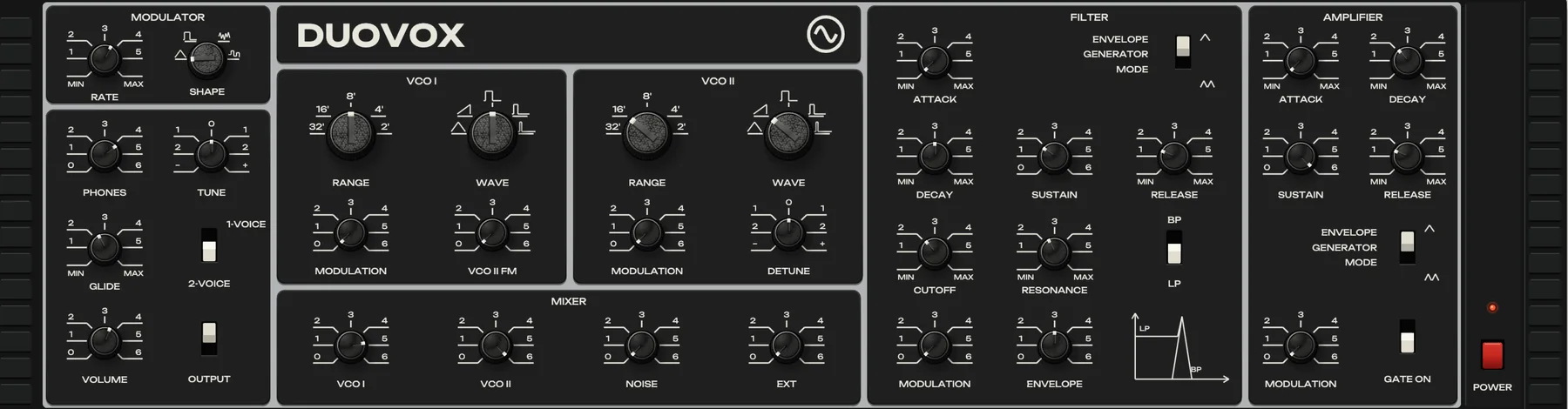 Loop switch2-voiceResonanceEXT
The software side by side
Six software products claim the Polyvox in some way. Two are full synthesizers, one is a filter effect, one is a sample library, two are free plug-ins from the 2000s and 2010s, and one is a native FL Studio synth that cites the Polyvox as an influence.
| Duovox | Atomika | Filtomika | Hideaway Polivox | Polyvoks Station / Polyakov | Sawer | |
|---|---|---|---|---|---|---|
| Maker | Monosounds | Cherry Audio | Cherry Audio | Hideaway Studio | Syncersoft / Music-Society | Image-Line |
| What it is | Modelled synth | Modelled synth | Filter effect | Sampled Kontakt library | Free SynthEdit-era VSTi | FL Studio native synth |
| Price | $29 at launch, then $59 | $49 list | $19 | $23.25 (list $27.90) | Free | Bundled with FL Studio |
| Formats | Mac VST3 / AU, Win VST3 | VST, VST3, AU, AAX, standalone | VST, VST3, AU, AAX | Full Kontakt 4.2.4+ | Windows 32-bit VST | FL Studio only |
| Original front panel, control for control | Yes, extras on a rear panel | Rearranged, extras on the panel | Filter only | Kontakt interface | Panel design copied | Own design |
| 2-voice (duophonic) mode | Yes | Yes | n/a | Yes, scripted | Not documented | Not documented |
| Polyphony | 2 to 8 voices | Up to 16, plus unison | n/a | Not documented | Not documented | Up to 24 |
| Looping envelopes | Yes | Yes | n/a | Yes | Not documented | "Homage" to them |
| External audio in | No (ВНЕШ. loops the output) | No | Yes, it is an effect | Not listed | Polyakov: EXT adds saturation | No |
| Non-original extras | Poly, velocity, drift, key track, drive, cutoff law (rear) | HP / notch / peak, drives, arp, FX, aftertouch | More flexible than the original, per reviews | Sampled through a 1968 B&K filter | None | 24 dB filter, HP |
| Factory presets | 257 | 350+ | - | 64 instruments, 66 multis | - | FL presets |
Sources for every row are linked in the sections below. "Not documented" means we found no source either way, so we do not count it against the product.
Atomika: the big one
Atomika came out on 9 October 2024 and is the most complete Polyvox synth on sale. Mark Barton did the filter DSP. It has both generators with the five footages and five waveforms, VCO II modulating VCO I, the low-pass and band-pass filter, envelopes that loop, mono and duophonic modes, and a switch that puts the panel lettering into Russian. On top of that Cherry built a modern synth: polyphony up to 16 voices with unison, high-pass, notch and peak filter modes, Starve, Filter Drive and Amp Drive controls, an arpeggiator, an effects page, velocity and aftertouch, and a wider LFO (user guide). It lists at $49 and runs as VST, VST3, AU, AAX and standalone on Mac and Windows.
The reviews are good. MusicRadar gave it five stars and called the duophonic mode splendid (MusicRadar, January 2025). Synth Anatomy liked the sound and listed real complaints: no global effects bypass, modulation without a matrix, an amp drive that clips quickly, presets that lean on the effects, and no external input (Synth Anatomy, October 2024). Cherry also published a side-by-side video against a real unit, which is worth watching whichever plug-in you end up with.
Where Atomika wins: if you use Pro Tools (AAX) or want a standalone app, if you want big polyphonic stacks with unison, an arpeggiator and built-in effects, or if you want filter modes the original never had. Duovox has none of those.
Where it differs from the original: the panel is rearranged, and the additions sit on the same panel as the 1982 controls, so a patch can drift away from anything a real Polyvox could do without you noticing. Cherry's guide calls the original's duophony inconsistent, and Atomika's answer is a clean poly mode next to the duophonic one.
What the 2-voice switch does
On the 1982 instrument a switch marked 1-ГОЛ. / 2-ГОЛ. decides whether both oscillators follow one key or two. In 2-voice mode one generator takes the highest held key and the other the lowest, both notes share one filter and one amplifier, and glide moves only one of them (Sound On Sound, 2010). That shared path is why a two-note Polyvox line sounds like one instrument playing an interval, and why it is different from two mono synths.
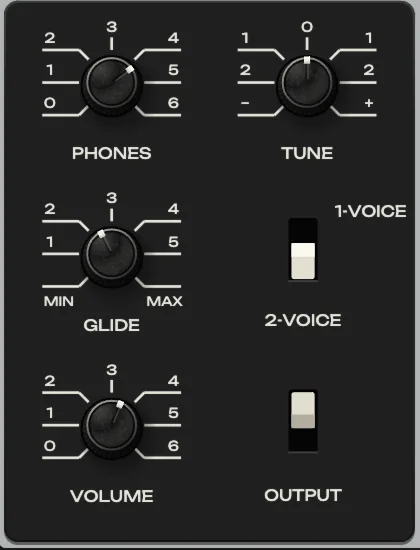 2-voiceGlide
Duovox does it the way the schematic does: VCO I on the highest key, VCO II on the lowest, one filter, one amplifier, glide on VCO I only. In 1-voice mode the key scanner keeps the lowest key, as on the original. The player below holds a bass note and plays a melody above it, three ways.
In 1-voice you hear the bass alone, because the lowest key wins. In 2-voice the tune appears on top of the same filter, and the average spectral centre of the clip moves from about 850 Hz to 1,030 Hz. Poly mode, switched on from the rear panel, gives each key its own oscillators, filter and amplifier, which is the cleaner and brighter version (about 1,180 Hz). Atomika and Hideaway's library both offer a 2-voice mode too, so this is a shared strength of the serious options, and a gap in the free ones.
Filtomika: the filter as an effect
Filtomika followed in December 2024. It is the Atomika filter as an insert effect for $19, with about 20 percent off for Atomika owners (Rekkerd). Synth Anatomy's review describes it as less faithful in topology and more flexible than the original filter (Synth Anatomy, December 2024). There is also a VM Filtomika module for Cherry's Voltage Modular.
Filtomika is the answer to one specific job: running drums, guitar, vocals or another synth through a Polyvox-style filter. The original had an external input on the mixer (ВНЕШ.) for exactly that. No synth plug-in in this list, ours included, accepts audio from the host, so if that is your main use, buy Filtomika or one of the hardware filters below.
What Duovox does with ВНЕШ.
Duovox has the fourth mixer channel, ВНЕШ. (EXT), and we should be precise about what it does. It does not take audio from your DAW. The plug-in has no audio input at all. The knob feeds Duovox's own output back into its mixer, as if a cable ran from the output socket into the external input, AC-coupled like the real jacks. With the resonance up, that loop growls, howls and drones.
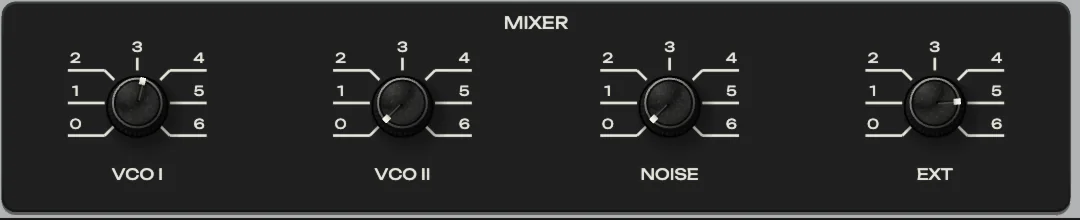 VCO I 3.3EXT 4.9
Turn the knob and the sound gets darker: on these level-matched clips the spectral centre falls from about 990 Hz at 0 to 580 Hz at 6, as the loop drags an undertone below the played note. It is a sound source in its own right (the CLASSIC preset Ext-In Loop latches the gate and lets the output eat itself into a drone), and it is something Atomika does not offer. It is not a substitute for Filtomika.
Hideaway Studio Polivox: a sampled unit
Hideaway Studio's Polivox is a Kontakt library built from a real unit: 845 24-bit samples, 64 instruments and 66 multis, with a low-pass and band-pass filter, looping envelopes and a scripted duophonic note assigner. Some of the samples were taken through a 1968 Brüel & Kjær filter. It sells for $23.25 at Best Service and Loot Audio against a list of $27.90, and it needs the full version of Kontakt 4.2.4 or later, not the free Player (KVR).
What you get is the sound of one particular instrument, recorded. What you lose is everything that happens between the mixer and the filter in real time. The overdrive from a hot mixer, the way loud input holds the resonance back, VCO II modulating VCO I at audio rate: in a sample library those are baked into whatever was recorded. If you already own Kontakt and want authentic raw material to layer, it is cheap and honest. If you want to play the instrument, a model fits better.
Why modelling matters for this sound
Vladimir Kuzmin built the filter from two К140УД12 op-amps used as integrators, and wrote that the chips step at low control currents, which makes the bottom end hard (Kuzmin's article). The mixer in front of it has unity gain and no limiting, so two oscillators at full level drive it into saturation. The scream comes from that combination, and it changes with every knob on the mixer and the filter.
On these clips the spectral centre goes from about 1.4 kHz with no resonance to 2.2 kHz at 4.5, then jumps to 3.6 kHz at 5.4 and 5 kHz at full. Most of the change is in the top quarter of the knob, which matches the original: the resonance does little until it suddenly does a lot. We tuned this against recordings of three original units, down to the harmonic shape of the self-oscillation (Duovox's calibration notes put the third harmonic of the resonance within a few dB of the recordings).
Polyvoks Station and Polyakov
If you search "free Polivoks VST" you will find two. Syncersoft's Polyvoks Station copies the panel design and function. It is a free Windows VST, 32-bit only, at version 2.2; a commenter on MatrixSynth in 2007 said it was built in SynthEdit, and users in 2021 reported random CPU spikes to 100 percent and crashes. Polyakov (Music-Society, 2017) is another SynthEdit build for 32-bit Windows: two oscillators, five waveforms, noise, and an EXT control that only adds saturation. You need a forum account to download it.
Both are worth a look out of curiosity if you have an old Windows machine. Neither loads natively in a current Mac DAW, and there is no 64-bit build of either.
Sawer, Ivoks and the filter modules
Image-Line's Sawer is a native FL Studio synth whose manual says it pays homage to the Polyvox envelopes and filters. It has its own oscillators, 1 to 24 voices, 24 and 12 dB low-pass and a high-pass mode, so it is a good synth in the family and not a clone. Red Rock Sound's Ivoks is a Polyvox-inspired synth for Reason (a Rack Extension since 2014) and iOS (AUv3, October 2022, free with a $4.99 unlock at launch) (MusicTech). The same developer has a PolyIvoks Filter for iOS.
For VCV Rack, Vult's Vortex module models the Polyvox filter (Vult docs), and one of the models in Vult's Freak Eurorack module is in the same style (gearnews). There are also preset and sample packs, such as a Polivoks bank for Phase Plant and Hollow Sun's 2011 Polivoks samples; those are sounds for other instruments.
As far as we could find, no other large plug-in company (Arturia, Softube, u-he, Native Instruments) has a Polyvox instrument, and we found no new Polyvox plug-in released after Filtomika.
The other feature the clones share
Each Polyvox envelope has a switch that makes it loop attack and decay while a key is down. One held key becomes a rhythm, and with different times on the filter and the amplifier you get two rhythms at once, without a sequencer. Atomika, Hideaway's library and Duovox all have it.
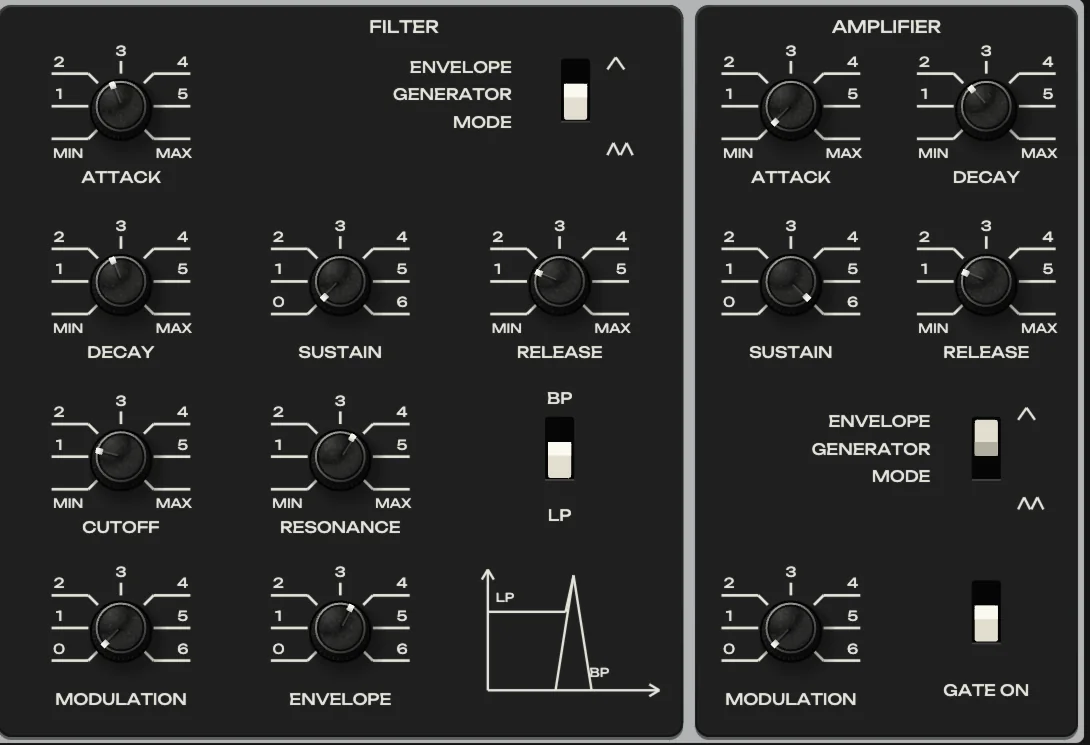 LoopAttackDecaySustain 0
In one-shot mode the filter opens once per key and settles dark. With the loop on and both times at 4.2 the filter sweeps open and shut about once every 1.7 seconds; at the preset's 2.5 it pulses around four or five times a second; at 1.3 it turns into a fast flutter.
Reissues, clones and modules
For context, because people search for these alongside the plug-ins. None of them is a keyboard Polyvox you can buy new today.
- Polivoks Pro (2016)100 keyboardless desktop units hand-built in Moscow with about 85 percent Soviet-era parts and MIDI, about 3 kg. Auctioned from a US$1,850 minimum bid; Sound On Sound reviewed it in 2018 at €1,650 and called it nasty but fab, with calibration and an intermittent fault as cons.gearnews ↗SOS ↗
- Elta MusicPolivoks-M (2018), a one-oscillator desktop at about US$500 made with Kuzmin. PF-3 stereo desktop filter at €350 direct. Polivoks-8, an eight-voice synth with a Polyvox-type filter, shown as a prototype at Superbooth 2026 and expected around €2,000; not released.CDM ↗Elta ↗Sonicstate ↗
- Erica SynthsBlack Polivoks VCF V2 Eurorack filter, roughly €179 to €198 at retail; the 3HP Pico VCF1 uses the same circuit. ACIDBOX II (2015) was a desktop built on Polyvox chips.ModularGrid ↗Sonicstate ↗
- Harvestman / Industrial Music ElectronicsR1982 Polivoks VCF and related Eurorack modules, made with Kuzmin's involvement.Listing ↗
- InfraDeep PVX-800 (2019)A Siberian duophonic desktop with original-type filters, an audio input, delay, ring mod and an arpeggiator, at $580 when announced.MusicTech ↗
- Behringer PolivoksAnnounced July 2021, prototype shown August 2023 with additions such as PWM and a sub-oscillator. No release and no price as of October 2026; Synth Anatomy called its future uncertain after Kuzmin died on 12 June 2026.SOS ↗Synth Anatomy ↗
If you want the filter on real voltages, the Erica, Harvestman and Elta filters are the practical route, and they process any audio. If you want the whole instrument on hardware, the options are a used original (see should you buy a real one) or waiting for Elta.
What we did differently
Duovox keeps the 1982 front panel as it was: both generators, the mixer with ВНЕШ., the filter with its unipolar envelope amount, the amplifier with the ВКЛ. gate-hold switch, the 1/2-voice switch and the ВЫХОД output mute. The cutoff follows a linear-in-hertz law by default, which is what the schematic suggests the original does. The three pulse widths (45, 20 and 8.8 percent) and the resonance were measured from recordings of three original units. Everything the original lacked lives on a rear panel you open separately.

It costs $29 at launch and $59 after, runs on macOS 11 or later as VST3 and AU and on Windows 10 and 11 as VST3, and comes with 257 presets. The free demo is the whole instrument; until you buy, it plays a burst of noise every 45 seconds and won't save presets or render offline. It has no AAX, no standalone app, no effects and no arpeggiator.
Which one should you get
For the Polyvox as it was, with the duophonic switch, the looping envelopes and the screaming filter on the original panel, get Duovox. That is the use case we built it for, and at its $29 launch price it costs less than Atomika's list price. The other cases point elsewhere:
- Pro Tools, a standalone app, 16-voice pads with unison, an arpeggiator or built-in effects: Atomika. It is the bigger synth and reviewers like it.
- Drums, guitars or vocals through this kind of filter: Filtomika in software, or an Erica, Harvestman or Elta filter in hardware.
- Raw samples of one real unit to layer in Kontakt: Hideaway Polivox.
- FL Studio and no budget: Sawer, which you may already own.
The free 32-bit plug-ins are for curiosity on an old Windows machine. If you are not sure about Duovox, the demo runs on Mac and Windows with every preset and the rear panel, so you can hear it in your own tracks before paying anything.
Product names are trademarks of their owners; mentioned for comparison only.
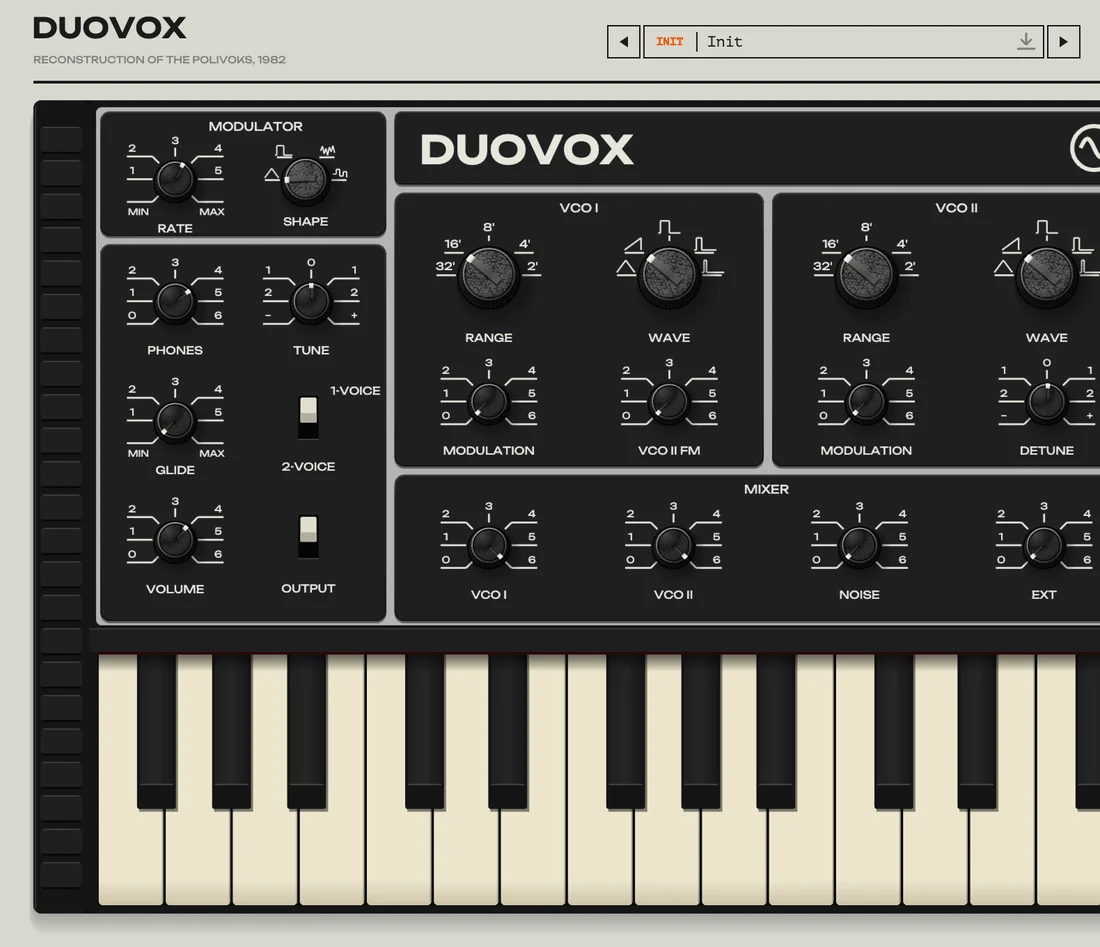
- The full Polyvox panel, control for control, with the scream, the looping envelopes and duophony
- A 4x/8x oversampled model of the two-chip filter, calibrated on recordings of real units
- 257 presets in ten banks and five packs, and a GEN button for new basses, leads and screams
- Extras the 1982 box never had: poly mode, velocity, pitch bend, drift, a rear panel