If you have heard what a Polyvox (Polivoks, Поливокс) does to a bassline, the next thought is usually a Reverb search. Originals still turn up, and some of the people who own one would not trade it for anything. They are also forty-year-old Soviet instruments with no MIDI, DIN sockets, a keyboard Sound On Sound called the worst its reviewer had played, and a case that weighs up to 20 kg.
This page is the honest version of that decision: what originals cost, what tends to go wrong, what you need to plug one into a modern studio, and what a plug-in such as our Duovox replaces and what it doesn't. We sell the plug-in, so we have tried to be careful with the case for the hardware too.
 Resonance MAXВЫХОДVCO I · 6VCO II · 6
What an original costs in 2026
The Polyvox was never sold outside the USSR, and roughly 25,000 were made, according to the figure designer Vladimir Kuzmin gave Red Bull Music Academy in 2016. So there are two markets: inside Russia, where it is an old domestic instrument, and in the West, where every unit has been shipped, often serviced and often modified. The figures below are asking prices from listings we could see, not confirmed sales; Reverb's sold-price guide was not reachable from our location.
| Where | Asking price | Notes |
|---|---|---|
| Reverb listings | $1,027 to $1,644 | Stock 1980s units, snapshot collected by soundprogramming.net (undated, page from 2026) |
| Reverb listings | $1,200 to $1,999 | "Serviced + MIDI" units, many from one seller; outliers at $199 and $3,999 |
| eBay | US$1,800 | Ended listing, MIDI-modified; not a confirmed sale |
| EU dealer | €1,000 | Polynominal |
| Australian dealer | $1,000 | Sold as is, with a dead key and a dead second oscillator (listing) |
| Russia, classifieds | 14,000 to 35,000 ₽ | Farpost 14,000; Au.ru 24,000 to 25,000, unsold; Festima Moscow 30,000 to 35,000, average about 25,500 |
| For comparison, 2016 | $800 to $1,500 | Range given by RBMA |
| For comparison, 2018 | About $400 | Russian second-hand market, per RBTH |
The rule of thumb: roughly 15,000 to 35,000 rubles (about $150 to $400) inside Russia, roughly $1,000 to $2,000 in the West, with MIDI-modified and serviced units at the top. The gap is shipping a 20 kg instrument across borders, servicing it and adding MIDI. When it was new it cost 920 rubles.
Spare parts have their own market. The same Reverb snapshot lists pots at $19 to $30, a set of knobs at $49 and a wooden side panel at $250, and a wooden stand made from oak side panels was listed on eBay for $250 in 2025.
What tends to go wrong
Gordon Reid reviewed an original for Sound On Sound in 2010, with input from Maciej Polak of the Polish dealer Analogia, and the owners' forums fill in the rest. These are the recurring problems, with where they come from.
- The keyboard. Reid called it the worst he has played: shallow travel, clatter, yellowed keys. It has 48 keys on reed switches, with no velocity. Cleaning is a common service request (VSE forum, 2009), and replacement keybeds are hard to find; the usual forum advice is a donor unit (ModWiggler).
- The case. The ribbed plastic side cheeks are brittle, clips break, and if the end pieces crack the bottom can come away (SOS 2010). Sale listings mention cracked corners and broken lid locks.
- Pots. Wobbly and scratchy, and uncleaned ones crackle. A worn cutoff pot gives bursts of static; forum advice is to clean it before replacing it, and to match the taper when you do.
- Tuning. The oscillators drift and are hard to tune (Vintage Synth Explorer). Owners report a very sensitive scale trimmer, a mixer setting that affects fine tuning, and a pitch slope that differs between the 1-voice and 2-voice modes.
- Jacks and power. Dead headphone and input sockets are usually cold solder joints, power-board transistors get replaced, and one owner traced a shorted rail to the power supply board (ModWiggler).
- The filter. Reid's review unit needed its filter and filter envelope repaired by David Croft at the Synthesizer Service Centre. A popular modification widens the narrow cutoff range with a resistor swap.
None of this makes an original a bad buy. It means the price on the listing is the start: budget for a technician who knows Soviet parts, and ask the seller what has already been done.
DIN sockets, no MIDI, 20 kilos
Every connection on the back of a stock unit is a five-pin DIN socket: main output, headphones, external input, an expression pedal for the cutoff, and mains power. Many owners have the audio sockets converted to quarter-inch jacks (ModWiggler mods thread); otherwise you need adapter cables. There is no MIDI, no CV or gate, no memory and no presets, and no pitch bender or modulation wheel. To sequence a stock unit from a DAW you need a MIDI retrofit, which is what the "serviced + MIDI" listings are selling.
The owner's manual gives the size as 780 by 490 by 195 mm and the mass of the set as no more than 20 kg; some sources say 15 kg. The lid comes off and becomes the transport case. It was made for the Soviet mains supply of 220 volts, so in 110-volt countries you also need a step-up transformer, and nobody should power up a forty-year-old supply that has not been checked.
The 2016 Polivoks Pro reissue solved most of this, with MIDI In and Thru and about 3 kg in a desktop box, but only 100 were made and it has no keyboard (gearnews; SOS review, 2018).
What owning one gives you
Some of it is real and no software replaces it. Every original is a little different: each unit was tuned by hand by the Formanta plant's staff, the parts have aged differently for forty years, and owners know their unit's drift, its sweet spots and its faults. You turn real knobs, and the instrument has a physical presence in a room that a plug-in window does not. The real external input takes any audio you plug into it, drums, guitar or voice, through the actual filter. And an original that is looked after holds its value: RBMA put Western prices at $800 to $1,500 in 2016, and current listings ask $1,000 to $2,000.
If you want the object, the history and the hands-on feel, and you have a technician, a free afternoon a month and space on the desk, buy one. Several working composers have: Marcin Przybyłowicz, who scored Cyberpunk 2077, told Den of Geek that he owns a 1982 unit.
What a plug-in gives you instead
Recall is the first thing. A Polyvox patch exists only as knob positions; when you change it, the old sound is gone unless you photographed the panel. In a plug-in the DAW saves the state with the project, and Duovox has 257 factory presets, A/B comparison and undo.

MIDI is the second. Duovox plays from any keyboard or the piano roll, and its rear panel adds what the original never had: velocity to the filter and to the level, a bend range, a mod-wheel vibrato, key priority, legato, and a poly mode with 2 to 8 voices, each a full copy of the instrument.

On the first chord of this player (A, C, E) the poly clip has all three notes, the 2-voice clip keeps A and E (the lowest and highest keys), and the 1-voice clip only A. We checked that on the spectrum of each clip. The front-panel modes are the original's; poly is the addition.
Stability is the third, and it is a choice. The DRIFT knob on the rear panel sets how much the oscillators wander. At 0 they hold their pitch exactly. On a single held note we measured a range of about 4 cents over seven seconds at the default setting (35 percent, which reads 2.1 on the player's 0 to 6 scale), and about 10 cents at full. With two oscillators on the same pitch that wander shows up as slow beating.
On these clips the level of a held note stays flat (0.0 dB of movement) with drift at 0 and swings by 2.3 dB at 2.1, 5.5 dB at 4.2 and 5.6 dB at 6, which is the beating you hear.
What carries over
The reason to want either is the sound, so that is where we spent the time. Duovox models the circuit from the factory schematics: the unity-gain mixer that overdrives the filter, the two-integrator filter that saturates inside its own loop, the five waveforms with the pulse widths (45, 20 and 8.8 percent) we measured from recordings of three original units, and the resonance tuned against the same recordings. It runs at four times the host sample rate, or eight in HQ mode.
 PhonesTune1 / 2 voiceВЫХОД
The front panel is the 1982 panel, including the switches that only make sense on this instrument: 1-voice and 2-voice, the ВЫХОД output mute and the ВКЛ. gate-hold. The lettering switches between Latin and Cyrillic.
Four presets, one melody. All four ride high resonance on a hot filter input; their average spectral centres run from about 2.4 kHz (Screaming Duo, two voices into one filter) to 5 kHz (The Duovox Scream, resonance at maximum).
What carries over less well: the ВНЕШ. knob in Duovox does not take audio from your DAW. The plug-in has no audio input, and the knob feeds its own output back into the mixer, which makes feedback tones and drones. If processing other audio through the filter is your main reason for wanting a Polyvox, an original, a hardware Polyvox filter or a filter plug-in fits better (see the emulations comparison). And a model is one instrument, consistent every time you open it. Your own original would be a slightly different instrument from ours.
Which one to get
Buy an original if you want the object, the hands-on playing and the real external input, you have access to a technician, and $1,000 to $2,000 plus servicing is fine for an instrument you will keep. Check the keyboard, the side cheeks and both oscillators before paying, and ask whether it has MIDI.
Use a plug-in if you want the sound inside projects you can reopen next year, with MIDI, presets and chords, on a laptop. Duovox is $29 at launch and $59 after, for macOS (VST3, AU) and Windows (VST3). The demo is the whole instrument with a burst of noise every 45 seconds, so you can hear whether it covers what you wanted the hardware for before you spend either amount.
Product names are trademarks of their owners; mentioned for comparison only.
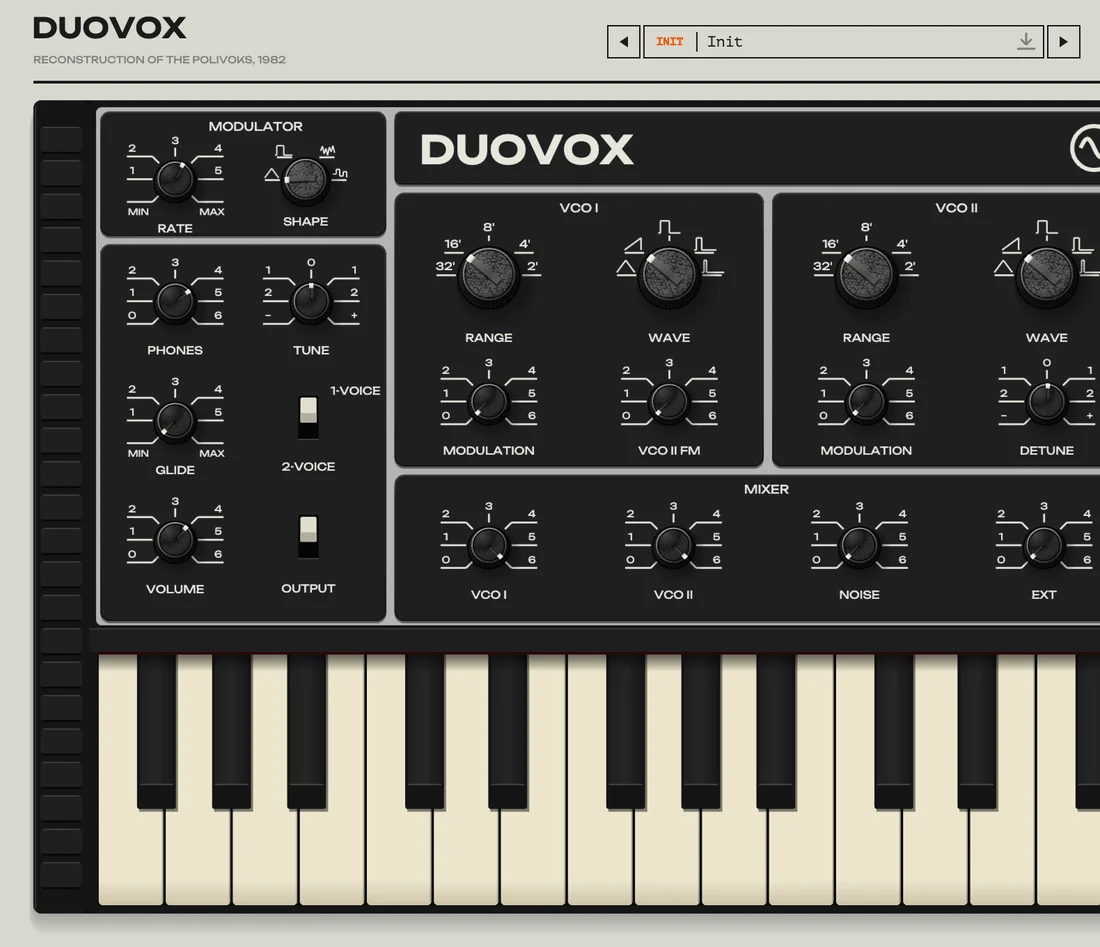
- The full Polyvox panel, control for control, with the scream, the looping envelopes and duophony
- A 4x/8x oversampled model of the two-chip filter, calibrated on recordings of real units
- 257 presets in ten banks and five packs, and a GEN button for new basses, leads and screams
- Extras the 1982 box never had: poly mode, velocity, pitch bend, drift, a rear panel