The Polyvox (Polivoks, Поливокс) went into production at the Formanta plant in Kachkanar in 1982, the same year Roland launched the SH-101 and around the time Moog stopped making the Minimoog. Its designer, Vladimir Kuzmin, had seen the Western instruments on paper. He wrote that the sound of Moog synthesizers was his ideal, and that he still chose not to copy any of their circuits (Kuzmin's article). What he built ended up sounding different from all of them.
This page puts the Polyvox next to five monosynths a producer is likely to know: the Minimoog Model D, the Korg MS-20, the ARP Odyssey, the Roland SH-101 and the Moog Prodigy. The specs come from Wikipedia, Vintage Synth Explorer, Sound On Sound and the designer's own article, linked in each section. The sound players are all Polyvox sounds played on our reconstruction, Duovox. We have no recordings of the other five synths, so there are no players for them and no claims about how they sound.
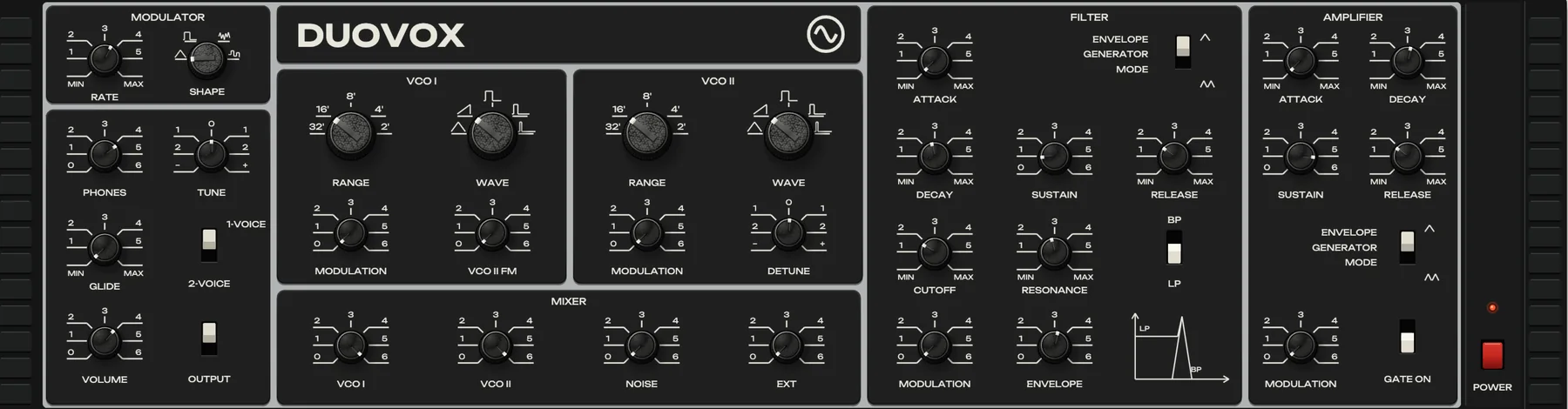 Looping envSquare LFOVCO II FM12 dB filterMixer drive
Six synths in one table
| Polyvox | Minimoog Model D | Korg MS-20 | ARP Odyssey | Roland SH-101 | Moog Prodigy | |
|---|---|---|---|---|---|---|
| Made | 1982 to about 1990 | 1970 to 1981 | 1978 to 1983 | 1972 to 1981 | 1982 to 1986 | 1979 to 1984 |
| Price new | 920 rubles | US$1,595 (1974) | US$750 | Not sourced | US$495 / £249 | £295 (UK) |
| Oscillators | 2, five waves each, 32' to 2' | 3 (the third doubles as LFO) | 2 | 2, with sync and PWM | 1, saw + pulse + sub | 2, with sync |
| Cross-mod | VCO II into VCO I pitch (exponential) | Osc 3 as LFO | Not in our sources | Sync, ring mod | Not in our sources | Sync |
| Voices | Duophonic | Mono, low note | Mono | Duophonic | Mono | Mono |
| Filter | 12 dB/oct LP or BP, two op-amp integrators | 24 dB/oct transistor ladder LP | 12 dB/oct LP + HP in series, self-resonant | Mk I 12 dB/oct; later 24 dB/oct | 24 dB/oct LP (IR3109) | 24 dB/oct ladder LP |
| Envelopes | 2 ADSR, each can loop | 2 ADS(D) | 2 | ADSR + AR | 1 ADSR | 2 ADS |
| LFO | Tri, square (up only), noise, S&H | Osc 3 | S&H | With S&H | Tri, square, random, noise | Tri, square |
| External audio in | Yes (ВНЕШ.) | Yes | Yes, with envelope follower | Not in our sources | Not in our sources | Not in our sources |
| Units made | About 25,000 (designer's figure) | 12,000+ | Not sourced | Not sourced | Not sourced | About 11,000 |
Sources: SOS 2010 and RBMA 2016 for the Polyvox; Wikipedia's articles on the Minimoog, MS-20, Odyssey, SH-101 and Prodigy, plus Vintage Synth Explorer. The Polyvox unit count is disputed: Kuzmin told RBMA 25,000 and other sources give anything from 20,000 to 100,000. The Minimoog end year is also given as 1982 in some sources.
The synth Kuzmin had in mind
The Model D is the reference most people carry around for "analog monosynth": three oscillators, a 24 dB per octave transistor ladder and two contour generators, at US$1,595 in 1974. Kuzmin studied a hand-copied Minimoog schematic and a Moog filter while designing the Polyvox. He then went his own way, citing the need for a design that was clean of foreign patents, and he picked a 12 dB per octave filter on purpose, writing that the difference in slope is barely audible, especially with resonance (Kuzmin's article).
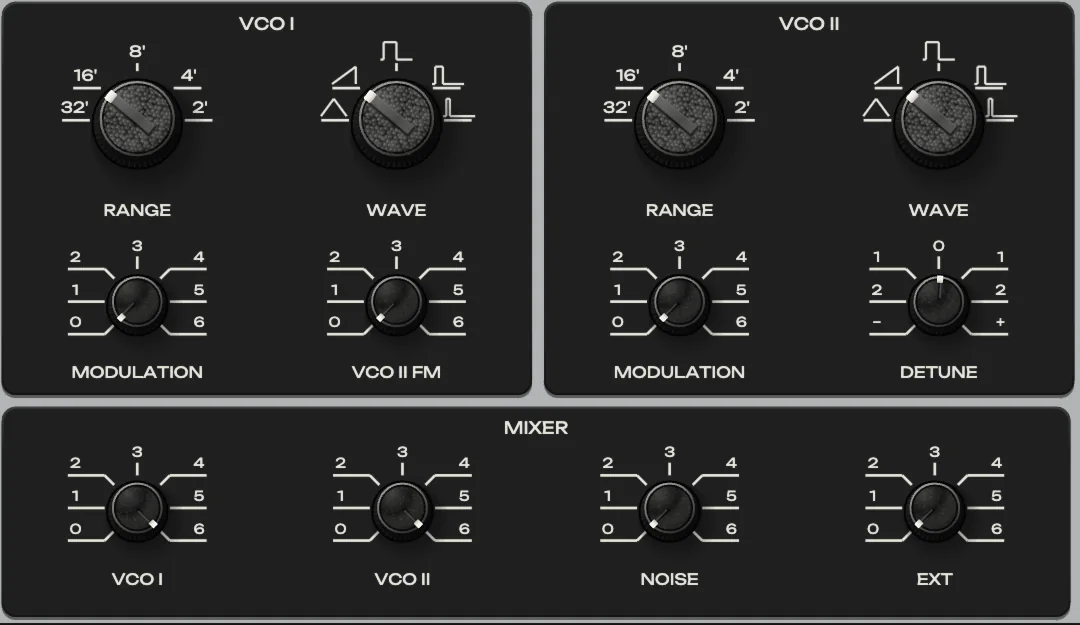
The difference that matters more is how the filter distorts. The Polyvox mixer is a unity-gain summer with no limiting, and the filter behind it is built from two К140УД12 op-amps running as integrators, with their inputs behind a divider that overloads at a few volts. Two oscillators at full level drive those integrators into saturation inside the filter loop. The player keeps resonance at 5.1 and only changes how hard the mixer hits the filter.
 VCO II FM66
On these level-matched clips the spectral centre falls from about 2,490 Hz at mixer 1.5 to 1,960 Hz at mixer 6. As the input gets hotter, the bright ringing of the resonance gives way to a thicker, denser bass. The Harvestman's manual for its Polyvox filter module describes the same thing: there is a sweet spot of input level, and above it the self-oscillation disappears (Harvestman manual).
Where the Minimoog wins: Gordon Reid's 2010 review says plainly that the Polyvox is weak at brass and at the creamy leads the Minimoog is known for (SOS). The Model D also has a third oscillator, which the Polyvox does not.
The other 12 dB screamer
The MS-20 (1978 to 1983, US$750) is the closest relative in filter slope: its low-pass is 12 dB per octave, and it sits in series with a self-resonant high-pass. Sources disagree on whether the high-pass is 6 or 12 dB. Early units used the Korg-35 chip and later ones an LM13600, which Wikipedia describes as less aggressive. The MS-20 also has a patch panel and an external signal processor with an envelope follower, built for running other instruments through it.
The Polyvox has an external input too, on the fourth mixer knob, ВНЕШ. On the hardware that is a real audio input. Duovox, as a plug-in instrument, has no audio input: its ВНЕШ. knob loops Duovox's own output back into the mixer. If you mainly want to process other sounds through a filter of this kind, an MS-20 (or a Polyvox filter as an effect) does a job Duovox doesn't.
What the Polyvox has and the MS-20 doesn't: a second voice and a band-pass mode on the main filter. The band-pass is 6 dB per side, two integrators tapped at a different point.
The only other duophonic
The Odyssey (1972 to 1981) is the one synth on this list that shares the Polyvox's two-voice idea. Both split two held keys across two oscillators and send them through one filter, and the first Odyssey filter, the ARP 4023, was also 2-pole at 12 dB per octave. ARP moved to 4-pole filters on the Mk II and Mk III (Wikipedia). The Odyssey has oscillator sync, pulse width modulation and a ring modulator. The Polyvox has none of those.
On the Polyvox, VCO I takes the highest held key and VCO II the lowest, and glide works on VCO I only in 2-voice mode (SOS). Hold a bass note, play a melody on top, and turn glide up: the top voice slides between notes while the bottom one holds still.
Cherry Audio's Atomika guide calls the Polyvox's note assignment inconsistent, and it is: release the upper key and that oscillator drops onto the lower note, and both voices share one pair of envelopes. Duovox keeps that behaviour on the front panel and offers a clean 2 to 8 voice poly mode on its rear panel for when you want chords.
Same year, opposite idea
The SH-101 arrived in November 1982 at US$495: one oscillator with saw, pulse with PWM and a sub-oscillator, a 24 dB per octave filter on Roland's IR3109 chip, one ADSR, and an arpeggiator and 100-step sequencer built in (Wikipedia; Electric Druid on the IR3109). Its rhythm comes from that sequencer.
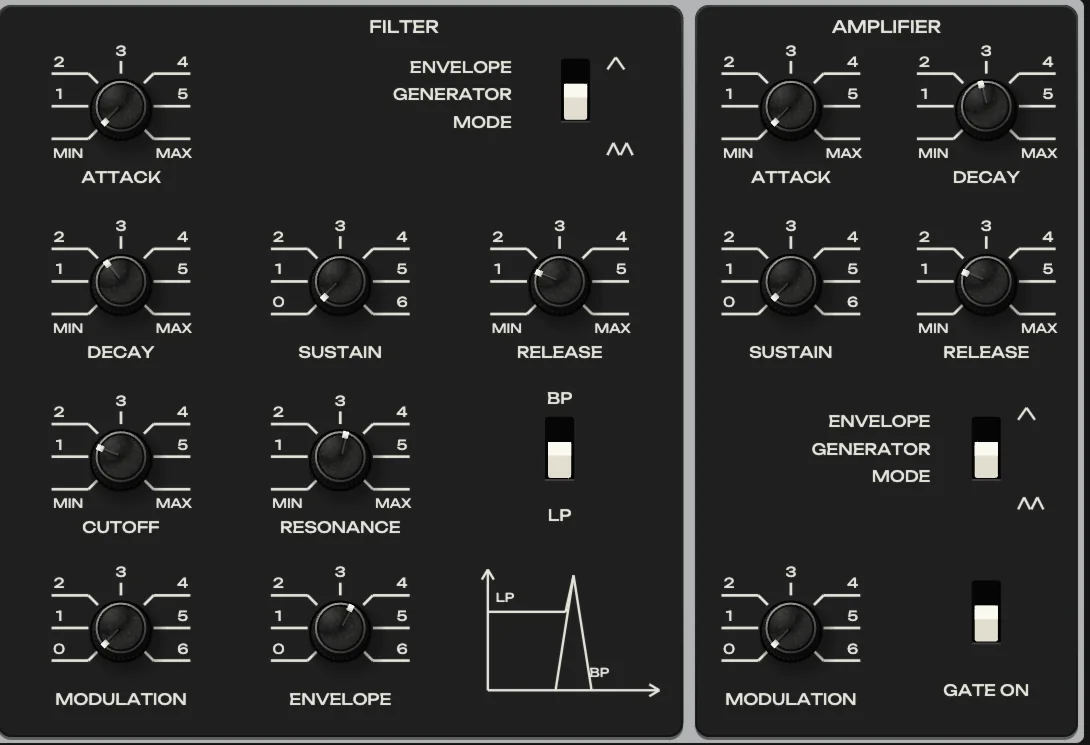
The Polyvox has no sequencer, no arpeggiator and no memory. Its rhythm comes from the envelopes. Each of the two envelopes has a switch that makes it repeat attack and decay for as long as the gate is open, when sustain is at 0. Give the filter and the amplifier different times and one held key plays two rhythms against each other. None of the specs we cite above for the other five synths lists a looping envelope.
 LoopDecay 2.7Decay 2.2Loop
With both envelopes in one-shot mode each note is a single pluck that settles. Looping the filter envelope turns it into a pulse (the average spectral centre rises by about 70 percent, from about 950 Hz to 1,620 Hz). Looping the amplifier too chops the sound into separate hits, which is why that clip is quieter on average: there are gaps between the hits. The ВКЛ. switch on the amplifier plate holds the gate open with no key pressed, so a looping patch can run on its own.
Sync vs exponential FM
The Prodigy (1979 to 1984, £295 in the UK, about 11,000 made) was Moog's budget two-oscillator mono, with oscillator sync and a 24 dB ladder (Wikipedia; Vintage Synth Explorer). Sync is the classic way to get a tearing lead out of two oscillators.
The Polyvox has no sync. Its cross-modulation is one knob on the VCO I plate, VCO II FM, which feeds VCO II's audio into VCO I's exponential pitch input. Kuzmin wrote that it gives effects like a ring modulator. Duovox models it as exponential FM, as the circuit suggests.
The carrier here is a plain triangle, so you can hear the sidebands arrive. The spectral centre climbs from about 360 Hz at 0 to 580 Hz at 3.7 and 1,120 Hz at 6, and the clip moves from a soft lead to a bell and then to a metallic clang. Because the modulation is exponential, it also pulls the average pitch upward, so at high settings the notes drift sharp and lose their centre. That is part of the sound.
A square wave that only goes up
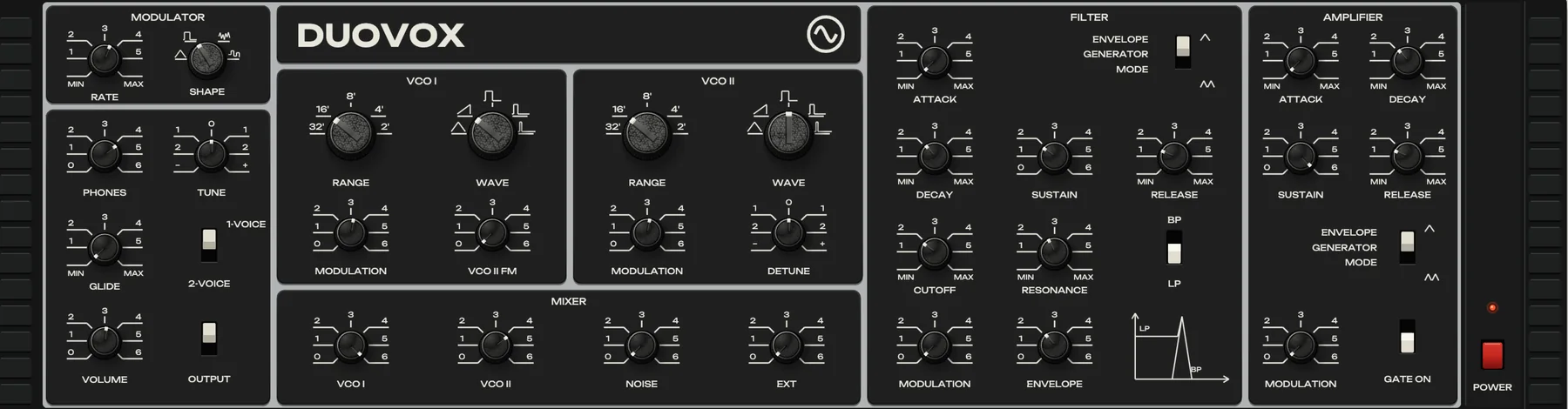
The Polyvox's modulator has four shapes: triangle, square, noise and sample-and-hold. On the square the modulation is one-sided: the pitch jumps from the played note upward and back, so the note you play stays the bottom of the trill. That is how the original's "trill" works, and it is the only repeat function on the instrument besides the looping envelopes.
 SquareRate3.23.2
On this preset the modulation depth is 3.2 on both generators, which works out to seven semitones: with the triangle the pitch swings about that far above and below the note, and with the square it jumps a fifth up and back. We checked it on a probe render with the filter open: on the square the measured pitch sat between the played note and 6.99 semitones above it, and never below.
What the Polyvox does worse
Reid's list, from the 2010 review: a poor keyboard, no modulation wheel, a flimsy case, scratchy pots, drift, and weak brass and creamy leads. The keyboard has 48 keys with no velocity. There is no pulse width modulation, no sync and no third oscillator. If your track needs a smooth, round lead, the Minimoog and the Prodigy are better at it, and the SH-101 is a better fit for a sequenced line you program once and leave running.
What you get in exchange is a bass that arrives pre-distorted, a resonance that screams and then limits itself, rhythm from one held key, and two-voice lines through one filter. Those are hard to get from the five synths above without extra gear.
Playing one today
An original Polyvox is a used 1980s instrument that was never sold outside the USSR, and we cover what owning one involves in should you buy a real Polyvox. Duovox puts the 1982 front panel in your DAW, with the duophonic switch, the looping envelopes, the unipolar square trill and the VCO II FM where they were, and a rear panel for velocity, poly mode and the rest. It is $29 at launch and $59 after, for macOS (VST3, AU) and Windows (VST3), and the demo plays everything.
If you are choosing between plug-ins, the emulations comparison covers every one we could find.
Product names are trademarks of their owners; mentioned for comparison only.
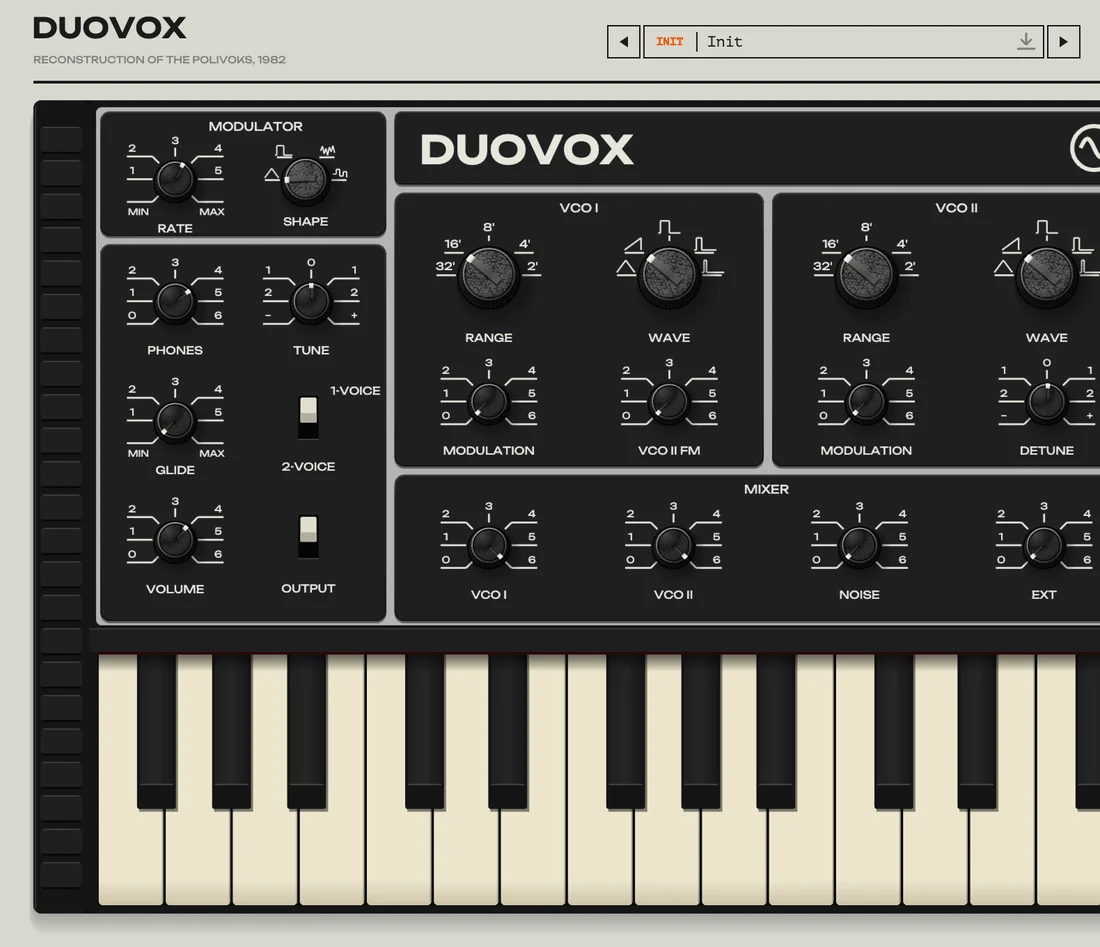
- The full Polyvox panel, control for control, with the scream, the looping envelopes and duophony
- A 4x/8x oversampled model of the two-chip filter, calibrated on recordings of real units
- 257 presets in ten banks and five packs, and a GEN button for new basses, leads and screams
- Extras the 1982 box never had: poly mode, velocity, pitch bend, drift, a rear panel