Coldwave, post-punk and early synth-pop were built on cheap gear played straight: a drum machine, a bass in eighth notes, a thin lead over the top. The Polyvox (Polivoks, Поливокс) was the cheap gear on the Soviet side. It cost 920 rubles, it was sold in shops, and by its designer's own count about 25,000 were made between 1982 and 1990.
This page is what is documented about that pop past, then the practical part: the bass, the pads, the lead and the drums from Duovox, our reconstruction of the instrument. All players are unprocessed renders of factory presets.
Why a Soviet synth fits
Vladimir Kuzmin told Red Bull Music Academy in 2016 that the factory made about 25,000 and that the price was high but within reach of cultural organisations. It was never sold outside the USSR, so the people who played it in the 1980s were Soviet bands, studios and clubs.
Who used it is less well documented than the internet suggests. Here is what has a source, and how good the source is.
- Goldfrapp (Will Gregory) ABlack Cherry (2003). Gregory told Sound On Sound about a Russian synth he found in East Germany and called a "Polyvox", "a bit of a beast". The article credits it with the submarine-like bass on the title track and the metallic growl on "Train".SOS 2003 ↗
- Franz Ferdinand BTonight: Franz Ferdinand (2009). Paste, citing Billboard, reported the band recording with a collection of Russian Polyvox synthesizers; MusicTech later wrote that it was used throughout the record. Kuzmin names the band in his own article. Which tracks, and who played it, is not documented.Paste ↗ MusicTech ↗
- Агата Кристи CThe Sverdlovsk band's early records. Russian sources list them among the first users, but we found no quote from a band member.Synthtopia ↗
- Биоконструктор CThe Moscow electronic group's 1987 album «Танцы по видео», listed in the Russian Wikipedia article without a citation.Wikipedia (RU) ↗
A is the artist's own words, B the press or the designer, C a list without a primary source. We did not find a documented case of a current coldwave or sovietwave act using one, so we do not claim any. The fit is in the sound: the low-pass filter is 12 dB per octave, so a closed filter still lets plenty of buzz through, and the two oscillators detune against each other into the slightly sour width these styles like. More on the Soviet side in the Soviet underground.
Eighth notes that stay apart
A post-punk bass plays straight eighths for bars at a time, so every note has to start clean and stop before the next. Eighth Note Bass does it with a saw and a pulse at 16', a short filter pluck and a low amp sustain (about 2 on the panel).
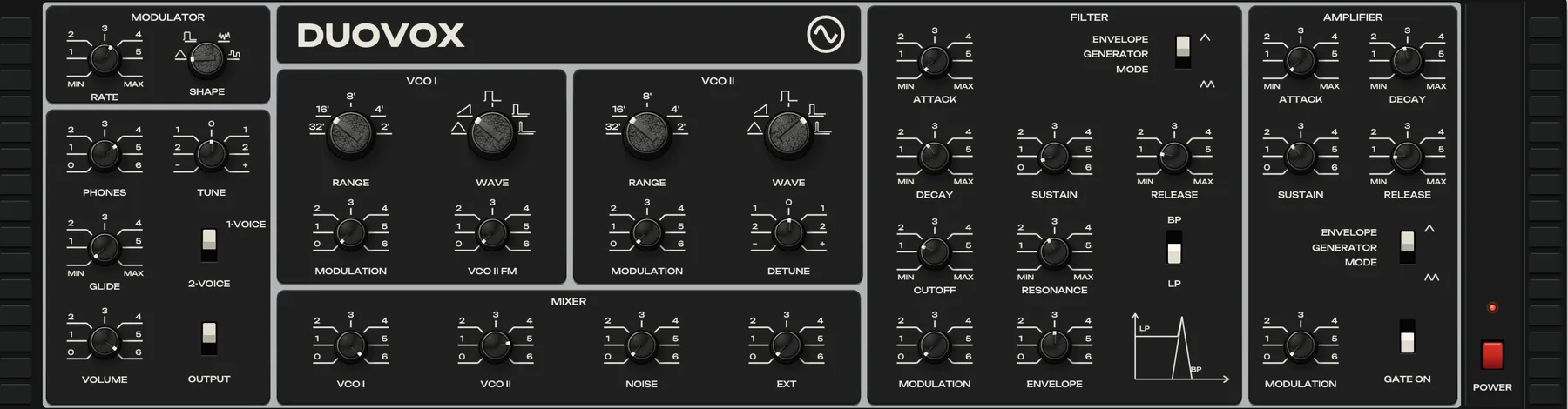 SawPulseSustainCutoffEnvelope
The five are close relatives with different jobs. Cold Chorus Bass holds its notes with two saws a few cents apart: the most even level of the five (5 dB between peak and average, against 10 to 14 dB for the others) and the darkest, so it sits under a drum machine without moving. Italo Pulse Bass swaps the saws for two pulses with a short decay, the running bass of italo disco. EBM Drive Bass is two saws at full filter drive with no sustain at all, for sequenced 8ths or 16ths. Night Tram Bass is the odd one, and the next player shows why.
Eighth Note Bass also has velocity to filter at 40 % on the rear panel. Program an accent on every other note, or on the first of each bar, and those notes open the filter a little further, which gives a straight line the push of a picked bass without a compressor.
Band-pass: a bass above the kick
The filter has two modes, low-pass and band-pass, on a lever switch. Night Tram Bass uses band-pass, which removes the bottom octave along with the top. On these clips the share of energy below 200 Hz drops from about 70 % in low-pass to about 11 % in band-pass, and the bass gets about 9 dB quieter. What is left is the nasal, rattling middle that sits above a kick and a sub instead of on top of them.
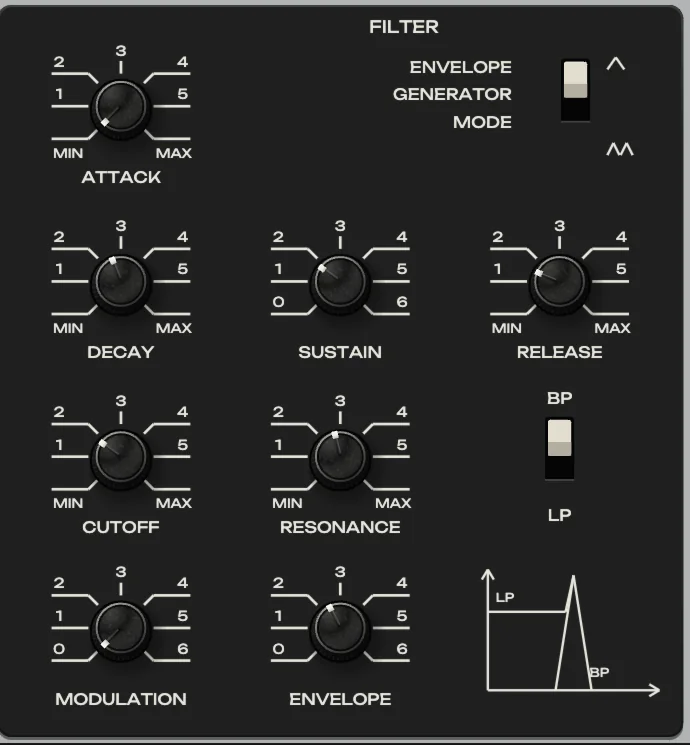 BPCutoffResonance
Cold pads in poly mode
The 1982 instrument could not play a chord: two oscillators, one filter, one amplifier, at most two notes. Duovox keeps that on the front panel and puts a poly mode on the rear panel, with 2 to 8 voices, each a full copy of the instrument with its own filter and envelopes.

Frozen Pad is detuned saws with a slow attack and a long release. Winter Courtyard is darker, a saw and a pulse an octave apart with a light pitch wobble from the modulator, like a worn tape. Anthem Brass swells in with the filter opening, the big chord of a sovietwave chorus and the brightest of the four. Satellite Keys is a triangle and a square with a decaying amp, closer to an electric piano. Each voice is still two oscillators into a 12 dB filter, so these are plain pads; they leave room for a vocal and a reverb, which is what these styles want.
To stay with the 1982 behaviour, switch poly off and set the front panel to 2-voice. Two held keys then sound, the highest and the lowest, on the two oscillators through one filter. That is how the original played an interval, and for a fifth or an octave droning under a vocal it is enough.
The rear panel's STEREO knob pans the poly voices alternately left and right. Play it on headphones.
At 0 % the pad is mono. At 40 % the side signal sits about 16 dB under the middle, at 80 % (the preset) about 9 dB under. That is width from the voices themselves, before any chorus.
A lonely square
The coldwave top line is usually one plain voice played slowly. Lonely Square is two squares at 8', a triangle from the modulator into both pitches (around 4 to 5 Hz, a light vibrato), and a little glide so legato notes slide.
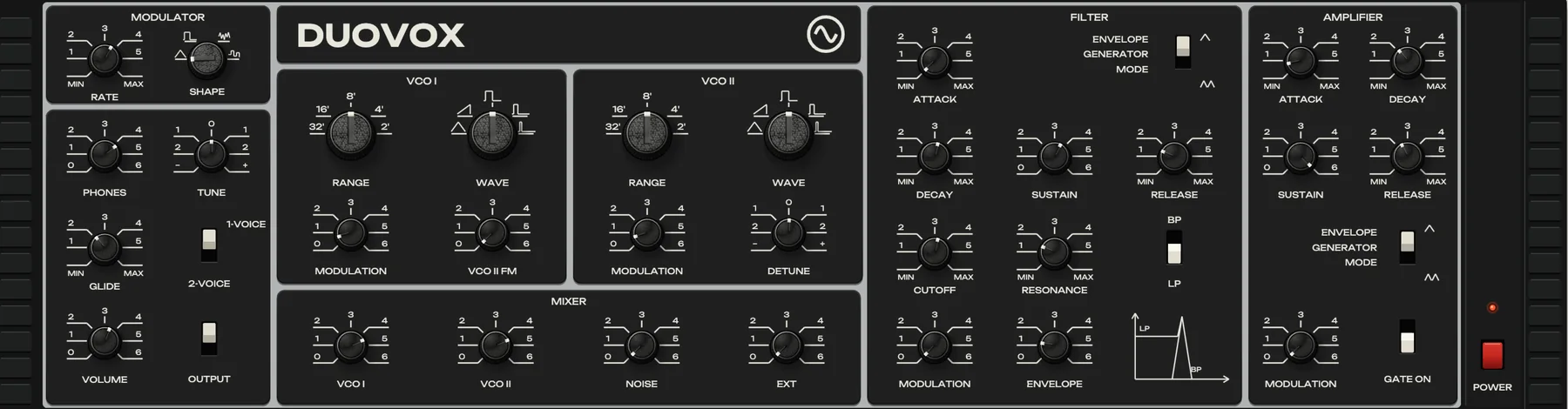 RateSquareSquareVibratoGlide
Broadcast Lead adds a saw at 4' over the square, which moves it up and brightens it (its spectral centre is about 1.7 kHz against 1.4 kHz). The square in both runs at 45 % duty, the width we measured on original units, slightly off a perfect 50.
A drum-machine kit from one synth
The Polyvox has no drum section, and the factory passport already listed effects like gunfire and rain, made from the noise generator and the envelopes. The same tricks make a kit. Cold Boom Kick runs a triangle into a filter with resonance near the top, and a fast filter envelope slams it shut, so each hit is a short resonant thump; about 70 % of its energy sits below 200 Hz. Play it on the low keys.
Machine Snare is noise at full level with a triangle body under it, through the band-pass filter, with no sustain. About a third of its energy is above 1.5 kHz, against about 1 % below 200 Hz.
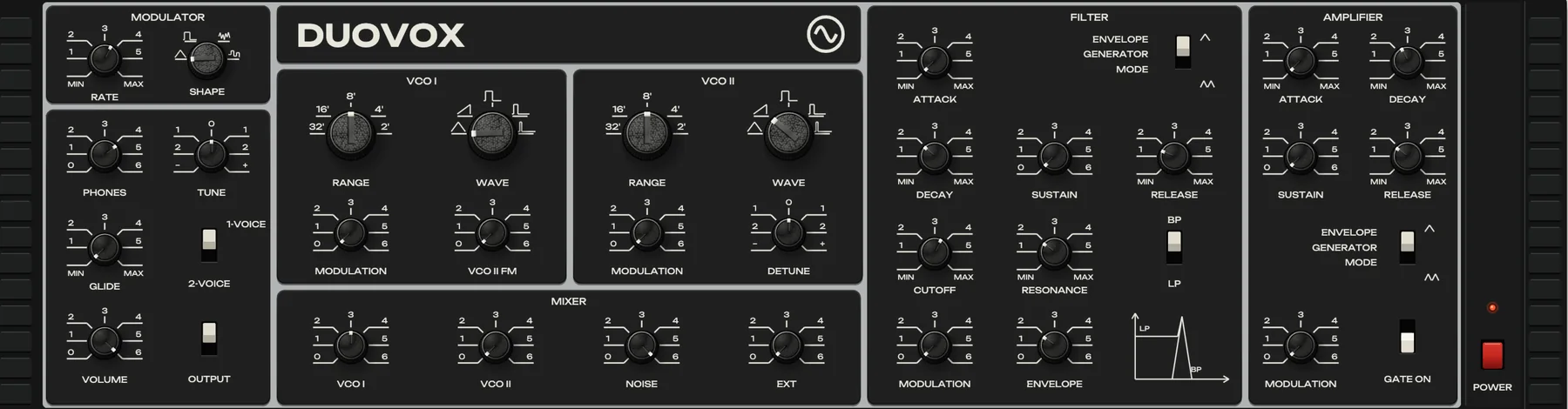 Sustain 0BPTriangle 3Noise 6
You need two instances (or one, playing kick and snare in separate passes), since a single Duovox plays one patch. The COLDWAVE PACK also has a tom and a hat (Synth Tom, Tin Hat), and the DRUMS bank has eight more, from Kick 1982 to Cowbell 82. The drums tutorial builds them from Init.
Italo, EBM and GEN
The DANCE PACK covers the brighter end: Italo Pulse Bass and EBM Drive Bass above, plus an Italo Lead, a Synth-Pop Pulse and rave stabs. When none of the presets fits, the GEN button in the header has Coldwave and Sovietwave modes. Each click builds a new patch in that style (a cold bass, a band-pass pad, a soft triangle lead) and levels it like the factory bank; undo takes it back.
If you want the full story of the panel and the price, see why Duovox. For the heavier end of the same circuit, see the Polyvox in metal and industrial.
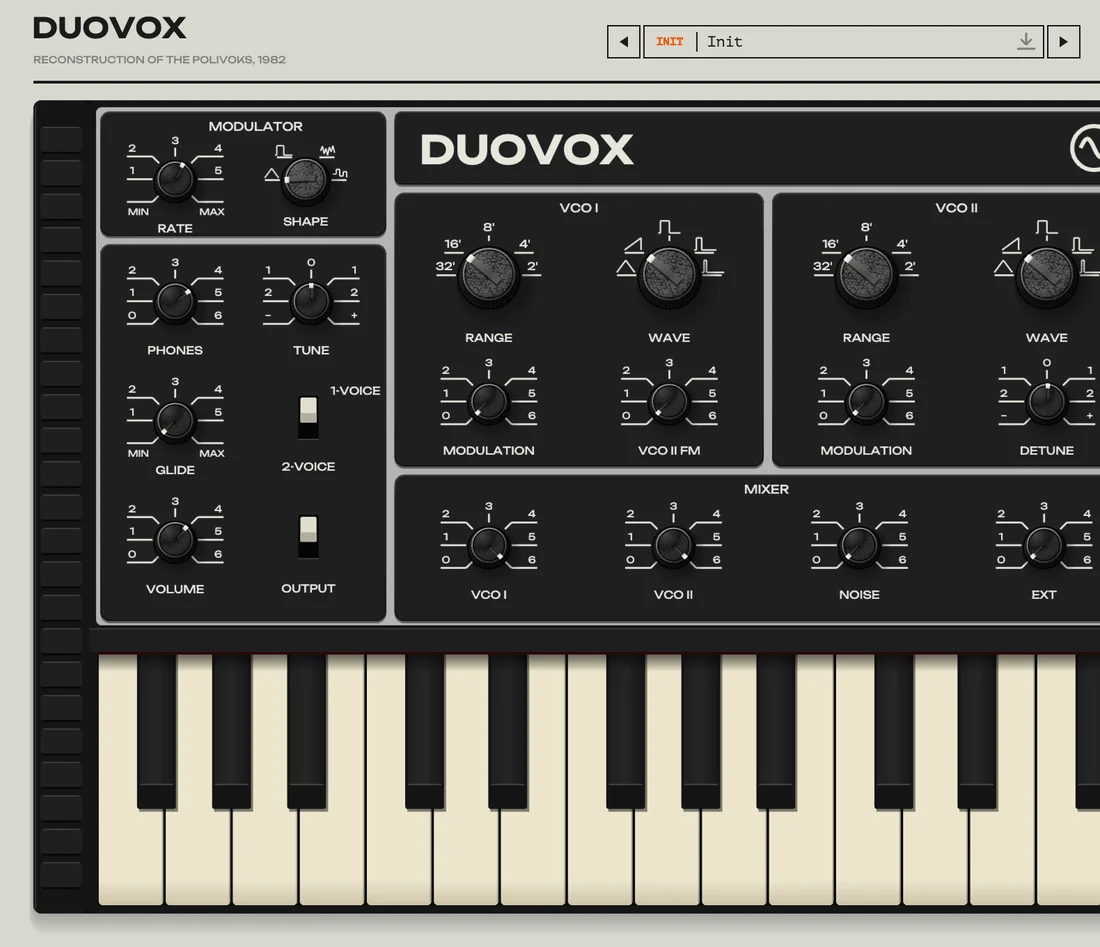
- The full Polyvox panel, control for control, with the scream, the looping envelopes and duophony
- A 4x/8x oversampled model of the two-chip filter, calibrated on recordings of real units
- 257 presets in ten banks and five packs, and a GEN button for new basses, leads and screams
- Extras the 1982 box never had: poly mode, velocity, pitch bend, drift, a rear panel