In the West the Polyvox (Polivoks, Поливокс) is a rare import with a story attached. At home it was a domestic product: designed by a defence enterprise in Sverdlovsk, assembled in a small town in the Urals, sold in shops for 920 rubles, roughly 25,000 of them between 1982 and the end of the Soviet Union.
This article sticks to what can be sourced. The hardware facts come mostly from the designer, Vladimir Kuzmin (Владимир Кузьмин), in his own long article and his interviews. The band stories are much thinner, and each one carries a grade: A the artist says it, B reputable press or Kuzmin says it, C only uncited Wikipedia, lists or social posts. Every Soviet band below is grade C. The players are our own patches in Duovox, in the territory of Soviet new wave, synth-pop and post-punk. None of them is a recreation of a record.
Designed at Vector, in Sverdlovsk
Kuzmin was born in October 1953 in Vladivostok and died on 12 June 2026, aged 72. He designed the Polyvox at Вектор (Vector), an enterprise in Sverdlovsk (now Yekaterinburg) that the Red Bull Music Academy interview calls a former war factory. Sound On Sound credits Olimpiada Kuzmina (Олимпиада Кузьмина) with the panel and industrial design and Yuri Feofilov (Юрий Феофилов) with hardware; a 2017 Habr article also names Igor Fedoseev and Yuri Zapalov.
Kuzmin's article, «"Поливокс": как создавался "советский военный синтезатор"» ("Polyvox: how the 'Soviet military synthesizer' was made"), is the best single source on the design. He writes that he studied a hand-copied Minimoog schematic and a Moog filter, that the sound of Moog synthesizers was the ideal, and that he deliberately did not copy either. The filter he built instead, a 12 dB state-variable design on two К140УД12 op-amps, is a large part of why the instrument sounds the way it does.
- Vladimir Kuzmin BHis own article on the design, in Russian, with the letters from Rick Wakeman and Bob Moog reprinted at the end.ProSound / iXBT ↗
- Red Bull Music Academy, 2016 BInterview with Kuzmin: birth year and place, units made, price, never sold outside the USSR.RBMA ↗
- Obituaries, June 2026 BDate of death and age.Fontanka (ru) ↗Synth Anatomy ↗
Built at Formanta, in Kachkanar
Production went to the radio plant «Форманта» (Formanta) in Kachkanar (Качканар), a town in Sverdlovsk oblast. Kuzmin writes that the plant had been built to give the town's women work, and that the assembly and tuning staff were almost all women. Some Western sites put the factory in Kurgan or Perm; the sources do not support that.
What came off the line was a heavy black tub, 780 × 490 × 195 mm with the lid on, and the lid doubled as the transport case. Each section of the panel sits on its own plastic plate, which Kuzmin describes as a deliberate choice: one plate per module. The ribbed plastic side cheeks are where the "military" nickname comes from. Kuzmin explains that the team picked the military style because it was fashionable, and that the cheeks look like tank tracks. He also tells of a security clerk who flagged the word «Атака» (attack) on the envelope controls as suspicious.
Kuzmin's article gives the peak rate as 200 to 300 instruments a month. A few dozen of the 1982 units had fluorescent paint on the knob pointers, according to Habr. The instrument won a bronze medal at ВДНХ (VDNKh), the national exhibition of economic achievements in Moscow, and the lead developers received an industrial-design certificate.
ЭМС «Поливокс». Designed at Вектор, Sverdlovsk. Built at Форманта, Kachkanar. Duophonic, two generators, a 12 dB filter with low-pass and band-pass, two envelopes that can loop, a modulator, an input for an external signal. Retail price 920 rubles. Production about 25,000, 1982 to 1990 or 1991.
About 25,000 units at 920 rubles
The numbers people quote disagree, so here they are with where each comes from.
| Figure | Value | Source |
|---|---|---|
| Units made | 25,000 | Kuzmin to RBMA, 2016. The figure we use. |
| Units made | about 29,000 | Kuzmin, as quoted by Habr, 2017 |
| Units made | about 20,000 | Synthtopia, 2009 |
| Units made | about 100,000 | "Western sources", per Wikipedia. No primary source; we do not use it. |
| Price | 920 rubles | SOS 2010, RBMA, English Wikipedia. The figure we use. |
| Price | 800 or 600 rubles | MusicRadar (800), Synthtopia 2009 (600); Russian Wikipedia gives 800 to 920 |
| Years | 1982 to 1990 | Wikipedia, SOS, RBMA. Kuzmin's own article says up to 1991. |
The RBMA interview describes the price as high but affordable for cultural organizations, and says the instrument was never sold outside the USSR. That is the practical picture: a domestic synthesizer sold in shops, priced within reach of cultural organizations, made in the thousands and not exported.
A panel in Russian, and two voices
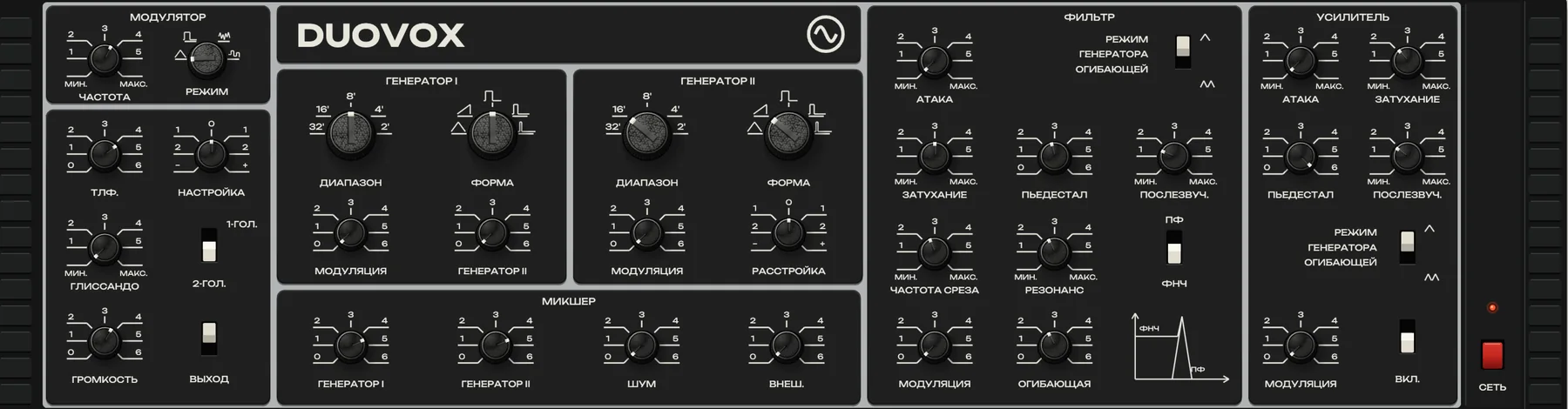
The panel was printed in Russian, and Duovox can print it the same way. The АБВ / ABC button in the header switches the lettering; the screenshots on this page use the Cyrillic version. The table gives the main labels as Duovox prints them and what they mean.

| Label | Transliteration | Meaning |
|---|---|---|
| ГЕНЕРАТОР I / II | generator | VCO I / VCO II |
| ДИАПАЗОН · ФОРМА | diapazon · forma | Range (32' to 2') · wave |
| РАССТРОЙКА | rasstroyka | Detune (VCO II) |
| МИКШЕР · ШУМ · ВНЕШ. | miksher · shum · vnesh. | Mixer · noise · external input |
| ФИЛЬТР · ФНЧ · ПФ | filtr · FNCh · PF | Filter · low-pass · band-pass |
| ЧАСТОТА СРЕЗА · РЕЗОНАНС | chastota sreza · rezonans | Cutoff · resonance |
| ОГИБАЮЩАЯ | ogibayushchaya | Envelope (amount) |
| АТАКА · ЗАТУХАНИЕ · ПЬЕДЕСТАЛ · ПОСЛЕЗВУЧ. | ataka · zatukhaniye · p'yedestal · poslezvuch. | Attack · decay · sustain · release |
| УСИЛИТЕЛЬ | usilitel' | Amplifier |
| МОДУЛЯТОР · ЧАСТОТА · РЕЖИМ | modulyator · chastota · rezhim | LFO · rate · shape |
| ГЛИССАНДО · 1-ГОЛ. / 2-ГОЛ. | glissando · 1-gol. / 2-gol. | Glide · one voice / two voices |
| ВКЛ. · ВЫХОД · СЕТЬ | vkl. · vykhod · set' | Gate on (hold) · output · power |
The 2-ГОЛ. position is what set the Polyvox apart from most synths of its price: two voices from one keyboard. Per SOS, the upper key goes to the first generator and the lower key to the second, and both share one filter and one amplifier. The CLASSIC bank in Duovox has a preset built around that, Two-Hand Duet: the left hand plays a bass on VCO II at 16', the right a tune on VCO I at 8'.
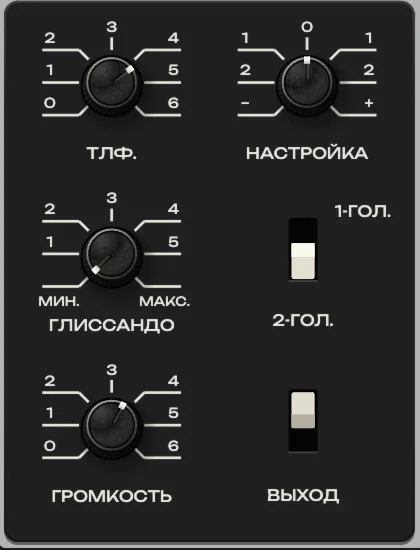 2-ГОЛ.
In 1-voice mode the lowest key wins, so the tune disappears: 53 % of the energy in that clip is below 200 Hz. Switch to 2-voice and it falls to about a fifth, because the right hand is back.
The rest of the CLASSIC bank stays within what a 1980s owner could set on the panel. Manual Fig. 1 is the one setting the factory manual drew: one saw at 32', the filter wide open, an organ-style envelope.
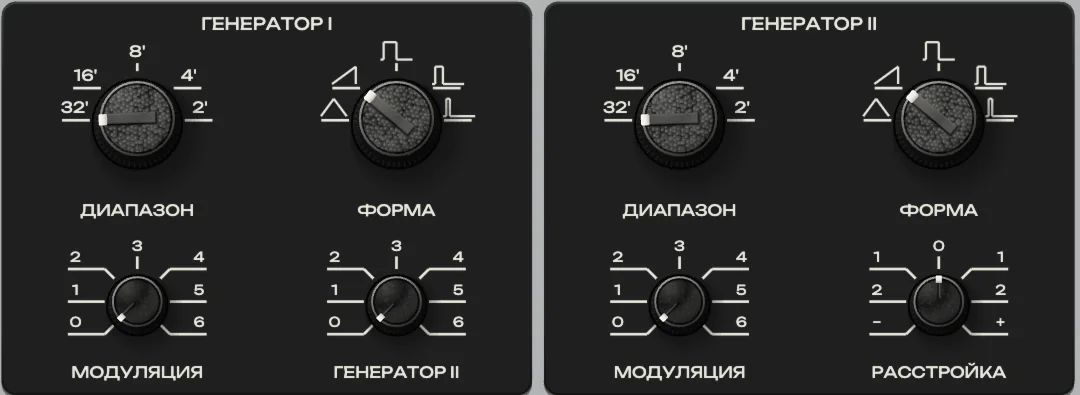 32'Пила / saw
Gordon Reid's 2010 review in SOS is frank about the weak points of the hardware: a poor keyboard, no mod wheel, a flimsy case, scratchy pots, drift, and not much use for brass or creamy leads.
The Soviet bands: reported, not confirmed
Here the sources get thin. Every name below comes from Russian Wikipedia, from lists published after Kuzmin's death in June 2026, or from a single older article. We found no interview in which a band member says they played a Polyvox on a named record. That does not make the stories false. It makes them reported.
- Агата Кристи (Agata Kristi) CA Sverdlovsk band, from the city where the instrument was designed. A 2026 Rossiyskaya Gazeta piece (via mail.ru) says their early songs used it and points to the hit «Сказочная тайга» (Skazochnaya tayga) as built on a synth riff. Synthtopia (2009) says they were among the first to appreciate it. No band member quote found.RG / mail.ru (ru) ↗Synthtopia ↗
- Биоконструктор (Biokonstruktor) CRussian Wikipedia links them to the album «Танцы по видео» (Tantsy po video, 1987), without a citation. The 2026 RG list says they used the instrument best of all. No primary source.ru.wikipedia ↗RG / mail.ru (ru) ↗
- Кооператив Ништяк (Kooperativ Nishtyak) CListed on Russian Wikipedia without a citation, and in the 2026 RG list.ru.wikipedia ↗
- Фряновское шоссе (Fryanovskoye Shosse) CListed on Russian Wikipedia, which cites only the band's own Facebook page.Band page ↗
Some names you may have seen are missing on purpose. For Кино (Kino), Наутилус Помпилиус (Nautilus Pompilius), Браво (Bravo), Альянс (Alyans) and Зодчие (Zodchiye) we found nothing that ties them to the Polyvox. Our searches were weaker on Russian-language sources than on English ones, so if you have an interview or a credit, we would like to see it. The Western names, from Mick Gordon to Franz Ferdinand, are sorted the same way in who used the Polyvox.
Patches in the territory of Soviet new wave, synth-pop and post-punk
We cannot play you the records here, and we would not pretend a preset is one of them. What we can do is show the kinds of parts this instrument is good at in that music, using the COLDWAVE pack, which was written for it.
The eighth-note bass
A bass that plays every eighth note on one pitch is the engine of a lot of new wave. On the Polyvox the life in it comes from the filter envelope: each note opens the filter a little and closes again.
On these clips the spectral centroid moves from about 260 Hz with the envelope at 0 to about 1.6 kHz at 5.4, with the level nearly the same, while the share of energy below 200 Hz only drops from 93 % to 76 %. The bottom stays; the front of each note changes.
The band-pass bass
Post-punk often puts the bass above the kick drum instead of under it. The band-pass position on the filter (ПФ) does that by removing the bottom.
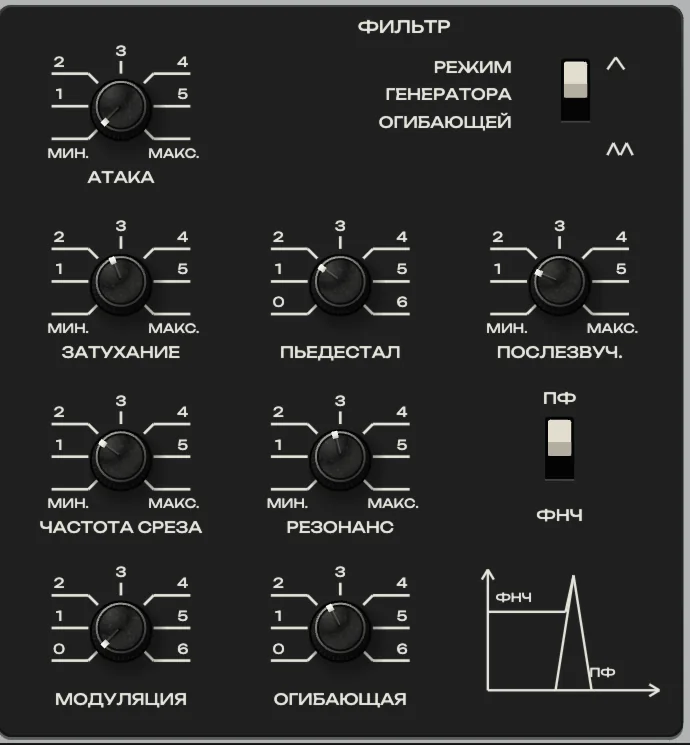 ПФ / BPСрезРезонанс
Measured: in low-pass, 71 % of the energy is below 200 Hz; in band-pass, 15 %. Unmatched, the band-pass version is about 9 dB quieter, which is worth knowing before you reach for the switch in a mix.
The thin lead
For synth-pop tunes we wrote square and narrow-pulse leads with a little vibrato. Reid is right that creamy leads are not this instrument's thing, so these four stay in a thinner, nasal area.
Chords, with a warning
The 1982 instrument plays at most two notes at once. Duovox adds a poly mode on its rear panel (2 to 8 voices), and the COLDWAVE pads use it. They are useful for sovietwave chords; they are also something the original could not do, so use them knowing that.
Duovox also has a GEN button with Coldwave and Sovietwave kinds, which builds a new patch in that style on each click. The history of the instrument after 1991, from the 2016 reissue to the Behringer and Elta projects, is in the Polyvox history.
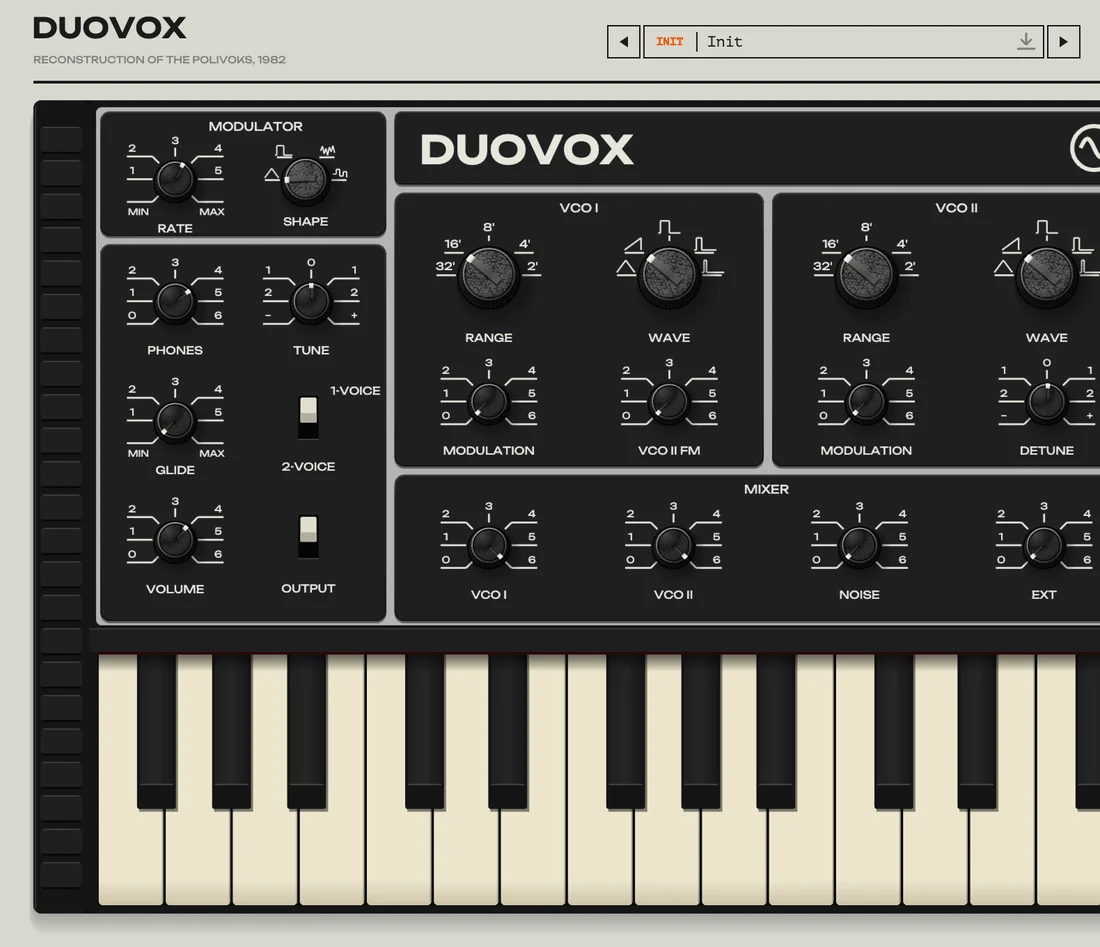
- The full Polyvox panel, control for control, with the scream, the looping envelopes and duophony
- A 4x/8x oversampled model of the two-chip filter, calibrated on recordings of real units
- 257 presets in ten banks and five packs, and a GEN button for new basses, leads and screams
- Extras the 1982 box never had: poly mode, velocity, pitch bend, drift, a rear panel