The Polyvox (Polivoks, Поливокс; also spelled Polyvoks and Polivox) is a duophonic analogue synthesizer built in the Soviet Union from 1982. Its designer, Vladimir Kuzmin, wrote the story of how it was made in an article for ProSound. Most of this page follows that article, and where other sources disagree with him we say so.
Kuzmin was born in Vladivostok in October 1953. He died on 12 June 2026, aged 72 (Synth Anatomy, Fontanka). The sounds on this page come from Duovox, our reconstruction of its panel.
An engineer who wanted a synthesizer
In 1980 Kuzmin had been at Vector, an enterprise in Sverdlovsk (now Yekaterinburg), for more than four years, and had already worked on its electronic instruments. Soviet musicians knew synthesizers from foreign records and touring bands. Outside Moscow, Leningrad and the Baltic capitals almost nobody could get one, so people wrote to the factories asking why industry did not make them, and some of those letters reached Vector.
His first idea was a small instrument with one oscillator in a little case with a lid. Then he decided that if the plant was going to make one, it should be as good as the foreign machines. Information was the problem. The team asked visiting bands to let them look at their Moogs, Korgs and Rolands, and took broken ones home to repair. A hand-copied Minimoog schematic turned up, but it was built on discrete transistors, and copying was ruled out anyway: Vector's patent office checked every circuit for patent clearance.
Any new product had to pass the ministry, a long list of approving bodies and a trial batch. Kuzmin led the development. Yuri Feofilov was the lead constructor, Kuzmin's wife Olimpiada Kuzmina the lead designer, and Igor Fedoseev joined later. The prototype was ready in 1980 and series production began in 1982.
Two К140УД12 chips and no capacitors
Kuzmin had built a Moog ladder filter as soon as the team got hold of its schematic, and liked it, but did not want to copy it. He settled on a state-variable filter instead: two integrators, a low-pass and a band-pass output, no trimming in production. He was not worried that it was 12 dB per octave rather than the Moog's 24, because in his experience the difference is hard to hear in practice, less so with resonance.
Western state-variable filters of the time used the CA3080, a transconductance amplifier the Soviet industry did not make. The nearest thing was the К140УД12, an op-amp whose supply current could be set by a control voltage, and Kuzmin first dismissed it. Going back through its full technical conditions, he noticed that the chip's open-loop cutoff frequency changes in proportion to the control current. An op-amp run open-loop with current control is already a tunable integrator. Two of them and a handful of resistors make the whole filter, with no capacitors at all, because the chip's own internal compensation does the integrating.
His colleague Igor Mironov, who ran the guitar-processor group, did not believe it. Kuzmin showed him a breadboard that swept across the audio range with adjustable resonance, and Mironov checked the wires and looked under the board for hidden capacitors. Kuzmin also wrote that the filter sounded a little harsh, especially in the low range, because the chip's output stage develops a step at small control currents. In 1982 that counted as a flaw. He thought the aggressive, fat sound modern musicians like owes a lot to it.
The filter in Duovox is a model of those two integrators: the input overload behind the chip's divider, the step in the output stage that grows as the cutoff goes down, and the resonance that compresses itself when the input is loud. The filter tutorial takes it apart knob by knob.
Why people call it the military synth
A four-octave keyboard leaves a small panel, too small for full labels, so the graphics went onto separate plastic plates, one per module, standing up from the frame. The electronics follow the same idea: every section on its own circuit board, easy to test on the line and to repair. The knobs were a custom design cast at the plant.
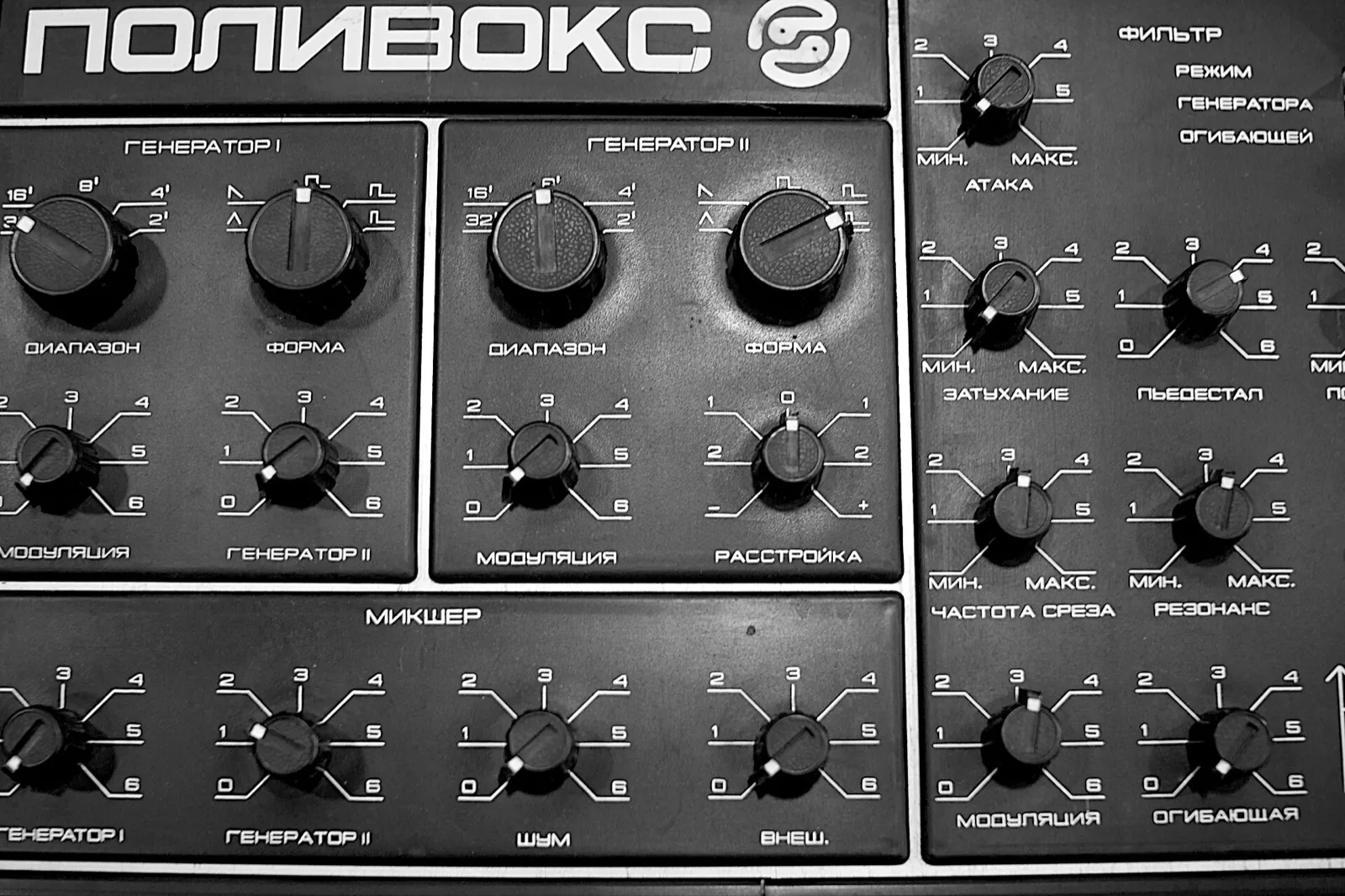
Then there are the side cheeks, thick black plastic with deep ribs. Kuzmin says they look like tank tracks, which is why the West calls the Polyvox the "Soviet military synthesizer". Military style was fashionable in Western design at the time and the team adopted it on purpose; Synth Anatomy credits Olimpiada Kuzmina with the look. Vector did defence work, and Kuzmin described it to Red Bull Music Academy as a war factory that decided to make instruments. The Polyvox was still a consumer product sold in ordinary shops. The line that it was "made and sold by the military" (Sound On Sound, 2003) takes the nickname literally.
The only security incident Kuzmin remembers is about a word. The artwork for the panel labels had to be signed off by the plant's security department, and the clerk there studied the unfamiliar names for a long time before pointing at «Атака» (attack) and asking what that was.
Kachkanar, 920 rubles, and a glowing batch
Series production went to the Formanta radio plant in Kachkanar, a mining town in Sverdlovsk oblast. Kuzmin explains that the plant was built to give the town's women work, since the men mostly worked at the ore combine, and the assembly and tuning lines were staffed almost entirely by women. He spent weeks there when the first units went down the line.
One complaint kept coming back: the synthesizers would not hold their tuning. The oscillators' exponential converter is kept heated to a fixed temperature. After a shop in Novgorod wrote about five units that would not stay in tune, Kuzmin, a tuner and a quality inspector were sent to find out why. The heater circuit had never been adjusted at the factory; its trimmers were all at one end of their travel.
Another story from the line ended better. The white dot on each knob was hand-filled with nitro paint. One evening, with the lights going off in the shop, Kuzmin saw dozens of finished instruments standing in a row with hundreds of green points glowing on their knobs: a worker sent to another shop for paint had been given a phosphorescent one. Nobody repainted them. A 2017 Habr article dates the batch to 1982 and puts it at a few dozen units.
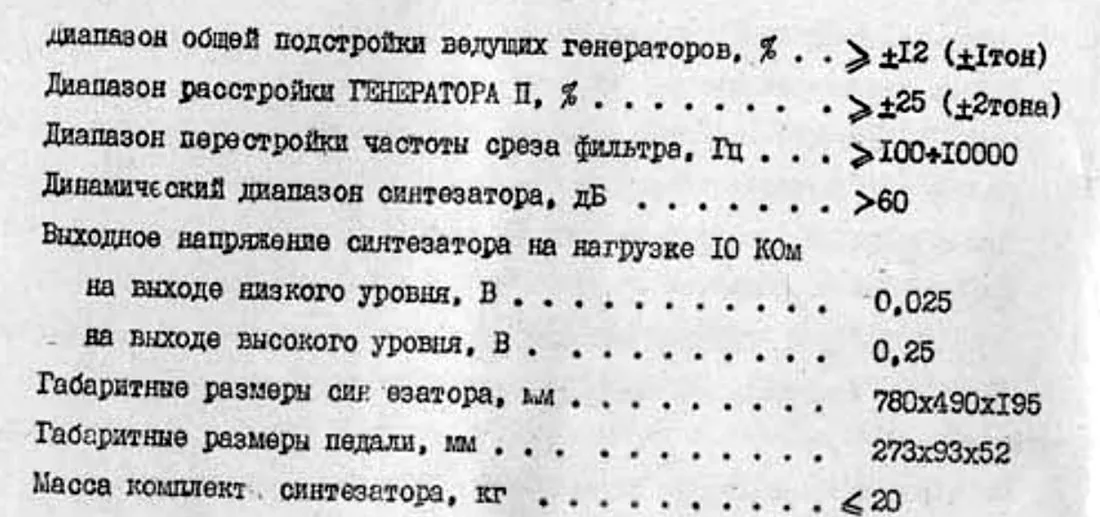
From the factory manual: master tune at least ±12 % (a whole tone either way), VCO II detune at least ±25 % (two whole tones), filter cutoff 100 to 10,000 Hz, dynamic range over 60 dB, dimensions 780 × 490 × 195 mm, and up to 20 kg for the complete set. Scan: Internet Archive.
The price was 920 rubles. Kuzmin told RBMA that was a lot for one person and not much for a culture club or an ensemble; Marcin Przybyłowicz's own 1982 unit still wears an 800-ruble tag (Den of Geek). At its peak the plant made 200 to 300 a month. The instrument won a bronze medal at VDNKh, the Moscow exhibition of economic achievements, and the lead developers received a certificate for the industrial design.
How many were made depends on whom you ask. Kuzmin told RBMA in 2016 that they made 25,000. The 2017 Habr article quotes him at about 29,000. In his own article he says he cannot give a total. The end date is just as loose: 1990 in the RBMA interview and Habr, "up to 1991" in his article. None of them were sold abroad while the USSR existed; they left the country privately after the borders opened.
Two things never made it onto the panel: a pitch bender and a modulation wheel. The constructors ran out of time, and the plan was to add them once production settled. Kuzmin's team later designed a two-axis joystick, which first appeared on the Maestro synthesizer. The Polyvox kept its bare left end.
The only patch the factory ever printed
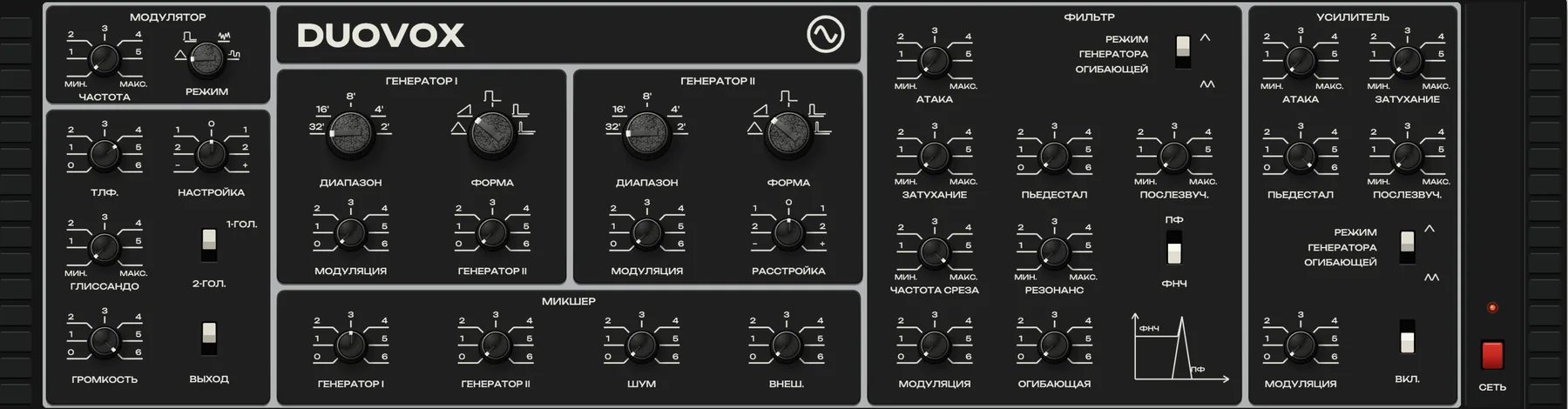
The owner's manual has no patch sheets. Its Fig. 1 explains the controls on a drawing of the panel with every knob set to a starting position: VCO I on the sawtooth at 32 feet, its mixer level at 3, the filter open, the amplifier sustain at 6, volume at 3. As far as anyone has found, those are the only knob positions the factory ever published.
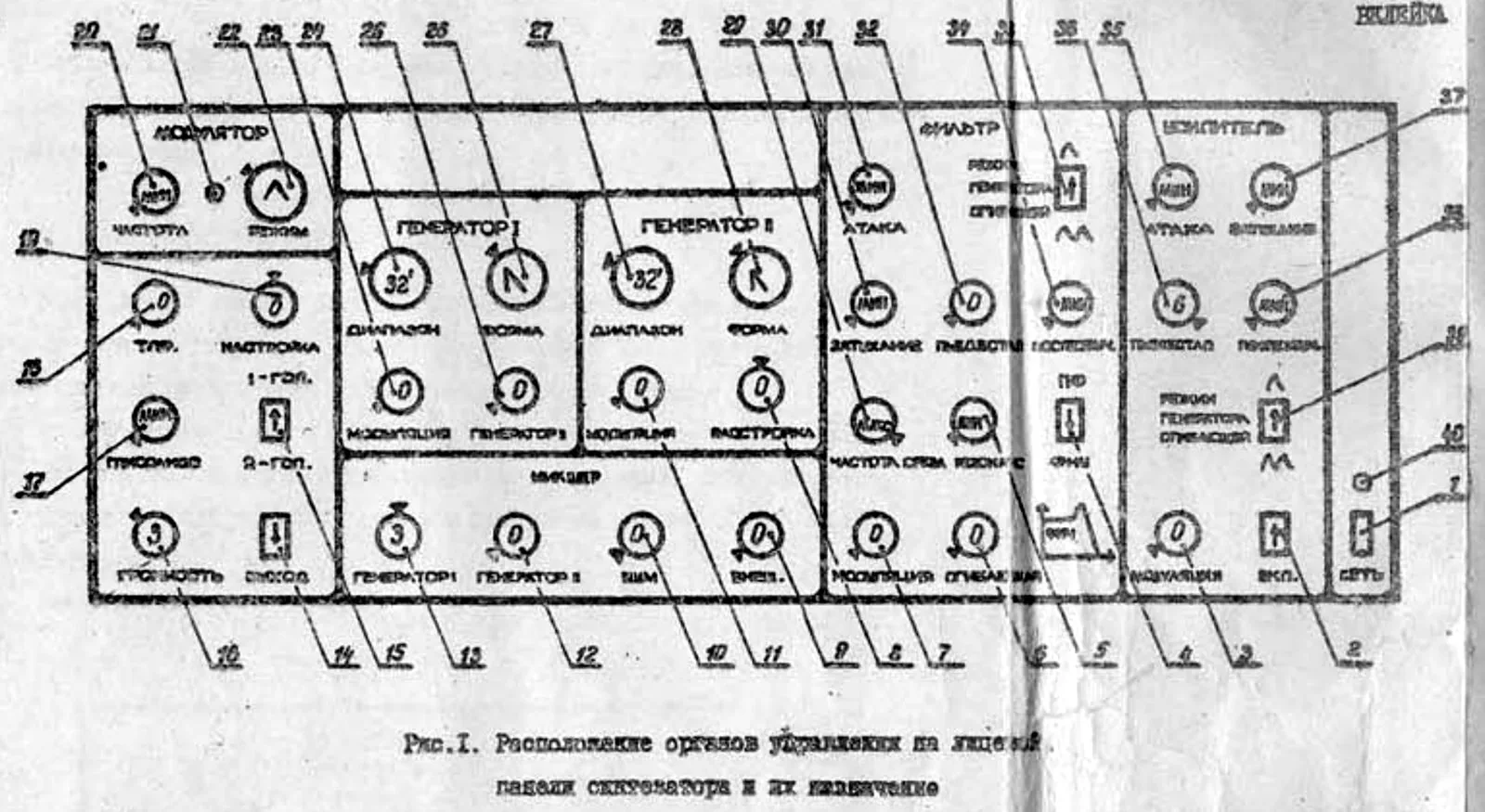
"Fig. 1. Layout of the controls on the front panel of the synthesizer and their purpose." Every control is numbered and drawn at its starting position. Scan: Internet Archive.
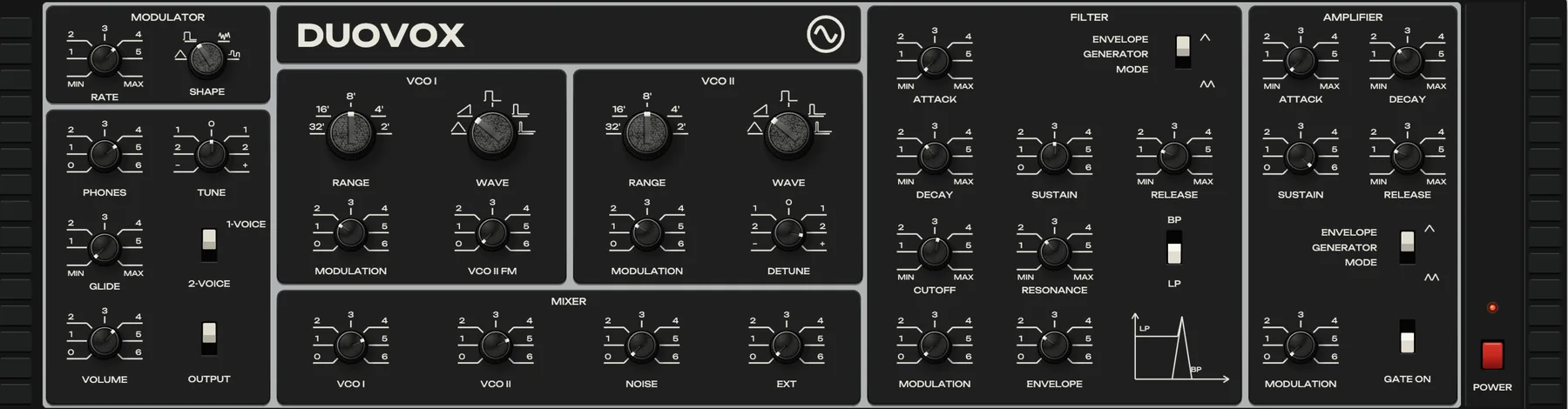
Duovox ships those settings as Manual Fig. 1 in the CLASSIC bank, and the screenshot at the top of this page is that preset with the panel lettering switched to Cyrillic. It sounds the way a test patch should: one plain sawtooth, two octaves below the keys, with nothing moving.
Three sounds Kuzmin described
Kuzmin's article explains a few of the instrument's tricks. Here they are as he described them, played on Duovox.
The trill chord
The modulator has a triangle and a square, and Kuzmin points out that they are different in kind: the triangle swings both ways around zero, while the square is a train of positive pulses at a 50 % duty cycle. On pitch, the square does not wobble a note; it lifts it and drops it back, a trill between two notes. At 5 to 7 Hz, he wrote, the ear hears two notes with a tremolo on them. Detune the two generators to an interval, modulate both, and one key plays a four-note chord.
 Square≈ 5.7 Hz+2 st+2 st+3 st
Below about 3 Hz the notes take turns; in Kuzmin's range they fuse; much faster and the trill becomes roughness on the tone. Tracked on the renders, the trill alternates between C and D at 1.3, 2.2, 4, 5.7, 8 and 13 Hz across the six positions.
One string bent to another
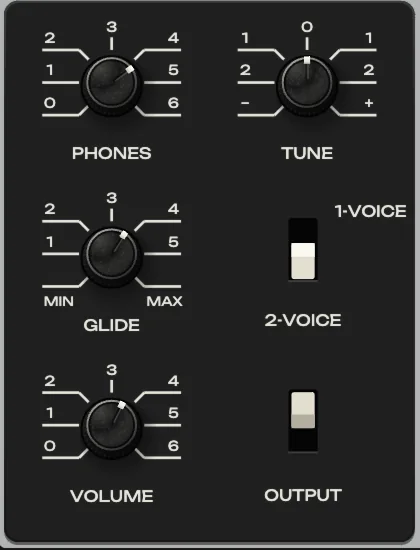
In 2-voice mode each generator follows its own key, one the upper and one the lower. Glide in 1-voice mode moves both generators, but in 2-voice mode it moves only one. Kuzmin compared the result to a guitarist bending one string up to the pitch of another. In the player the low A is held throughout, and the upper notes glide out of it and back into it.
 2-voiceGlide
We tracked each oscillator separately in these renders: VCO II stays on 220 Hz for the whole phrase, and only VCO I travels. The duophonic glide tutorial goes further into the note rules.
The envelope that loops
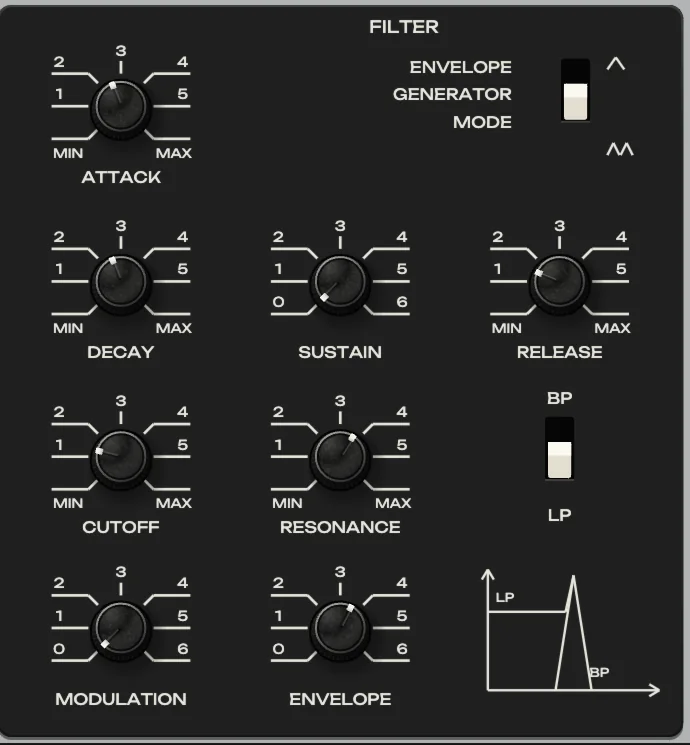
Both envelopes have a switch between single and periodic. In periodic mode, with sustain at zero, the envelope repeats with a period equal to attack plus decay, its shape set by the ratio between them. Kuzmin stressed that the cycle starts with the key, so a note always begins on an attack and never lands in a dip, which is what happens with an ordinary LFO. That gave the instrument two extra modulation sources, one for the filter and one for the amplifier.
 PeriodicAttackDecay0
Move attack and decay together and the period changes while the shape stays the same. Measured on the renders, the filter loop runs at about 11, 7, 4.7, 2.6 and 1.4 cycles a second across the five positions.
There is a whole tutorial on the looping envelope, and the trills have their own.
Letters, records and a second life
Kuzmin's article ends with letters from abroad. Rick Wakeman wrote that he had only seen pictures until a man brought a Polyvox to his concert in Russia, and closed with a line about the instrument: "Any instrument that makes it's 'own sounds' is special." Bob Moog wrote that he had heard the Polyvox but never seen one, and was glad it was popular again. They are letters of praise. Neither man is known to have recorded with it.
The records came from elsewhere. Will Gregory found one in East Germany and used it on Goldfrapp's Black Cherry (2003). Franz Ferdinand used several on Tonight (2009), and Kuzmin names them and Rammstein in his article. Mick Gordon demonstrated his on camera for the DOOM (2016) score, and both composers of Cyberpunk 2077 own one. The artists page grades every claim by its source, and signature sounds shows how to get into those territories in Duovox.
Modules, a reissue and a clone that never shipped
The circuit outlived the factory. Harvestman made Eurorack modules of the filter with Kuzmin's involvement. Erica Synths makes its own Polivoks VCF module, about €180 to €200 at retail. Elta Music worked with Kuzmin and Olimpiada Kuzmina on the Polivoks-M (2018), a one-oscillator desktop based on a "junior" concept Kuzmin had drawn in 1990, and still sells Polivoks filters including the PF-3. Its eight-voice POLYVOX 8, with one filter built on К140УД12 chips, was shown as a prototype at Superbooth 2026 (Sonicstate).
In 2016 a team in Moscow announced Polivoks Pro, a keyboardless desktop version: 100 units, hand-built with about 85 % Soviet-era parts, MIDI in and thru, 3 kg instead of 20 (gearnews). Gordon Reid reviewed it for Sound On Sound in April 2018 at €1,650 direct and liked it, calibration trouble and all. Asked by RBMA whether he would bring the original back himself, Kuzmin said you cannot step into the same water twice.
Behringer announced a Polivoks made in collaboration with Kuzmin in July 2021 (SOS) and showed a prototype in August 2023 with additions the original never had, such as pulse-width modulation and a sub-oscillator (Synth Anatomy). It has not been released. When Kuzmin died in June 2026, Synth Anatomy wrote that its future was uncertain.
How we rebuilt it as Duovox
Other software versions exist (see the comparison). This is how we built ours.
We started from the factory schematics, redrawn block by block by Russian DIY builders. They give the topology, the chip types and the voltages: a mixer that sums its four inputs at unity gain, two К140УД12 integrators behind a divider of about 1 to 48, a sawtooth of about 10 volts into it. Kuzmin's article supplied the intent: which way the trill goes, what the periodic envelope does, why the filter is gritty at low cutoff. Where neither says, Duovox makes a reasoned estimate.
Then we calibrated against recordings of three real units: two owners' demo videos and a commercial multisample set of a third instrument. The recordings were used only for measurement and nothing from them ships. Averaging single cycles put the pulse widths at about 45, 20 and 8.8 % (nobody had published them), the triangle at a 52 % rise with rounded tops, and the output coupling at a 10 Hz high-pass. The resonance was matched on a recorded filter sweep, and the filter's key tracking came out at a median of 0.62. What the recordings could not tell us, like absolute envelope times, stays an estimate.
 32'Saw6MAX3
The panel is the 1982 panel, with the 1-voice/2-voice switch, the output mute and the gate hold switch, lettered in English or in Cyrillic. The EXT knob in the mixer listens to the instrument's own output, as if a cable ran from the output jack back into the input. The things the box never had live on a rear panel: poly mode, velocity, pitch bend, drift, a choice of cutoff law. The filter runs 4x oversampled, 8x in HQ mode. Kuzmin wrote that his team had been aiming for the sound of Moog synthesizers, that something else came out, and that he had come to be glad of it. We tried to keep the something else.
- Vladimir Kuzmin, ProSound A«"Поливокс": как создавался "советский военный синтезатор"». Development, filter, panel, Formanta, glowing knobs, letters.Source ↗
- Red Bull Music Academy, 2016 AInterview with Kuzmin: 25,000 units, 920 rubles, never exported, Vector as a war factory.Source ↗
- Habr, 2017 BAbout 29,000 units per Kuzmin, the 1982 glowing-paint batch, the reissue.Source ↗
- Sound On Sound BPolivoks Pro review, April 2018; Behringer announcement, 2021.Source ↗
- Synth Anatomy, 2026 BKuzmin's death on 12 June 2026; status of the Behringer project.Source ↗
- Owner's manual ASpecifications and Fig. 1, scanned.Source ↗
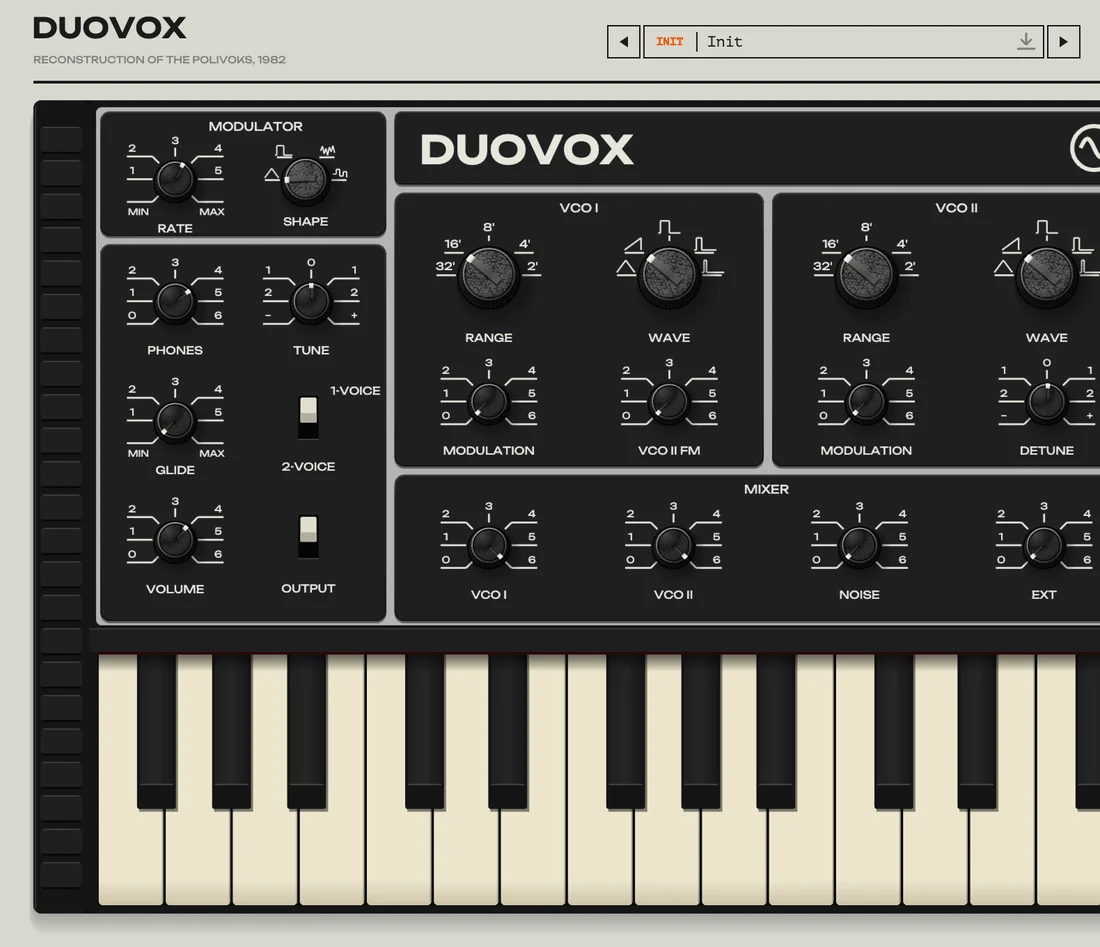
- The full Polyvox panel, control for control, with the scream, the looping envelopes and duophony
- A 4x/8x oversampled model of the two-chip filter, calibrated on recordings of real units
- 257 presets in ten banks and five packs, and a GEN button for new basses, leads and screams
- Extras the 1982 box never had: poly mode, velocity, pitch bend, drift, a rear panel