
Most famous-user lists for the Polyvox (Polivoks, Поливокс) are long and mostly wrong. Four uses hold up: a game score, two albums and a second game score, each backed by the composer's own words or by solid press. The artists page grades every claim. This page takes those four and asks a producer's question: what is that territory, and how do I get there on the panel?
Nobody published the patches. So each recipe below says what is documented, with the link, describes the territory in general terms, and then builds a patch in Duovox step by step. Read "in the territory of" literally: these are starting points with the same circuit, not copies of anyone's sound. We use no audio from the games or records; every player is Duovox.
In the territory of DOOM: an industrial scream bass
- Mick Gordon, DOOM (2016) ADemonstrates his Polivoks in his own video "DOOM: Behind The Music Part 2" (around 2:53, the point Wikipedia cites). Game Informer quotes him: operating it is "kind of an adventure".Video ↗
What is documented: Gordon owns one and shows it on camera. The video's own description says the episode is about synthesis techniques and about using pure sources, sine waves and noise, to capture analogue circuits. Game Informer adds old cassettes and guitar pedals to his tool list, and gearnews names a nine-string guitar tuned very low. Which cues the Polyvox ended up in is not stated anywhere we found.
The territory, then: plain sources and synth tones driven through hardware until they distort, sitting beside very low guitars. On the Polyvox the distortion comes built in, from the mixer that overloads the filter, so the recipe is a bass that grinds on its own.
 16'32'Square3.31.5
From Init: VCO I sawtooth at 16', VCO II square at 32'. In the mixer, VCO I at 6, VCO II at 3, NOISE at 1.5.
Turn VCO II FM on the VCO I plate to about 3.3. VCO II now bends VCO I's pitch on every cycle.
LP, cutoff about 1.8, resonance 4.3, envelope amount 3, attack minimum, decay 2.7, sustain 1.5. On the rear panel, FILTER DRIVE to maximum.
Attack minimum, decay 3, sustain 5.4, short release. 1-voice mode.
First the idea from the video description, tried on this filter: the same envelope and resonance with a bare triangle, then bare noise, then the full recipe.
The VCO II FM knob decides how much the note grinds. We measured it on a held note without the noise: with FM at 0, the energy between the note's harmonics sits about 9 dB below the energy on them. From 3.3 up it is 14 to 17 dB above, which is why the pitch turns into a buzz.
Resonance puts the scream on top. Keep it under 4 under a guitar; past 5 it becomes the lead.
In a mix this bass already carries its own distortion, so it usually needs less than a clean synth would. If it smears the guitars, lower NOISE first, then VCO II FM; the resonance can stay. A high-pass around 30 Hz cleans up what the 32-foot square adds below the note.
For whole drops, walls and breakdowns built this way, see the Polyvox for metal and industrial.
In the territory of Black Cherry: a driven glam bass
- Will Gregory, Goldfrapp ASound On Sound, July 2003: a Russian synth he found in East Germany and calls a Polyvox, "a bit of a beast". SOS credits it with the submarine bass on "Black Cherry" and a metallic growl on "Train".Source ↗
Gregory also told SOS he could not read the Cyrillic panel and that the knobs he read as "Ron" and "2 Ron" make everything go mental. Those are the 1-ГОЛ. and 2-ГОЛ. positions of the voice switch: one voice and two voices. The article names no settings, so the patch below is ours.
The territory: a bass with weight under the floor, a slight swell on each note, and a top end that turns metallic when you push it. A glam stomp rather than a sequencer line.
 AttackSquareRes 3.664.5
VCO I square at 16', VCO II sawtooth at 16', VCO II detuned a hair sharp. Mixer: VCO I at 6, VCO II at 4.5.
LP, cutoff about 1.6, resonance 3.6, envelope 2.1. Give the filter envelope some attack (about 1.2), decay 3.6, sustain 1.8, so each note opens slightly late. FILTER DRIVE at maximum.
Attack minimum, decay 3.6, sustain 5.4. GLIDE at 1.5, so legato notes slur.
The mixer is the drive. Measured on the level-matched clips below, the gap between peak and average level falls from about 10 dB with the mixer at 1.8 to about 5 dB at 6. That is the filter compressing the bass.
For the growl, switch VCO II to the triangle at 32' and bring up VCO II FM. Up to about 2 the bass gets rougher; by about 4 more of the sound sits between the note's harmonics than on them.
Flip the voice switch to 2-VOICE and hold two keys: the upper one goes to VCO I (the square), the lower one to VCO II, both through the same overdriven filter. Played as a fifth or an octave, the bass becomes a riff with two parts that distort each other. With glide up, only VCO I slides.
In the territory of Tonight: a nervy dance-rock line
- Franz Ferdinand BPaste, January 2008, citing Billboard: the band was adding "a collection of Russian Polyvox synthesizers" to the danceable tracks of the album they were making in Glasgow. MusicTech (2015) says it was used throughout Tonight. Kuzmin names the band in his own article.Source ↗
This one is press-reported. No band member names a track or a setting in anything we found; track lists that circulate rest on a critic's guess and a forum listener's. Who played it is not documented either.
The territory: a guitar band making a dance record, so a short, bright synth riff that pushes eighth notes and stays out of the guitars' way. On the Polyvox that means a pulse and a saw an octave apart, a resonant filter that snaps shut, and the band-pass mode when the guitars take the low mids.
 Pulse4'DecayLP / BPRes 3.9
VCO I on the pulse (fourth wave position) at 8', VCO II sawtooth at 4', slightly sharp. Mixer 5.4 and 3.6. Keep the rear-panel drive at its default.
Cutoff 2.7, resonance 3.9, envelope 2.7, attack minimum, decay 1.9, sustain 0.6.
Attack minimum, decay 2.7, sustain 3, a short release, a touch of glide (0.9).
Play it in straight eighths in the upper middle of the keyboard. Then flip the LP / BP switch. The band-pass clip's spectral centroid sits about 1 kHz higher and its level 3 dB lower, the cost of losing the low end.
Filter decay sets how nervous it is. Short decays give one clipped blip per note; long ones let the notes run together, and the line gets brighter on average.
Two variations worth a minute. Push GLIDE to about 2 and play the riff legato: the pitch slurs between notes in a way that sounds played rather than sequenced. Or set the modulator to square at a fast rate and give VCO I a little MODULATION: the square lifts the pitch on every pulse, so each note gets a short upward trill.
In the territory of Cyberpunk 2077: an ugly drone bass
- Marcin Przybyłowicz and P.T. Adamczyk ADen of Geek, December 2020: both composers own Soviet-made Polivokses, Przybyłowicz's from 1982. He calls it "remarkably ugly-sounding" and says it still sounds like nothing else.Source ↗
The interview does not say which cues use it. What it does give is the composer's own description, and that is a usable brief: ugly on purpose, dark, and unlike anything else in the rack.
The territory: a low drone or held bass that never quite settles. Two oscillators a semitone apart do the ugliness, and a looping filter envelope with some randomness keeps it moving without any sequencer.
 PeriodicS&H0+1 st1.1
VCO I sawtooth at 16', VCO II narrowest pulse at 32'. DETUNE on VCO II to 0.5 on its scale, which is a semitone sharp. Mixer 6 and 4.8. FILTER DRIVE at maximum.
Cutoff 1.4, resonance 4.2, envelope 2.1. Envelope mode switch to periodic, sustain 0, attack 3.7, decay 4.3.
Modulator on S&H at a slow rate (about 2.4 on the dial), filter MODULATION at 1.1.
Attack 1.8, sustain 6, release 3. For a drone with no key held, flip GATE ON (ВКЛ.).
Detune is the ugliness control. The VCO II scale reads in whole tones, so 0.5 is a semitone.
With the envelope on periodic the filter reopens about every 1.5 seconds while you hold the key; we measured it from the renders. The S&H makes each cycle slightly different.
Play it on the bottom two octaves and leave room around it. The loop already provides the movement, so it works best with sparse drums or none, and a long reverb after it rather than before.
What these patches are not
Three things separate any patch from a record. The players: Gordon, Gregory and the rest worked their own units, which were never calibrated identically even at the factory. The chain: cassettes, pedals and mix processing are part of every one of those sounds and are not documented. And the parts: nobody has published which cue or bar uses the Polyvox, so describing one as "the sound" would be invention.
What Duovox does reproduce is the instrument: the mixer that overloads the filter, the two-integrator filter, the trill direction of the square modulator, the looping envelopes and the duophonic glide. Start from these four, then go to the bass tutorial, the filter or the looping envelope and make your own.
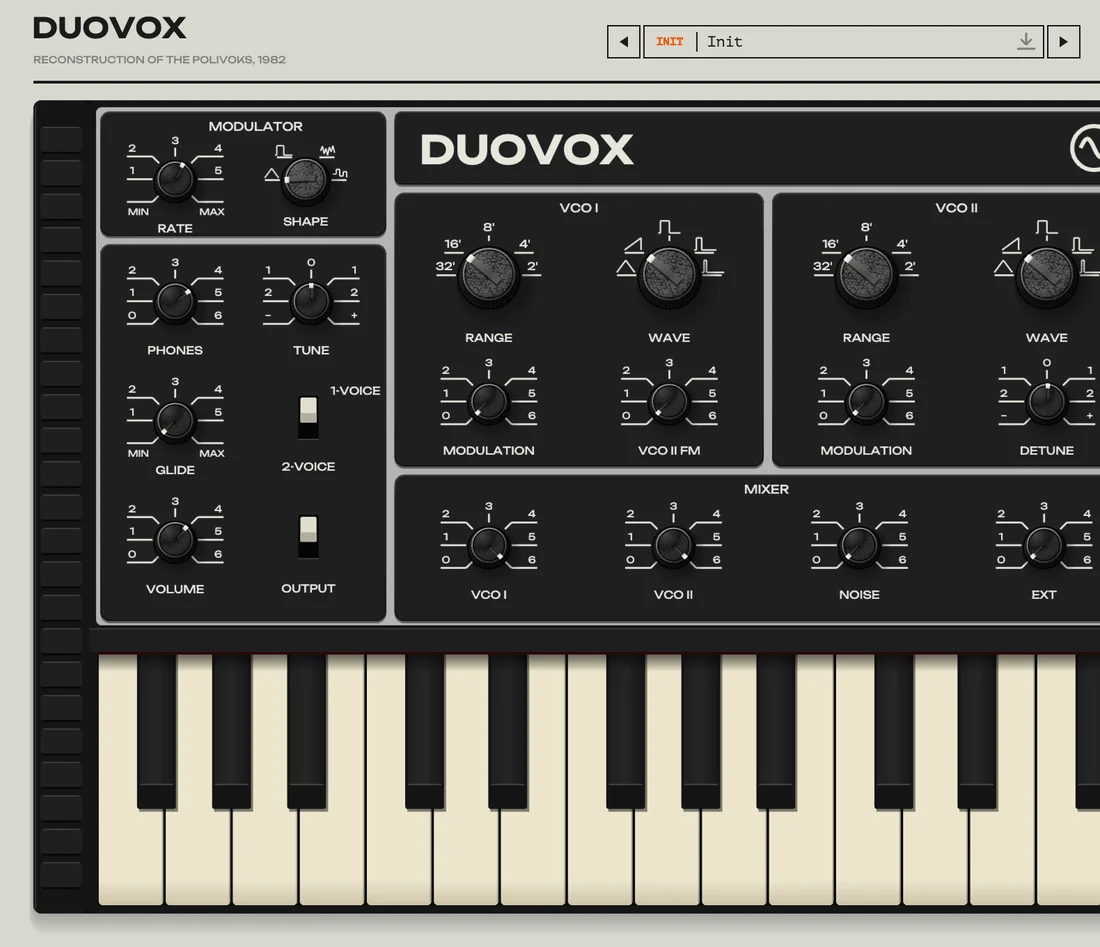
- The full Polyvox panel, control for control, with the scream, the looping envelopes and duophony
- A 4x/8x oversampled model of the two-chip filter, calibrated on recordings of real units
- 257 presets in ten banks and five packs, and a GEN button for new basses, leads and screams
- Extras the 1982 box never had: poly mode, velocity, pitch bend, drift, a rear panel