
The Polyvox (Polivoks, Поливокс) was built in the Soviet Union from 1982 and never sold abroad, so every Western record made with it starts with someone tracking one down. A few of those people talked about it on the record. Many more are attached to it by lists that copy each other. This page keeps the two apart.
For each name you get what the source actually says, the link, and a grade. Under the bigger entries there is a short note on the sound and a player built from our plug-in, Duovox. Those players are our patches in the same territory. They are not recreations of the records, none of these artists used Duovox, and we do not play or quote their music here: follow the links for that.
How the sources are graded
- A The artist or composer says it in their own interview or video.
- B Reputable press says it, or the designer, Vladimir Kuzmin, names the artist.
- C Only Wikipedia without a working citation, Equipboard, forum posts or lists in obituaries.
A grade C entry is not false. It means that if you repeat it, you are repeating a list.
Mick Gordon, DOOM (2016)
- Mick Gordon AComposer of the DOOM (2016) score. He demonstrates the Polyvox in his own video "DOOM: Behind The Music Part 2" (Wikipedia points to about 2:53). Game Informer quoted him in May 2016; gearnews lists the Polyvox among the DOOM gear, with a frame from Part 1.Part 2 video ↗Part 1 video ↗Game Informer ↗gearnews ↗
This is the best documented modern use. Gordon talks about the synth himself, on camera, and the Game Informer piece carries the story in its headline: DOOM sounds made from old cassettes and a Russian synthesizer. His line about the panel is the one most people quote: "I don't speak Russian, and operating [it] is kind of an adventure." None of the coverage gives a cue-by-cue list, so we cannot tell you which tracks in the score carry it.
The sound
What makes the Polyvox fit a score like this is in the circuit, and we can describe that. The mixer sums both oscillators at unity gain into a filter built from op-amps that overload at a few volts, so a hot patch is distorted before any pedal. The second oscillator can frequency-modulate the first at audio rate, which turns a bass into something closer to machinery. Below is that knob on a METAL pack preset.
 Saw16'SquareFM 3.3
We measured the steps on a held note: with FM at 0 about 1 % of the energy sits between the harmonics, at 2.7 just under a fifth, and from 3.3 up close to 90 %. That is the point where a pitched bass turns into a grind. The four presets in the next player are other ways into the same area. The metal and industrial article goes further.
Marcin Przybyłowicz and P.T. Adamczyk, Cyberpunk 2077 (2020)
- Marcin Przybyłowicz & P.T. Adamczyk AComposers of the Cyberpunk 2077 score. In a Den of Geek interview Przybyłowicz says both of them own Soviet-made units and that his is from 1982. He describes it as a duophonic synth that sounds unlike anything else. IGN also has a behind-the-scenes video on the score.Den of Geek ↗IGN video ↗
Przybyłowicz is not sentimental about it. He calls it "remarkably ugly-sounding" and says that is the appeal. Two composers on one project each owning a Polyvox is unusual for an instrument that was only ever sold in Soviet shops.
The sound
He singles out the duophony, so that is what our player shows. With the 1 / 2 voice switch on 2, the upper key goes to VCO I and the lower key to VCO II, and both run through the one filter. In 1-voice mode the lowest key wins. Hold a bass note with the left hand, play a line with the right, and flip the switch.
 2-voice
The difference shows in the numbers too: in 1-voice, 59 % of the energy is below 200 Hz because only the held bass sounds; in 2-voice it drops to about a third, because the melody is back. The duophony lesson covers the rules of the note assigner.
Will Gregory and Goldfrapp, Black Cherry (2003)
- Goldfrapp / Will Gregory AIn Sound On Sound's 2003 piece on recording Black Cherry, Gregory describes a Russian synth he found in East Germany and calls it a "Polyvox". The article credits it with the deep bass on the title track and the metallic growl on "Train". It does not say in so many words who played it on each track.Sound On Sound ↗
This is the source behind the spelling we use. Gregory says "Polyvox", and so does a lot of English-language press after him. His short verdict: "a bit of a beast". The same article repeats the old line that the instrument came from the military, which Kuzmin later explained himself: the team picked a then-fashionable military look, and the side cheeks resemble tank tracks. It was a civilian product sold through shops.
The sound
SOS describes a submarine-like bass and a metallic growl. Both are classic Polyvox territory: two saws driven into a low filter for the first, and a harder, buzzier edge for the second. Our player uses Soviet Monster Bass on a stomping glam riff and lets you turn the cutoff.
 SawSaw66
The measured change sits in the top end: energy above 1.5 kHz is about three times stronger at cutoff 5 than at 1, while the share below 200 Hz barely moves. The bass stays, and the edge comes and goes. The bass tutorial builds this patch knob by knob.
Franz Ferdinand, Tonight (2009): what is sourced and what is not
- Franz Ferdinand BPaste (January 2008, citing Billboard) reports that the band was working on the third album with Russian Polyvox synthesizers. MusicTech (2015) says it was used throughout the record. Kuzmin names the band in his own article, and the Red Bull Music Academy interview mentions them in its introduction.Paste (archive) ↗MusicTech ↗Kuzmin (ru) ↗RBMA ↗
The album is well sourced. Paste's wording is "a collection of Russian Polyvox synthesizers", plural, and MusicTech, Kuzmin and RBMA repeat the link. The details people add to it are weaker:
- "Ulysses" and "Lucid Dreams" as the Polyvox tracks: English Wikipedia credits this to a critic, and the other trail leads to a MatrixSynth post where a listener guesses. Not confirmed by the band.
- The story that the band argued over who got to play it: a Russian Habr article (2017) attributes it to Rolling Stone, but we could not find it in either 2008 Rolling Stone studio report.
- Who played it on the record: not stated anywhere we looked. Rolling Stone says Nick McCarthy plays the synth riffs but does not name the synth.
The sound
Rolling Stone's 2008 studio reports describe the album as more dance than rock. For a synth lead that has to stay nervous next to guitars, the Polyvox tool we would reach for is the modulator on noise: random movement on the pitch and filter, so a lead never settles. Our Nervous Wire preset does that; the player compares it with three steadier leads.
 NoiseRate
Hot Wire is the outlier, with a spectral centroid around 3.6 kHz against 1.5 to 1.8 kHz for the others, because it runs through the band-pass filter.
Rammstein and Christian "Flake" Lorenz
- Rammstein / Flake B/CKuzmin names Rammstein in his own article, and Habr says Flake took part in a promo photo shoot for the new Polivoks. Equipboard says he can be seen playing one in the live video of "The Beautiful People" at the Echo awards on 22 March 2012. No studio album or track is attributed anywhere.Kuzmin (ru) ↗Habr (ru) ↗Echo 2012 video ↗RBTH ↗
The designer's word puts this above a plain list entry, and the video is there to check. What is missing is any Rammstein record credited to the Polyvox, so "Rammstein used it on stage" is as far as the sources go.
The sound
Next to a wall of guitars a synth bass needs a top that cuts. One way on this panel is to put VCO II an octave above VCO I and drive both into the filter. The player switches the second oscillator between the same footage and an octave up.
Crashed Disco Balls, live sets
- Crashed Disco Balls (Kuba Kristo, Gdańsk) BA 2010 Bottomlayer interview has the Polyvox in his main live rig next to a Roland SH-09 and a Juno-60, and he calls it his "all-time favourite".Bottomlayer (archive) ↗
A smaller name with a clear source: a working electronic act with a Soviet keyboard of nearly 20 kg in the live rig. Our player is three DANCE pack basses on a 16th-note electro line, in the club territory his rig points to.
Rick Wakeman and Bob Moog: letters, not records
- Rick Wakeman BWrote to Kuzmin that a man brought a Polyvox to his concert in Russia, and praised an instrument with its "own sounds". A unit described as his, "gifted by a fan", was later listed on Reverb. No recording with it is documented.Kuzmin (ru) ↗Reverb listing ↗
- Bob Moog BSent Kuzmin a short note of congratulations on the instrument's new popularity. He wrote that he had heard the Polyvox but never seen one. Not a user.Kuzmin (ru) ↗
Both letters are reprinted in Kuzmin's article, in English with Russian translations. They show who knew about the instrument. Neither shows anyone recording with it, and lists that put Wakeman or Moog among "users" stretch them.
Reported users with weak sources (grade C)
These names are reported, and some may well be true. The source behind each is a list, a photo or a social post.
- Bring Me The Horizon CNamed in the Russian Wikipedia article and in several 2026 obituaries of Kuzmin (Afisha, Fontanka); some of those lists add the 2020 track "Kingslayer". We found no interview, credit or video confirming either.ru.wikipedia ↗Afisha (ru) ↗
- Tara Busch (I Speak Machine) CBought one in January 2017, per her Facebook post as listed on Equipboard.Equipboard ↗
- Thomas P. Heckmann CPresents and demos the synth in a Telekom Electronic Beats video, mentioned by Equipboard and RBTH.RBTH ↗
- Yuksek, Luis Dubuc (Mystery Skulls) CA Polyvox is visible in a studio tour and in a rack in their videos, per Equipboard. Ownership, no documented track.Equipboard ↗
- Daniel Miller (Mute) CTalks about it in a video, per Equipboard. Discussion, not use.Equipboard ↗
- Zardonic CAn Instagram post calling it a monster, per Equipboard; also in a 2026 obituary list. No track named.RG / mail.ru (ru) ↗
- KanZer C"Pepel" and "Plat'e", per English Wikipedia, which cites an Instagram post.Instagram ↗
- Агата Кристи, Биоконструктор, Кооператив Ништяк, Фряновское шоссе CSoviet and Russian bands named by Russian Wikipedia and 2026 press lists, mostly without primary sources. They have their own article.Soviet underground →
Often claimed, not confirmed
These come up in forum threads, video comments and listicles. For each we looked for an interview, a credit or a video, and here is what we found.
- The Weeknd, Tim Sköld: Equipboard links a photo of studio gear for each. A photo of a synth in a room is not a credit, and nothing ties it to a record.
- Aphex Twin, Boards of Canada, The Chemical Brothers: no source. The searches that bring these names up tie them to the Roland SH-101, a different 1982 synth.
- Kraftwerk, Depeche Mode: no source found.
- Кино (Kino), Наутилус Помпилиус (Nautilus Pompilius), Браво (Bravo) and other big Soviet rock names: no source found. Russian-language sources are harder to search, so this one is open rather than closed.
- Psyclon Nine, Not My God and a few others: listed on Russian Wikipedia without a citation.
- Bryan Ferry: one 2021 Russian article names him. It most likely garbles a Rolling Stone line that called Alex Kapranos "Bryan Ferry-style".
If you have a primary source for any of these (an interview, a liner-note credit, a video where the artist plays it on a record), we will move the name up.
Getting into this territory yourself
Every player on this page is a preset from Duovox's factory bank, rendered by the plug-in with nothing after it. The heavy ones are in the METAL and INFERNO packs, the club basses in DANCE, the leads in LEAD, METAL and EXPERIMENTAL. If you want the panel these records were made on, the instrument itself is rare and expensive now; Duovox reconstructs the same circuit, with the duophony, the looping envelopes and the external input.
The Soviet side of the story, with the bands at home and the factory in Kachkanar, is in the Polyvox in the USSR.
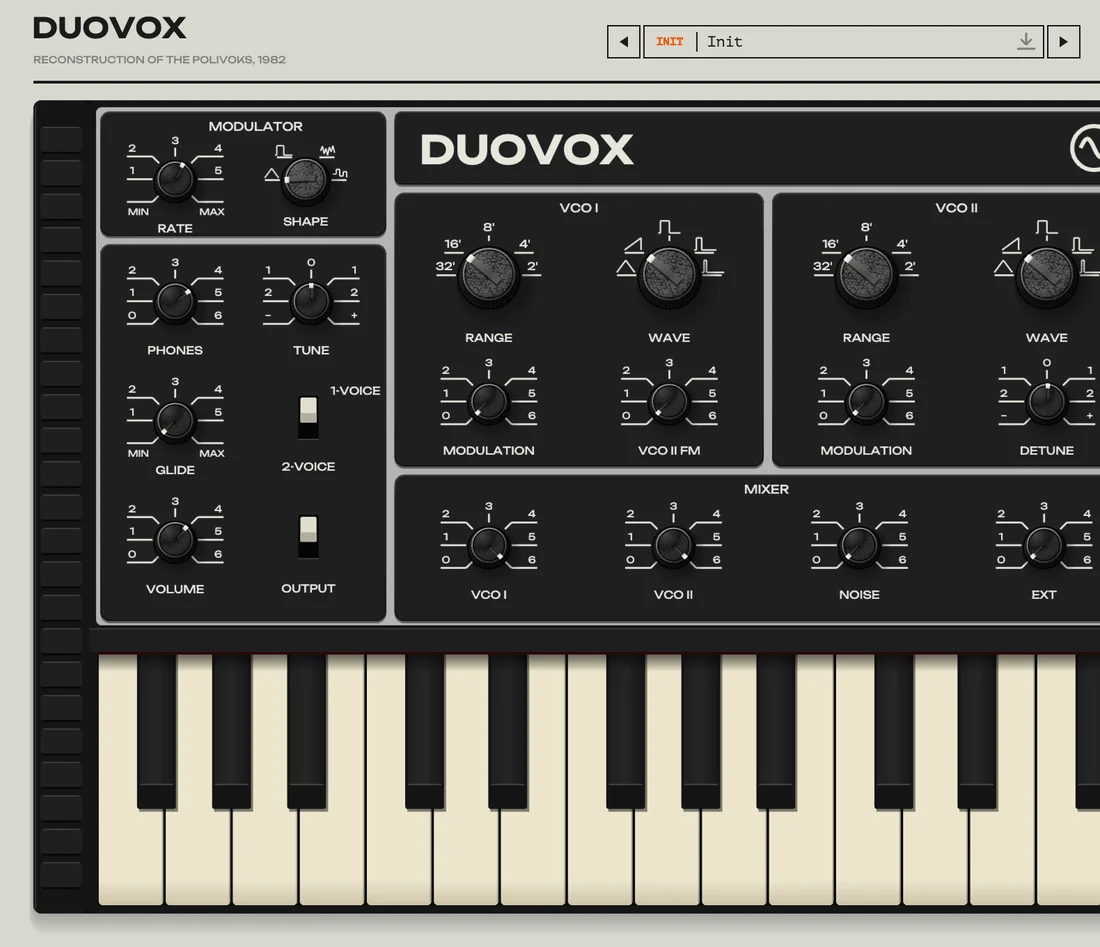
- The full Polyvox panel, control for control, with the scream, the looping envelopes and duophony
- A 4x/8x oversampled model of the two-chip filter, calibrated on recordings of real units
- 257 presets in ten banks and five packs, and a GEN button for new basses, leads and screams
- Extras the 1982 box never had: poly mode, velocity, pitch bend, drift, a rear panel