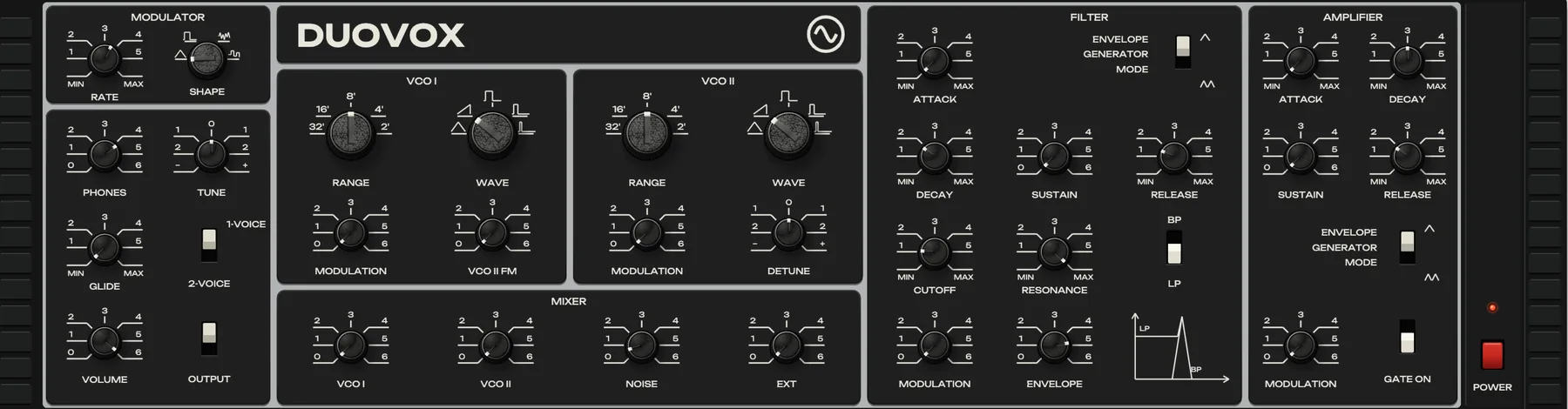
The Polyvox (Polivoks, Поливокс) of 1982 has nothing for drums: no trigger inputs, no accent, no separate outputs. It does have a filter that rings on its own when you turn the resonance up, a white noise source, a band-pass mode and two envelopes, one of which can loop. That turns out to be a full kit.
The Etheroneph article on the instrument makes the point in passing: short sounds with high resonance and fast modulation give percussion with a sharp attack and a slightly rounded start, and with the footage, waveforms and envelopes you get kicks, snares and hats. Below, each drum is built on Duovox, our reconstruction, and rendered on its own. At the end they play together.
The filter is the oscillator
Start from the Init preset and turn both oscillators to 0 in the mixer. Turn RESONANCE to the top. The filter now has nothing to filter, so it rings at its own cutoff frequency: a sine-like tone with a slightly squared shape. Set CUTOFF low (1.1) so the resting pitch is deep, then give the filter envelope a big ENVELOPE amount (4.8), a short DECAY (1.8) and SUSTAIN at 0. Every key now throws the ringing pitch up and lets it fall. On the amplifier: decay 3, sustain 0.
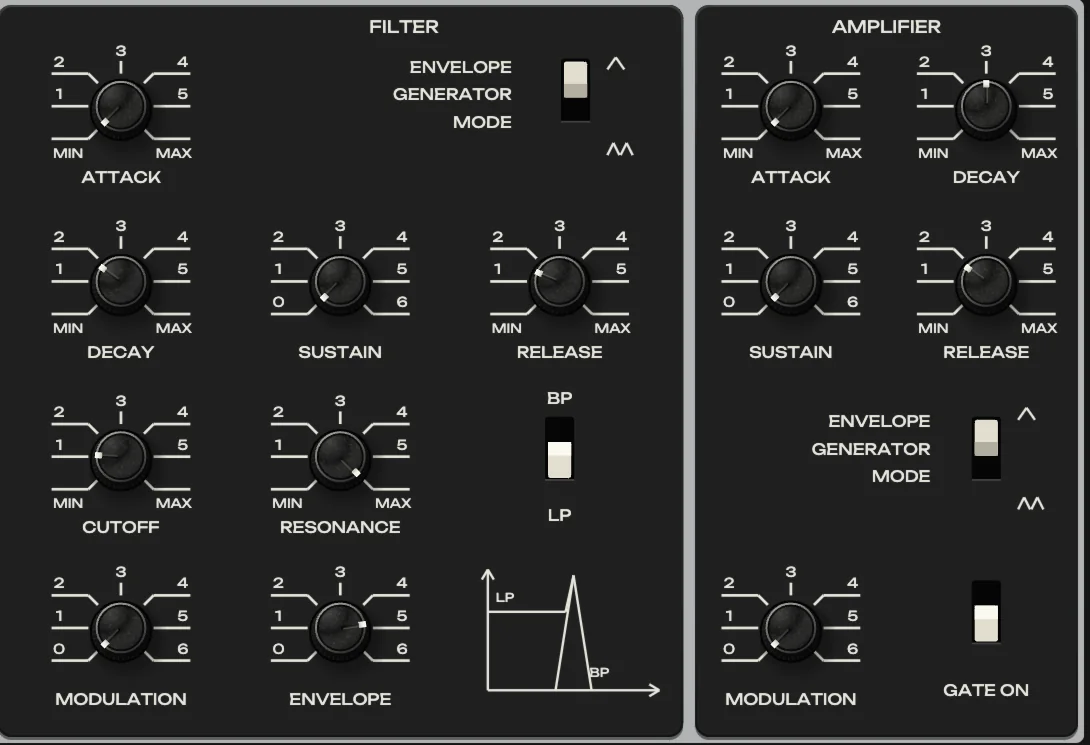 3.01.81.1MAX4.8
That is the factory preset Kick Boom. We tracked its pitch on C2: about 1.1 kHz at the start, 420 Hz after 20 ms, 140 Hz after 40 ms, and settled near 43 Hz by 80 ms. That is about an octave and a half every 20 ms for the first 40 ms, then the pitch slows down and settles: a click, a fast drop and a tuned thump.
Resonance is the switch that makes it exist. With the mixer off, the kick appears only when the filter self-oscillates, which on this filter happens in roughly the top sixth of the knob.
We measured these clips: at 4.5 the pattern sits 36 dB below the full kick, at 4.9 about 28 dB below, at 5.2 within 5 dB, and from 5.4 up it is all there. If a patch has gone silent, this is the first knob to check.
The filter DECAY sets how fast the pitch falls, so it decides the drum. Short gives a click and a thud. Long keeps the high part of the sweep audible and the kick turns into a laser zap that lands on a kick. The spectral centroid of the clips doubles across the knob, from about 2.5 kHz to 5 kHz.
Tuning
On the 1982 instrument the filter follows the keyboard by a fixed internal amount, with no knob for it. Duovox puts that amount on the rear panel as KEY TRACK, and the drum presets set it to 100 %, so the kick follows the keys like an oscillator. In our renders Kick Boom settles near 43 Hz on C2 and near 87 Hz on C3, an octave apart. Pick the key that fits the bass.
Four kicks
Kick 1982 does it differently: it keeps a triangle in the mixer at 32', two octaves under the key, at 5.4, so the ringing filter sweep sits over a very low sub wave. Cold Boom Kick from the COLDWAVE pack is the same idea with the triangle at 16' and a shorter tail. The third position plays Kick 1982 with the mixer at 0, so you can hear what the triangle adds.
Noise and a triangle through the band-pass
A snare has two parts: a short tuned body and a burst of noise. On the Polyvox both go through the same filter. Put NOISE at 6 in the mixer, VCO I on triangle at 8' at 3.6, switch the filter to BP with the cutoff around 3.3 and resonance 2.1, and give the filter envelope a little amount (2.1) and decay (2.1) so each hit opens and closes the band. Amplifier decay 2.5, sustain 0.
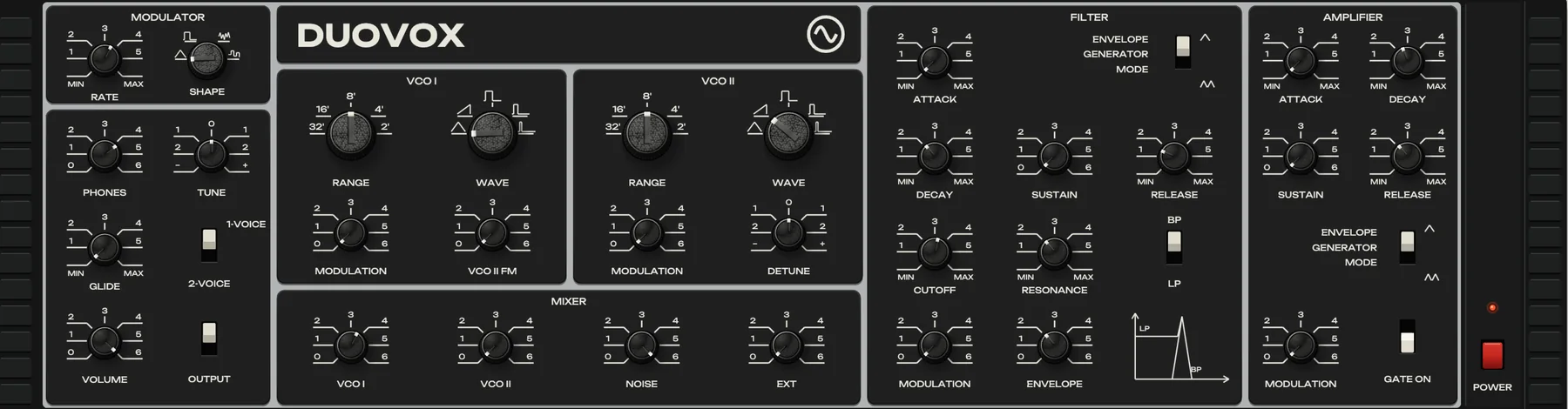 TriangleBPCutoff3.66
The band-pass is 6 dB per octave on each side, so it is wide; it shapes the noise more than it isolates a tone. The key you play tunes the triangle body and, through key tracking, moves the band as well. Around D3 the body sits low and solid; higher keys make it more of a crack. Machine Snare from the COLDWAVE pack is the harder variant.
Noise, higher and shorter
Hats are noise through the band-pass with the cutoff high. Hi-Hat uses noise at 6, both oscillators off, BP at 5.3 with resonance 2.7, no filter envelope and an amplifier decay of 1.3 with no sustain. Open Hat is the same with the amplifier decay at 3 and the release at 2.7, so the tail rings on when you let go.
A 12 dB filter never makes a metallic, glassy hat the way a drum machine's bank of square oscillators does. These are closer to the brushed, hissy hats of early drum machines. If you want more metal, use the cowbell recipe below with the range at 2' and a short decay.
The looping envelope makes the flutter
A hand clap is several people clapping a few milliseconds apart, and drum machines fake it with a few quick bursts of noise. The Polyvox has a part that does exactly that: the amplifier envelope's periodic mode. With the mode switch on the looping position and sustain at 0, the envelope repeats attack and decay for as long as the key is held, and the loop always starts from the key press.
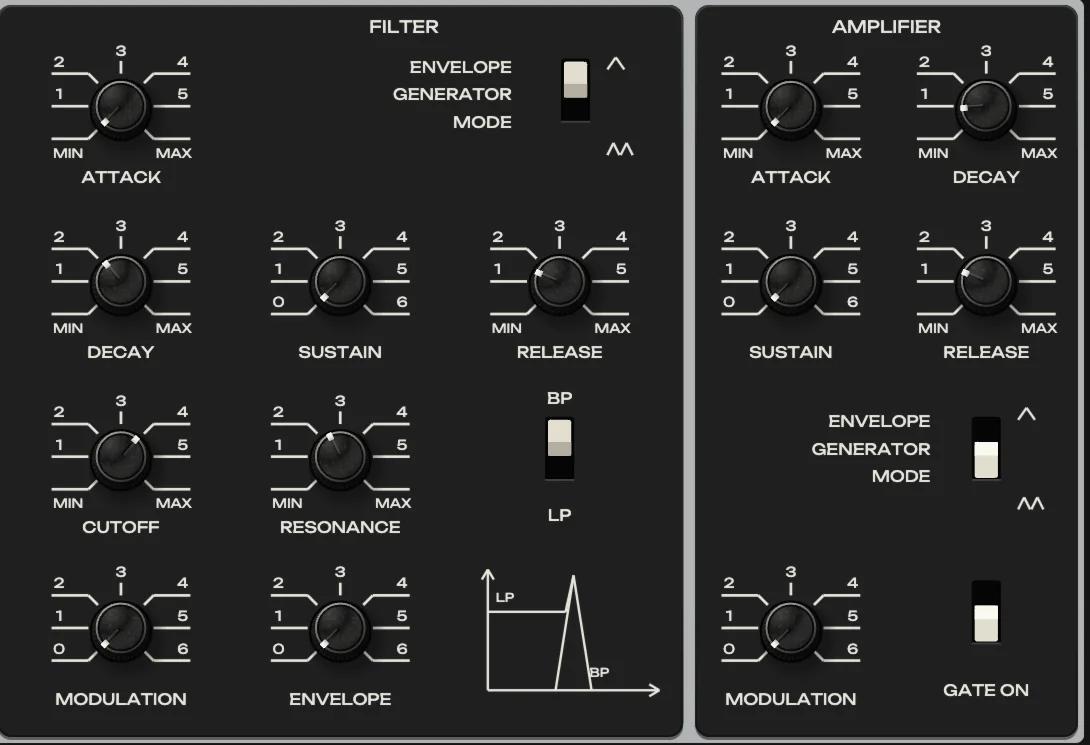 0.90BPPeriodic3.9
With the decay at 0.9 the Clap preset re-fires about every 24 ms. That makes the note length the number of claps: a 25 ms note gives two bursts, 50 ms gives three, 100 ms gives five. Then the release takes over as the room tail. Club Clap from the DANCE pack loops a little faster, about every 20 ms, with a longer release.
For the clap, quantise the note length, not only the start. A 1/32 note at 120 bpm is about 62 ms, three or four bursts. If the claps sound uneven from hit to hit, check that every MIDI note has the same length.
Pitched hits
Tom Zap is the kick recipe with an oscillator in it: a square at 16' at 4.8 in the mixer, cutoff 1.1, resonance 4.8, envelope 4.2 with decay 2.4, amplifier decay 3. The resonance is high but below self-oscillation, so the sweep rings on the square instead of replacing it. With key tracking at 100 % you walk down the keys for a fill.
Cowbell 82 uses both oscillators as squares at 4', with VCO II detuned 3.6 semitones up, a gap that is not a musical interval in any key. Through the band-pass at 3.7 with resonance 3 and a short amplifier decay, the two tones clang against each other.
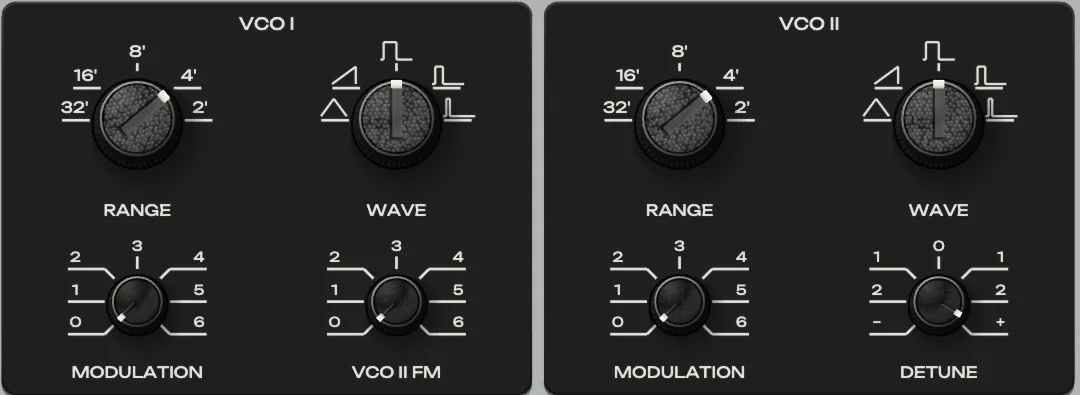 4'Square4'Square+3.6 st
Rim Click is the shortest: the narrowest pulse at 4' through a resonant band-pass (cutoff 4.2, resonance 3.6), amplifier decay 0.7, almost nothing after the attack.
All of it, two bars
Here is the kit playing a two-bar pattern at 120 bpm: Kick Boom on every beat with a pickup into the last one, Snare on 2 and 4 with Clap layered on each 4, closed hats on most offbeats, open hats at the end of each bar, a rim and a cowbell for syncopation and a three-note Tom Zap fill. Each part was rendered by Duovox on its own and the renders were summed and level-set. Nothing else touched it: no samples, no EQ, no compression.
That is also how you would do it with the plug-in in a DAW: one instance per drum, each on its own MIDI track. The instrument is mono at heart, and every voice shares one set of panel settings, so a single instance cannot be a kick and a snare at the same moment. The rear panel's VEL > LEVEL control is useful here: it lets velocity set the level of each hit, which the 1982 keyboard never could, and gives you accents and ghost notes.
Twelve drum presets
Every drum preset in Duovox on one rhythm, level-matched up to a common peak ceiling, so the sustained ones line up and the short clicks (Rim Click, Hi-Hat) stay a little quieter. They all play A2 here, which suits some more than others; the clips above use the keys each one is built for.
The kick depends on the self-oscillating filter, and that filter has more to give than drums: the filter tutorial covers the scream and the resonance. The clap trick comes from the looping envelope, which also turns one held key into a rhythm. And the factory passport's wind, surf and gunfire are in sound effects.
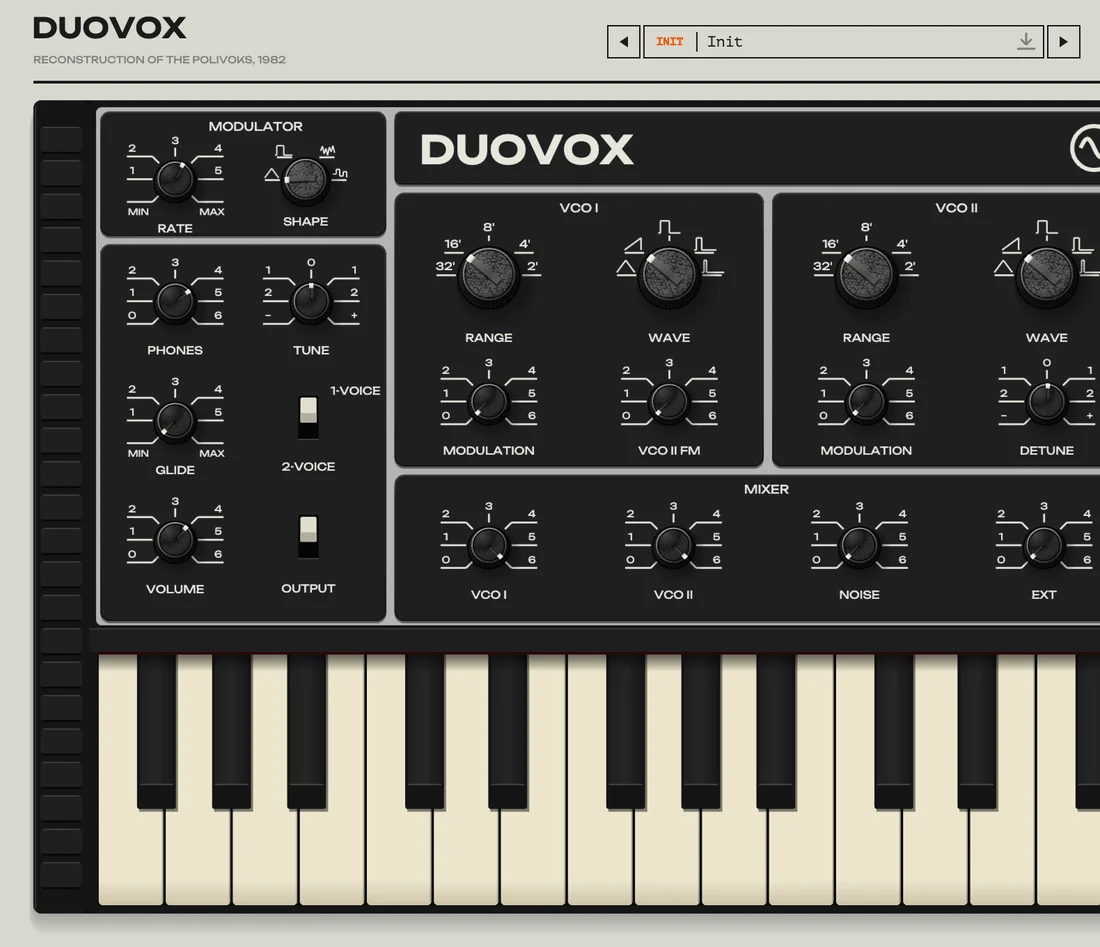
- The full Polyvox panel, control for control, with the scream, the looping envelopes and duophony
- A 4x/8x oversampled model of the two-chip filter, calibrated on recordings of real units
- 257 presets in ten banks and five packs, and a GEN button for new basses, leads and screams
- Extras the 1982 box never had: poly mode, velocity, pitch bend, drift, a rear panel