DUOVOXPolyvox JournalGet Duovox
TutorialPolyvox Journal

Polyvox sound effects, rebuilt from the factory list

The factory papers for the 1982 synth list wind, sea surf, gunfire, rain and a steam locomotive among the sounds it can make. All five are possible with no key held down. Here they are knob by knob, plus a UFO, a laser zap and a satellite beacon.

By MonosoundsUpdated 06 Nov 20268 min read
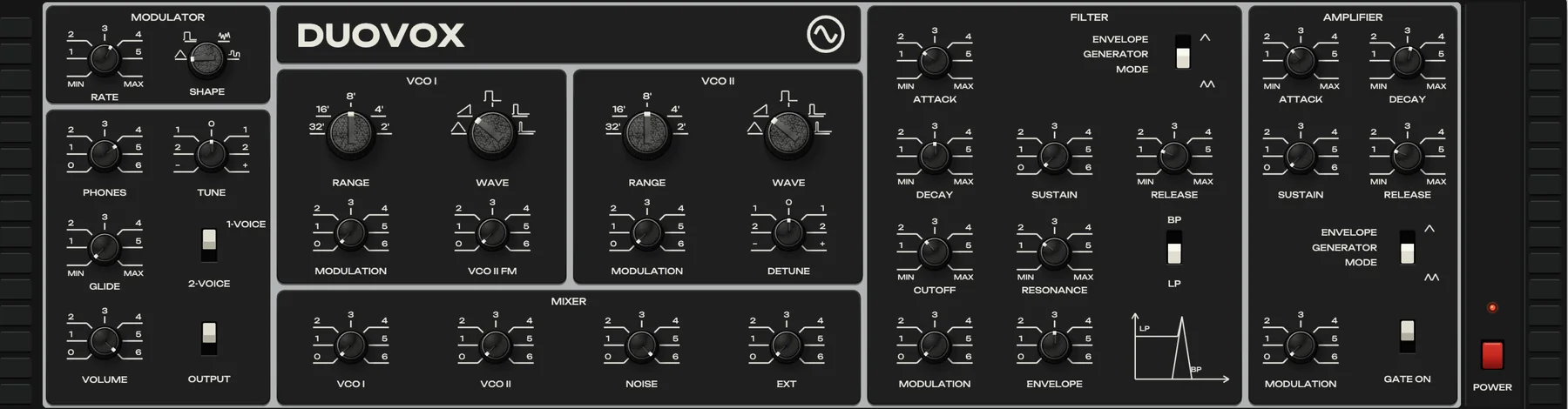
Steam Train in Duovox: only noise in the mixer, both envelopes looping, the gate held on. No key needs to stay down.LoopLoopGate onNoise 6
Steam Train in Duovox: only noise in the mixer, both envelopes looping, the gate held on. No key needs to stay down.

The factory passport of the Polyvox (Polivoks, Поливокс), the spec sheet that came with every 1982 unit, has a list of things the instrument can do. Next to the musical sounds it names wind, sea surf, gunfire, rain and a steam locomotive. None of them needs anything the panel does not have: a noise source, a filter that can be band-pass, two envelopes that can loop, and one lever that holds the gate open.

Below, each effect is patched in Duovox, our reconstruction, with the plates shown and the knobs that matter playable. Five more follow that the factory did not list: a UFO, a laser zap, a satellite beacon, a landing saucer and a feedback howl. Every one ships in the FX bank under the name used here.

01The lever

GATE ON: a key that never comes up

On the 1982 panel, at the bottom right of the amplifier plate, there is a lever marked «ВКЛ.», "on". Vladimir Kuzmin, who designed the instrument, explains in his own account of the project that it sends the gate to every block and starts the envelope generators, as if a key were held down. Duovox labels it GATE ON in Latin lettering and keeps «ВКЛ.» in Cyrillic.
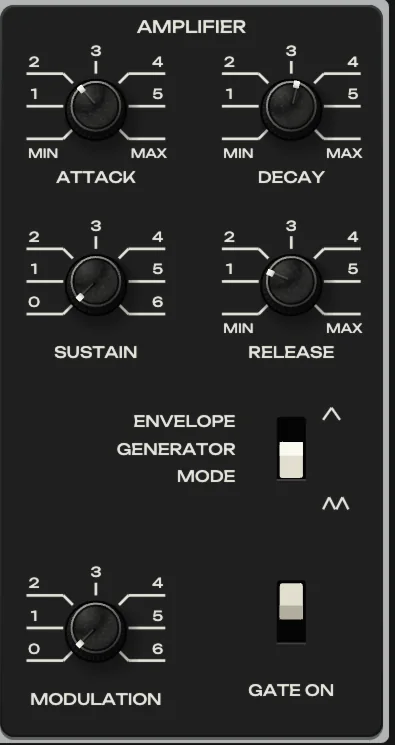
The amplifier plate. The lever bottom right is GATE ON, «ВКЛ.» on the 1982 panel: it holds the gate open with no key pressed.LoopGATE ON
The amplifier plate. The lever bottom right is GATE ON, «ВКЛ.» on the 1982 panel: it holds the gate open with no key pressed.

For effects this lever does two jobs. A drone or a noise bed keeps sounding while your hands are on other knobs. And an envelope set to the periodic mode (the ΛΛ icon on its lever) loops for as long as the gate is high, so the sound keeps moving with no key at all. Kuzmin describes that mode too: with sustain at 0, the envelope repeats its attack and decay, and each cycle takes the attack time plus the decay time.

GATE ON, one short key pressDuovox · 0:02
Play
ВКЛ.
The same half-second tap on a key. With the gate off the train stops when the key comes up; with it on the envelopes keep looping until you flip the lever back.
Pick a position →

Three of the ten patches here use the lever. The others want a key, because the key press is the event: a shot, a zap, a beep.

02Wind

Noise, a band-pass and the slowest triangle

Set the MIXER to noise only: VCO I and VCO II at 0, NOISE at 6. On the FILTER plate flip the mode lever to BP, set CUTOFF around 2.7 and RESONANCE around 4.2. Put the ENVELOPE amount at 0, so only the modulator moves the filter. On the MODULATOR plate choose the triangle and turn RATE all the way down. Then bring up the filter's MODULATION knob to about 2.7. Set the amplifier SUSTAIN to 6 and flip GATE ON.
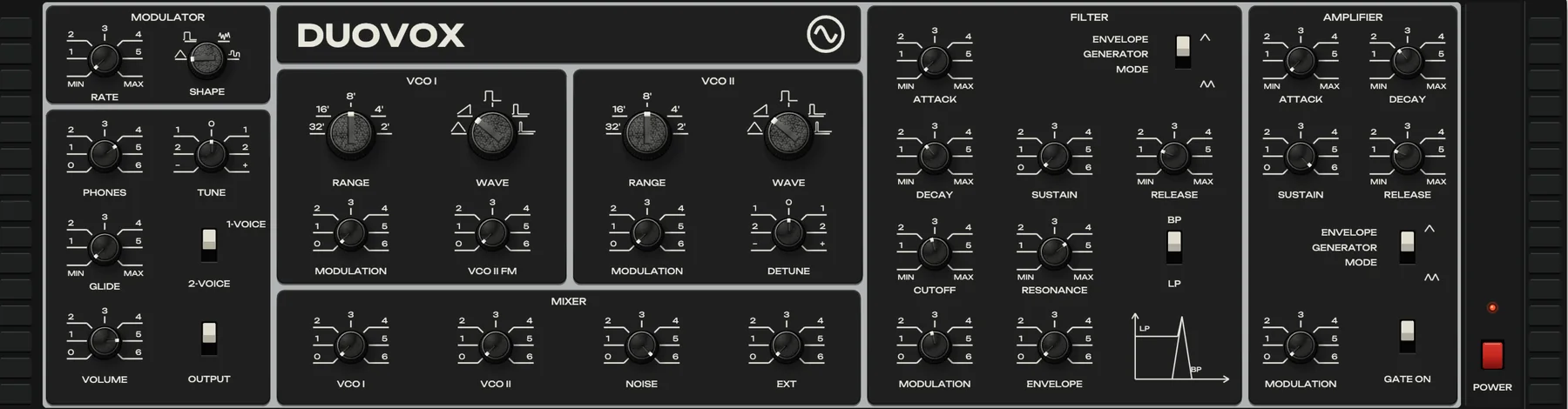
Wind: noise into the band-pass filter, the modulator triangle at its slowest moving the cutoff.TriangleMINBP4.262.7
Wind: noise into the band-pass filter, the modulator triangle at its slowest moving the cutoff.

The band-pass is the Polyvox filter's second output: 6 dB per octave on each side of the cutoff, according to the schematic. It takes a narrow slice out of the noise, and the triangle walks that slice up and down. The depth knob decides how far.

Wind: filter modulation depthDuovox · 0:07
Play
Modulation
Depth of the slow triangle on the cutoff. At 0 it is a steady hiss through a band-pass; around 3 the band starts to rise and fall like gusts; near 6 it swings through the whole range.
Turn the knob →

On these clips the level swing across a gust grows from 2 dB at depth 0 to about 11 dB at the preset's 2.7. The speed of the gusts is the modulator rate. At MIN it runs at 0.7 Hz in Duovox, one gust every 1.4 seconds. Rate is on a bent curve, as owners describe the original pot: the first half of the travel barely moves it, the top rushes.

Wind: modulator rateDuovox · 0:07
Play
Rate
The gust speed. MIN is 0.7 Hz on the Duovox rate law, about one gust every 1.4 s. By 4 (about 7 Hz) the wind turns into a fast whoosh, then into a buzz.
Turn the knob →

Resonance is the difference between air and a whistle. It also changes level a lot: on this player the MIN clip is about 14 dB quieter than the one at 5.1, because a narrow resonant band passes more energy at its peak.

Wind: resonanceDuovox · 0:07
Play
Resonance
How narrow the band is. Low resonance gives broad hiss, around 4 the wind starts to whistle at the cutoff, and near the top it sings a pitch.
Turn the knob →
Load in Duovox: WindNoise into BP, resonance 4.2, triangle at MIN on the cutoff, GATE ON.
Duovox
03Surf

Two envelopes breathing in and out

Surf is the same noise without the modulator. Switch the filter back to LP, cutoff around 2.4, resonance low. Now flip both envelope mode levers to periodic, set both SUSTAIN knobs to 0 and give both envelopes a long ATTACK (about 4.3) and a long DECAY (about 4.7). The filter envelope amount goes to 2.4.
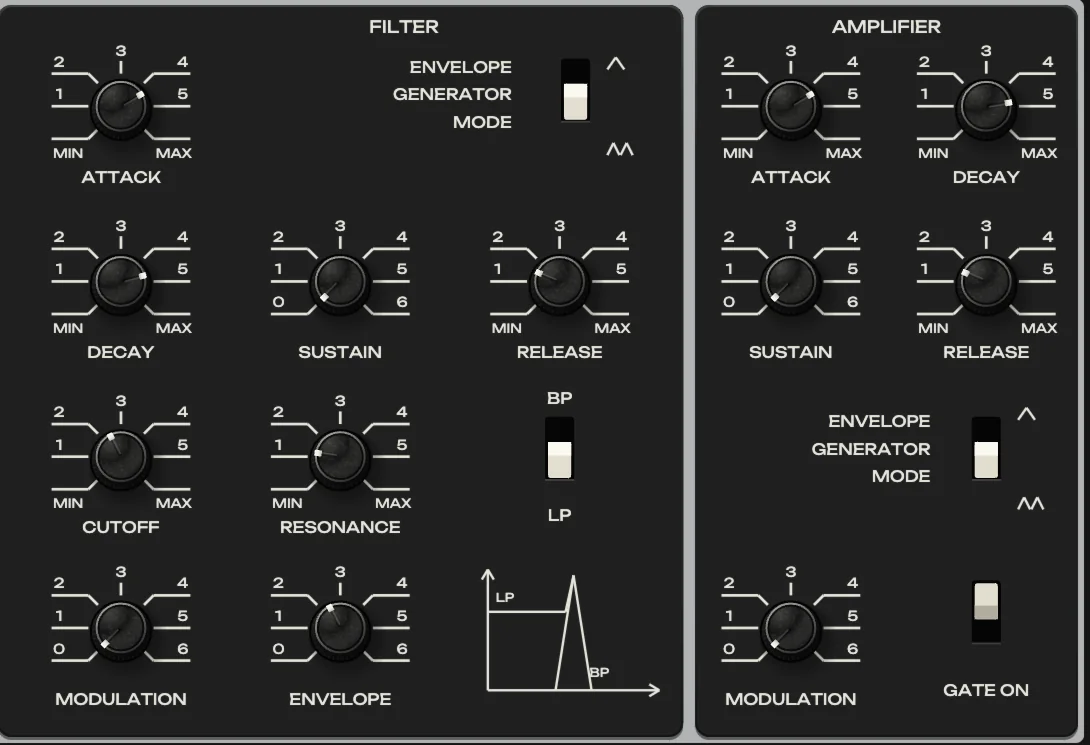
Surf: the filter and the amplifier envelopes both in periodic mode, with long attack and decay, sustain at 0.Loop≈4.3≈4.34.8≈4.7Loop
Surf: the filter and the amplifier envelopes both in periodic mode, with long attack and decay, sustain at 0.

Each wave builds over the attack and drains over the decay, then the loop starts again. In the preset a wave arrives about every 2.8 seconds. The filter envelope opens the sound as the amplifier envelope swells it, so the top of every wave is brighter as well as louder. The player turns both decay knobs together.

Surf: wave length (both envelopes)Duovox · 0:07
Play
Decay
Both decay knobs together. The period of a looping envelope is attack plus decay, so the decay sets how often a wave breaks. Short decays turn the sea into a pump.
Turn the knob →

Measured on these clips, the wave rate goes from about one per 1.1 seconds at 2.7 to one per 3.3 seconds at 5.4. If the two envelopes get slightly different times they drift apart, and the waves stop lining up with their own brightness, which sounds more like a real beach.

04Gunfire

A noise burst, then a burst that repeats

One shot is a noise burst through a filter that snaps open. Noise at 6, LP, cutoff around 2.4, filter ENVELOPE at 6 with a short decay (1.8 on the panel) and sustain 0. On the amplifier: attack at MIN, decay 1.8, sustain 0. Every key press is one shot.
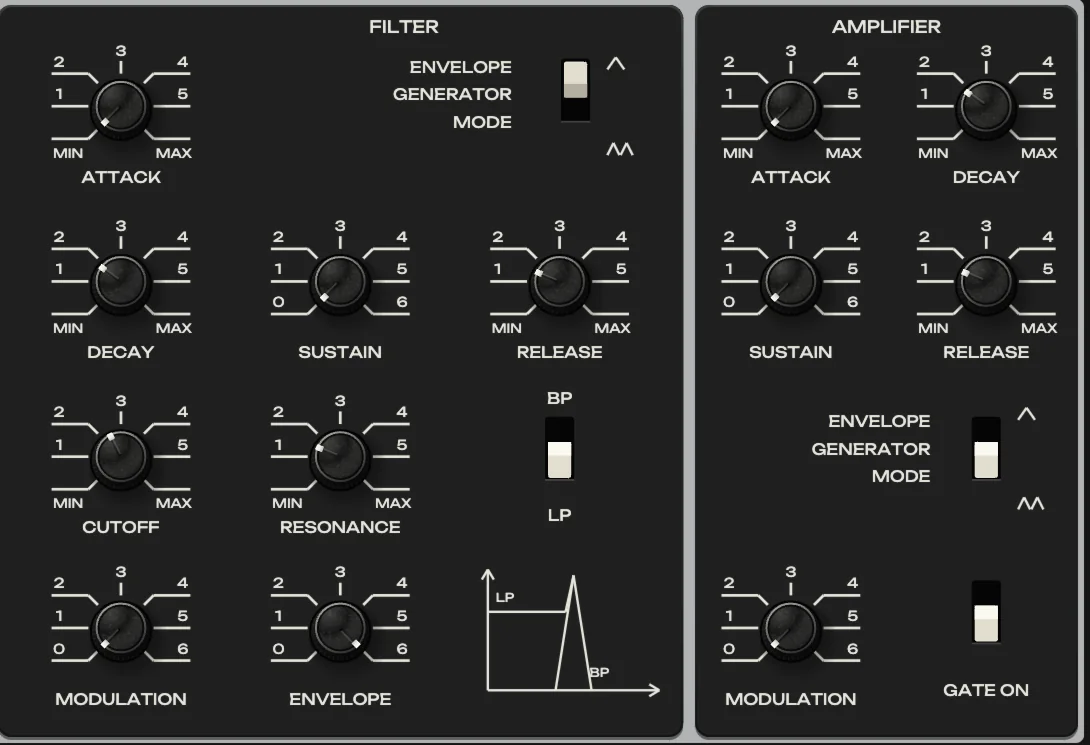
Gunfire: noise with the filter envelope at full and a short looping amplifier envelope.1.81.8Loop2.46
Gunfire: noise with the filter envelope at full and a short looping amplifier envelope.

For the machine gun, flip only the amplifier envelope to periodic. While the key is held the amplifier loops its short attack and decay, about 16 times a second in the preset. The filter envelope stays one-shot, so the first round is the brightest and the rest settle.

Gunfire: single shots, then a burstDuovox · 0:04
Play
Amp env mode
Three short taps and one held key. With the amplifier envelope on one-shot each key is one shot. In periodic mode a held key keeps firing until you let go.
Pick a position →
Gunfire: rate of fireDuovox · 0:04
Play
Decay
The amplifier and filter decay together. Lower is a faster gun with shorter cracks, higher sounds like slower, heavier fire.
Turn the knob →

On the rate player the loop rate measured from the clips falls from about 42 cracks a second at 0.9 to about 4 at 3.0.

05Rain

Sample and hold on a band-pass

Rain uses the modulator's fourth shape, sample and hold: noise sampled at the rate you set and held until the next step, so each step is a new random voltage. Send it to the filter and every step lands the band-pass somewhere new. Noise at 5.4, filter on BP, cutoff 3.6, resonance 4.2, filter MODULATION 3.6. The modulator on S&H at 5.3, which is 19 steps a second in Duovox.
Rain: noise plus VCO I as a triangle at 2 feet, the sample-and-hold jumping the band-pass around 19 times a second.S&H5.32'Triangle33.6
Rain: noise plus VCO I as a triangle at 2 feet, the sample-and-hold jumping the band-pass around 19 times a second.

The extra ingredient is VCO I as a triangle at 2 feet, the highest range, at 3 in the mixer. It puts a pitched tick inside the hiss.

Rain: S&H rateDuovox · 0:05
Play
Rate
How many new random cutoff values per second. Around 2 they are single drips (1.8 Hz), at 4.2 (about 7 Hz) a light shower, at 5.3 (19 Hz) steady rain, at MAX (40 Hz) it smears into a hiss.
Turn the knob →

Slow steps are single drips: at 2.4 the band moves about twice a second. Past 5 the steps run together. Across the player the swing of the clip's brightness shrinks from about 1.3 kHz to 0.9 kHz.

Rain: the triangle in the mixerDuovox · 0:05
Play
VCO I
VCO I at 2 feet puts a steady C6 (about 1 kHz) under the noise. The band-pass only lets it through when a random step lands near it, so the ping comes and goes with the drops. At 0 it is filtered noise and nothing else.
Turn the knob →
Load in Duovox: RainNoise and a 2' triangle into BP, S&H at 19 Hz on the cutoff.
Duovox
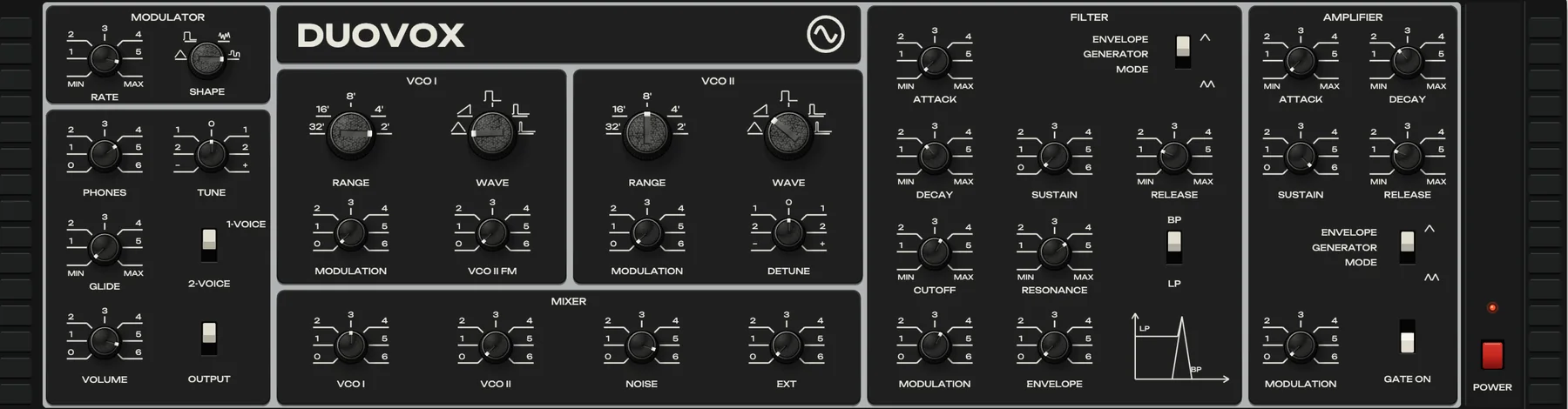
06Steam train

Two loops at two speeds

This is the effect that shows off the two looping envelopes best. Noise at 6, LP, cutoff 2.1, resonance 1.8. Both envelope levers on periodic, both sustains at 0. The amplifier envelope makes the chuff: attack 2.1, decay 3.3. The filter envelope loops at a different speed (attack 1.8, decay 3) with the ENVELOPE amount at 3. GATE ON holds it all.
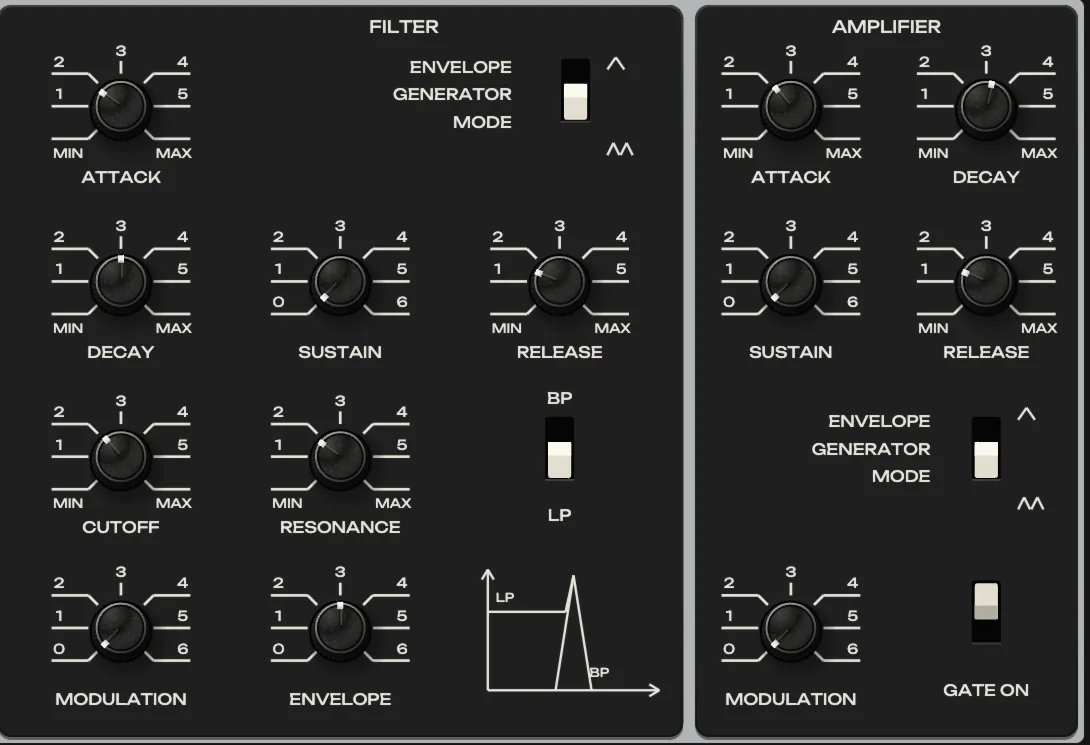
Steam Train: two looping envelopes at different speeds. The amplifier makes the chuff, the filter loop drifts against it.1.82.13.333
Steam Train: two looping envelopes at different speeds. The amplifier makes the chuff, the filter loop drifts against it.

In the preset the amplifier loop runs at about 2.6 cycles a second and the filter loop at about 3.7. Because the two never line up, the bright moments wander across the chuffs. Turn the amplifier loop on its own and the engine changes speed under a filter loop that does not.

Steam Train: speed of the amplifier loopDuovox · 0:07
Play
Amp A + D
Amplifier attack and decay turned together. Lower values shorten the cycle and the engine runs faster; the filter loop keeps its own speed, so the accents slide around.
Turn the knob →

The amplifier loop measured from 7.8 cycles a second at 2.1 down to 0.4 at 4.5. To make the train pull away, sweep all four timing knobs from long to short. The clip below does it over eight seconds with the plug-in's own parameter ramps, as you would by hand.

Steam Train leaving the stationDuovox · 0:10
Play
All four looping knobs swept from slow to fast over eight seconds, as you would turn them by hand.
Load in Duovox: Steam TrainTwo periodic envelopes at different speeds on noise, GATE ON.
Duovox
07Not in the passport

UFO, laser zap and a satellite beacon

These three use the oscillators instead of noise, and they lean on the modulator's square wave. On the Polyvox that square is unipolar: Kuzmin describes it as positive pulses only. Pitch modulated by it jumps from the played note to a note above and back, a trill, where most synths would wobble around the note.

UFO

VCO I on the triangle at 4 feet, MODULATION 3.9 with the modulator on the square at about 2.6 Hz. VCO II on the square at 8 feet, but at 0 in the mixer: you never hear it directly. Instead its VCO II FM knob on the VCO I plate bends VCO I's frequency at audio rate.
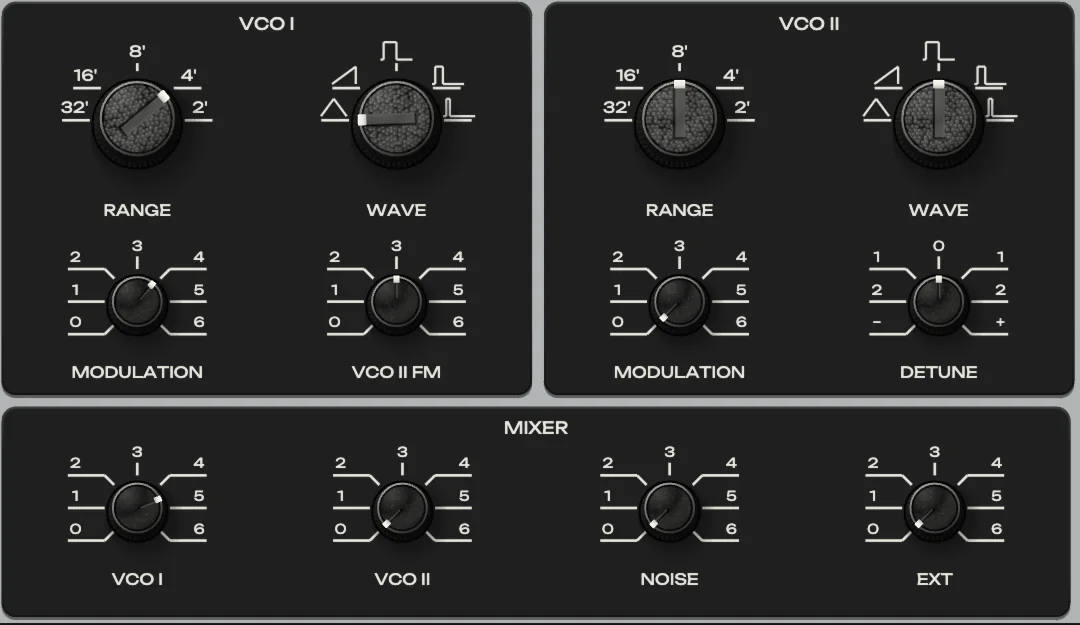
UFO: VCO I triangle at 4 feet, frequency modulated by VCO II (a square at 8 feet that you do not hear in the mixer), and a square-wave trill from the modulator.4'Triangle3.930
UFO: VCO I triangle at 4 feet, frequency modulated by VCO II (a square at 8 feet that you do not hear in the mixer), and a square-wave trill from the modulator.
UFO: VCO II FMDuovox · 0:05
Play
VCO II FM
How hard VCO II bends VCO I. At 0 it is a plain two-note trill of a triangle. Turn it up and new partials appear between the harmonics: 12 spectral peaks at 0, more than 30 from 3 up, most of them no longer in tune with the note.
Turn the knob →

Laser zap

A saw at 4 feet into a low-pass closed almost all the way (cutoff 0.7), resonance up at 5.4, filter ENVELOPE at 6 with a decay around 1.9. Each key throws the cutoff to the top and lets it fall back, and the resonance sings the fall.
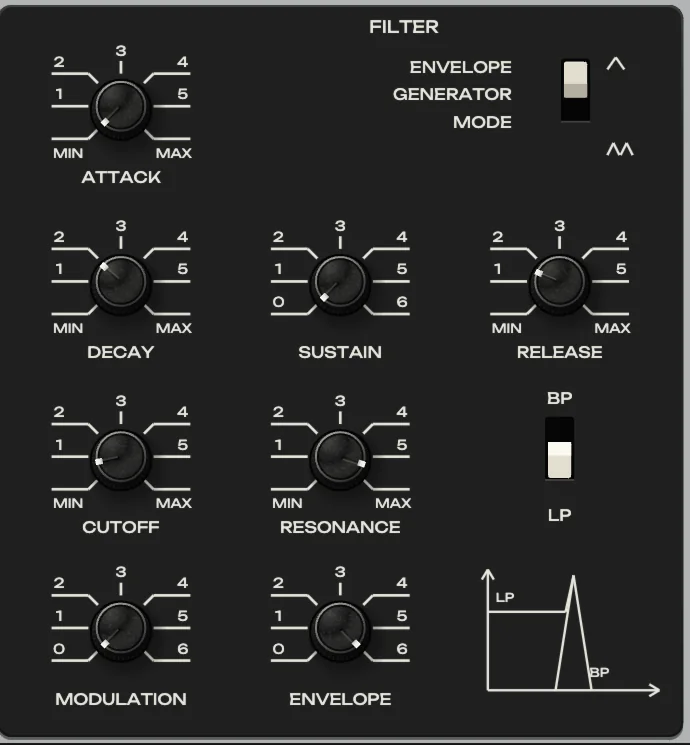
Laser Zap: a resonant filter closed down, kicked to the top by the envelope, falling back over the decay.1.90.75.46
Laser Zap: a resonant filter closed down, kicked to the top by the envelope, falling back over the decay.
Laser Zap: filter decayDuovox · 0:03
Play
Decay
The length of the downward sweep: 28 ms at 0.9, 90 ms at the preset's 1.9, 440 ms at 3.3 on the plug-in's readout. Short is a chirp, long is a falling whistle.
Turn the knob →
Laser Zap: resonanceDuovox · 0:03
Play
Resonance
Below 4.5 the zap is mostly a filtered saw. At 5.4 the filter rings at its own pitch while the envelope drags it down, and the average brightness of the clip jumps from about 3.8 to 6.9 kHz.
Turn the knob →

Sputnik beacon

A triangle at 4 feet, filter mostly open, the square wave on VCO I's pitch with MODULATION 4.3 and the rate at 4.1, about 6.5 Hz. The deep unipolar trill reads as beeps between two pitches.
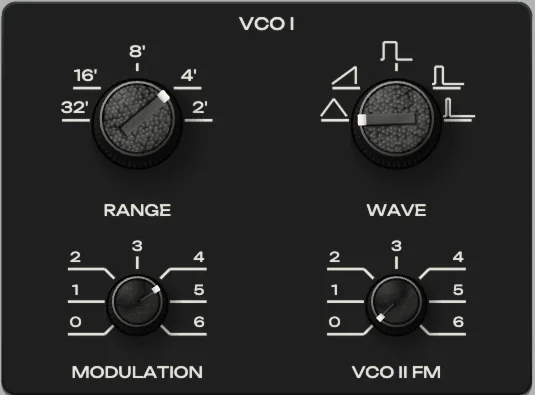
Sputnik Beacon: a triangle at 4 feet with deep square-wave pitch modulation.4'Triangle4.3
Sputnik Beacon: a triangle at 4 feet with deep square-wave pitch modulation.
Sputnik Beacon: modulator rateDuovox · 0:05
Play
Rate
The beep rate. The square wave from the modulator only goes up, so the pitch jumps between the key and a note above it. At 4.1 (about 6.6 Hz) it beeps; higher it becomes a warble.
Turn the knob →
08The filter alone

A landing saucer and a feedback howl

The last two take the oscillators away. For UFO Landing, every mixer knob is at 0 and RESONANCE is at MAX, so the filter oscillates by itself and becomes the sound source. A slow triangle (about 1 Hz) on the filter's MODULATION at 3.3 makes it waver, GLIDE at 4.8 slides it between keys, and the rear panel's key tracking is turned up to 80 % so the pitch follows the keyboard more closely than the 62 % default.
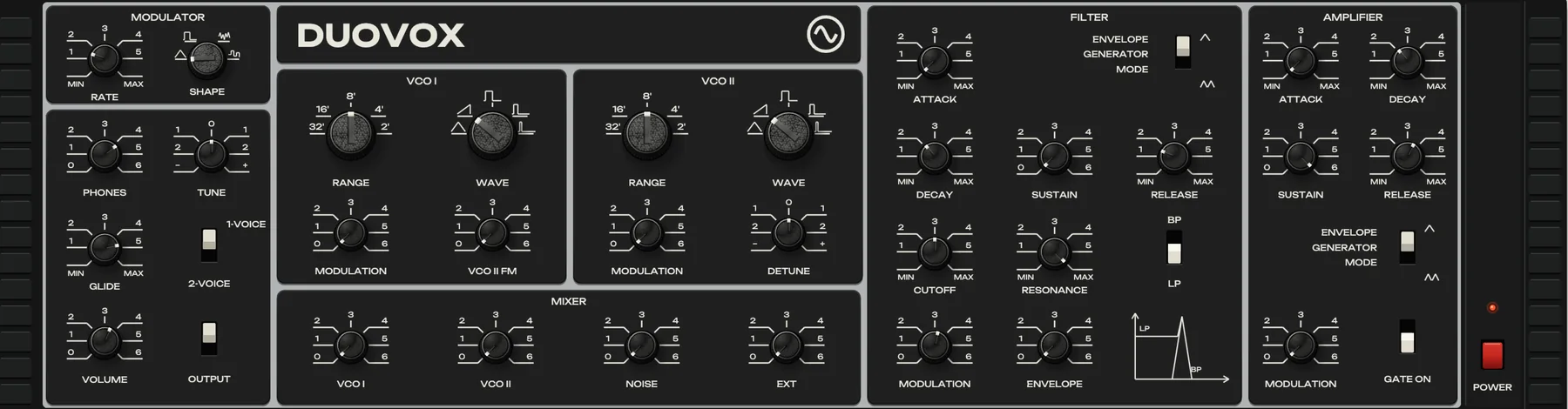
UFO Landing: nothing in the mixer at all. The sound is the filter oscillating on its own, swept by a slow triangle, with glide between keys.4.8MAX0003.3
UFO Landing: nothing in the mixer at all. The sound is the filter oscillating on its own, swept by a slow triangle, with glide between keys.
UFO Landing, four keys going downDuovox · 0:08
Play
Four held keys, each lower than the last. The filter pitch glides down between them while the triangle keeps it wobbling.

Feedback Howl uses the fourth mixer input. On the 1982 unit «ВНЕШ.» (EXT) was an external input on a DIN socket at the back. Duovox has no audio input, so its EXT knob listens to the plug-in's own output instead, the way a patch cord from the output to the input would. The preset has a square at 16 feet at 4.5 in the mixer and EXT at 4.5.
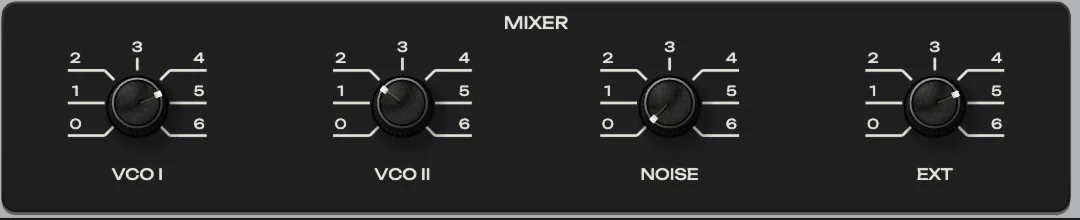
Feedback Howl: in Duovox the EXT knob hears the plug-in's own output, like a patch cord from the output back to the input.4.51.8EXT 4.5
Feedback Howl: in Duovox the EXT knob hears the plug-in's own output, like a patch cord from the output back to the input.
Feedback Howl: EXT levelDuovox · 0:04
Play
EXT
How much of the output goes back in. Up to about 5 the loop thickens and squashes the note. Past 5.5 it takes over: almost all the energy moves off the note's harmonics and the patch howls at pitches of its own.
Turn the knob →

We measured the share of energy that sits off the played note's harmonics on each clip. Up to 5.1 it stays under 1 %. At 5.5 the second note jumps to about 90 %, and at 6 both do. The preset sits just under that edge, so a small move of the knob tips it over.

09All ten

The FX bank side by side

The player runs the same key pattern through all ten presets, level-matched. Gunfire and Laser Zap come out quieter than the rest because their peaks hit the limit first.

Ten effects, one keyDuovox · 0:06
Play
Preset
The ten FX presets from this page, each on the same key pattern and level-matched.
Pick a position →
The ten patches on one card
WindNoise · BPMod 2.7Resonance 4.2, triangle at MIN, GATE ON.
SurfNoise · LPA 4.3 D 4.7Both envelopes periodic, sustain 0, GATE ON.
GunfireNoise · LPEnv 6Amp envelope periodic, decay 1.8, hold a key.
RainNoise + 2' tri · BPS&H 5.3Filter modulation 3.6, resonance 4.2.
Steam TrainNoise · LP2 loopsAmp A 2.1 D 3.3, filter A 1.8 D 3, GATE ON.
UFO4' triFM 3Square trill 3.9 at 2.6 Hz, VCO II silent in the mixer.
Laser Zap4' saw · LPRes 5.4Cutoff 0.7, envelope 6, decay 1.9.
Sputnik Beacon4' triMod 4.3Square at 6.5 Hz on the pitch.
UFO LandingMixer emptyRes MAXTriangle at 1 Hz on the cutoff, glide 4.8.
Feedback Howl16' squareEXT 4.5Push EXT past 5.5 for the howl.

The looping envelopes behind surf and the train get a lesson of their own in the looping envelope, the square-wave trill behind the beacon is in modulator trills, and the sound playground has a player for nearly every knob on the panel.
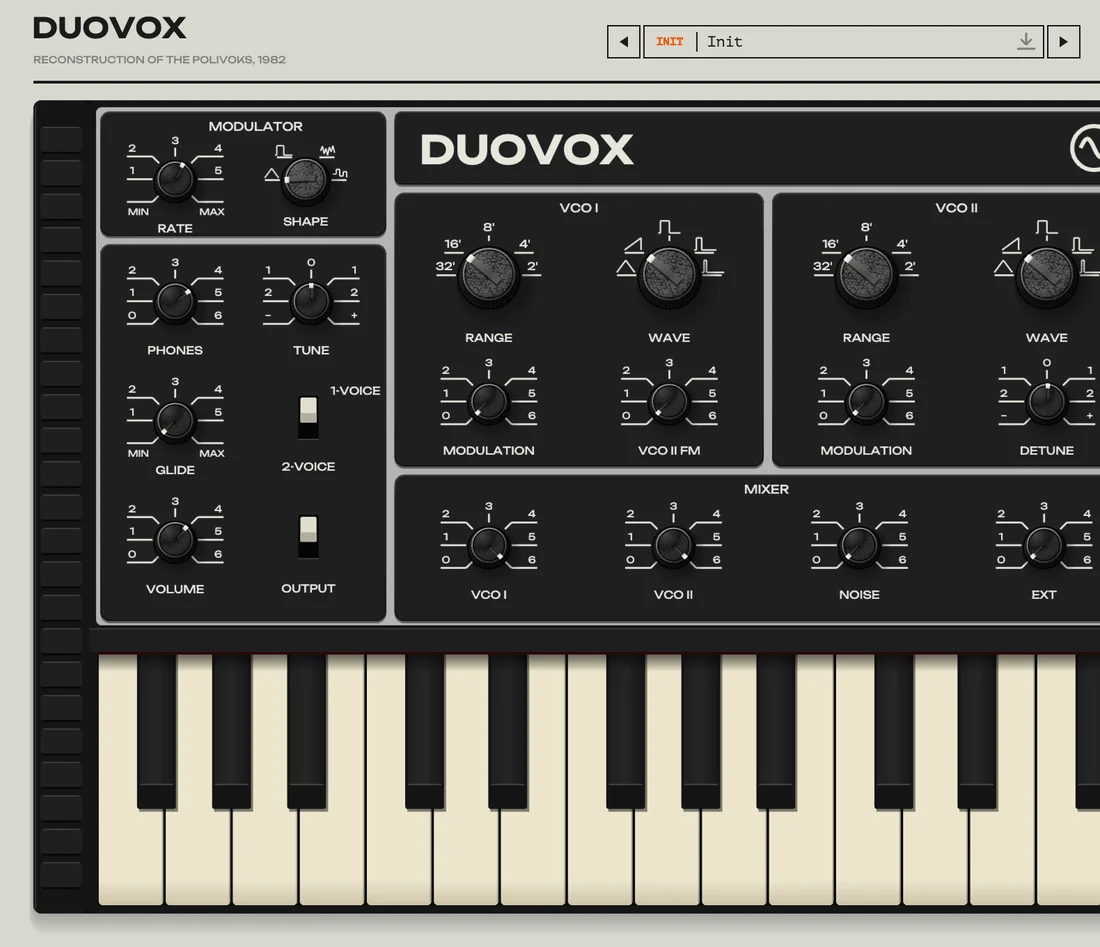
Duovox, the full panel
DUOVOX
The Polivoks (Polyvox) synth as a VST3/AU plug-in
  • The full Polyvox panel, control for control, with the scream, the looping envelopes and duophony
  • A 4x/8x oversampled model of the two-chip filter, calibrated on recordings of real units
  • 257 presets in ten banks and five packs, and a GEN button for new basses, leads and screams
  • Extras the 1982 box never had: poly mode, velocity, pitch bend, drift, a rear panel
macOS 11+ (VST3, AU) · Windows 10/11 (VST3) · free demo
?FAQ

Questions

Can the Polyvox make sound effects without a key held down?

Yes. The lever labelled «ВКЛ.» on the amplifier plate (GATE ON in Duovox) holds the gate open, so the envelopes start and stay open with no key pressed. With the envelopes in periodic mode they keep looping on their own. That is how the wind, surf and train patches on this page run.

How do you make wind on an analog synth?

White noise into a band-pass filter with some resonance, and a slow triangle LFO moving the cutoff. On the Polyvox: noise at 6, filter on BP, resonance around 4, the modulator on the triangle at its slowest rate and the filter MODULATION knob around 3.

How do you make a steam train sound on a synthesizer?

Noise through a low-pass filter, with the amplifier envelope looping for the chuff. On the Polyvox the filter envelope can loop too, at a different speed, so the accents shift against the chuffs. Turn both loops faster together and the train speeds up.

Which Duovox presets are these?

Wind, Surf, Gunfire, Rain, Steam Train, UFO, Laser Zap, Sputnik Beacon, UFO Landing and Feedback Howl, all in the FX bank.

Is the EXT input in Duovox a real audio input?

No. Duovox is an instrument with no audio input, so its EXT knob feeds back the plug-in's own output, like a patch cord from the output socket to the input. On the 1982 unit «ВНЕШ.» was a real external input on a rear DIN socket.

→Keep reading
DUOVOXthe Polivoks (Polyvox) plug-in$59Get Duovox