The Soviet Union built its own synthesizers, electric organs and drum machines through the 1970s and 1980s, in factories from Kachkanar to Murom to Zhitomir. Almost none of them were sold abroad, and most are rare today. Only one has been modelled in software in any depth: the Polyvox (Polivoks, Поливокс). The rest survive as sample libraries, a few freeware plug-ins, or nothing at all.
We make one of the Polivoks plug-ins, Duovox, so it is the centre of this page, and we say so up front. Everything else is listed with its maker, price, format and a link to where we checked it. When a product lives only on a forum post or a search snippet, it is not here. The sound players are all Duovox.
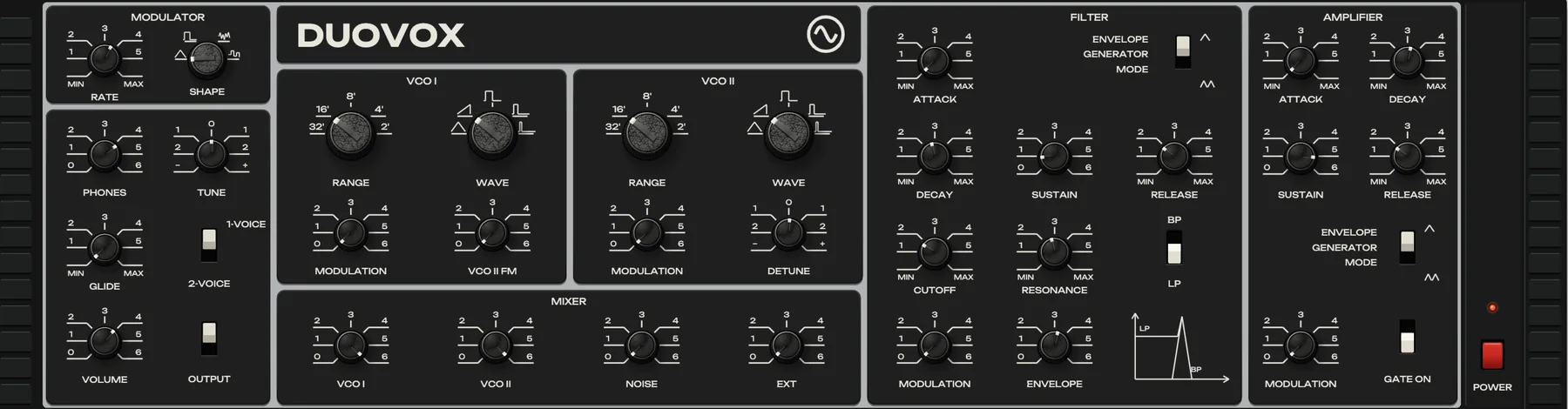 Five wavesVCO II FM1 / 2 voiceLP / BP
Which Soviet instruments have software
| Instrument | What it was | In software today |
|---|---|---|
| Formanta Polivoks | Duophonic synth, 1982 | Modelled synths (Duovox, Atomika), a filter effect, a Kontakt library, free 32-bit VSTs |
| ANS | Photoelectronic synth, finished 1957 or 1958 | Virtual ANS, a free standalone app (not a plug-in) |
| Elektronika EM-25 | Polyphonic string, organ and brass machine | Soundiron Elektronik 25, sampled, full Kontakt |
| Aelita, Altair 231, Maestro, Tom 1501 | Synths from Murom, Zhitomir and Kachkanar | Sampled together in Soviet Synths From Mars |
| Estradin 230 | Monosynth on the Minimoog pattern | Soviet Synths From Mars; SyncerSoft Estradion, free, Win 32-bit |
| Junost-70 | Transistor electric organ, 1970s | Rhythmic Robot Soviet Organ (Kontakt), UltraRare Yunost 70 |
| Lell electro-organ | Compact organ, 1980s | Elementary Sounds Drema, sampled |
| Lel UDS, Formanta UDS, Elista | Analogue drum machines | Tapechild UDS-16, Elsita-V, sample packs |
| Kvintet, Faemi, Formanta EMS-01, Alisa | Preset synth, organs, monosynth | No plug-in found |
The Polivoks: the one with real emulations
The Polyvox was designed at the Vector enterprise in Sverdlovsk by Vladimir Kuzmin, with Olimpiada Kuzmina on the panel design, and built at the Formanta radio plant in Kachkanar from 1982 (Sound On Sound, 2010). Kuzmin told Red Bull Music Academy that they made 25,000, at 920 rubles each, and that none were sold outside the USSR (RBMA, 2016). It has two oscillators with five waveforms each, VCO II able to frequency-modulate VCO I, a 12 dB filter with low-pass and band-pass modes built from two К140УД12 op-amps, two envelopes that can loop, and a keyboard that plays two notes at once through one filter.
That filter is the sound people come for. Kuzmin's op-amp integrators saturate early, and the mixer in front of them feeds them at unity gain with no limit (Kuzmin's article), so turning the oscillators up drives the filter itself.
On Soviet Monster Bass the clip's spectral centre barely moves between 0.6 and 1.8 on the cutoff (about 1,010 to 1,050 Hz), then climbs to 1,330 Hz at 3.6 and 1,950 Hz at 4.8. Below the middle of the knob the brightness hardly changes; the opening happens in the top half.
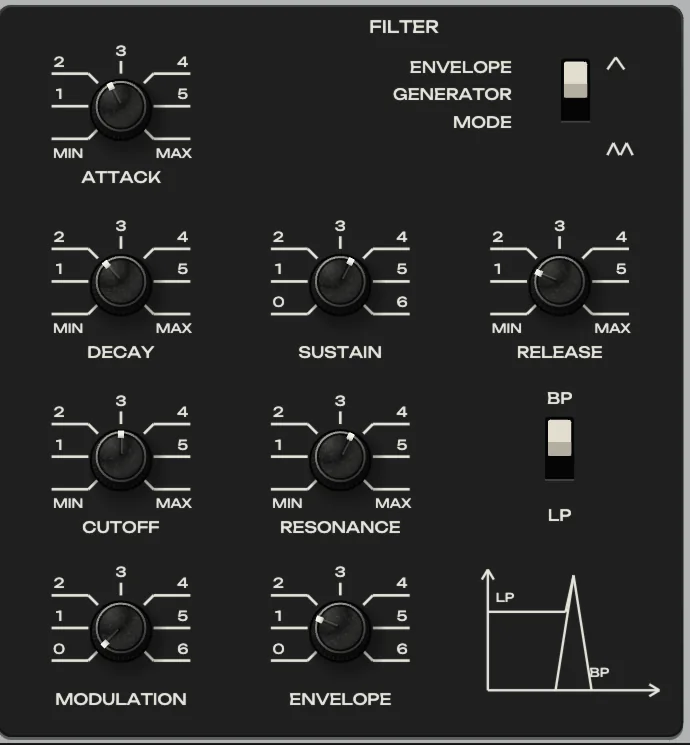 BPCutoffResonance
The same circuit gives a band-pass output. Switched to BP, Bandpass Vox loses its low end: the spectral centre goes from about 1.2 kHz in LP to 2 kHz in BP, and the clip comes out about 5 dB quieter, because the band-pass throws away the fundamentals.
VCO II can bend VCO I at audio rate. On FM Bell Lead, with VCO II a square tuned a little more than an octave above the triangle on VCO I, the spectral centre moves from about 560 Hz with no FM to 1.1 kHz at 4.8, as the extra partials appear at intervals that are not harmonics of the note.
The Polivoks plug-ins
- Monosounds DuovoxOur model. The 1982 front panel control for control, including the 1/2-voice switch, the gate-hold switch and the output mute; additions (poly mode, velocity, drift, key track) on a rear panel. 257 presets. macOS 11+ VST3 / AU, Windows 10 and 11 VST3. $29 at launch, then $59. Free demo.Duovox ↗
- Cherry Audio AtomikaReleased October 2024. Modelled, with mono and duophonic modes plus up to 16-voice poly, extra filter modes, arpeggiator and effects. VST, VST3, AU, AAX, standalone. $49 list.Cherry Audio ↗
- Cherry Audio FiltomikaThe Atomika filter as an effect, for your own audio. $19.Cherry Audio ↗
- Hideaway Studio PolivoxSampled Kontakt library, 845 samples, full Kontakt 4.2.4+. $23.25 (list $27.90).Best Service ↗
- Polyvoks Station, PolyakovFree, Windows 32-bit only, from 2007 and 2017. See free Polivoks VSTs.plugins4free ↗
The full side-by-side, with reviews, is in every Polivoks plug-in compared.
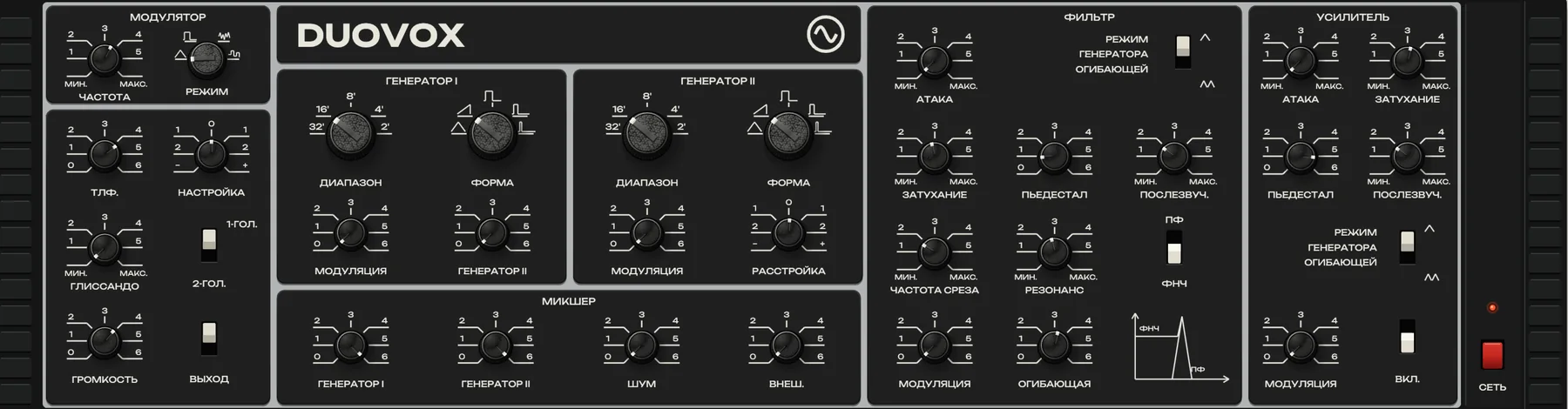
Duovox can show the panel in its original Cyrillic or in English. Either way the knobs are where they were in 1982.
Murzin's photoelectronic synthesizer
The ANS is the oldest instrument here and the least like a keyboard synth. Evgeny Murzin worked on it for two decades and finished it in 1957 or 1958, depending on the source. Sine waves printed on glass discs shine through a glass plate coated in black mastic; you scratch the score into the mastic, and photocells turn the light into sound, with pitch on the vertical axis and time on the horizontal. Only one survives, at the Glinka Museum of Musical Culture in Moscow, and Edward Artemiev used it on the score for Tarkovsky's Solaris (1972) (Wikipedia; MusicTech, 2015).
Alexander Zolotov's Virtual ANS recreates the idea: you paint a spectrogram and it plays. Version 3.0.4 came out in October 2025 for Windows, macOS and Linux as a free download (the author asks for donations), with paid iOS and Android versions. It is a standalone app, not a VST or AU, so you record its output into your DAW.
EM-25, the polyphonic one
"Elektronika" was a brand name used across many Soviet electronics factories. The EM-25 is a fully polyphonic divide-down machine with string, organ and brass sections that all share one filter, one amplifier and one envelope (Hollow Sun); MusicTech calls it the Soviet answer to a Roland Juno in looks, though simpler inside.
Soundiron's Elektronik 25 samples one: $29, 3.6 GB, released in 2021. It needs the full Kontakt 5.5 or later; the free Kontakt Player runs it only in demo mode. We found no modelled EM-25, and nothing for the EM-26, EM-04 or Spectr synths.
Aelita, Estradin and four more in one library
The Aelita was a monophonic three-oscillator synth with 44 keys, built at the Murom radio plant from 1980 (Wikipedia). The Estradin 230 came from Zhitomir in the mid-1980s, and Gordon Reid's SOS review says it closely copied the Minimoog's layout and sound. Kachkanar, the Polyvox's plant, also made the Maestro polysynth.
None of these has a modelled plug-in. Samples From Mars' Soviet Synths From Mars samples them together: 50 presets from the Polivoks, Aelita, Altair 231, Estradin 230, Maestro and Tom 1501, plus 100 drum hits from the Formanta UDS, Lell UDS and RMIF Elista, for $39. It comes as WAV, SFZ and patches for Ableton Live, FL Studio, Kontakt (full 5.6.5+), Logic, Maschine and Reason. SyncerSoft, who made Polyvoks Station, also released a free Estradion VST of the Estradin 230, again 32-bit Windows only.
Junost and Lell
The Junost-70 (Юность) organ is a decade older than the Polyvox. Rhythmic Robot's Soviet Organ samples one through both its built-in speaker and a separate speaker set, for $37.50 in the full Kontakt 4.2.3 or later. UltraRare's Yunost 70 is a $9 VST and VST3 rompler for Mac and Windows built from recordings of the same organ, produced from 1970 to 1973 on germanium transistors. Elementary Sounds' Drema is built from a 1980s Lell electro-organ, listed at $59 on Pulse Audio.
Soviet drum machines
The Formanta UDS (also sold as Rockton) was a seven-channel analogue drum synth from the same factories as the Polyvox (MusicTech). Three products cover this corner:
- Tapechild UDS-16: a modelled 16-voice drum synth whose models are inspired by the Lel UDS and the Formanta Rockton. VST3, AU and standalone, macOS 11+ and 64-bit Windows 10 and 11. $49, list $79.
- Digital Systemic Elsita-V (2020): a free VST, VST3 and AU model of the Elista, a four-channel analogue drum machine made from 1989 to 1991. A donation unlocks four outputs.
- SampleScience 80s Soviet Drums: $20, sampled from nine machines including the Lel UDS, Formanta UDS and Elista, as VST, VST3 and AU.
A Polyvox makes drums too. The filter self-oscillates into a clean tone, and with the envelopes short it gives kicks, toms and zaps; Duovox has a DRUMS bank of these (see Polyvox drums).
Here the mixer is at zero and nothing but the ringing filter sounds, at an average spectral centre of about 2.3 kHz. On Formanta Whistle the rear panel's key track is at full so the filter's pitch follows the keys.
Soviet instruments with no plug-in
We searched for each of these by its Latin and Cyrillic names, with "VST", "plugin", "Kontakt" and "samples", and found nothing we could verify:
- Kvintet (Квинтет), the 1986 preset string synth Kuzmin designed at Formanta, with a detune function (MatrixSynth). Reid calls it his favourite early Formanta.
- Faemi, which SOS describes as the first commercially successful Russian electronic keyboard, designed by Vladimir Lugovetz; Kuzmin worked on its polyphonic Faemi-M.
- Formanta EMS-01, a two-manual organ with a monosynth inside, which Kuzmin himself called too heavy and unreliable (SOS).
- Alisa-1377 and 1387 from Lyubertsy. SyncerSoft made a free Alice-1377, but KVR lists it as no longer available.
If you own one of these and want to record it, sample libraries are how most Soviet instruments got into software, and the field is open.
Where to start
If you want to play a Soviet synthesizer as an instrument, with the knobs doing what they did, the Polyvox is where the software is, and Duovox is the version that keeps the 1982 panel as it was. Atomika is the bigger modern synth around the same filter. For the sound of Soviet string machines, organs and other synths, the sampled libraries above are honest and cheap: Elektronik 25 for the EM-25, Soviet Synths From Mars for six synths in one, Soviet Organ or Yunost 70 for the Junost. For drums, Elsita-V costs nothing and UDS-16 goes further.
The Duovox demo is the whole instrument with a burst of noise every 45 seconds, no preset saving and no offline render, so you can try it on Mac or Windows before deciding.
Product names are trademarks of their owners; mentioned for comparison only.
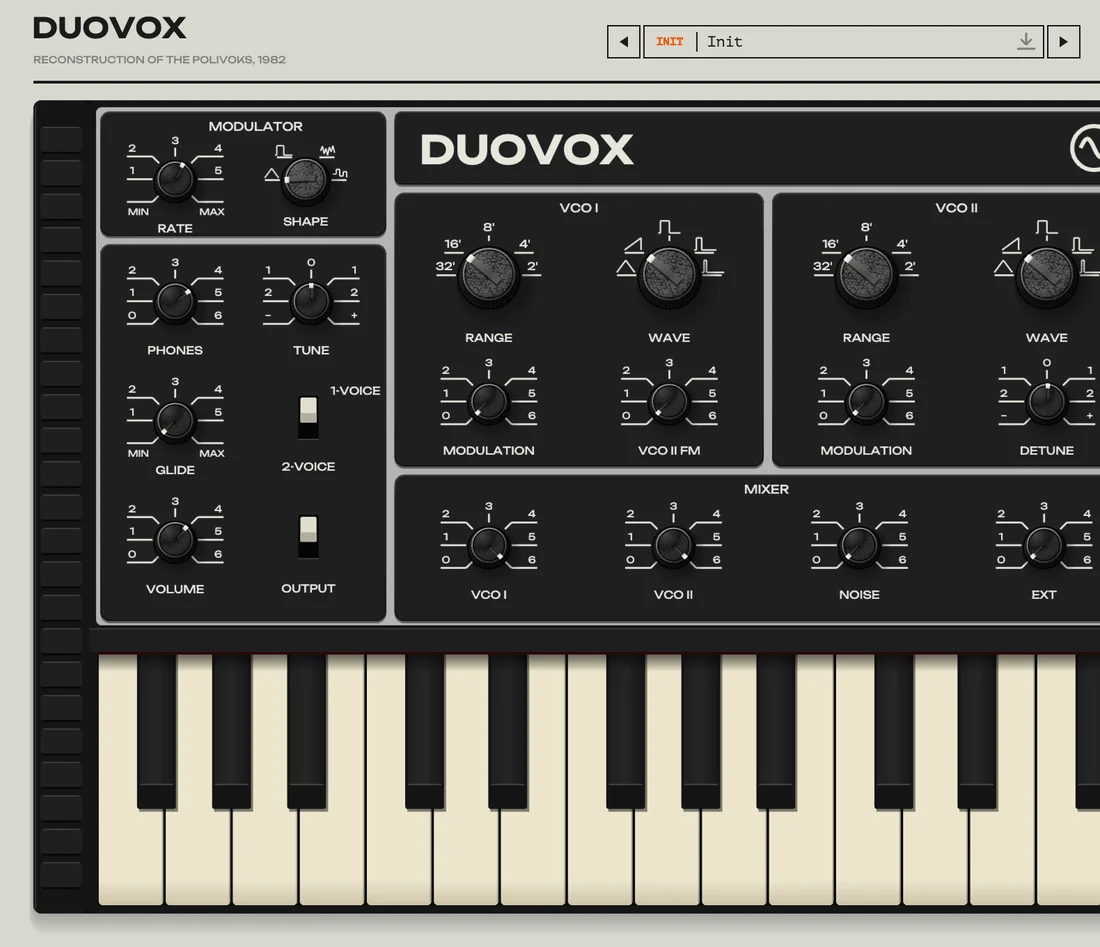
- The full Polyvox panel, control for control, with the scream, the looping envelopes and duophony
- A 4x/8x oversampled model of the two-chip filter, calibrated on recordings of real units
- 257 presets in ten banks and five packs, and a GEN button for new basses, leads and screams
- Extras the 1982 box never had: poly mode, velocity, pitch bend, drift, a rear panel