If you searched for the Behringer Polyvox (Polivoks, Поливокс), the short answer is that it does not exist yet. Behringer announced it in July 2021 together with Vladimir Kuzmin, the engineer who designed the 1982 original, and showed one prototype photo in August 2023. We checked again on 19 October 2026 and found no release date, no price and no product page.
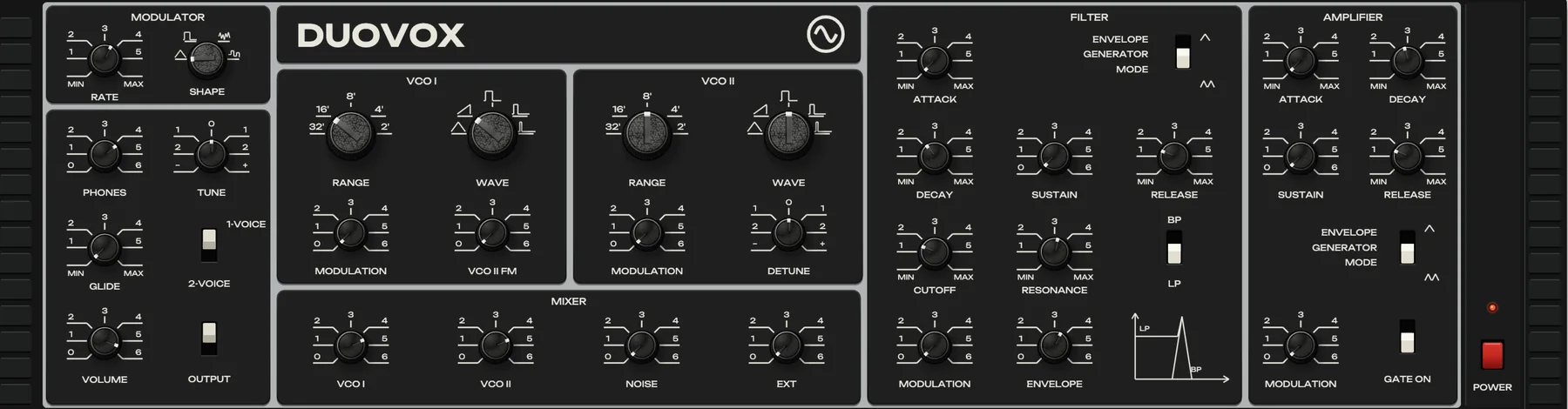
Below is everything the public record says, with links, and nothing we cannot back up. After that, the options a Polivoks buyer has today. The screenshots and sounds come from Duovox, our reconstruction of the original panel, and we use them to show the 1982 features any new Polyvox will be judged against.
The trademark and the announcement
Behringer has owned the Polivoks trademarks since 2019, according to Synth Anatomy. On 16 July 2021 the company announced that Kuzmin had joined it to "reimagine" the instrument. Sound On Sound reported that Kuzmin had contacted Uli Behringer himself because he wanted his work to carry on, and that Uli welcomed him to the team. The Yekaterinburg site e1.ru dated the first talks to April 2021.
The announcement had no specification, no date and no price. Sound On Sound assumed it would be made in large numbers, and MusicRadar and Sonicstate ran the same news. For context: the original was designed at the Vector enterprise in Sverdlovsk, built at the Formanta plant in Kachkanar from 1982 to about 1990, sold for 920 rubles, and Kuzmin told Red Bull Music Academy that about 25,000 were made. The history page has the full story.
The prototype photo
On 25 August 2023 Behringer posted a photo of a prototype on Facebook. Synth Anatomy and Synthtopia both reported it, and Synth Anatomy described the unit as "undergoing thorough testing and hopefully the approval of Vladimir". The price was TBA. Here is what the photo showed, sorted against the 1982 panel (our sort, from the factory documentation and Kuzmin's own article):
| On the 2023 prototype | On the 1982 original |
|---|---|
| Two oscillators, 32' to 2', detune | Yes: ДИАПАЗОН 32' to 2' on both, РАССТРОЙКА on VCO II |
| Pulse width and PWM controls | No. Five fixed waveforms, no PWM |
| Sub-oscillator | No |
| FM, noise, external input level | Yes: VCO II into VCO I, ШУМ, ВНЕШ. |
| LP / BP filter with its own two-mode ADSR | Yes: ФНЧ / ПФ, one-shot or periodic envelope |
| Second two-mode ADSR, gate-on, LFO to the amp | Yes: УСИЛИТЕЛЬ plate with ВКЛ. and МОДУЛЯЦИЯ |
| LFO with rate, waveform and slope | Rate and four waveforms; no slope control |
| Mono / duophonic switch | Yes: 1-ГОЛ. / 2-ГОЛ. |
| MIDI In on the front, CV/gate | No MIDI, no CV/gate |
| Labels in two languages | Russian only |
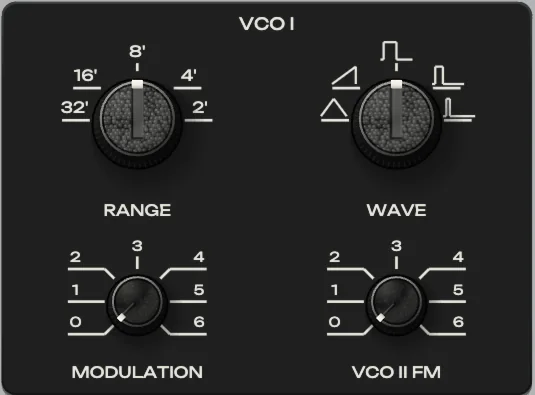
So the prototype kept the 1982 control set and put extras on top of it. Most of the extras are about control (MIDI, CV, a second language on the panel). PWM is the one that reaches the sound itself. The original's waveform selector has five detented positions, and the three pulse widths are fixed. The Sound On Sound audio page notes there is no PWM.
 8'WAVE
Play the five positions below. VCO I is on its own, the filter is mostly open and the clips are level-matched, so you hear only the waveform. In Duovox the three pulse positions are about 45, 20 and 9 percent wide, the widths we measured on recordings of three real units. The tone moves in steps. A PWM knob would let it sweep, which is a different instrument, and if the Behringer version ships with PWM it will be able to make sounds the original cannot.
Duophony and looping envelopes
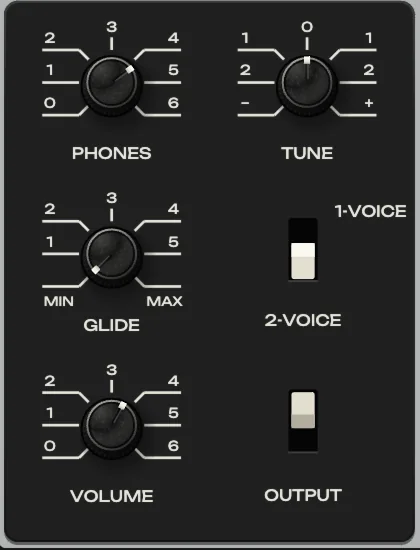
Two things on the prototype matter more than the additions, because they are what makes a Polyvox play like one. The first is the voice switch. In 2-voice mode the keyboard sends the upper of two held keys to one oscillator and the lower to the other, and both notes go through the same filter and amplifier (Sound On Sound, 2010; Kuzmin's article). It is a duophonic synth with one shared signal path, which is why two notes interact.
 1-VOICE / 2-VOICEGLIDE
The player runs the same two-hand phrase in both modes. In 1-voice mode both oscillators follow one key and the lowest held key wins, so the right-hand melody is lost under the held bass note. In 2-voice mode both lines play.
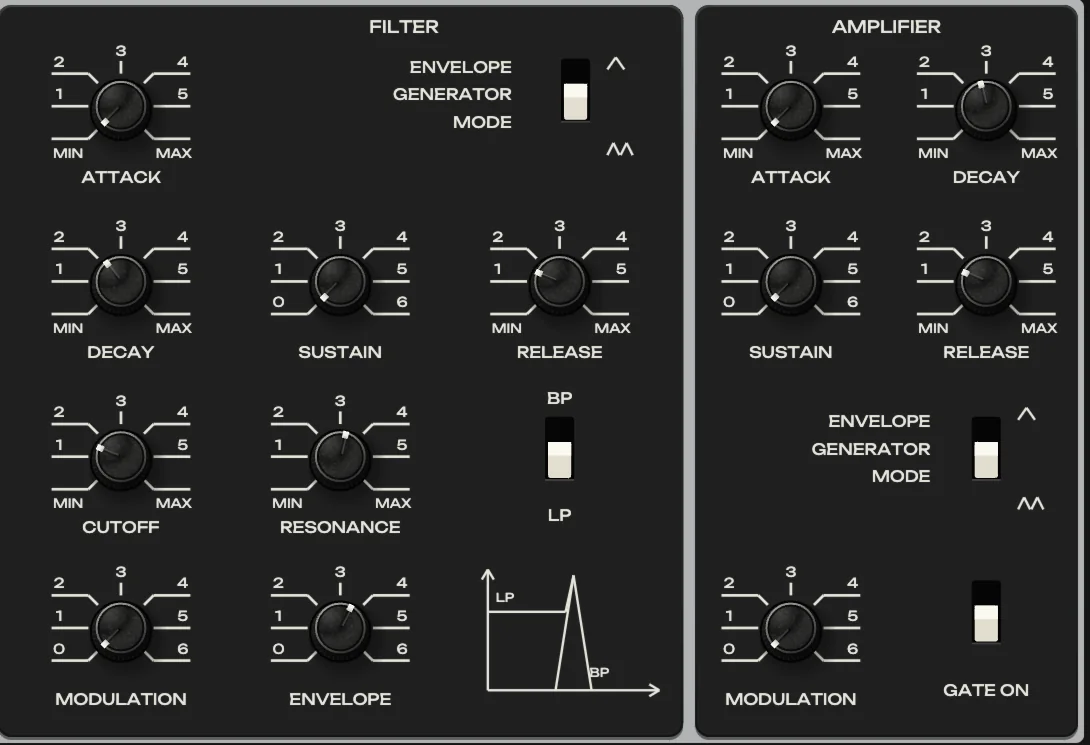
The second is the envelope mode switch on the filter and amplifier plates. In the periodic position, with sustain at 0, the envelope repeats its attack and decay for as long as the key is down, starting from the key press each time (Kuzmin). With different decay times on the two plates the filter and the level loop at different speeds. The prototype's "ADSR with two modes" suggests Behringer kept it.
 LoopingDECAYDECAYSUSTAIN 0Looping
On the last position the amplifier loops too, so the clip is quieter on average: the level falls to zero at the end of every cycle. That is the preset doing what the panel says, not a rendering problem. There is more on this in the looping envelope tutorial.
No news, then Kuzmin's death
After August 2023 the trail goes quiet. MusicTech's guide to Behringer's pipeline, dated April 2025, says Behringer had given no further updates. MusicRadar's 2025 roundup of announced but unreleased Behringer products lists it as a Polivoks clone with the price TBA and no news after the prototype post.
Vladimir Kuzmin died on 12 June 2026, aged 72, after a third stroke (Fontanka). Elta Music, which worked with him on its own Polivoks instruments, announced it. Synth Anatomy wrote that the Behringer synth "has not been released" and that its future is now uncertain.
On 19 October 2026 we searched again: news sites, Behringer's own site, retailers. We found no post-2023 statement from Behringer about the Polivoks and no product page or shop listing. We don't know whether the project is paused, cancelled or close to release, and we won't guess. If it ships, this page gets updated.
The eight-voice synth shown at Superbooth 2026 is the Elta Music Polivoks-8 (also written POLYVOX 8), a different project from a different company, expected at about 2,000 euros (Sonicstate). It has no release date either.
What a Polivoks buyer can do today
There are four routes, and they differ a lot in money and in how close they get to the 1982 instrument.
A used original
Originals turn up on Reverb, eBay and Russian classifieds. Asking prices in the West sit roughly between 1,000 and 2,000 dollars, with serviced and MIDI-retrofitted units at the top; inside Russia they go for roughly 15,000 to 35,000 rubles (price snapshot). Check the keyboard, which Gordon Reid called the worst he had played, the brittle plastic side cheeks, scratchy pots and tuning drift. Plan on a service. The hardware vs plug-in page goes through the faults one by one.
The reissues and circuit-based hardware
- Polivoks Pro (2016): 100 keyboardless units hand-built in Moscow with Kuzmin's involvement, mostly from Soviet-era parts, with MIDI. Sound On Sound reviewed it in 2018 at 1,650 euros. You will only find one used.
- Elta Music Polivoks-M (2018): a one-oscillator desktop based on a 1990 Kuzmin concept, made with him, launched at about 500 dollars. Elta's PF-3 stereo filter costs 350 euros direct.
- Eurorack filters on the original chip type: the Erica Synths Black Polivoks VCF (around 180 to 200 euros) and the Harvestman R1982 VCF, which was made with Kuzmin.
The filters give you the circuit's grit on anything you feed them. They don't give you the panel: no duophony, no looping envelope pair, no hot mixer in front.
A plug-in
Several plug-ins model the Polyvox, sample it or borrow from it. They differ in duophony, external input and what they add, and our comparison of every Polyvox plug-in lays them out side by side with sources.
Duovox is ours. It keeps the 1982 control set on the front: the five fixed waveforms, the voice switch with the original note assignment, the periodic envelopes, ВКЛ. and ВЫХОД, and a filter model calibrated against recordings of real units. The extras (poly mode, velocity, pitch bend, drift) are on a separate rear panel. It has no audio input: its ВНЕШ. (EXT) knob feeds the plug-in's own output back into the mixer, like a patch cord from the output to the input.
Sources
- Synth Anatomy, 2021Behringer has owned the Polivoks trademarks since 2019; Kuzmin joins.Source ↗
- Sound On Sound, 16 July 2021The partnership announcement; Kuzmin contacted Uli Behringer.Source ↗
- Synth Anatomy, 25 August 2023The prototype photo and its feature list; price TBA; awaiting Kuzmin's approval.Source ↗
- MusicTech, April 2025No further updates from Behringer.Source ↗
- Fontanka, June 2026Kuzmin's death on 12 June 2026, aged 72.Source ↗
- Synth Anatomy, June 2026Not released; future uncertain.Source ↗
- Sound On Sound, 2018Polivoks Pro review, 1,650 euros.Source ↗
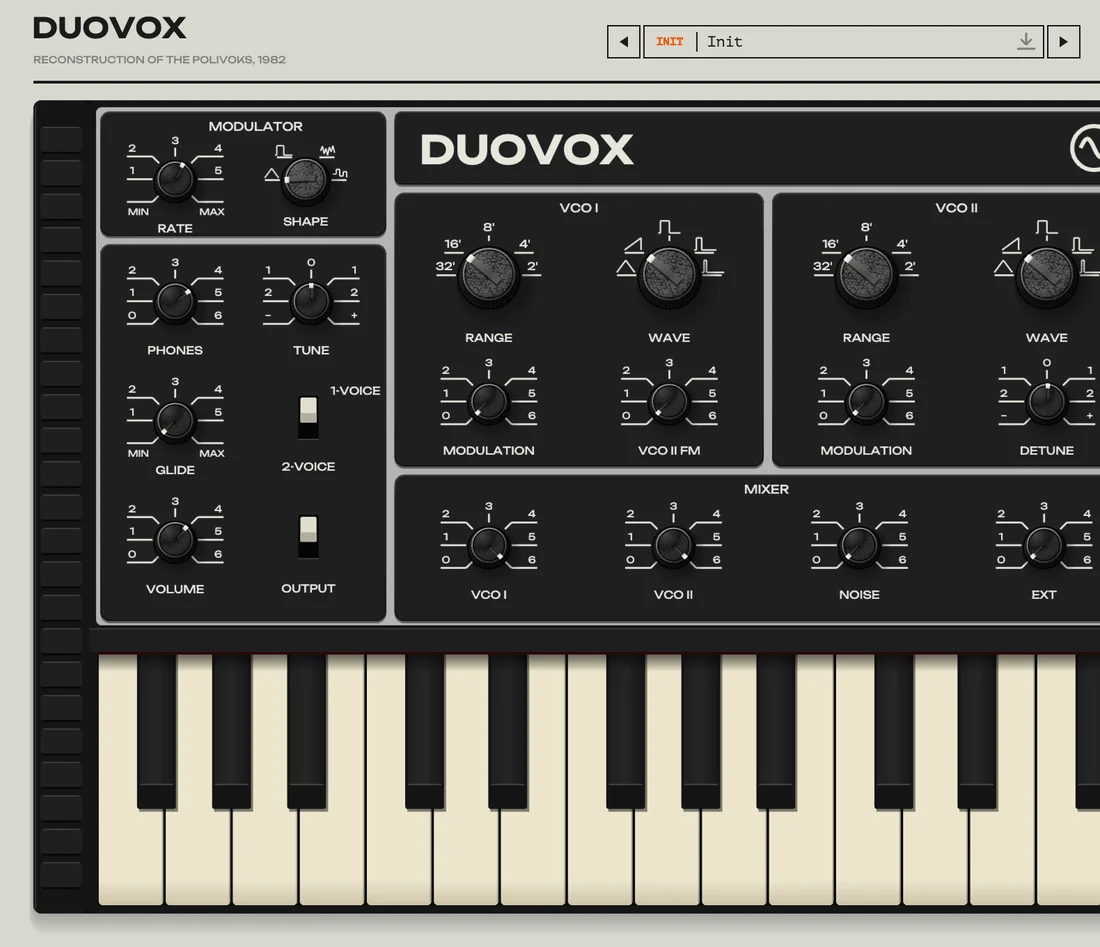
- The full Polyvox panel, control for control, with the scream, the looping envelopes and duophony
- A 4x/8x oversampled model of the two-chip filter, calibrated on recordings of real units
- 257 presets in ten banks and five packs, and a GEN button for new basses, leads and screams
- Extras the 1982 box never had: poly mode, velocity, pitch bend, drift, a rear panel