Ten minutes and two oscillators is all Serum 2 needs to produce a believable Rhodes-style electric piano. The formula: sine wave for the body, a quiet bell partial playing the tine, and velocity handling all the expression.
For exposed solo playing, a good sampled Rhodes still wins. In RnB and lo-fi beats, though, a synthesized EP actually sits in the mix better, and every piece of it stays under your control.
What a tine actually sounds like
Every Rhodes note breaks down into three parts:
- A dark, nearly pure sine fundamental — that’s the body of the note.
- A bell-ish overtone ringing on top — that’s the tine.
- A brief metallic bark when you hit hard: the attack.
Drop any one of the three and listeners hear “synth” instead of “keys”. The bark is the piece most DIY attempts leave out.
The two-oscillator patch
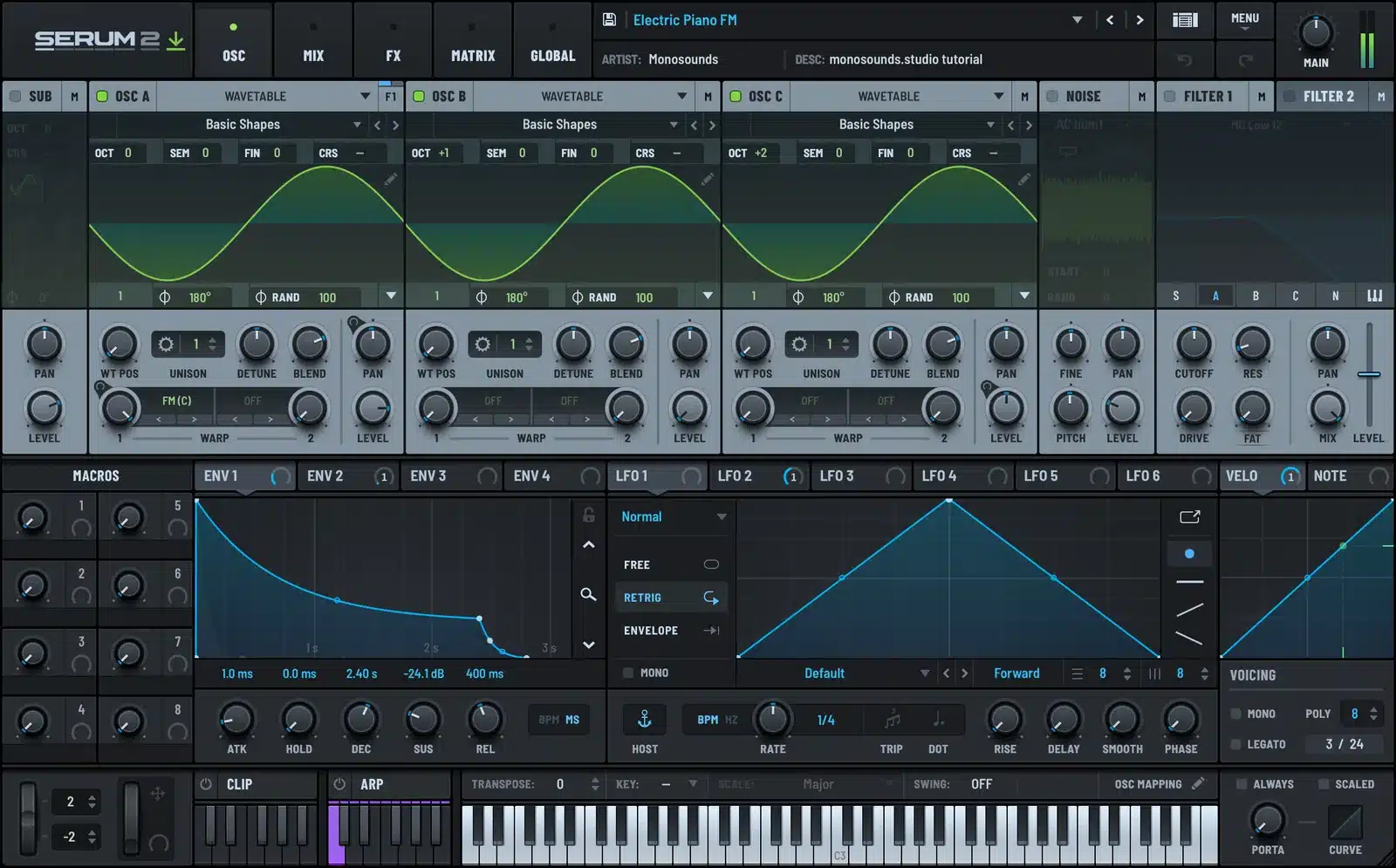
- Osc A: an ordinary sine. It plays the fundamental. Let it stay boring.
- Osc B: a second sine tuned way up. Begin a bit over two octaves higher, in the +26 to +31 semitone zone, then adjust by ear until it rings like a bell rather than a chord tone.
- Pull Osc B down further than instinct says, around 12 dB below Osc A. It should ring behind the note, never beside it.
- Amp envelope: attack instant, decay 1.5–3 seconds, sustain low at 10–20%, release near 0.4 s. Real tines keep quietly ringing, so don’t set sustain to zero.
Here’s the detail that makes it convincing: Osc B gets its own envelope with a shorter decay. Bell dies first, body hangs on. That’s precisely how a struck tine behaves, and hardly anyone bothers to program it.
Velocity is the whole instrument
Play a Rhodes softly and it’s round; dig in and it barks. Velocity needs to hit at least three destinations:
- Velocity to Osc B level, so hard hits push the bell forward.
- Velocity to FM amount. Have Osc B frequency-modulate Osc A a little, then map velocity onto that FM depth. Barely anything at low velocity, clearly there at max. This is where the bark lives, and it’s the most important single routing in the whole patch.
- Velocity to filter cutoff, via a gentle lowpass around 2–4 kHz that opens up as you play harder.
Then use actual dynamics when you play. An EP with full velocity mapping, played at a flat velocity of 100, loses to a cheap ROMpler.
Rather see the wiring than build it yourself? Download the free Serum 2 presets and open the keys patches; every velocity routing is right there in the mod matrix.
This is how a velocity-shaped key patch of this kind sounds in practice, taken from our free piano pack:
Tremolo that pans
That classic suitcase Rhodes tremolo is not a volume wobble; it’s the sound swinging left and right. Put an LFO on pan, roughly triangle shape, synced near 1/8, moderate depth.
Something mixing taught me: with a long, wide reverb behind it, deep panning turns to mush regardless. In a full mix, less tremolo depth reads cleaner than whatever amount impressed you in solo.
Effects: chorus, a little dirt, a small room
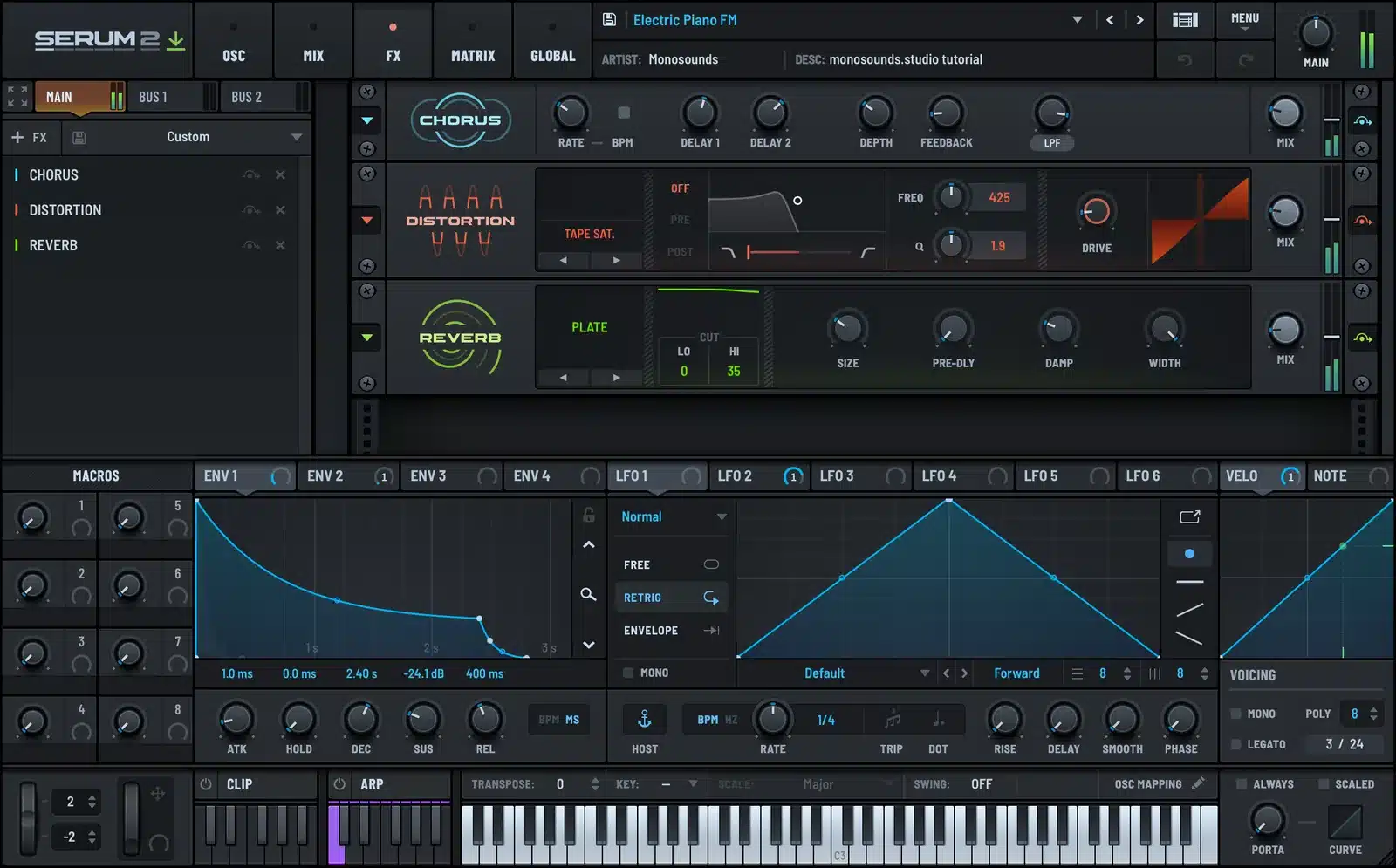
- Chorus: rate slow, depth low. A bell partial through chorus is essentially the entire “Dyno” piano sound from 80s ballads.
- Drive: a hint of soft distortion ahead of the chorus welds body and bell into a single instrument.
- EQ: pull 300–500 Hz down a couple of dB in a thick mix, since that’s the range where EPs go boxy.
- Reverb: a short plate or room at low mix. Big halls convert EPs into pads.
Making it lo-fi or RnB ready
Lo-fi version: put a slow LFO on fine tune at ±3–7 cents. That gives you the warped-tape drift. Want full cassette? Layer in some quiet noise for hiss. The whole aesthetic gets covered in the lo-fi Serum 2 tutorial.
For RnB it’s the voicing that counts, more than the sound design: sevenths and ninths played close together, left hand kept out of the sub range. Keep the patch clean and let the harmony carry it — there’s more on this in the RnB production guide.
Here’s a demo of where keys like these land in an RnB context:
Once free packs run dry, the Serum 2 preset bundles gather the RnB and lo-fi packs at the lowest per-preset price. Makes sense if keys and pads are what you work with daily; pass if a single sound is all you’re after.
FAQ
Why does my EP patch sound like a cheap organ?
Your bell partial is either too loud or never fades. Give Osc B a faster envelope of its own and sink it well below the fundamental.
How much FM for the bark?
Nearly zero at soft velocity, obvious at maximum. Route velocity to FM depth and cap the top just short of clangy.
Sampled Rhodes or synthesized?
Samples take it for exposed solo parts. Inside a busy beat, the synthesized version cuts through more easily and needs less corrective EQ. The keys patches across all our Serum 2 preset packs are designed for that second situation: mix-ready over showcase-ready.
Should tremolo be volume or pan?
Pan, assuming the suitcase Rhodes vibe is what you want. Volume tremolo sounds more like a guitar amp.
Two sines, a single FM routing, one LFO on pan. It’s a tiny patch on purpose: the expression should come from your fingers, not from the preset browser.
I run Monosounds.studio and make the packs myself. Ten-plus years of producing, 97+ releases, 16,000+ downloads. Every Serum 2 preset we ship passes a CPU check on a mid-range laptop and gets used in a real track before release. If it does not survive a mix, it does not go in the pack.
More about Maxim & the studio →

