Transition FX might be the least glamorous sounds in music, yet every single arrangement leans on them. The riser pulling you into the drop, the impact landing on the downbeat, the downlifter carrying you back out. In Serum 2 all three come from noise, pitch envelopes and very little else.
Make them once, save them as presets, and you’ll never again find yourself scrolling a “cinematic FX” sample pack at 2 a.m. This is the set I actually work with.
The basic riser
- Init a patch. Switch the noise oscillator on, white noise, and kill the main oscillator for now.
- Bring in a highpass filter and give a slow envelope or LFO the job of sweeping the cutoff up from roughly 200 Hz to 8 kHz.
- Give the amp envelope a long attack, several seconds, letting the sound fade up as it climbs.
- Match the sweep length to the transition. A 2-bar riser at 128 BPM comes out around 3.75 seconds; 4 bars is 7.5.
That’s the workhorse right there. Two upgrades turn it from default into deliberate:
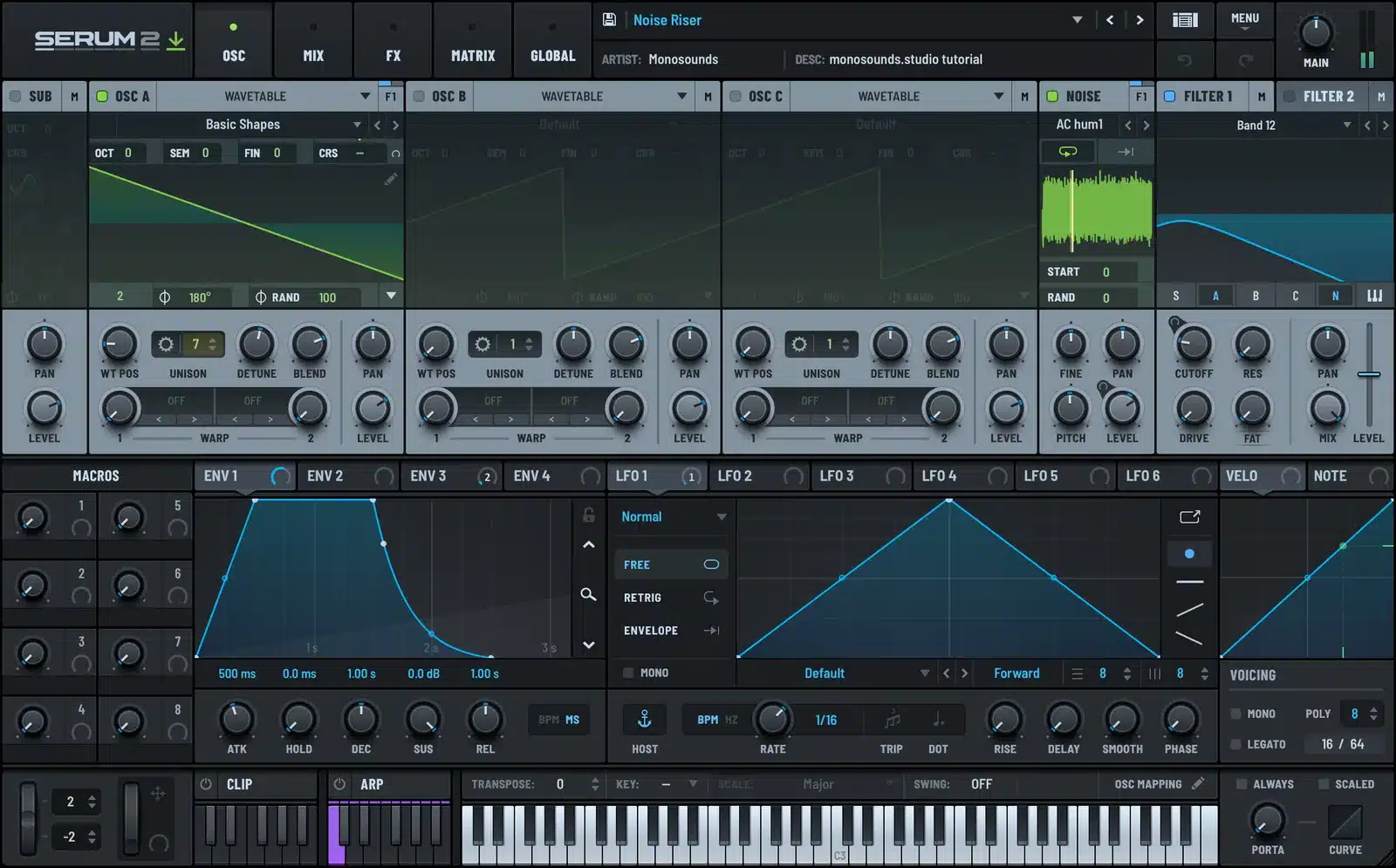
- Slide a saw oscillator under the noise and give it a pitch envelope climbing one octave over the same duration. A tonal riser pulls much harder than plain noise.
- Automate the reverb mix upward as the riser runs. A sound getting wetter while it climbs signals “something is coming” even played quietly.
Pitch envelopes do the heavy lifting
Now the part nobody tells you: the emotional shape of a transition lives almost entirely in the pitch curve, not the volume. A riser with a slow exponential pitch curve, with most of the movement packed into the final bar, generates far more tension than a straight line stretched across four bars. Draw it lazy at the beginning and steep at the finish.
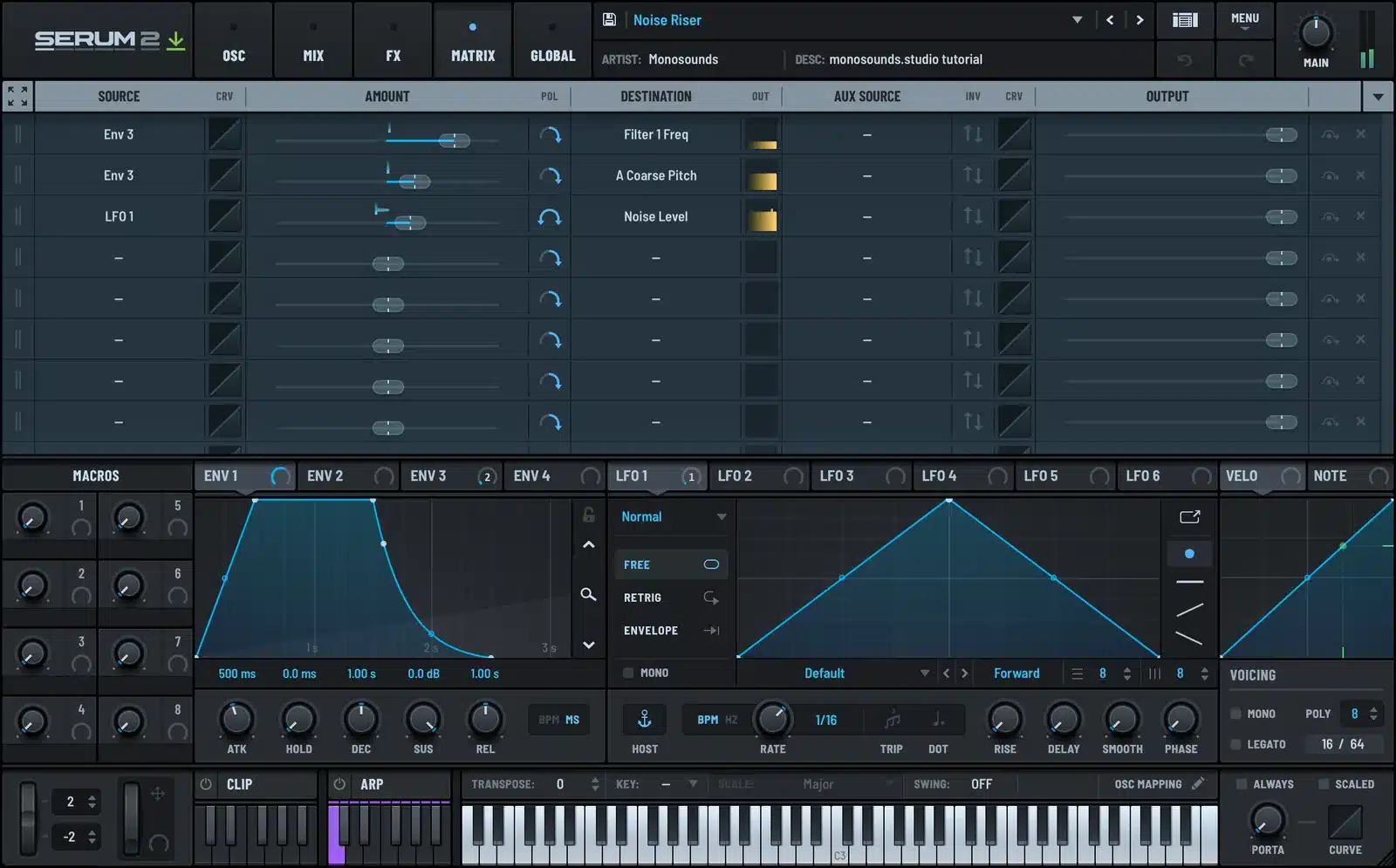
Flip that logic for downlifters. Rapid fall up front, then a long lazy tail. Symmetric curves are what stock sounds use, which is exactly why symmetric curves sound like stock sounds.
Downlifters and sub drops
Conceptually a downlifter is just a riser run in reverse: white noise, filter sweeping downward, pitch sinking, reverb drying up. Where a riser announces the drop, this one answers it. Keep them quieter than instinct says, something like 6–10 dB below your risers. They exist to fill the exit, not to get noticed.
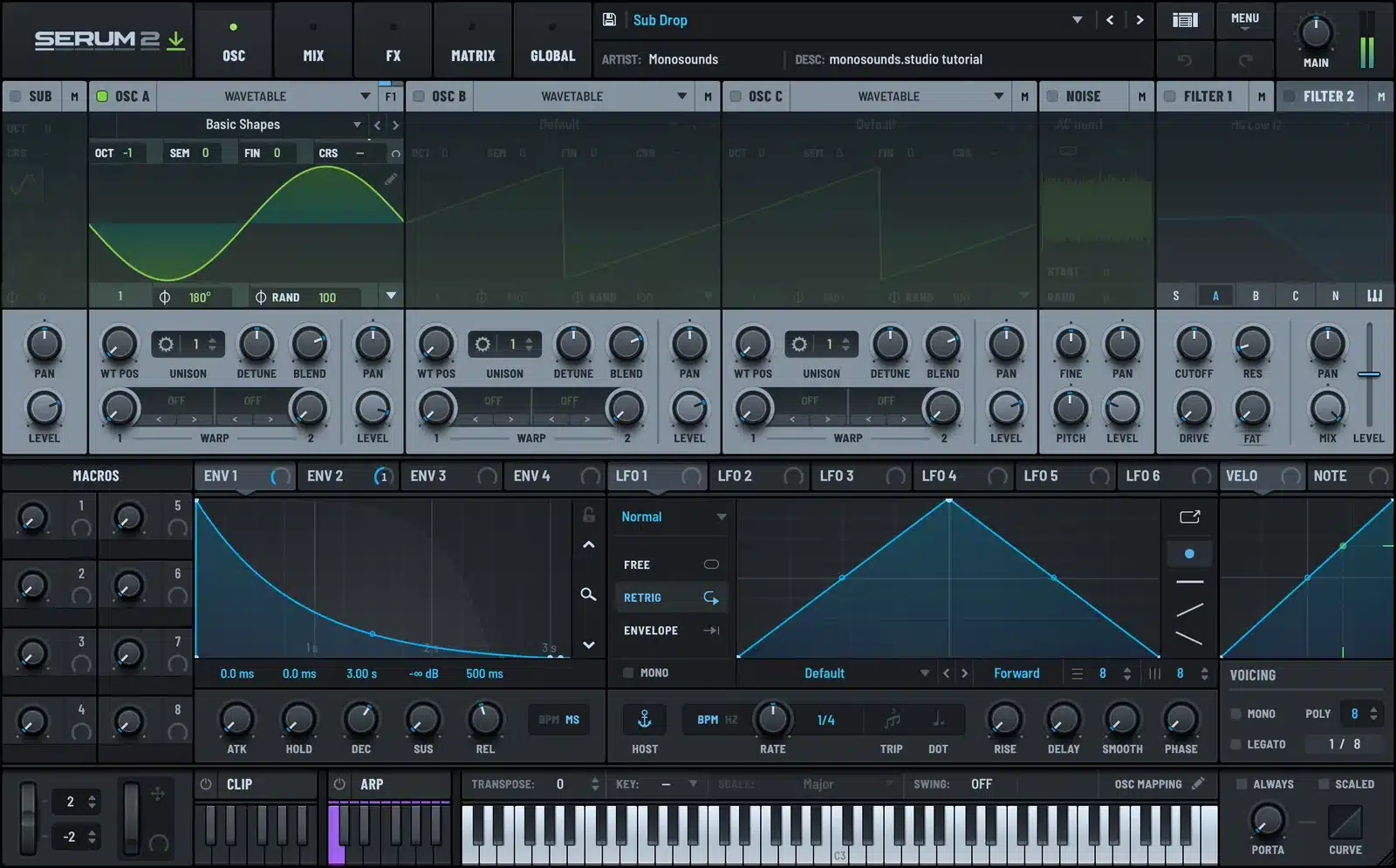
The sub drop is simpler still and hits harder:
- A single sine oscillator, no filter.
- A pitch envelope diving one to two octaves across 1–2 seconds.
- Fire it on the drop’s downbeat, starting somewhere around G1–C2.
One hard-earned warning: audition it in mono and on small speakers. Once a sub drop sinks under 30 Hz it’s nothing but a woofer massage nobody actually hears. Mine stop around 35–40 Hz.
Impacts
Impacts are built in layers, and synthesis handles two of the three. The low boom: a sine with a quick pitch envelope dropping an octave in 100–200 ms, essentially an oversized kick. The noise splash: a burst of white noise, fast decay, generous reverb. Layer three, some textured hit or found-sound clank, is frankly easier to lift from a recording than to synthesize. I’ve stopped fighting that; a synth doesn’t have to be the source of everything.
This kind of accidental chaos was an analog synth specialty. Below is the sort of raw experimental Moog material I mean, the stuff that turns into an impact layer once you add a pitch drop and a reverb.
Build the FX folder once
The real productivity win isn’t any one patch. It’s that Serum 2 stores user presets under Presets/User, where you can create an “FX” folder holding Riser 2bar, Riser 4bar, Downlifter, Sub Drop, Impact Boom. Ten minutes of setup, and every track after that skips the sample-pack scroll for good. Commercial packs land in the same folder tree, so anything from the full list of Serum 2 packs can be reorganized right alongside.
Two habits that keep the folder genuinely useful:
- Name presets by length and bars rather than vibes. Mid-session, “Riser 4bar dark” wins against “Skyfall Tension VII” every time.
- In each patch, map a single macro to “intensity”, driving filter range, reverb mix and drive at once. One knob scales the same riser from a quiet intro transition all the way to the final drop.
Prefer to start from worked examples? The free Serum 2 presets pack makes a decent dissection kit; these same envelope tricks appear all through it.
Fitting transitions into a mix
More transitions die in the arrangement than in the patch. Where I’ve landed:
- Highpass all risers around 150–200 Hz. Their low end argues with the bassline for no benefit whatsoever.
- Give risers a light sidechain to the kick, so the build keeps pumping with the groove rather than smearing across it.
- Kill the riser dead an instant before the drop lands. That half-beat of nothing hits harder than any impact sample ever will. Took me embarrassingly long to figure out.
Once you’re past one-off patches and into full genre libraries, the Serum 2 preset bundles carry FX-type patches next to the basses and leads, and per preset they’re the best deal we offer.
Related guides: the Serum 2 effects guide goes through the reverb and distortion moves used above, and pads and atmospheres is this article’s sustained-texture sibling.
FAQ
How long should a riser be?
As long as the phrase: 2 or 4 bars covers most dance music. Work out the seconds from your BPM and set the envelope to exactly that rather than eyeballing.
Why do my risers sound like stock samples?
Because the pitch and volume curves are straight lines. Draw them exponential, slow at the start and steep into the finish, and ride the reverb mix up through the build.
What note should a sub drop start on?
Somewhere around G1–C2, dropping one to two octaves. End the fall near 35–40 Hz, otherwise small speakers get nothing whatsoever.
Do I need transition FX in every track?
In dance genres, mostly yes, though quieter than instinct suggests. When a listener registers the riser as its own sound, chances are it’s too loud.
Glamorous work this is not. But one afternoon spent building five FX presets keeps paying out in every track you finish afterward, and few corners of sound design offer a trade that good.

I run Monosounds.studio and make the packs myself. Ten-plus years of producing, 97+ releases, 16,000+ downloads. Every Serum 2 preset we ship passes a CPU check on a mid-range laptop and gets used in a real track before release. If it does not survive a mix, it does not go in the pack.
More about Maxim & the studio →

