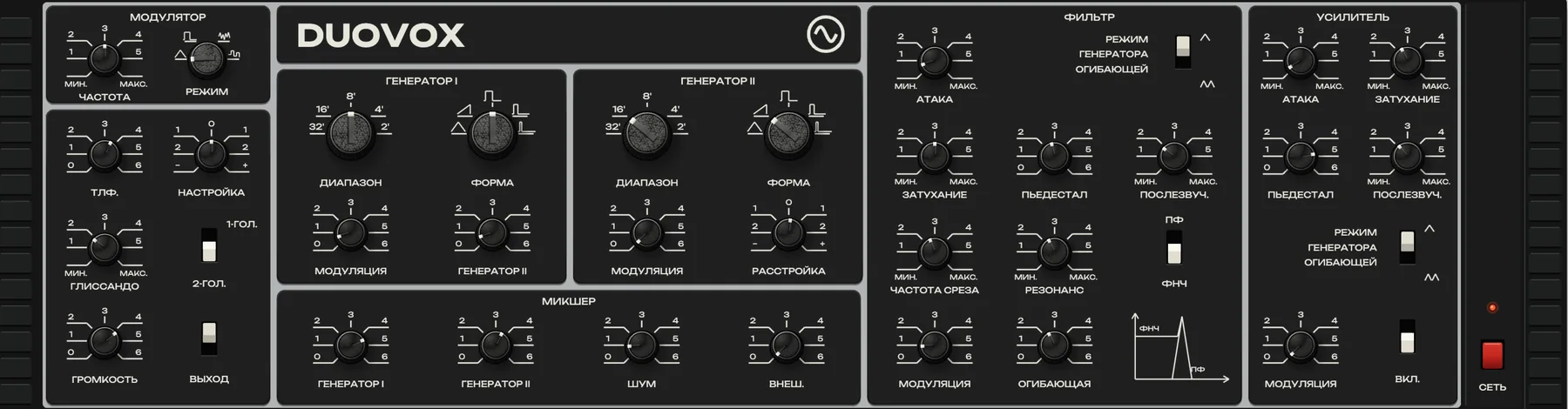
The Polyvox (Polivoks, Поливокс) was built for Soviet musicians, so every label on its panel is in Russian. Most of them translate the way you would expect. A few don't: the sustain knob says "pedestal", the release knob says "after-sound", the voice switch has been read as "Ron" by Western owners, and the two switches that matter most for performance, ВКЛ. and ВЫХОД, just say "on" and "output".
This guide covers every label on the 1982 front panel, plate by plate, using the label inventory we compiled for Duovox from factory schematics, museum photos and Vladimir Kuzmin's own article. Each plate is shown twice: on the left as the original is lettered, on the right with the Latin lettering Duovox can switch to. The players show what a label means in sound where the translation alone would mislead you. It works just as well with a real unit in front of you.
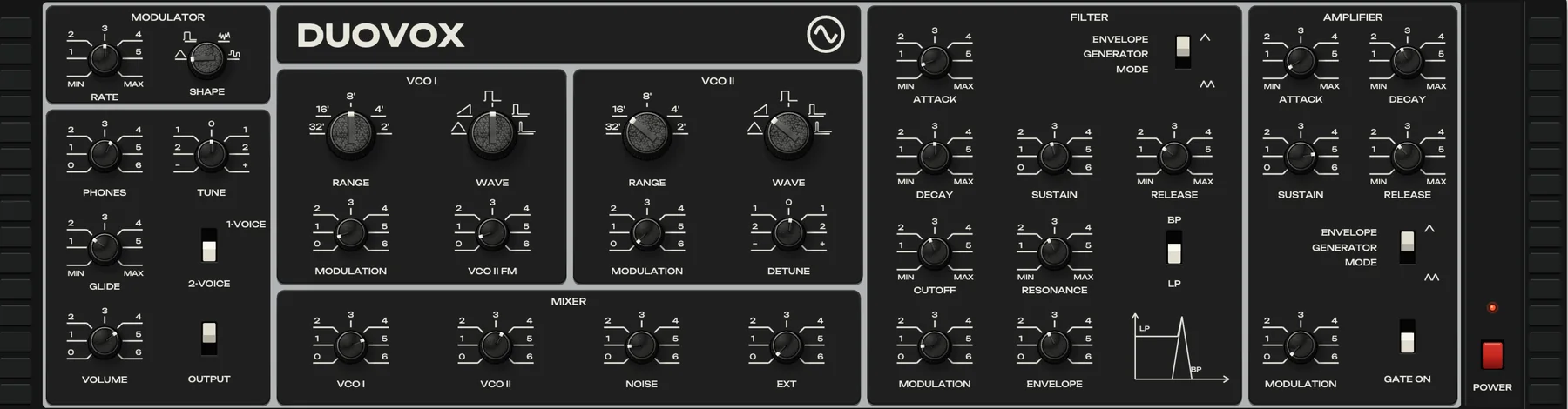
How the panel is written
Three kinds of scale are printed around the knobs. Times and the filter controls run from МИН. (min.) to МАКС. (maks.) with 1 to 5 between them. Levels and depths run from 0 to 6. The two tuning knobs are bipolar and read 2, 1, 0, 1, 2 with a minus and a plus at the ends. A full stop after a label means it is abbreviated: ТЛФ., ВНЕШ., ПОСЛЕЗВУЧ., ВКЛ. and ГОЛ. are all shortened words, and the tables give the full form.
Transliteration here is the plain English-style scheme you will see on most synth forums: ж is zh, х is kh, ц is ts, ч is ch, ш is sh, щ is shch, й is y, and ь (the soft sign) is an apostrophe. In Duovox the АБВ / ABC button in the header switches the whole panel between the two letterings. Positions, scales and sound don't change.


The modulator plate
Top left. МОДУЛЯТОР (modulyator, "modulator") is the LFO. It has no depth control of its own: each destination has a МОДУЛЯЦИЯ knob on its own plate.
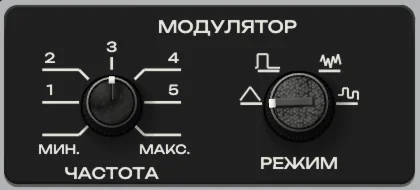 РЕЖИМ · waveformЧАСТОТА · rate
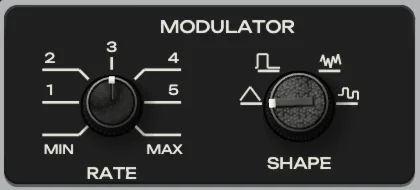 SHAPERATE
| Printed | Transliteration | Literally | What it does | Duovox |
|---|---|---|---|---|
| ЧАСТОТА | chastota | frequency | LFO rate, МИН. to МАКС. | RATE |
| РЕЖИМ | rezhim | mode | LFO waveform, four positions drawn as icons: triangle, square, noise, sample and hold | SHAPE |
РЕЖИМ is a rotary switch, not a knob, and here "mode" means waveform. Kuzmin's article adds a detail the icons don't show: the triangle swings both ways around zero, while the square is a train of positive pulses only. Square-wave pitch modulation therefore jumps between the played note and a note above it, a trill rather than a wobble around the pitch.
ТЛФ., НАСТРОЙКА, 1-ГОЛ. and ВЫХОД
Below the modulator, the plate with no title. It holds the global controls and the two levers that confuse newcomers most.
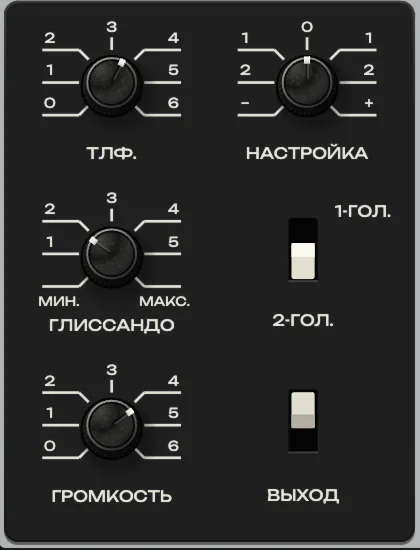 ТЛФ. · phonesНАСТРОЙКА · tune1-ГОЛ. / 2-ГОЛ.ВЫХОД · output
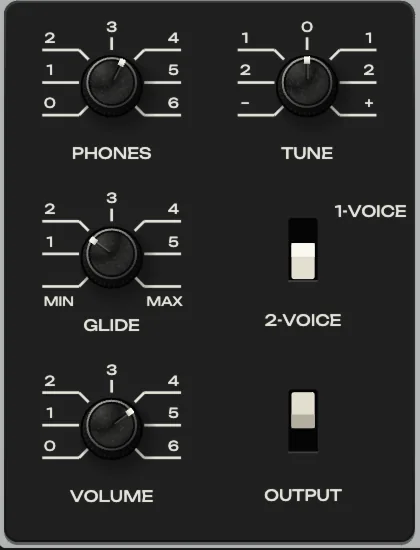 PHONESTUNE1-VOICE / 2-VOICEOUTPUT
| Printed | Transliteration | Literally | What it does | Duovox |
|---|---|---|---|---|
| ТЛФ. | TLF. (telefony) | telephones | Headphone level, 0 to 6. Телефоны is the old Russian word for headphones | PHONES |
| НАСТРОЙКА | nastroyka | tuning | Master tune, bipolar, about 2 semitones each way | TUNE |
| ГЛИССАНДО | glissando | glissando | Glide time, МИН. to МАКС. In 2-voice mode only one oscillator glides | GLIDE |
| 1-ГОЛ. / 2-ГОЛ. | 1-gol. / 2-gol. (golos) | 1-voice / 2-voice | Lever: both oscillators on one key, or duophonic (VCO I on the upper key, VCO II on the lower) | 1-VOICE / 2-VOICE |
| ГРОМКОСТЬ | gromkost' | loudness | Main output volume, 0 to 6 | VOLUME |
| ВЫХОД | vykhod | exit, output | Lever: mutes the main output; the headphones stay live | OUTPUT |
The "1-Ron / 2-Ron" switch
In a 2003 Sound On Sound interview about Goldfrapp's Black Cherry, Will Gregory admitted he couldn't read the panel and described a control that "says Ron" with another below it "called 2 Ron". He was reading the Cyrillic ГОЛ. as Latin letters. Zoe Blade's synth notebook sets it straight: гол is short for голос, "voice", and the lever switches between one voice and two. It is also a lever, not a knob. If a forum post mentions the Ron switch, this is the one.
The duophonic mode is worth its own page (duophony and glide). The short version: with two keys held, VCO I plays the upper one and VCO II the lower one, through one filter and one amplifier.
ВЫХОД is a mute, and ТЛФ. is what stays on
Kuzmin explains why the ВЫХОД lever exists: you could silence the main output to re-patch between songs and keep working on headphones. On a real unit the two outputs are separate DIN sockets. Duovox has one stereo output, so with ВЫХОД off you hear the ТЛФ. level in place of ГРОМКОСТЬ. Set the two knobs differently and the lever becomes a two-level switch.
In this clip ГРОМКОСТЬ is at 4.8 and ТЛФ. at 2.1. The second position comes out about 12 dB quieter, and nothing else in the sound changes.
The two oscillator plates
ГЕНЕРАТОР (generator) is the Soviet engineering word for an oscillator. The two plates are identical except for the bottom-right knob.
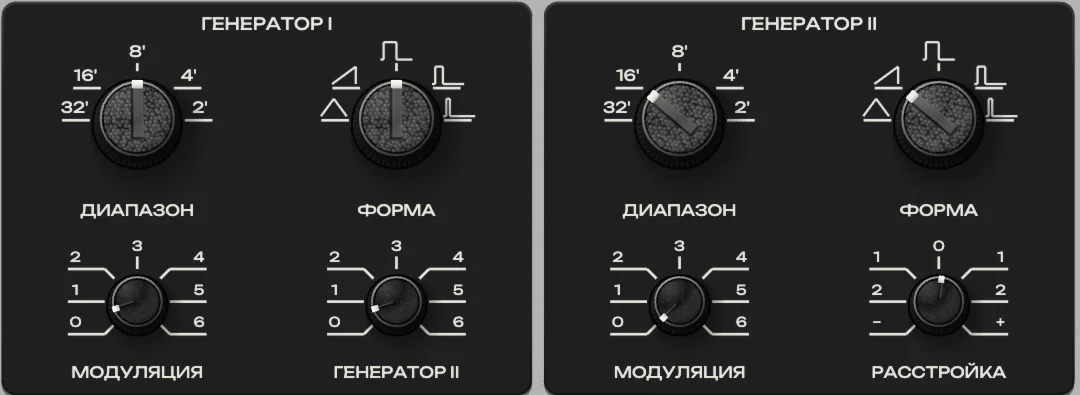 ДИАПАЗОН · rangeФОРМА · waveformГЕНЕРАТОР II · FMРАССТРОЙКА · detune
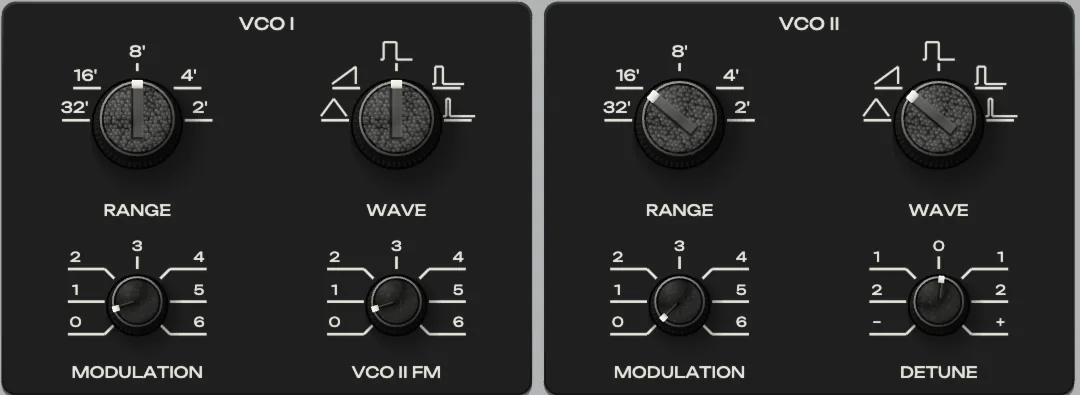 RANGEWAVEVCO II FMDETUNE
| Printed | Transliteration | Literally | What it does | Duovox |
|---|---|---|---|---|
| ГЕНЕРАТОР I / II | generator I / II | generator | Plate titles: oscillator 1 and 2 | VCO I / VCO II |
| ДИАПАЗОН | diapazon | range | Rotary switch: footage 32', 16', 8', 4', 2' | RANGE |
| ФОРМА | forma | form, shape | Rotary switch: triangle, saw, square and two narrower pulses (icons only). No PWM | WAVE |
| МОДУЛЯЦИЯ | modulyatsiya | modulation | LFO depth into this oscillator's pitch, 0 to 6 | MODULATION |
| ГЕНЕРАТОР II (on plate I) | generator II | generator II | How much VCO II modulates the pitch of VCO I at audio rate (FM), 0 to 6 | VCO II FM |
| РАССТРОЙКА (on plate II) | rasstroyka | detuning | Detunes VCO II against VCO I, bipolar; the factory passport gives more than 25 percent each way | DETUNE |
The one that trips people up is the knob called ГЕНЕРАТОР II on the ГЕНЕРАТОР I plate. It is not a second level control: it is the FM depth, and Kuzmin describes the result as ring-modulator-like. Duovox prints it as VCO II FM, and the FM tutorial covers it. НАСТРОЙКА and РАССТРОЙКА look alike, and both share the root строй (tuning). The first tunes the whole instrument, the second only pulls VCO II away from VCO I.
The mixer
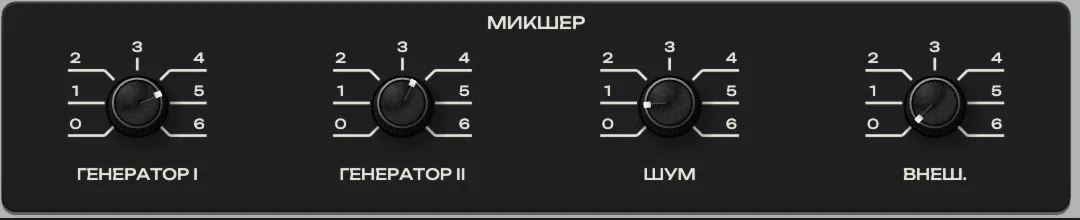 ШУМ · noiseВНЕШ. · external
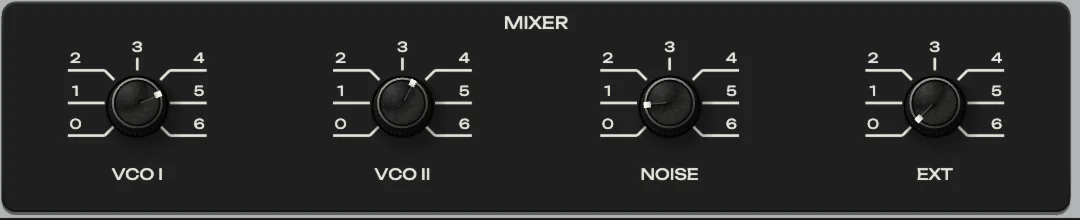 NOISEEXT
| Printed | Transliteration | Literally | What it does | Duovox |
|---|---|---|---|---|
| МИКШЕР | miksher | mixer | Plate title | MIXER |
| ГЕНЕРАТОР I / II | generator I / II | generator | Oscillator levels into the filter, 0 to 6 | VCO I / VCO II |
| ШУМ | shum | noise | Noise generator level | NOISE |
| ВНЕШ. | vnesh. (vneshniy) | external | Level of the rear-panel audio input | EXT |
The mixer is a plain op-amp summer with unity gain on every channel and no limiting, which is why two oscillators turned up to 6 overdrive the filter. That is the famous bass, and the bass tutorial turns the knob for you. ВНЕШ. on the original is the level of an external signal plugged into the rear DIN socket. In Duovox there is no audio input: the knob takes the plug-in's own output and feeds it back into the mixer, as if a cable ran from the output to the input. The preset Ext-In Loop is built on that.
The filter plate and its envelope
The largest plate. The top three rows are the filter's own envelope, the bottom two the filter itself.
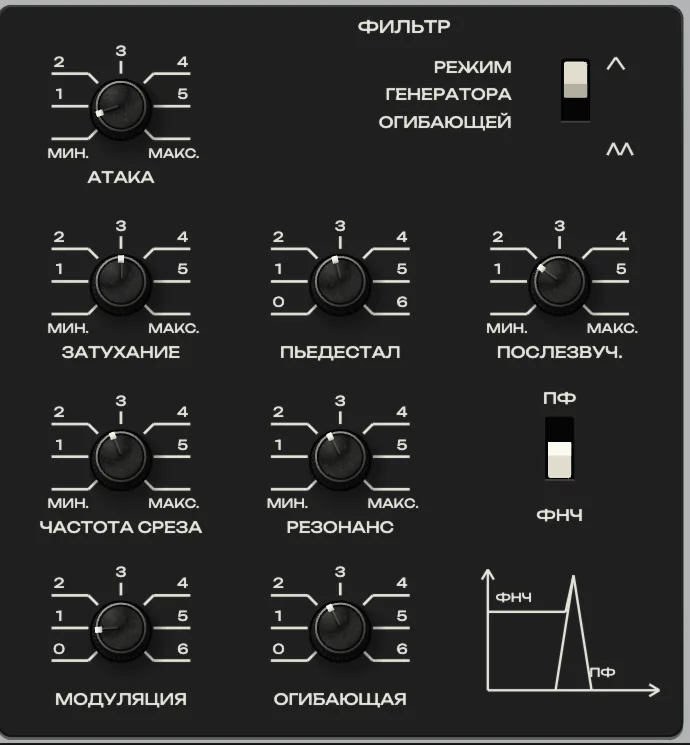 РЕЖИМ ГЕН. ОГИБ.ЗАТУХАНИЕ · decayПЬЕДЕСТАЛ · sustainПФ / ФНЧОГИБАЮЩАЯ · env amount
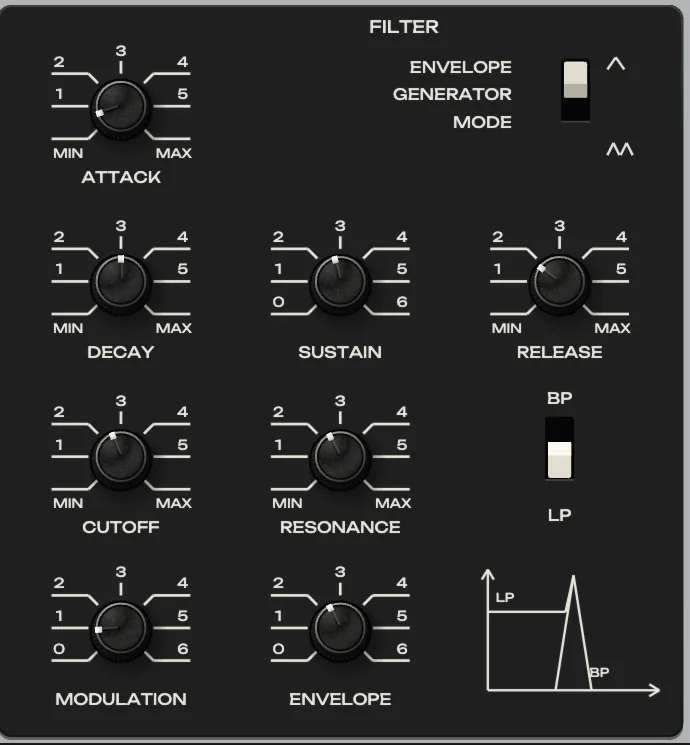 ENV MODEDECAYSUSTAINBP / LPENVELOPE
| Printed | Transliteration | Literally | What it does | Duovox |
|---|---|---|---|---|
| ФИЛЬТР | fil'tr | filter | Plate title | FILTER |
| АТАКА | ataka | attack | Envelope attack time | ATTACK |
| РЕЖИМ ГЕНЕРАТОРА ОГИБАЮЩЕЙ | rezhim generatora ogibayushchey | mode of the envelope generator | Lever: one-shot (single-envelope icon) or periodic (double-peak icon) | ENVELOPE GENERATOR MODE |
| ЗАТУХАНИЕ | zatukhaniye | dying away | Decay time | DECAY |
| ПЬЕДЕСТАЛ | p'yedestal | pedestal | Sustain level, 0 to 6 | SUSTAIN |
| ПОСЛЕЗВУЧ. | poslezvuch. (poslezvuchaniye) | after-sound | Release time | RELEASE |
| ЧАСТОТА СРЕЗА | chastota sreza | cut frequency | Cutoff | CUTOFF |
| РЕЗОНАНС | rezonans | resonance | Resonance, up to self-oscillation | RESONANCE |
| ФНЧ / ПФ | FNCh / PF | low-frequency filter / band filter | Lever: 12 dB per octave low-pass, or band-pass. ФНЧ is printed below the lever | LP / BP |
| МОДУЛЯЦИЯ | modulyatsiya | modulation | LFO depth to cutoff | MODULATION |
| ОГИБАЮЩАЯ | ogibayushchaya | envelope | How far the envelope opens the cutoff, 0 to 6, positive only | ENVELOPE |
ФНЧ stands for фильтр нижних частот and ПФ for полосовой фильтр, the standard Russian abbreviations for low-pass and band-pass. The small graph in the corner of the plate draws both curves with the same two labels. ОГИБАЮЩАЯ comes from a verb meaning "to bend around": the curve that wraps a signal, which is exactly what "envelope" means in English. The three-line label РЕЖИМ ГЕНЕРАТОРА ОГИБАЮЩЕЙ is the same word in another case, "mode of the envelope generator".
Periodic only works with ПЬЕДЕСТАЛ at 0
The mode lever has two icons and no words. The factory names are однократный (one-shot) and периодический (periodic). In the periodic position the envelope runs attack, then decay, then starts the attack again, for as long as the key is down, always starting from the key press. Kuzmin's condition is that ПЬЕДЕСТАЛ must be at 0. With any sustain the decay stops on that level and never gets low enough to restart the loop, so the lever seems to do nothing. That is how it behaves on the original, not a fault, and Duovox does the same.
We measured the high-frequency share of these clips in 30 ms slices. In the periodic position it dips about every 0.2 seconds as the filter loops. With ПЬЕДЕСТАЛ at 2 it stays flat after the first cycle, because the filter is parked on the sustain level. The looping envelope tutorial goes deeper.
The amplifier plate
УСИЛИТЕЛЬ (usilitel', "amplifier") has the same four envelope stages, the same mode lever and the same МОДУЛЯЦИЯ, applied to the level instead of the cutoff. Its last lever, ВКЛ., is the only control of its kind on the panel.
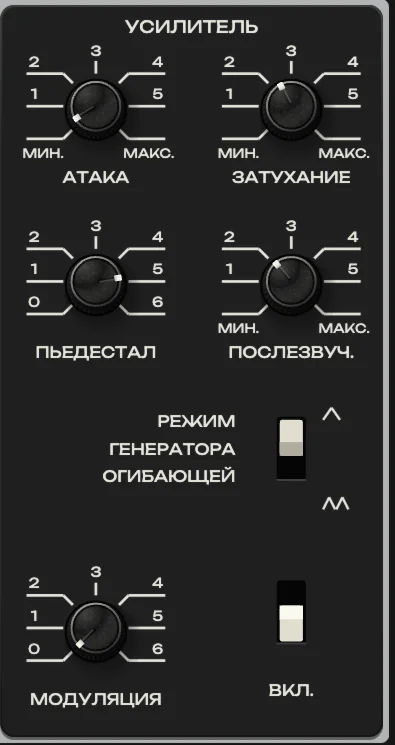 ПОСЛЕЗВУЧ. · releaseРЕЖИМ ГЕН. ОГИБ.ВКЛ. · gate onМОДУЛЯЦИЯ · LFO
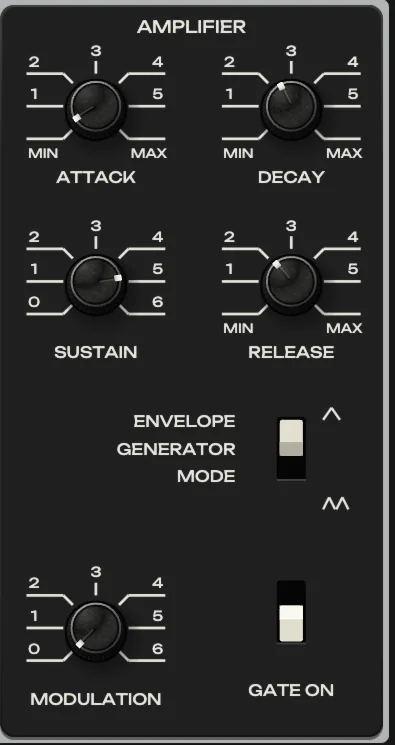 RELEASEENV MODEGATE ONMODULATION
| Printed | Transliteration | Literally | What it does | Duovox |
|---|---|---|---|---|
| УСИЛИТЕЛЬ | usilitel' | amplifier | Plate title | AMPLIFIER |
| АТАКА · ЗАТУХАНИЕ | ataka · zatukhaniye | attack · dying away | Attack and decay time of the level | ATTACK · DECAY |
| ПЬЕДЕСТАЛ · ПОСЛЕЗВУЧ. | p'yedestal · poslezvuch. | pedestal · after-sound | Sustain level and release time | SUSTAIN · RELEASE |
| РЕЖИМ ГЕНЕРАТОРА ОГИБАЮЩЕЙ | rezhim generatora ogibayushchey | mode of the envelope generator | Lever: one-shot or periodic, as on the filter | ENVELOPE GENERATOR MODE |
| МОДУЛЯЦИЯ | modulyatsiya | modulation | LFO depth to level (tremolo) | MODULATION |
| ВКЛ. | vkl. (vklyucheno) | on | Lever: holds the gate open with no key pressed | GATE ON |
ПЬЕДЕСТАЛ is a level, ПОСЛЕЗВУЧ. is a time
"Pedestal" is a good picture once you know it: the step the note stands on after the decay. Its scale is 0 to 6 because it is a level, while the three time knobs around it run МИН. to МАКС. In this player only the amplifier's ПЬЕДЕСТАЛ moves, with a medium decay. Each step up raises the held part of the note: the clip's average level goes from about −32 dB at 0 to −14 dB at 6.
ПОСЛЕЗВУЧ., "after-sound", is what happens once you let go. Here the notes are short stabs a second apart, and only the release moves. In our renders the tail takes about 0.02 seconds to fall 40 dB at 1.2 on the scale, 0.2 seconds at 3, about 1 second at 4.2 and about 4 seconds at 5.4, where the tails run into the next note.
ВКЛ. holds the gate
Kuzmin's description of ВКЛ. is that it sends the gate to every block and starts the envelope generators, with no key involved. Sound On Sound calls it Gate On. Vintage Synth Explorer's listing calls it keyboard memory, which it is not. Use it for drones, for feeding external signals through the envelopes, and for letting periodic envelopes run on their own. Duovox prints it as GATE ON.
The preset is Pseudo-Arp, with both envelopes on periodic. The key is tapped once for a quarter of a second. With ВКЛ. off the loops stop with the key. With ВКЛ. on they run to the end of the clip, about 13 dB louder on average for that reason alone.
СЕТЬ, the name plate and the rear panel
On the far right, under a small red lamp, the red button СЕТЬ (set', "network", in the sense of the mains) is the power switch. Duovox prints POWER there, and in the plug-in it silences the output. The long plate above the generators carries the name ПОЛИВОКС and the factory emblem; Sound On Sound notes that six tuning trimmers hide under it. Duovox puts its own name and emblem there.
The rear panel matters to owners. All the connectors on the original are 5-pin DIN sockets:
| Printed | Transliteration | Literally | What it is |
|---|---|---|---|
| Выход | vykhod | output | Main audio output |
| Тлф | tlf | telephones | Headphones |
| Вход | vkhod | input | External audio input (the ВНЕШ. channel), with low-level and high-level pins |
| Педаль | pedal' | pedal | The optical foot pedal, which moves the filter cutoff |
| Сеть | set' | mains | Power |
One more word on the panel had a story of its own. Kuzmin recalls that a clerk from the factory's security department flagged АТАКА as suspicious, a military-sounding word on a civilian product. It means attack in the envelope sense, and it stayed.
Duovox has no pitch bend or mod wheel on its front panel because the original had none. The extras (poly mode, velocity, bend range, drift, key priority) live on a separate rear panel in the plug-in, so the front stays a one-to-one map of the 1982 controls. You can use the Latin panel as a cheat sheet next to your hardware, or switch it to Cyrillic and learn to read the real one.
Sources
- Vladimir Kuzmin, ProSoundThe designer's article: envelope modes, ВКЛ., ВЫХОД, the modulator, the АТАКА anecdote.Source ↗
- Factory schematics (deralex)Block names, mixer, rear connectors, passport ranges.Source ↗
- Sound On Sound, 2010Gordon Reid's retrospective: Gate On, the trimmers under the name plate, duophony.Source ↗
- Sound On Sound, 2003Will Gregory on recording Black Cherry: the "Ron" switch.Source ↗
- Zoe Blade, synth notebookгол is short for голос, voice.Source ↗
- Wikimedia CommonsThe high-resolution panel close-up we read the lettering from.Source ↗
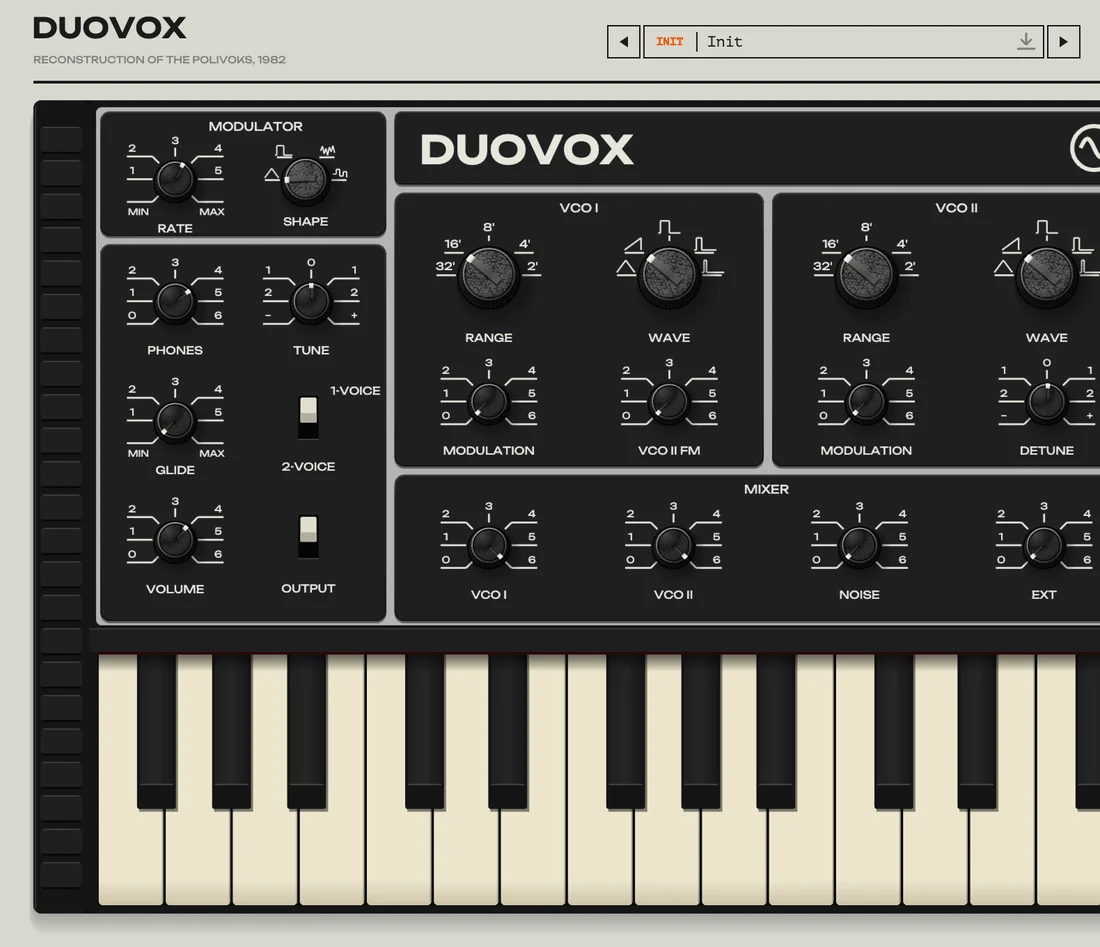
- The full Polyvox panel, control for control, with the scream, the looping envelopes and duophony
- A 4x/8x oversampled model of the two-chip filter, calibrated on recordings of real units
- 257 presets in ten banks and five packs, and a GEN button for new basses, leads and screams
- Extras the 1982 box never had: poly mode, velocity, pitch bend, drift, a rear panel