Strip any classic video game sound down and you’ll find a pitch envelope riding a simple waveform. Lasers, coins, jumps, power-ups: the old sound chips could do practically nothing else, so composers built an entire language out of pitch movement. Serum 2 can recreate every bit of it, and I’d argue it’s the most fun sound design practice you can get.
And the payoff goes past nostalgia. Game jams, indie titles, UI sounds and hyperpop all devour these patches. Here’s the full menu.
The chip rules
The NES chip offered two pulse waves, a triangle, and a noise channel. That was the whole palette. Staying in character inside Serum 2 means:
- Square or pulse wavetables, single voice, unison off.
- Triangle for the soft blips and anything low.
- The noise oscillator for percussion and explosions.
- No filter sweeps, no chorus, no reverb. Chips had none of it. Dryness IS the aesthetic.
One detail for authenticity: those chips moved pitch in coarse steps, never smooth glides. When Serum’s silky sweeps feel too modern, draw the pitch modulation as a stair-stepped LFO instead of a ramp. Stepped sweeps register as 8-bit immediately.
The coin
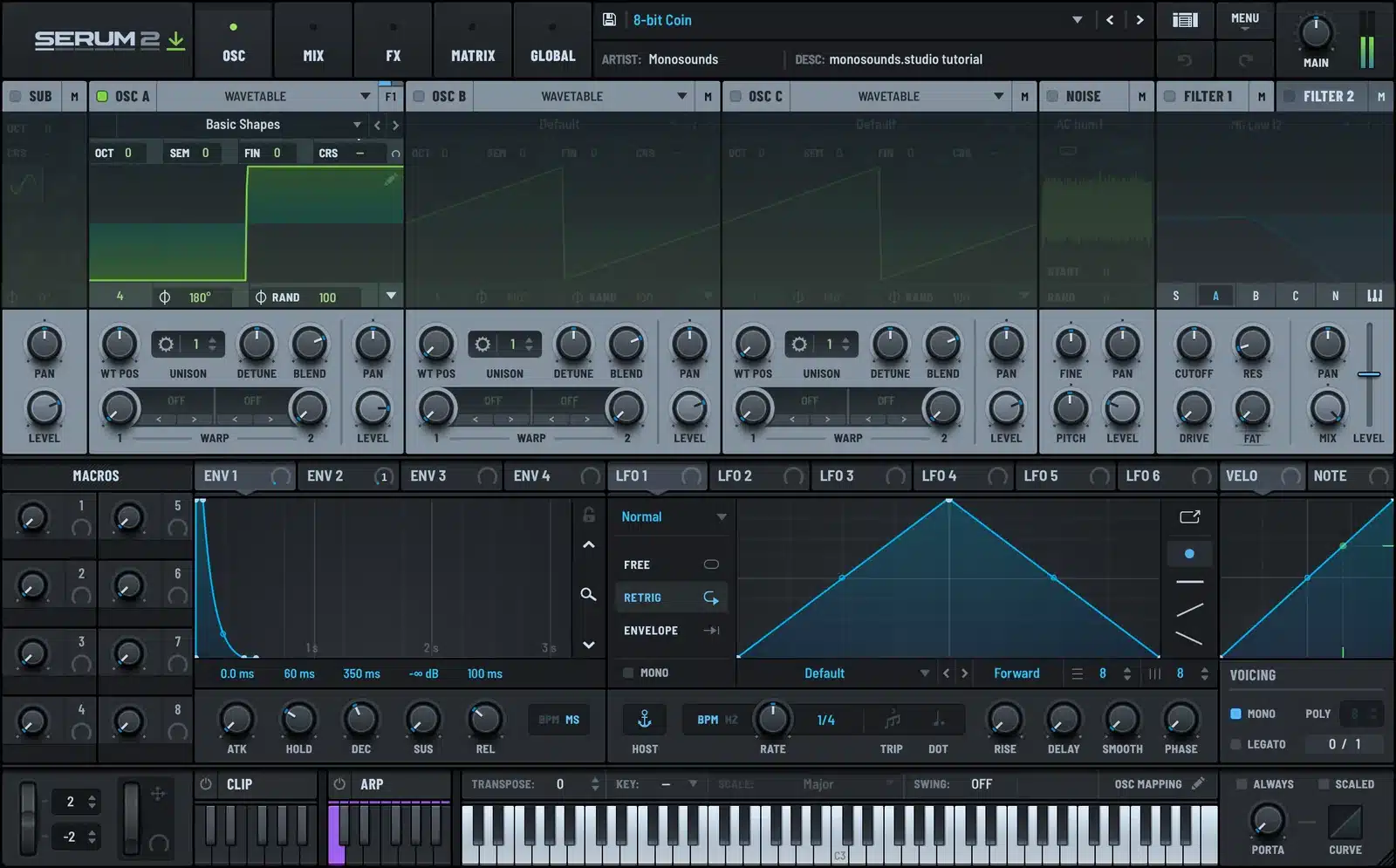
The famous coin isn’t a sweep at all, it’s two notes: a short high blip leaping up a perfect fourth or fifth, something in the neighborhood of B5 up to E6.
- Square wave, one voice.
- Amp envelope: zero attack, decay near 300–400 ms, zero sustain.
- Pitch envelope drawn as a step: sit on the first pitch for roughly 80 ms, then jump up and let it ring out.
The choice of interval is what makes it feel like a reward: rising fourths and fifths mean “success” to just about every human alive. Falling minor seconds mean “damage”. Interval direction alone can score a whole game’s emotional feedback, and that’s precisely what the 80s composers did.
The laser
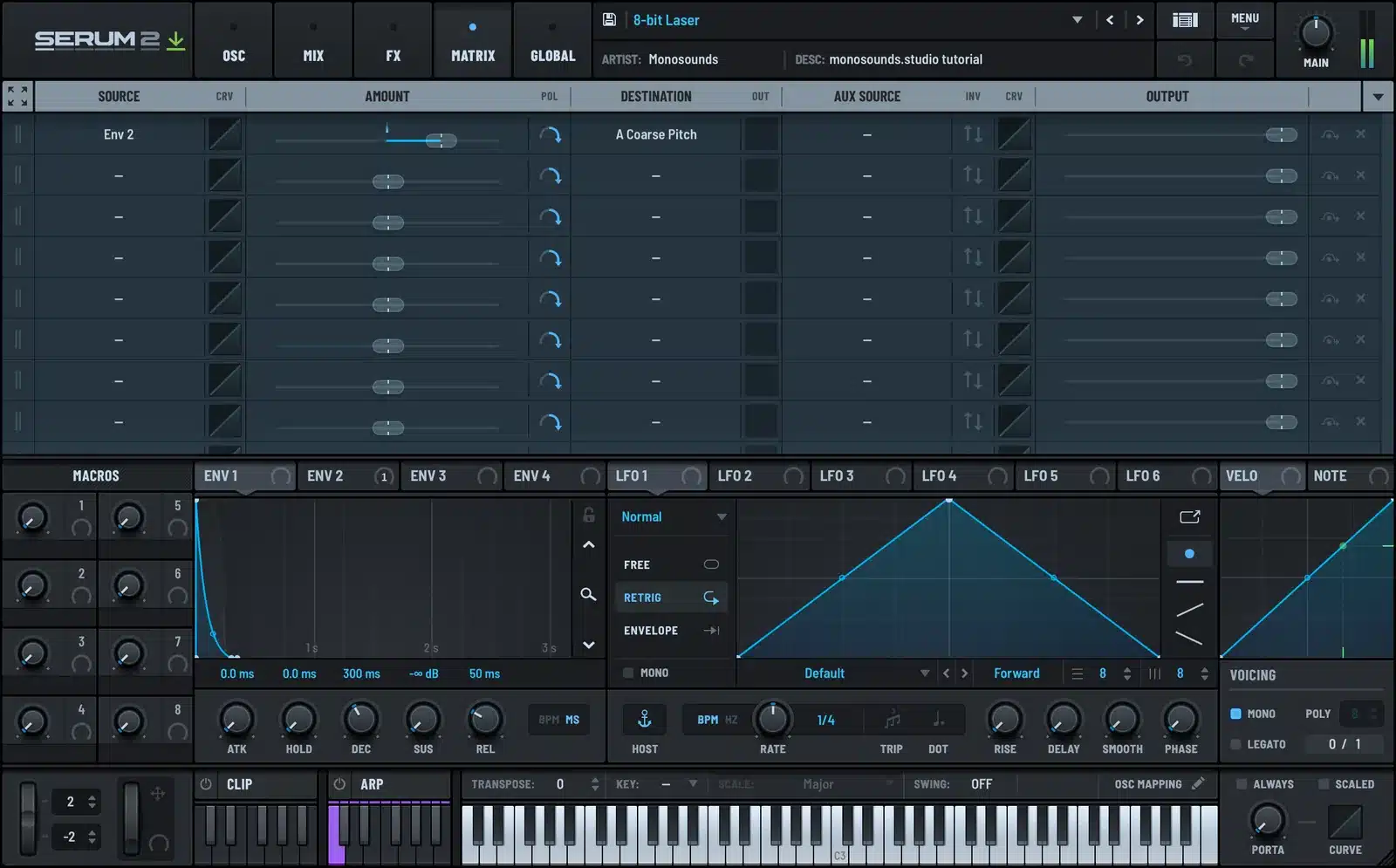
A laser is a rapid downward pitch sweep, and the exact numbers count:
- Square or saw, one voice.
- Pitch envelope starting at +24 semitones and falling to zero (or past it) within 100–200 ms.
- Amp decay to match, roughly 150–250 ms, no sustain.
Want a zappier weapon? Start the fall higher, +36, and tighten the time. A pinch of noise oscillator gives you a “pew” with some air around it. And routing a fast square-shaped LFO into pitch on top of the fall produces the wobbly ray-gun variant. An entire armory sits three knobs away.
The jump
A jump is the laser flipped: a quick rise, one octave in 150–250 ms, square wave, fast decay. The classic version bends the sweep so it moves fast at the bottom and slows toward the top, mirroring how an actual jump behaves physically. Draw that envelope concave and it instantly feels “right” in a way no straight line manages. Tiny detail, huge difference.
Explosions and damage
Noise oscillator, pitch not required:
- Amp envelope: instant attack, decay 400–800 ms.
- A lowpass filter dropping under its own envelope, so the blast opens bright and fades out dark.
- Distortion driven hard, then a bitcrush-style downsample for extra grit.
For damage or a “hurt” sound, stack a short falling square blip, a minor second down, over a noise burst. Power-downs get a long mournful descending stair-step. Identical tools, inverted intervals.
Worth remembering: analog synths were producing experimental blips and zaps decades before any game chip existed, and raw hardware recordings make superb layers under synth SFX. This is the sort of Moog material I have in mind.
Make it a folder, then make it yours
Store each patch in a “Game SFX” folder under Presets/User: Coin, Laser, Jump, Explosion, Powerup, Hurt. What makes these presets truly reusable is Serum 2’s macro system: put one macro on the pitch-envelope range and a second on decay time, and a single Laser patch turns into fifty different weapons through knob-twisting rather than re-patching.
For a wider pool of raw material, the free Serum 2 presets download is full of leads and plucks worth mangling into game sounds; give a bright pluck a stepped pitch LFO and you’ve already got a power-up.
These patches also bleed into actual music all the time. Hyperpop scatters coin-style blips as ear candy, and modern bass music has adopted the laser sweep as a fill. Once the folder exists it gets opened way more than you’d predict. And when the sound design habit grows into whole genres, the Serum 2 preset bundles are the cheapest per-preset way into our catalog. That’s the honest framing.
For the theory underneath it all, the oscillator types guide explains what makes squares and triangles behave the way they do, and the effects guide handles the distortion and downsampling moves.
FAQ
How do I make an 8-bit coin sound?
Square wave, a two-step pitch envelope leaping up a fourth or fifth after roughly 80 ms, amp decay near 300–400 ms, and keep every bit of it dry.
What makes a laser sound?
A pitch envelope diving from +24 semitones down to zero in 100–200 ms on a square or saw, paired with an equally fast amp decay.
Why do my retro SFX sound too modern?
Smooth glides and reverb, almost always. Switch to stepped pitch movement, a single voice, zero effects. The stair-steps and the dryness ARE the era.
Can I use these sounds in music, not just games?
Absolutely. Hyperpop, bass music and lo-fi all deploy coin blips and laser sweeps as transitions and ear candy. The hyperpop and bass packs in the Serum 2 preset catalog already include a few patches exactly like this.
Pitch envelopes, plain waves, zero reverb. Those chips had next to nothing to work with and still built a sound language every person on earth recognizes. That deserves an afternoon of your time!
I run Monosounds.studio and make the packs myself. Ten-plus years of producing, 97+ releases, 16,000+ downloads. Every Serum 2 preset we ship passes a CPU check on a mid-range laptop and gets used in a real track before release. If it does not survive a mix, it does not go in the pack.
More about Maxim & the studio →

