Techno is a sound-palette genre through and through. Warehouse pressure: kick and bass fused into one rumble, hypnotic stabs, leads with an acid edge. Melody barely exists and chords barely move. What keeps you listening is timbre, and whatever shifts across sixteen bars.
I make Serum 2 packs for a living, and techno is where a preset either carries real weight or it simply doesn’t. The bulk of the work sits in filtering, saturation, and getting the low end to cooperate with the kick.
Below: the rumble bass, the stabs, the acid lead and the noise textures, then tempo, mixing, and the mistakes that leave techno sounding thin once the volume goes up.
Start with the free pack
Grab the Free Serum 2 Techno Presets: 10 synths · 5 bass, audio demo on every patch, all royalty-free.
Install is under a minute: unzip into Serum 2’s user preset folder, rescan. Fifteen patches, leaning towards synths on purpose: in techno, the stabs and textures basically are the arrangement.
Who’s it for: anyone who already has a kick they love and wants everything around it to hit as physically as the kick does.
This is roughly the weight I’m describing:
The sound, part by part
Rumble bass
Don’t think of the rumble as a bassline. It’s a held low tone sitting underneath the kick, and the kick gates it. Sine or triangle, mono, single voice, long sustain, one root note held for eight bars.
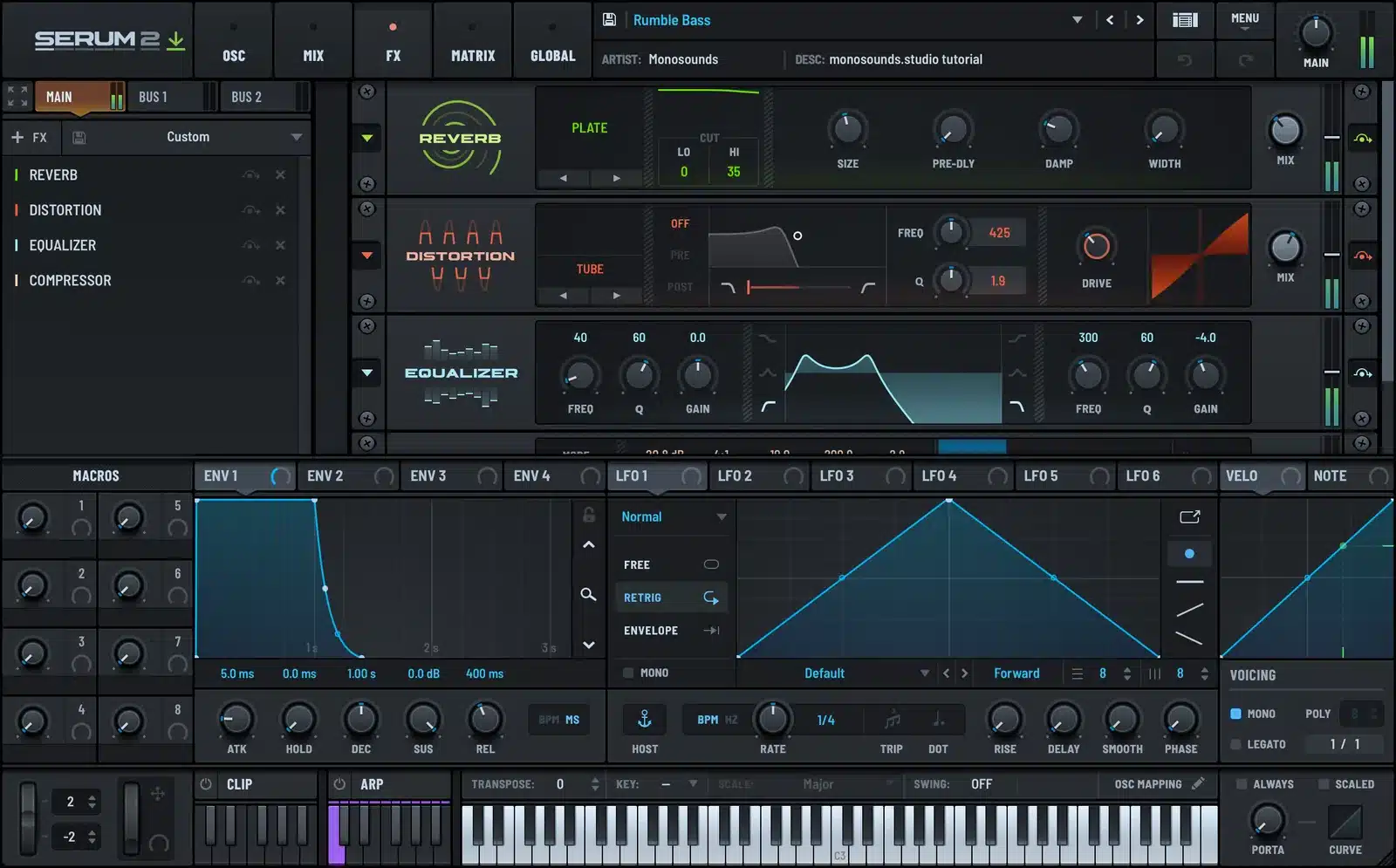
Sidechain it to the kick with a slow release — 150–250 ms — and put a short reverb in front of the sidechain. That reverb is exactly what makes a clean sub start rumbling.
Stay low with the note: usually the kick’s fundamental, or an octave up from it. Any clash between the two shows up instantly as wobble.
Stabs
A techno stab is short, resonant, and frequently dissonant. Start from a saw or an aggressive wavetable, decay around 150 ms, sustain zero, and open up a resonant band-pass somewhere between 800 Hz and 2 kHz.
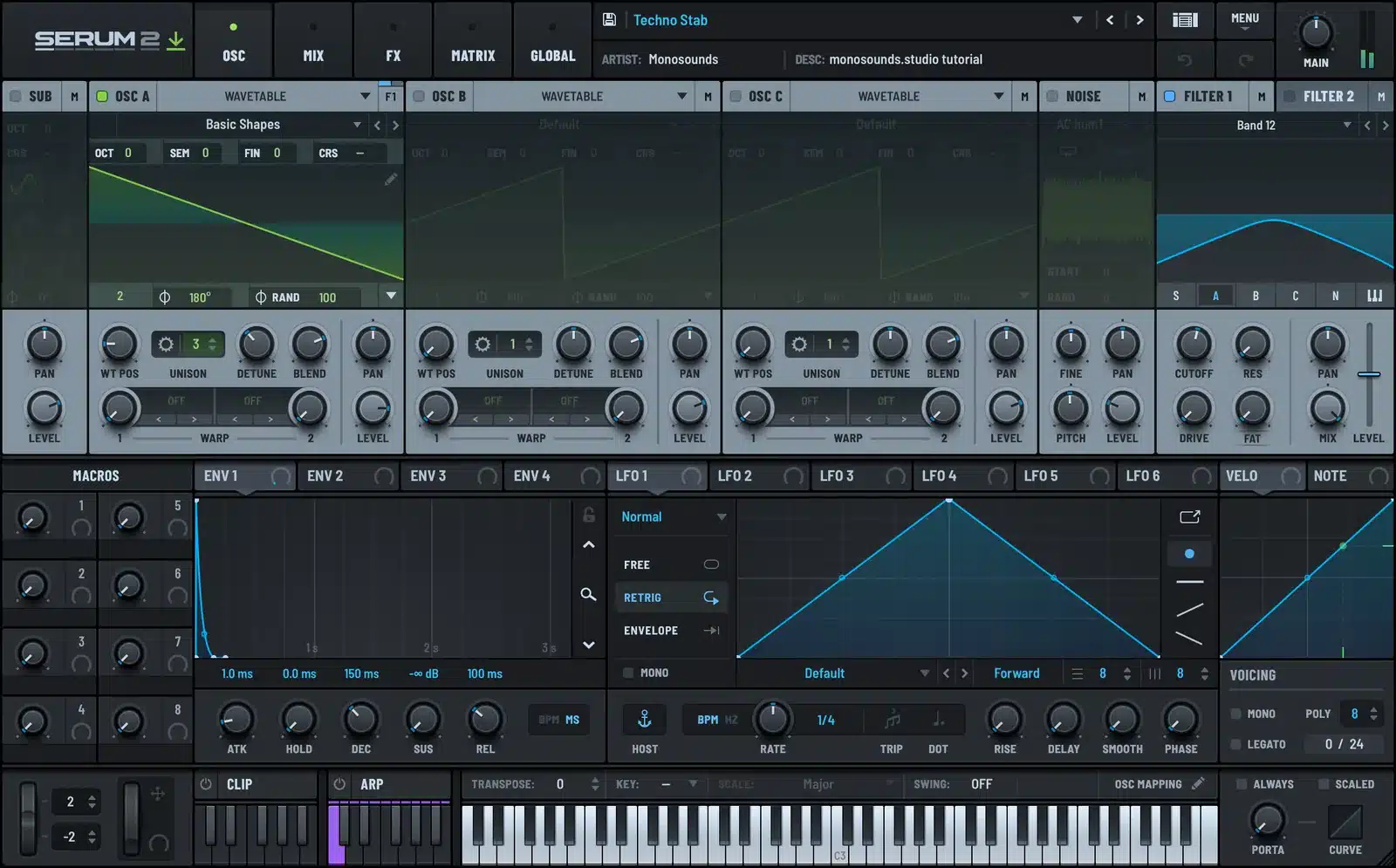
Now drive it hard: Serum 2’s distortion set to hard clip, then a high-pass at 200 Hz. A stab should carry zero low end; that territory belongs to the kick and the rumble.
Put it on an offbeat sixteenth, add a synced delay, and let it run sixteen bars unchanged. The repetition is the whole idea.
Acid leads
Acid means a square or saw into a resonant low-pass where the filter envelope does the moving. Crank resonance to around 60–70%, keep the decay short, and route the envelope to cutoff with real depth. Glide of 30–60 ms makes the notes slide into each other.
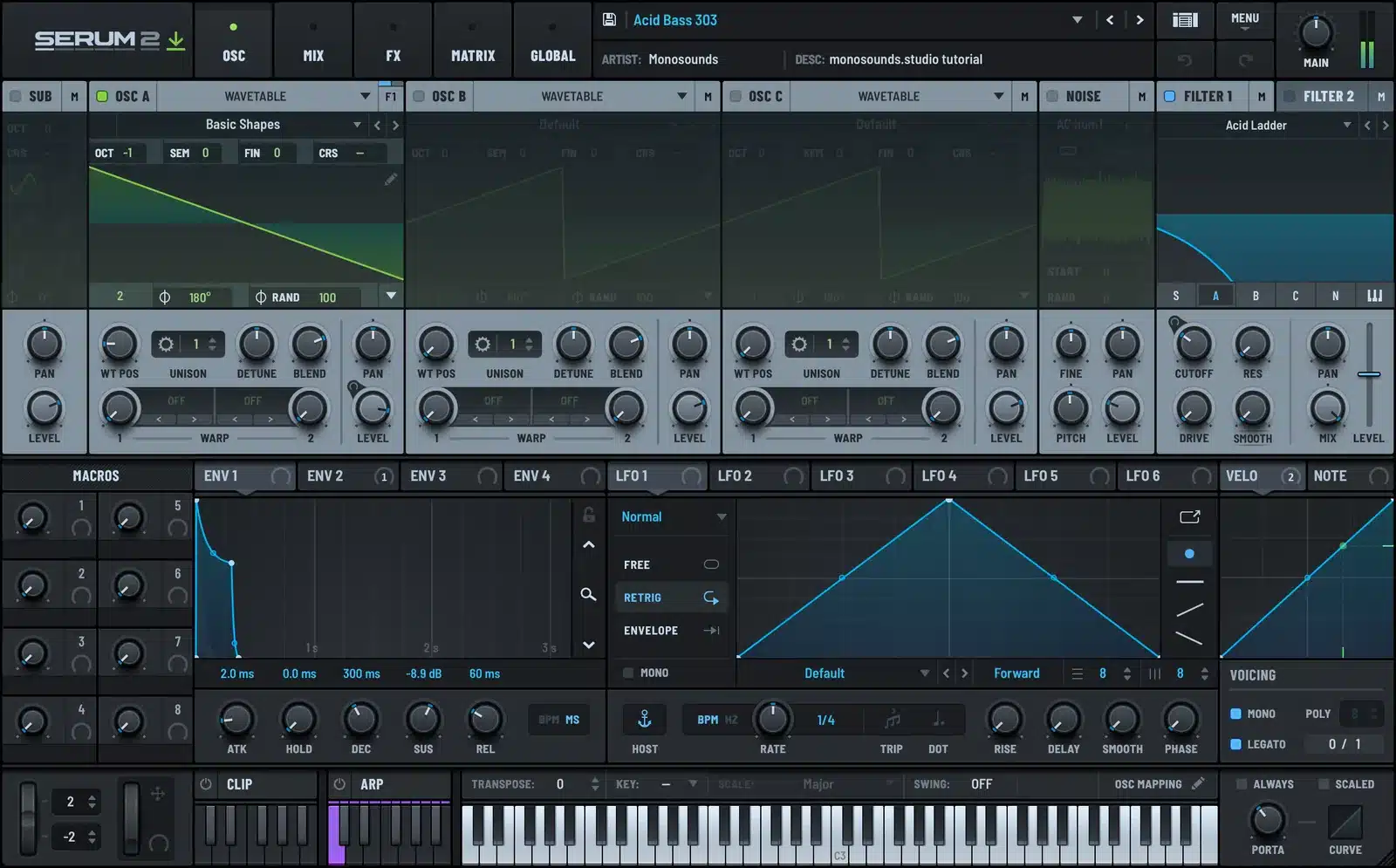
From there, ride the cutoff by hand through the section. Your choice of filter model changes the character considerably; the filter breakdown puts the resonant types side by side.
Noise and textures
In techno, filtered noise through a slowly opening band-pass counts as an entire layer. Give it a long reverb and automate the filter over thirty-two bars. One patch, and it works as riser, pad and atmosphere simultaneously.
Serum 2’s onboard FX handle most of this without ever leaving the plugin; the effects guide explains what each module actually does well.
Tempo, groove and arrangement
Most club releases sit at 128–134 BPM, and the harder stuff pushes beyond that.
The energy comes from the kick and from density, never from melody. Straight sixteenth hats, clap or rim on the offbeat, one percussion loop rotating every sixteen bars.
Arrangement trick I keep coming back to: build one 64-bar loop, then automate a single high-pass filter across all of it. Techno arrangement is mostly filtering and muting anyway, and if it works as a loop, it works as a track.
Mixing notes for techno
Mono under 150 Hz. Kick plus rumble carry most of the track’s energy, and stereo content down there will fold up on a big rig.
Anything with low content gets sidechained to the kick: rumble hard, stabs gently, noise not at all.
Cut 100–200 Hz on every element other than kick and rumble. Techno mixes feel huge because that band stays protected, not because anything is actually loud.
The loudness comes from saturating and clipping the drum bus. Yes, techno masters get pushed hard, but the pushing happens on the drums, never on the master limiter.
Common mistakes
Writing a melody. Caught yourself with a chord progression? You’re probably making melodic techno instead. Nothing wrong with that, but the mix approach is different.
A kick that is too short. Techno kicks run long. A 100 ms decay leaves the rumble nothing to interact with.
Too many elements. Kick, rumble, hats, one stab, one texture: that’s a finished techno track. More usually shrinks it.
Changing too often. Nothing should change before bar sixteen. Eight-bar changes make this genre feel restless.
When you outgrow the freebies
These 15 patches came out of the same design sessions as my Serum 2 preset bundles: full genre collections for a fraction of the single-pack cost. Rather cherry-pick? All the Serum 2 packs I have built are listed with demos.
FAQ
Do these presets work in Serum 1?
No. They run on the Serum 2 engine. Since Serum 2 is a free update for existing Serum owners, anyone who bought Serum 1 already has it.
Are the presets really royalty-free?
Yes. Releases, client jobs, beats you sell, no credit needed. The one restriction is reselling the presets themselves.
Can I use them in any DAW?
Any DAW hosting Serum 2 as VST3 or AU: Ableton, FL Studio, Logic, Cubase, Studio One, all of them. Serum 2 runs native on Apple Silicon too.
What BPM is techno?
128 to 134 BPM covers most club techno. Peak-time sets tend to run 132–140, and hard techno goes far past that.
My kick and rumble are fighting — how do I fix it?
First tune the rumble to the kick’s fundamental; put a spectrum analyser on the kick tail to find it. Then sidechain the rumble aggressively so it only speaks between kick hits. Still wobbling? The pitches are close but not matching: shift the rumble a semitone and listen again.

I run Monosounds.studio and make the packs myself. Ten-plus years of producing, 97+ releases, 16,000+ downloads. Every Serum 2 preset we ship passes a CPU check on a mid-range laptop and gets used in a real track before release. If it does not survive a mix, it does not go in the pack.
More about Maxim & the studio →

