Hardstyle is only as good as its sound palette, and that palette is euphoria at stadium scale: screeching leads, pitched kick-basses, anthem chords. This guide shows you how to build that sound inside Xfer Serum 2, and I'm handing out 15 presets so your starting point is professional patches rather than an init screen.
The genre runs at 150–160 BPM. For reference, listen to Headhunterz, Sub Zero Project and D-Block & S-te-Fan. One distorted kick anchors everything, and every remaining sound in the track has to survive sitting on top of it.
By the end you'll be able to build the three parts a hardstyle drop stands on: the screech lead, the reverse bass, and the chord stack behind them both.
Start with the free pack
Grab the Free Serum 2 Hardstyle Presets — 6 leads · 5 bass · 4 plucks, each one with an audio demo, all royalty-free. Installing takes under a minute: unzip into Serum 2's user preset folder, rescan, done.
Study the leads first. They arrive already distorted, filtered and detuned far enough to slice through a hard kick, which happens to be the single toughest thing to pull off from an init patch. The bass patches are voiced for offbeat playing, and the plucks exist for breakdowns.
This pack is for you if you can program a kick pattern already but your synths keep drowning under it. Never loaded third-party patches before? My preset install guide walks through the folder layout first.
The sound, part by part
The screech lead
Begin on a saw wavetable, or any table rich in odd harmonics. Unison of 5 to 7 voices, detune somewhere between 0.15 and 0.25: wide enough to sound big, not so wide that the pitch smears at 155 BPM.
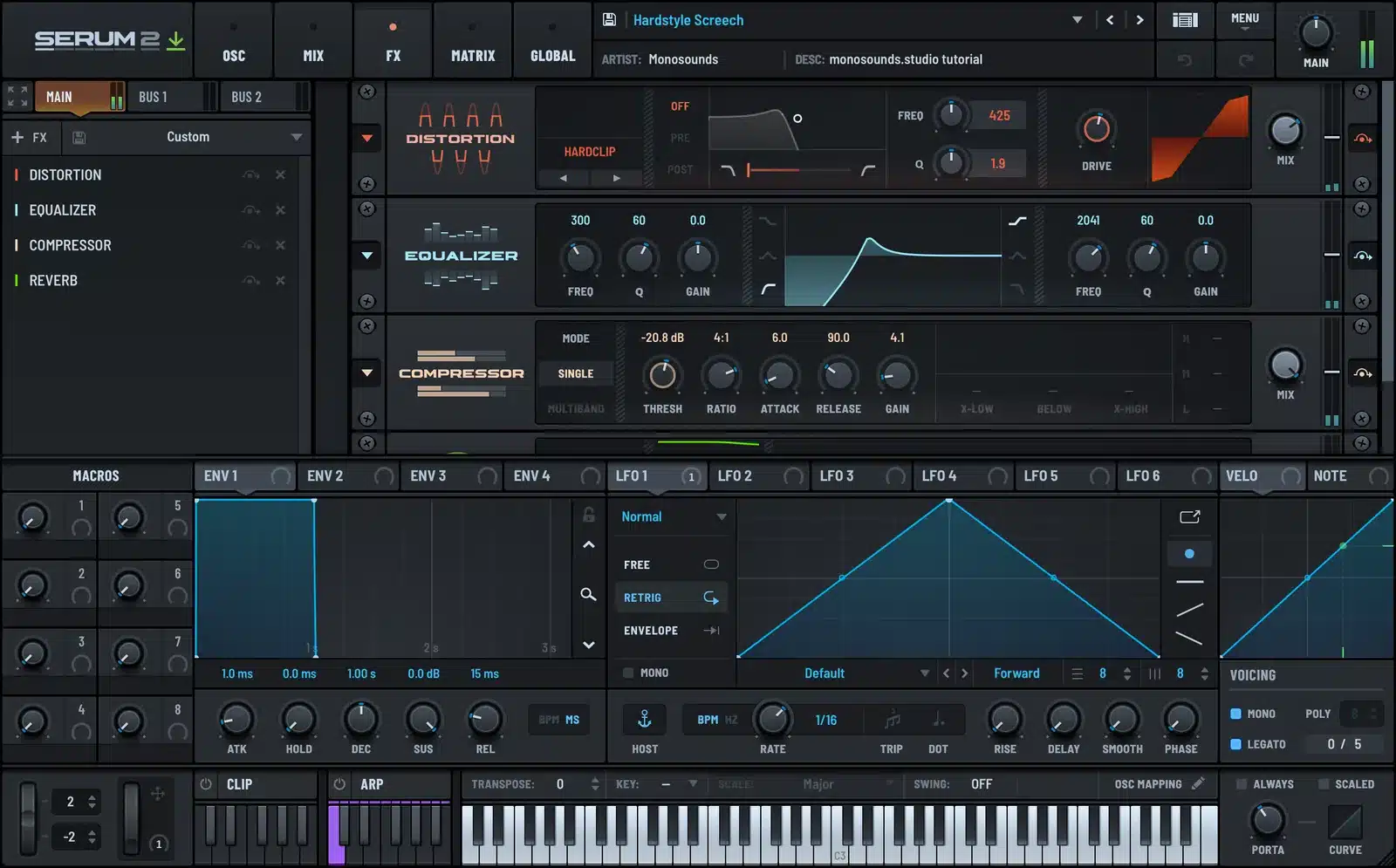
Here's the thing: the screech is a filter trick, not a wavetable trick. Slap a band-pass or peak filter on the oscillator, push resonance up to about 60–70%, and route an envelope to the cutoff in the mod matrix. Fast attack plus a 200–400 ms decay gets you the classic downward yelp. For the rhythmic version, drag a second modulator (an LFO running 1/8 or 1/16) onto the same cutoff.
Now distort it. Distortion goes before the reverb, never after, and you drive it until harmonics pile up above 4 kHz. If the cutoff sweep stops being audible once the distortion is engaged, pull the drive back by a third and compensate with more resonance. The filter guide covers which filter types hold their resonance under heavy drive.
The reverse bass
This is the offbeat swell filling the space between kicks. Load a saw or a saw/square blend, low-pass it around 200–400 Hz with a touch of resonance, and give the amp envelope a slow attack of 60 to 120 ms so each note rises instead of striking.
Then a short downward pitch envelope, a couple of semitones across 100 ms, so it leans into the kick that follows. Play it on the offbeat eighths. One voice, unison off, mono. Width belongs to the lead, never to this patch.
Anthem chords
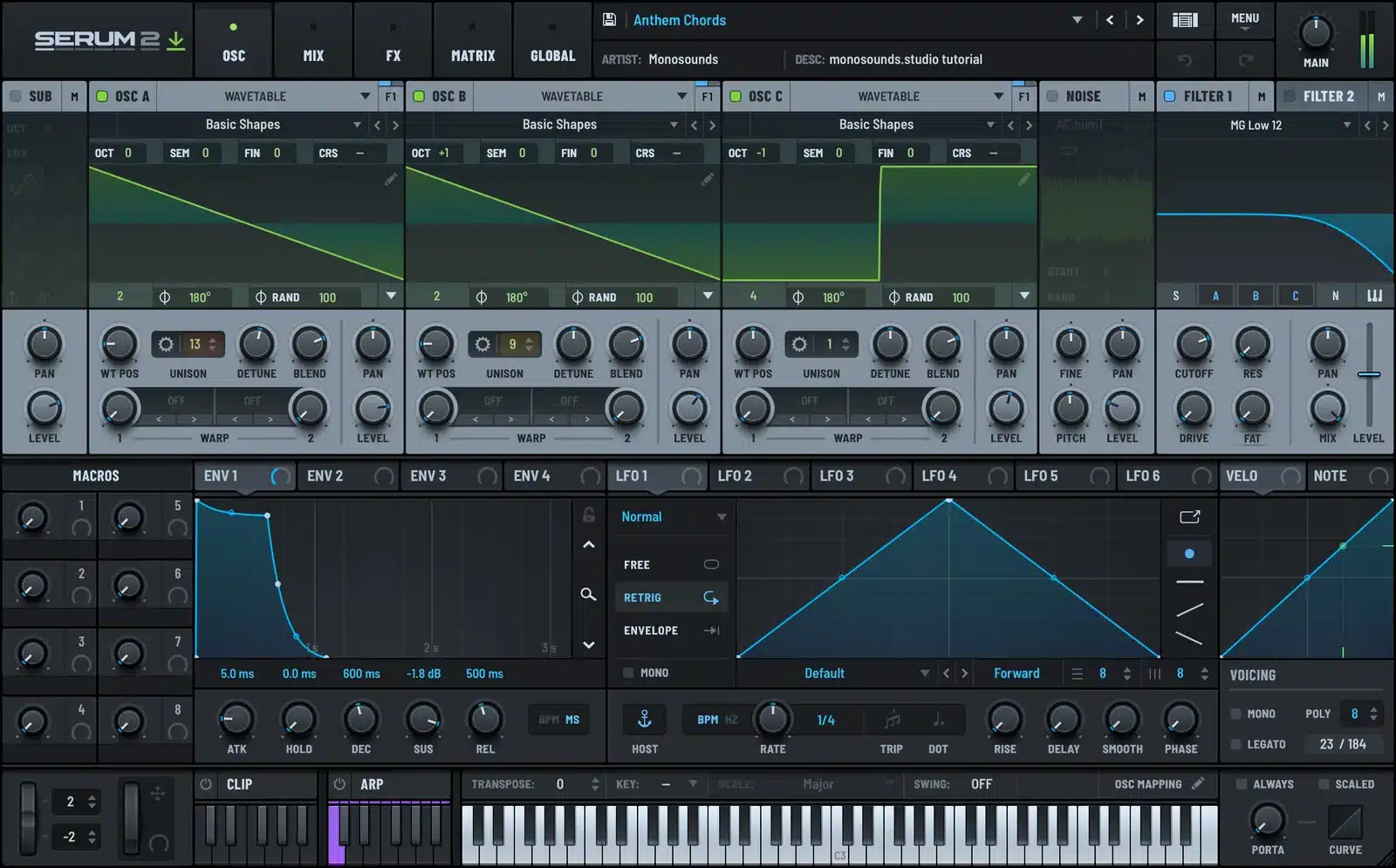
A detuned saw stack, unison 4 to 6, minor with a sus2 or add9 sitting on top. High-pass the entire patch around 250 Hz so it never argues with the kick tail. And one slow filter opening across four bars does more here than any pile of extra layers.
Building the kick tail
Most hardstyle producers pair a kick sample with a tail designed separately, and honestly that remains the fastest route. Want to build the tail in Serum 2 anyway? Use a sine, run a pitch envelope from a high starting note down to the track's root across 300–500 ms, then distort and clip the result. Tune that root to the song's key or the entire drop will fight itself.
Tempo, groove and arrangement
150–160 BPM covers nearly everything. Euphoric sits at 150, the modern main-stage sound at 155, and 158–160 crosses into rawstyle.
Kick on every quarter, reverse bass on the eighths in between. That two-part machine is the entire groove; the lead rides above it while the hats handle the sixteenths.
An arrangement habit worth stealing: write the drop first, then work backwards to build the breakdown. Hardstyle breakdowns run long, 32 bars is common, and they only feel earned when you know precisely what they're leading into. The drop itself stays simple: most are eight bars repeated with a single variation.
Mixing notes specific to hardstyle
Everything under 120 Hz goes to the kick, alone. High-pass the lead at 250–300 Hz and the chords at 250 Hz and watch the mix suddenly find room.
Below roughly 150 Hz, keep it all mono. Especially the reverse bass, since any stereo content down there and the kick stops punching on a big system.
In this genre, loudness lives in distortion and clipping on the kick and lead, not on the master fader. Drive each element until it's loud by itself, then balance the levels.
Take a narrow cut out of the lead at 300–500 Hz. Stack three screeches and that's exactly the band where they collapse into mud.
Sidechain the reverse bass to the kick even though the two never overlap; a short 40 ms duck cleans up the handoff.
Common mistakes
Layering four leads instead of fixing one. Three detuned saws through one filter reads as a single sound; three separate patches through three separate chains reads as a mess. Make one lead loud and clear first, then ask whether you even need a second.
Distorting after the reverb. That smears the tail into noise. The order is distort, filter, then send to reverb.
Leaving the kick untuned. Kick tail in G, track in F minor? No amount of EQ will make that sit right.
Making the breakdown too pretty. One strong melodic idea is what a hardstyle breakdown needs, not four. The layers belong in the drop.
When you outgrow the freebies
These 15 patches came out of the same design sessions as our Serum 2 preset bundles, complete genre collections priced at a fraction of buying packs individually. Or browse the full Serum 2 preset catalog and grab packs one at a time.
And if the screech itself is what you want to dig into, the effects guide goes deeper on distortion staging than I have space for here.
FAQ
Do these presets work in Serum 1?
No, they're built on the Serum 2 engine. Serum 2 is a free update for Serum 1 owners, so the fix is simply installing it.
What BPM should hardstyle be?
150 to 160 BPM. The euphoric end is 150, 155 is today's default, and 158–160 heads into rawstyle.
My screech lead disappears under the kick. What do I fix first?
Before touching anything else, high-pass the lead at 250–300 Hz. Nine times out of ten the problem is the lead fighting the kick in the low mids, not the lead being too quiet.
Are the presets really royalty-free?
Yes. Releases, client work, tracks you sell, no credit needed.
Can I use them in any DAW?
Any DAW that runs Serum 2: Ableton, FL Studio, Logic, Cubase, Studio One and the rest.
I run Monosounds.studio and make the packs myself. Ten-plus years of producing, 97+ releases, 16,000+ downloads. Every Serum 2 preset we ship passes a CPU check on a mid-range laptop and gets used in a real track before release. If it does not survive a mix, it does not go in the pack.
More about Maxim & the studio →

