Organic House is earthy, hypnotic music. Woody plucks, breathy leads with a flute-like quality, textures that live comfortably beside real percussion instead of fighting it. The whole game is making a synth that never announces itself as one.
For reference: Sébastien Léger, Hernan Cattaneo, anyone on All Day I Dream. Tempo runs 110–120 BPM. The tracks are long and patient, assembled from small looping motifs rather than big obvious hooks.
Here’s how I get Serum 2 to sound acoustic (plucks, keys, breathy leads, texture layers), plus the arrangement and mix choices that keep a track warm instead of letting it fade into background music.
Start with the free pack
Grab the Free Serum 2 Organic House Presets: 5 plucks, 5 keys, 4 texture patches and 1 pad, all royalty-free, each with its own audio demo. Unzip into Serum 2’s user preset folder and rescan.
The pack makes most sense if you’re already working with live percussion or sampled loops and need synth parts that can sit next to them. Start with the keys and plucks; those two categories carry the bulk of organic house tracks.
The sound, part by part
Woody plucks
The recipe: very short attack, fast decay, zero sustain, and a wavetable built on odd harmonics rather than a tidy saw.
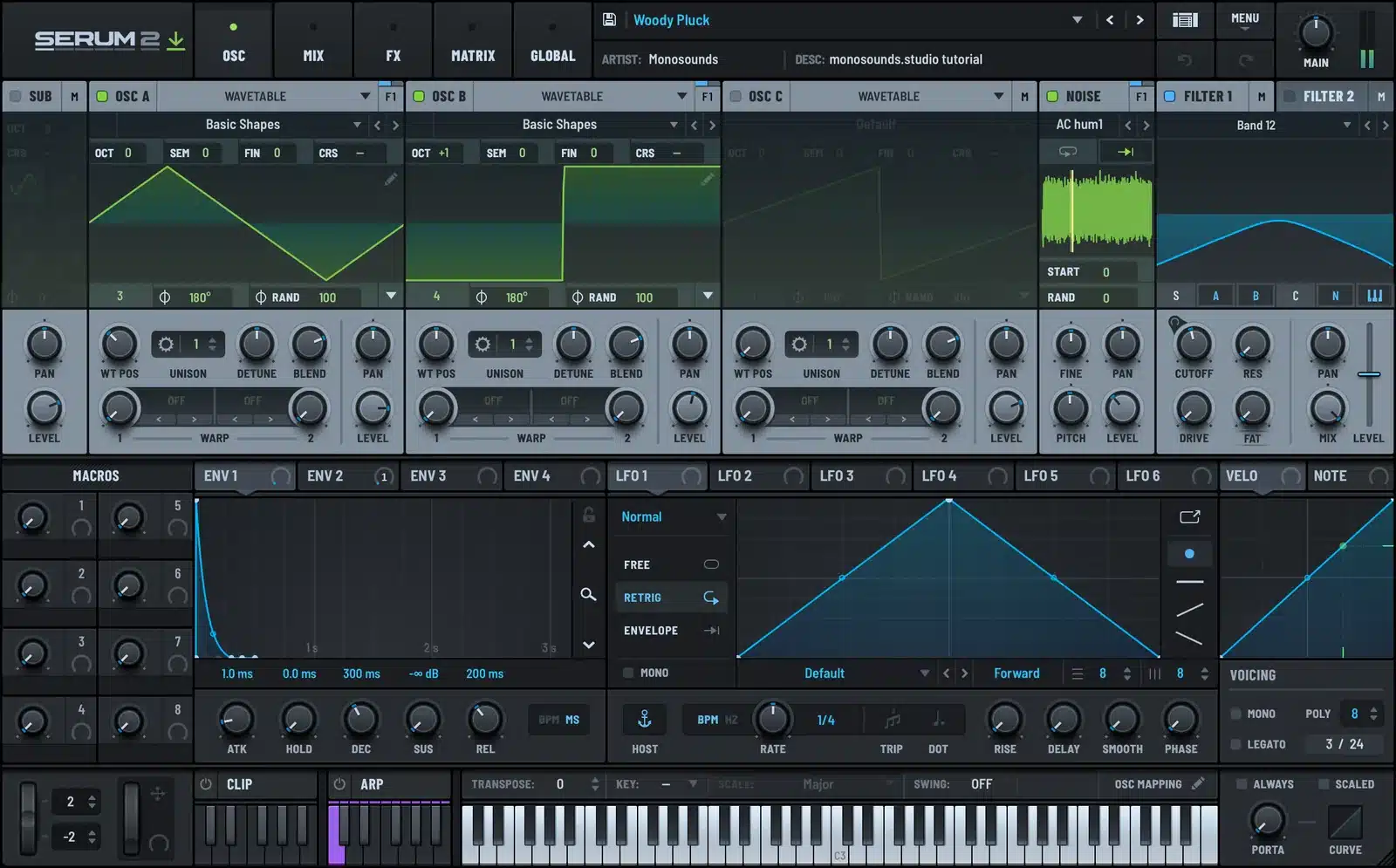
Choose a wavetable with some character: something hollow or bell-like beats anything “analogue”. Unison 2, detune 6. Attack 2 ms, decay 250 ms, sustain 0, release 300 ms. Then send the amp envelope to filter cutoff too, so the tone goes darker as the note fades. Real acoustic instruments shed their high end almost immediately, and that one routing is what tricks the ear.
Sneak in a tiny pitch envelope as well: a few cents drifting upward across the first 20 ms, the way struck instruments behave. Finish with a stereo delay at 3/16, return highpassed at 400 Hz.
Worth reading here: the oscillator types guide. Serum 2’s granular and sample oscillators will take you further toward acoustic territory than wavetables ever will alone.
Keys and mallets
Same shape, longer tail. Decay around 800 ms, still no sustain. Stack a second oscillator a perfect fifth up at low volume, quiet enough that it registers as an overtone, not a chord.
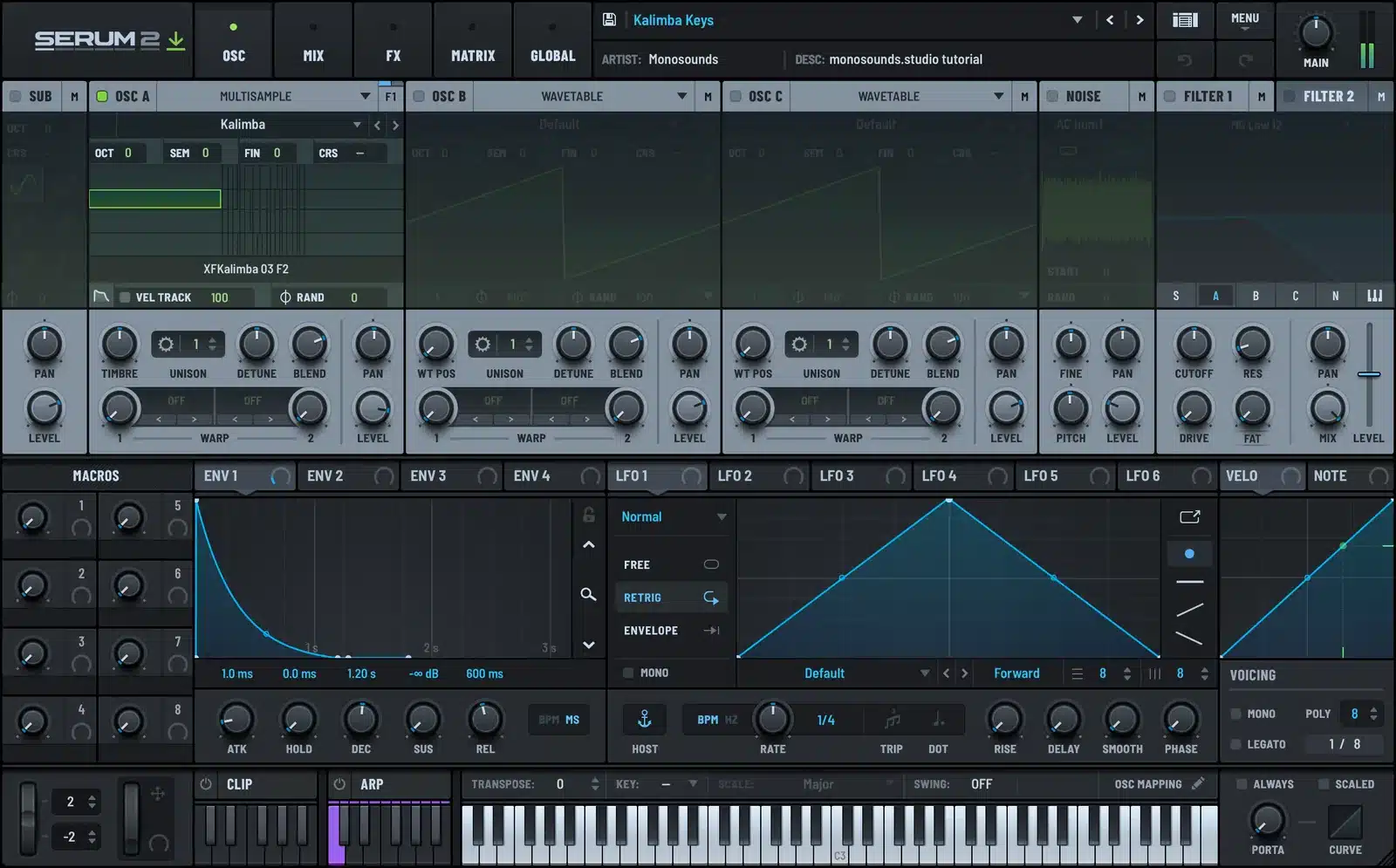
Detune one oscillator 3 to 7 cents and give that detune a slow modulation. No real instrument is ever perfectly in tune with itself.
Then a whisper of chorus (stay under 15 percent) and a plate reverb near 1.5 seconds. Keep the space small. In organic house, reverbs are rooms, never halls.
Breathy leads
This is where the noise oscillator earns its place. Mix a little filtered noise, bandpassed around 2 kHz, into a soft sine or triangle, and set an envelope so the noise peaks at the start of every note and fades over 100 ms.
That’s a breath. It’s the entire difference between a flute-like lead and a plain sine wave. Then add gentle pitch vibrato from an LFO with a 300 ms delay, so only the held notes get vibrato.
Textures and pads
Long, quiet, filtered to death. Attack 2 seconds, release 4. Point an LFO at wavetable position running at 1/1 or slower.
Then process without mercy: highpass at 400 Hz, a long reverb, and a low-pass that you automate across the entire track. A texture layer should register as a feeling, not a sound. The pads and atmospheres guide goes through the settings in more depth.
Tempo, groove and arrangement
110–120 BPM, with 116 to 118 being where most current releases land. Drop under 110 and the dancefloor stops responding.
The groove belongs entirely to the percussion. Shakers, congas, bongos, rim hits: stacked, spread wide, and never fully snapped to grid. Push hits around by hand until the loop breathes.
The defining arrangement move of the genre: one new percussion element every 16 bars for the first three minutes. There is no drop. Energy accumulates, and the release comes from subtraction rather than addition.
Expect tracks of 7–9 minutes. The main melodic idea frequently waits until minute three to appear. That’s a feature, not a flaw.
Mixing notes for organic house
Mono below 100 Hz and nowhere else. Everything above can spread out, and the percussion especially should occupy the full stereo field.
Go easy on the sidechain: 2 to 3 dB tops, with a lazy release around 200 ms. The low end should breathe, never pump.
Do not touch the 200–500 Hz region. That warmth is precisely what makes the genre sound organic; carving it out of habit is the quickest route to a sterile track.
On the master bus, reach for tape saturation or a soft tube stage instead of heavy limiting. These records are supposed to be dynamic, and they typically get mastered several dB below club techno.
Roll off above 14 kHz. Acoustic sources carry little energy up there anyway, and the mix feels more natural without it. The effects guide shows the FX rack order I use for this kind of work.
Common mistakes
Sounds that are too clean. Flawless tuning plus zero noise equals synthetic. Introduce detune drift, a quiet noise layer, and imperfect timing.
Too much reverb. Big halls shove everything to the back of the mix. Stick to short rooms and get your sense of space from delays.
Writing a drop. There is no drop in organic house. Build a big tension-and-release moment and what you’ve actually made is progressive house with congas.
Quantising the percussion. Shakers welded to the grid murder the feel. Play them in by hand, or nudge every single hit.
When you outgrow the freebies
These 15 patches were made in the same sessions as my Serum 2 preset bundles, entire genre collections priced below what the packs cost separately.
Prefer picking a single style? All the Serum 2 packs I’ve built live on one page.
FAQ
Do these presets work in Serum 1?
No. They’re built on Serum 2’s engine. Serum 2 is a free update for Serum 1 owners.
Are they royalty-free?
Yes. Releases, client work, tracks you sell, all without credit. The only restriction is redistributing the preset files themselves.
Can a wavetable synth really sound acoustic?
Close enough for this genre. Envelope shape and imperfection do the heavy lifting: fast decay, filter tracking the amp envelope, a little detune drift, a small noise layer. Serum 2’s granular and sample oscillators close the remaining gap.
What BPM is organic house?
110–120 BPM, with the bulk of releases sitting around 116 to 118.
My track sounds pleasant but nothing happens — how do I add interest?
Work the percussion, not the melody. Introduce one new hand-percussion layer every 16 bars, then around minute five pull everything back to just two elements for 32 bars. That contrast is what listeners actually experience as an event.

I run Monosounds.studio and make the packs myself. Ten-plus years of producing, 97+ releases, 16,000+ downloads. Every Serum 2 preset we ship passes a CPU check on a mid-range laptop and gets used in a real track before release. If it does not survive a mix, it does not go in the pack.
More about Maxim & the studio →

