Progressive House rises or falls on its sound palette — long-arc builds: shimmering arps, layered plucks, basses that keep evolving for thirty-two bars. Patience defines the genre. A sound that would bore you inside eight bars turns hypnotic when given thirty-two.
Designing Serum 2 packs is my day job, and progressive house is the genre where most of my hours go into modulation rather than the oscillator itself. The raw tone tends to be simple. What sells it is that nothing ever sits still.
What follows: the arp, the plucks, the bass and the pads, then tempo, arrangement, mixing, and the four habits that flatten a progressive track.
Start with the free pack
Grab the Free Serum 2 Progressive House Presets: 8 drums · 3 chords · 3 pads · 2 others · 2 leads · 2 bass · 1 synth · 1 pluck, all royalty-free, every patch paired with an audio demo.
Installing takes under a minute: unzip into Serum 2’s user preset folder, rescan, done. Twenty-two patches with drum sounds included, so a rough arrangement never has to leave the plugin.
Who’s it for? Producers who already get structure and need sounds that survive long automation. Each patch carries at least one macro tied to something worth moving slowly.
The sound, part by part
Arps
The classic shimmering progressive arp is a short pluck fed through Serum 2’s arpeggiator at sixteenths with a dotted-eighth delay running behind it. The patch itself stays narrow; width is the delay’s job.
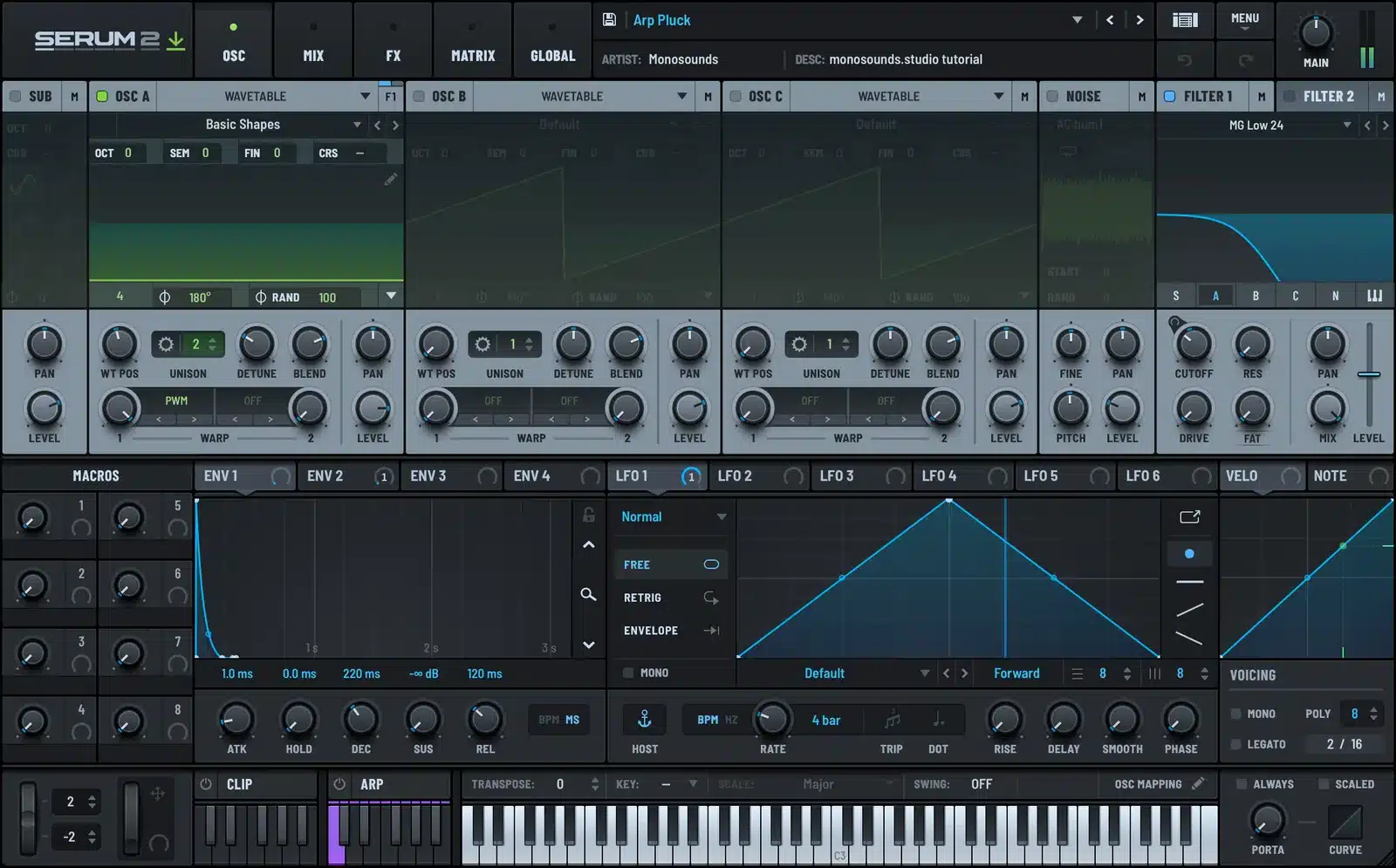
Settings: decay near 200 ms, sustain at zero, unison 2 or 3, detune under 10%. Then put an LFO on filter cutoff cycling once every eight or sixteen bars.
Here’s the thing about arps: they only get interesting when the accent pattern shifts. Spread velocity across the sequence, or swap one note of the pattern every four bars.
Layered plucks
This is the Prydz-adjacent trick. Take a pluck, duplicate the track, detune the copy 8–12 cents, pan the pair hard left and right. Then stack a third layer an octave higher, quieter, filtered above 2 kHz.
Give all layers identical envelope times so they fuse into one instrument. Mismatched decay times sound like three separate plucks; matched decay times sound like a single wide one.
Bass
Progressive bass rolls on the offbeat; it’s not a stab. Sine or gentle saw, mono, decay around 250 ms, sustain low, with a filter slowly opening across the section.
The growth lives in automation, not the patch. Nudge the low-pass open a little every eight bars through the build and the bass swells without a single new element.
Pads and supersaws
Progressive pads run wide and bright. Unison of 7, detune 25–35%, slow attack, high-passed at 200 Hz so they stay clear of the bass. This is straight supersaw territory: the supersaw guide applies, same voicing and detune rules.
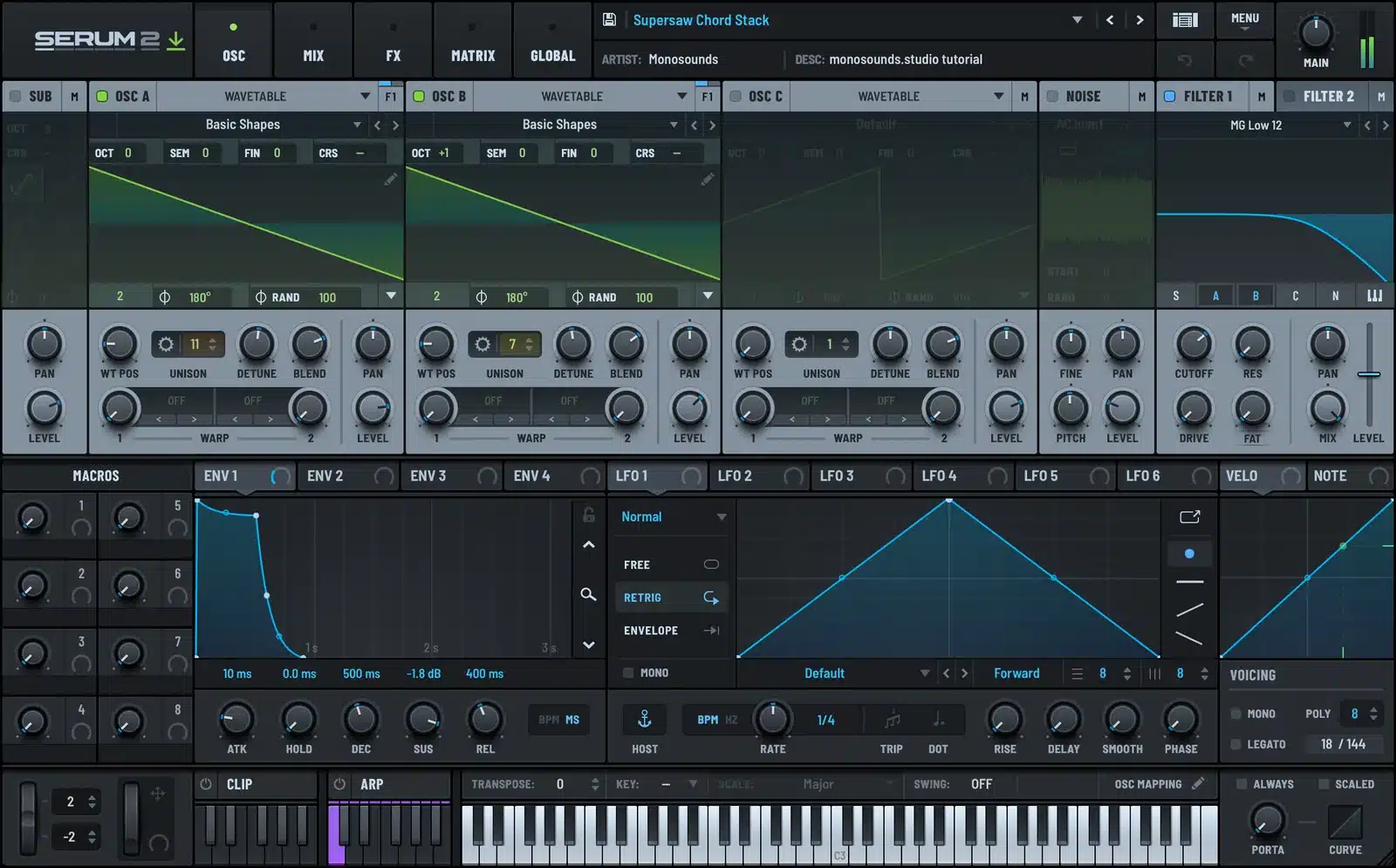
Map filter cutoff, unison detune and reverb send to macros, then ride all three through the build. Strip down almost any big progressive breakdown and you’ll find those three moves and little else. If the mod matrix still feels foreign, the modulation guide shows the drag-and-drop routing.
Tempo, groove and arrangement
Progressive house lives at 122–126 BPM, usually 124.
The energy curve IS the genre. Thirty-two bars of intro, thirty-two of build, a drop holding for 32 or 64 bars, then a breakdown pared back to pad and arp. Sections run twice the length of most house subgenres, on purpose.
A habit that works: sketch the filter automation for a section before writing a single note into it. Get the curve right and the parts practically place themselves. It also keeps you out of the trap of piling on layers to manufacture energy that automation should be providing.
Mixing notes for progressive house
Mono below 120 Hz, no exceptions. Progressive mixes go wide everywhere else, which means the low end has to hold the anchor.
Sidechain the pads, plucks and reverbs against the kick with a medium 60–90 ms release. Pumping belongs to this sound, but it should feel like breathing, not a gate slamming.
Cut into 300–500 Hz on the pads. Seven unison voices spread over a chord makes that band dense enough to eat the entire mix.
High-pass every reverb return at 300 Hz. Long tails plus low mids equals fog, and this genre runs on long tails.
Loudness comes from the drum bus and a controlled bass, never from crushing the master. One more thing: heavy unison burns CPU fast, and the CPU notes cover which settings actually move the needle.
Common mistakes
Eight-bar thinking. Change sections every eight bars and it reads as house, not progressive. Double every length and listen to what happens.
Static supersaws. Seven unison voices with zero movement is a wall, not a sound. Automate that cutoff.
Too many layers in the drop. Progressive drops often carry fewer elements than the build did. That contrast is the whole payoff.
Bass with too much character. Give the bass a personality and it starts fighting the arp. Keep it plain. Let it roll.
When you outgrow the freebies
These 22 patches came out of the same design sessions as my Serum 2 preset bundles, full genre collections for a fraction of the single-pack prices. Prefer choosing one pack at a time? The full Serum 2 preset library has audio demos on every product page.
FAQ
Do these presets work in Serum 1?
No. They run on the Serum 2 engine. Serum 2 is a free update for existing Serum owners, so Serum 1 buyers already have access.
Are the presets really royalty-free?
Yes. Releases, client work, beats you sell, no credit needed. The only restriction is reselling the presets themselves.
Can I use them in any DAW?
Any host that loads Serum 2 as VST3 or AU: Ableton, FL Studio, Logic, Cubase, Studio One and the rest. Serum 2 runs native on Apple Silicon.
How long should a progressive house track be?
Seven to nine minutes for the club mix, four to five for a radio edit. The long version is the point; that arc needs space to unfold.
My build has automation everywhere but still feels flat — what am I missing?
The drums, most likely. When the hats, ride and percussion keep the same density through the whole build, no filter automation on earth will generate tension. Add a percussion layer every eight bars and strip the low end away progressively, so the drop becomes the first moment the sub comes back.

I run Monosounds.studio and make the packs myself. Ten-plus years of producing, 97+ releases, 16,000+ downloads. Every Serum 2 preset we ship passes a CPU check on a mid-range laptop and gets used in a real track before release. If it does not survive a mix, it does not go in the pack.
More about Maxim & the studio →

