Trap is all about its sound palette — dark, modern bounce: 808-style basses that slide, icy bell-ish plucks, pads straight out of a horror score. This guide shows how I get that sound in Xfer Serum 2, and I'm handing out 15 presets so you start from professional patches rather than a blank init screen.
For reference: Metro Boomin, Southside, Wheezy. The tempo reads 130–150 BPM on paper but the feel is half that, so hats fly while the melody crawls.
By the end you'll have the three ingredients of a finished trap beat: an 808 that slides and still translates to phone speakers, a melody patch with some attitude, and a pad that fills space without smearing the mix into soup.
Start with the free pack
Grab the Free Serum 2 Trap Presets: 10 others · 5 leads, audio demo on each, all royalty-free. Install takes under a minute: unzip into Serum 2's user preset folder and rescan.
The five leads handle the melodic side: plucks, bells, plus one thin detuned lead that sits nicely over an 808. Everything else is texture and bass patches for the low end and the background.
It’s aimed at producers who can already program drums and want the melodic layer to stop sounding like stock content. New to Serum? Go through the beginner walkthrough first, then come back here.
The sound, part by part
The 808
A trap 808 is a sine wave with a story attached. Begin with a sine or a very gentle triangle wavetable: one voice, no unison. For the amp envelope: attack instant, sustain not dropping, and enough release that notes bleed into each other, anywhere from 800 ms to 2 seconds depending on your tempo.
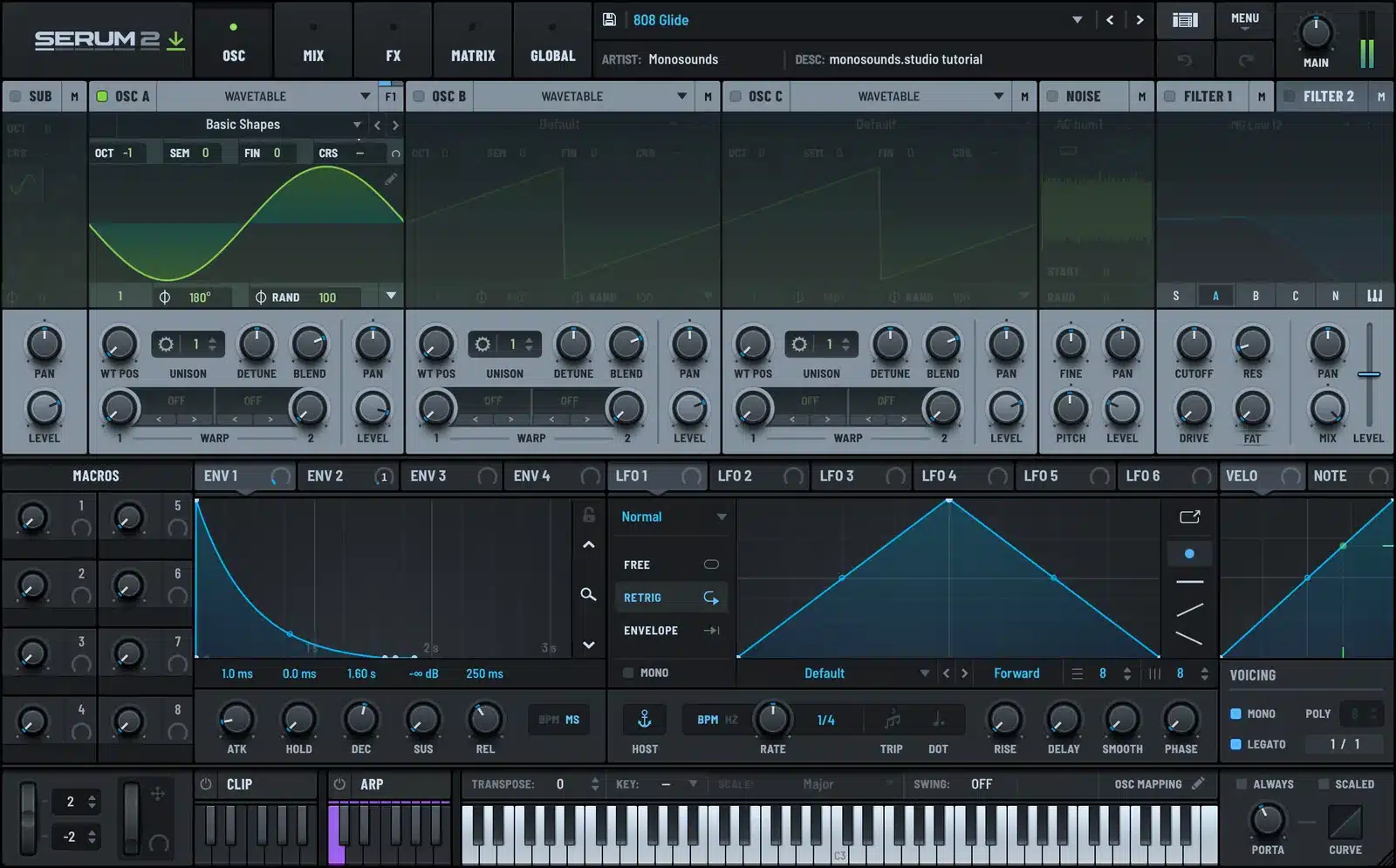
The slide comes from a pitch envelope, not the portamento knob: send a short envelope to oscillator pitch, start a few semitones above the target note, and drop over 30–60 ms. That’s the click-and-fall you hear on the front of every 808.
Distortion is what gets it heard on laptops. Put a soft-clip or tube distortion after the filter, drive until upper harmonics show up around 200–800 Hz, then dial it back until the fundamental is in charge again. There’s a longer version of all this in my piece on designing 808 bass in Serum 2.
Here’s a finished 808 from one of my paid packs — listen for how much distortion is really sitting on it:
Bells and icy plucks
The hook in most trap beats is a bell. Reach for a wavetable with inharmonic content, or FM one oscillator against another at a non-integer ratio; the metallic clang is the selling point.
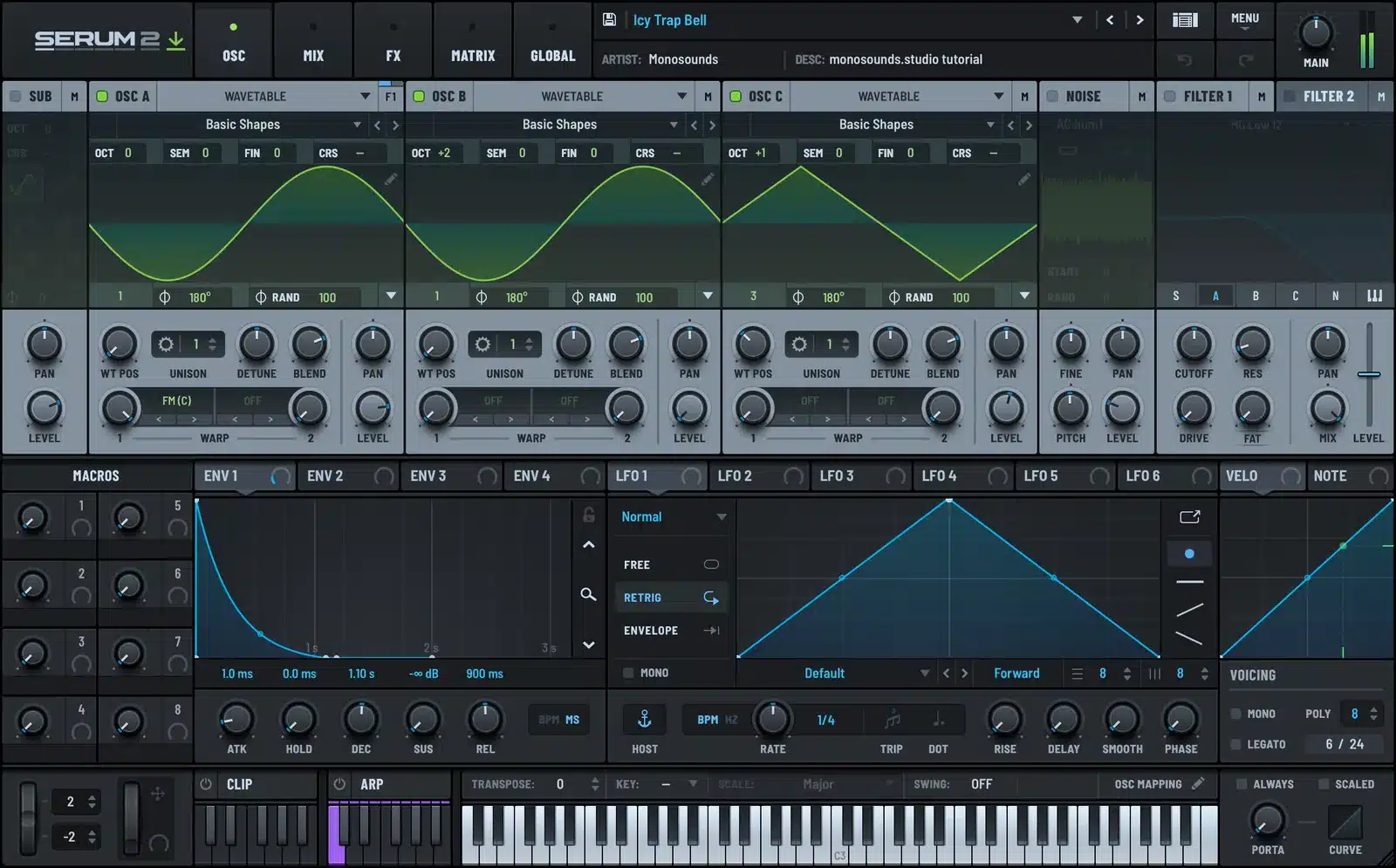
Keep the amp decay short, 200–500 ms, sustain nearly gone. Then a dotted-1/8 ping-pong delay and a plate reverb. Dry signal narrow, wet signal wide — that contrast is exactly what makes it icy.
Dark pads and textures
Pads in trap are wallpaper, not a feature. Low-pass a saw stack down to 2–3 kHz, put slow LFOs on the cutoff and on wavetable position, high-pass at 300 Hz. Deliberately detune two voices against each other; the beating between them is where the unease comes from.
The thin lead
When the beat wants a lead riding over the 808, thin wins over wide. Single saw, unison 3, detune below 0.10, run through a band-pass. Go any fatter and it starts fighting the vocal that will eventually land on top.
Tempo, groove and arrangement
Write it at 130–150 BPM, feel it at 65–75. Kick and snare hold down the half-time backbeat while the hats run 1/16 with 1/32 rolls thrown in here and there.
The 808 pulls double duty: it’s the bass and half of the rhythm at once. Put note changes where the beat should turn, not where a chord chart tells you. A long slide between two notes says more than a handful of extra notes ever will.
Here’s an arrangement habit worth stealing: build your eight-bar loop, then remove something on every second repeat. Trap arrangement is mostly subtraction anyway: pull the hats for two bars, mute the melody under a vocal, let the 808 come back alone right before the hook.
Mixing notes specific to trap
Everything under 100 Hz stays mono, and the 808 gets that range to itself. The kick may sit at 60–80 Hz only if it’s short.
Sidechain the 808 to the kick: a fast 30–50 ms duck. Not for pump; just to stop the two summing into a click.
Cut 200–400 Hz out of pads and melody. The 808’s harmonics live there, and protecting that band is the difference between a beat that translates and one that only works on your own monitors.
Hats get bright from a shelf above 8 kHz, never from level. Turning hats up until you hear them is exactly how trap mixes turn harsh.
Loudness comes from clipping the 808 and drums individually before the master, not from a limiter carrying everything at the end.
Common mistakes
Running a pure sine 808 with zero distortion. Massive on headphones, invisible on every phone speaker. Always check in mono at low volume.
Cramming too many notes into 808 patterns. Two or three per bar with slides wins over eight staccato hits nearly every time.
Mixing the pad too hot. If the pad is clearly audible, it’s probably sitting 4 dB too high.
Parking the melody in the same octave as the 808’s harmonics. Shift the bells up an octave and watch the whole beat open up. Neighbouring genres pull the same move; the phonk tutorial shows how far that trick stretches.
When you outgrow the freebies
These 15 patches came from the same design sessions as our Serum 2 preset bundles: full genre collections at a fraction of the single-pack price. Or browse all my Serum 2 packs one by one if a single sound is all you need.
FAQ
Do these presets work in Serum 1?
No. They run on the Serum 2 engine. Serum 2 is a free update for Serum 1 owners, so installing it is the entire fix.
What BPM is trap?
Written at 130–150 BPM, felt at 65–75. Most modern trap lands at 140.
My 808 sounds fine in headphones but disappears on phone speakers. Why?
Because nothing exists above the fundamental. Add distortion after the filter until the note reads at 200–800 Hz, then listen again in mono at low volume.
Are they really royalty-free?
Yes. Releases, client work, beats you sell, no credit needed.
Can I use them in any DAW?
Any DAW that hosts Serum 2: Ableton, FL Studio, Logic, Cubase, Studio One and the rest.

I run Monosounds.studio and make the packs myself. Ten-plus years of producing, 97+ releases, 16,000+ downloads. Every Serum 2 preset we ship passes a CPU check on a mid-range laptop and gets used in a real track before release. If it does not survive a mix, it does not go in the pack.
More about Maxim & the studio →

