Slap house is bounce built for radio. One elastic slap bass holds up the whole drop, some bright plucks sit on top, and the hook is simple enough that you remember it after a single play. Honestly, most of this genre is a single sound executed really well.
For reference, think Dynoro, Imanbek, R3HAB. The tempo lives at 124–128 BPM. It came out of Brazilian bass and turned sharper, cleaner and more pop as it went mainstream.
Here’s my step-by-step for the slap bass in Serum 2, the plucks and leads that surround it, and how I mix so a single bass patch can carry an entire drop.
Start with the free pack
Grab the Free Serum 2 Slap House Presets first: 10 basses, 5 leads, audio demos for each, all royalty-free. Drop the unzipped folder into Serum 2’s user preset directory and hit rescan.
Notice the ratio. Ten basses against five leads isn’t random: in slap house, the bass basically is the song. Pick one, write a four-note pattern, and you’re already most of the way to a finished drop.
Here’s the kind of weight I’m talking about:
The sound, part by part
The slap bass
A bass slaps because of three things: a pitch envelope, a quick filter envelope, and hard sidechain. Skip any of them and the sound falls apart.
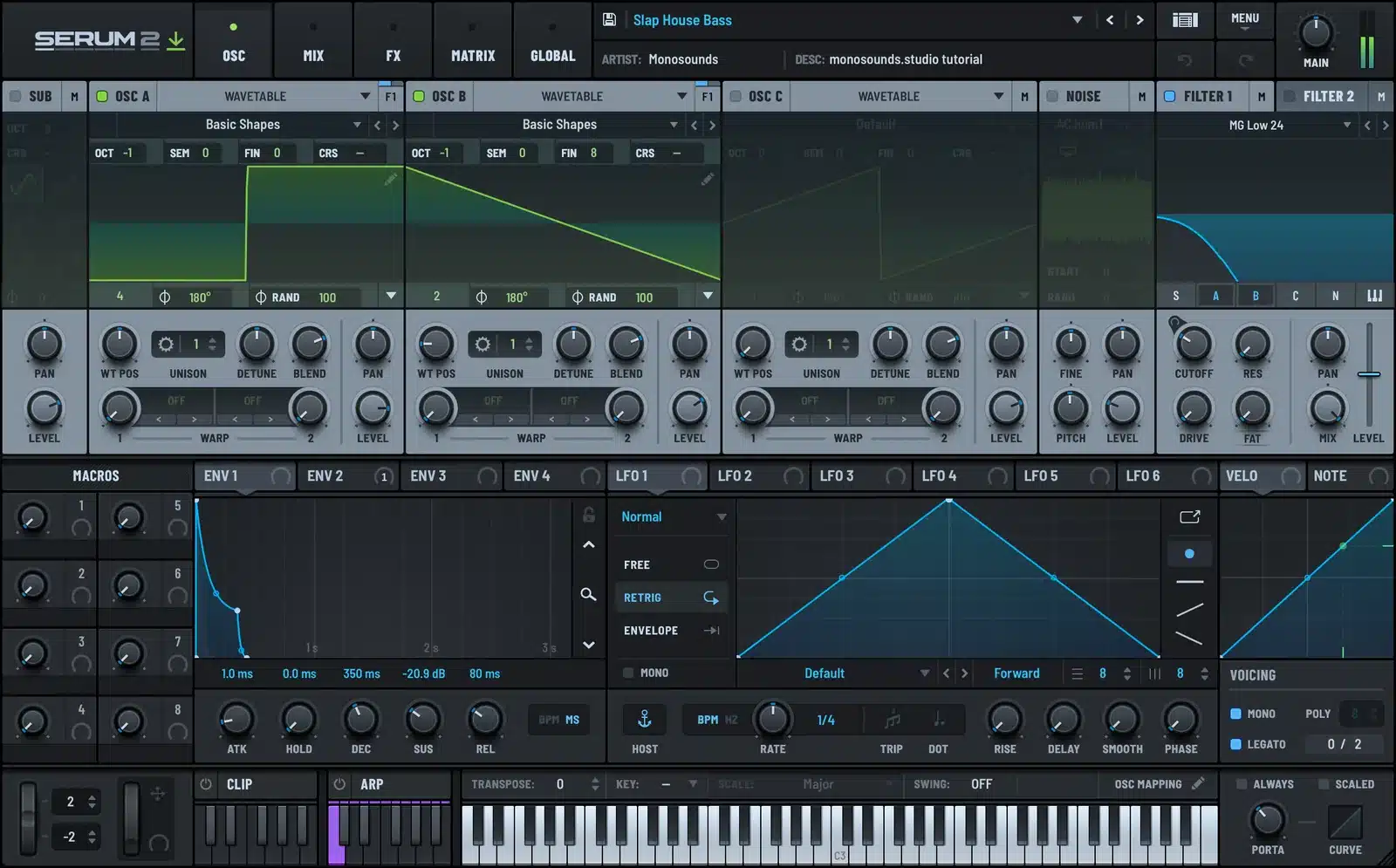
On oscillator A I use a saw, or a hybrid wavetable that’s heavy in the low harmonics. Unison at 1 or 2, detune below 5. Oscillator B gets a sine an octave down, at moderate level, for the sub.
Then a pitch envelope on oscillator A: roughly 2 semitones upward, attack at 0, decay 40 ms, sustain 0. You barely hear it in isolation, but that’s the snap.
Filter next: lowpass with the cutoff sitting low, resonance near 30 percent. Send an envelope to cutoff: attack 0, decay 180 ms, sustain 15 percent. No single control changes the character of the bass more than this. Sweep that decay while your pattern loops and stop right where it flips from pluck to sustained note.
For FX I go light drive, a lowpass afterwards to tidy things up, and a bit of chorus only on the top layer. My rundown of bass presets goes through the same layering idea in other genres if you want a comparison.
The sidechain, which is part of the sound
There’s nothing subtle about slap house sidechain. Set a volume-shaper or compressor to pull 8 to 12 dB, release around 150 ms, and shape the curve so it climbs back smoothly instead of jumping.
Trigger it from the kick, and add a silent 1/4 note MIDI trigger too if you need the pump running through sections where the kick disappears. How the release curve moves matters as much as the patch itself.
Plucks and leads
Keep these bright, short, and living above 1 kHz. Unison 3, detune at 10 percent, 200 ms decay, zero sustain. Add a 1/8 ping-pong delay and a small reverb and you’re done.
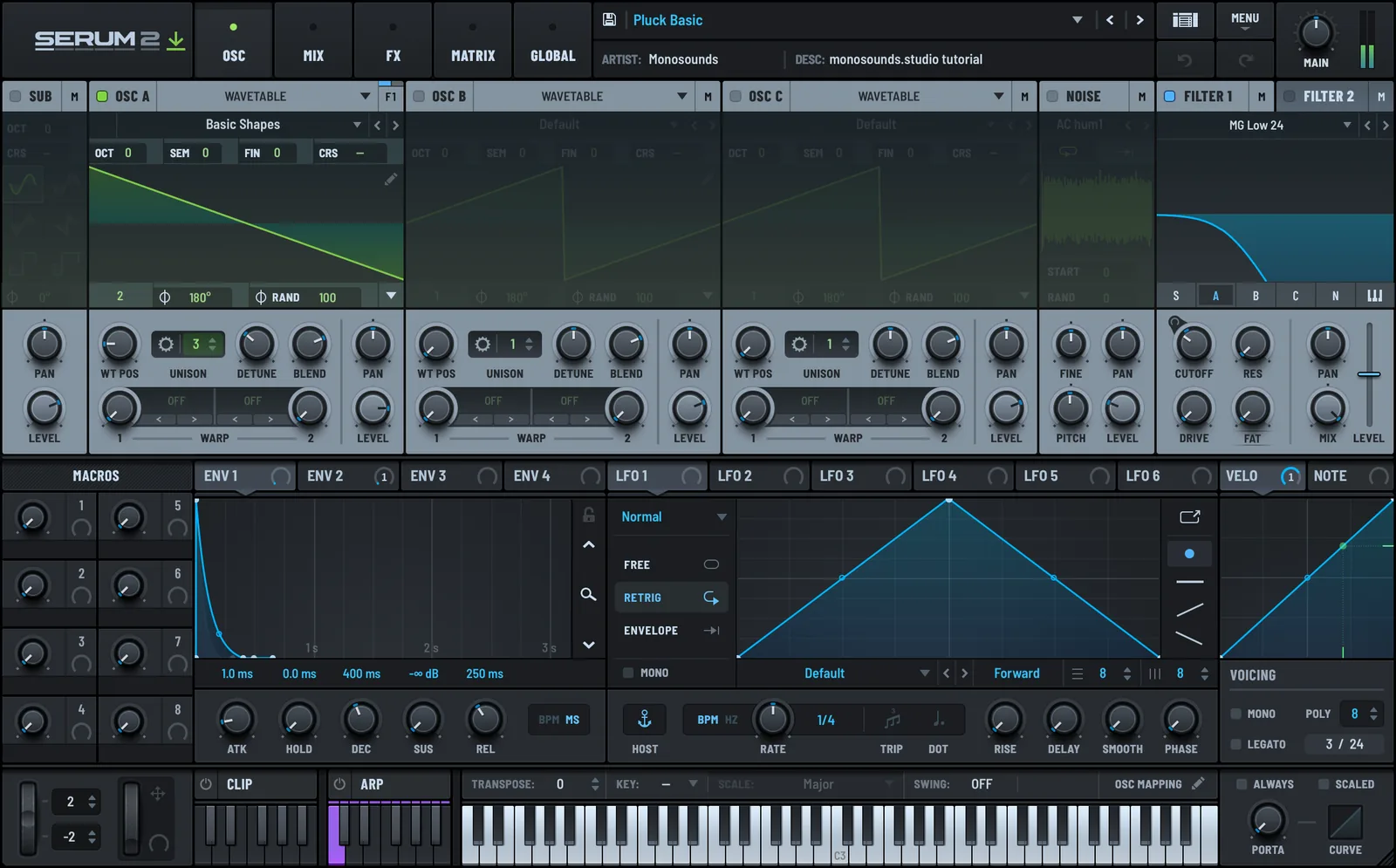
The melodic leads here are usually supersaws doubling the vocal line an octave higher. Unison 7, detune near 25 percent, blend pushed up. The supersaw guide walks through those settings if you’d rather build one from scratch than nudge a preset.
Highpass all of them at 300 Hz. Below that line, only kick and bass exist.
Vocal chops
This isn’t Serum 2 territory, but it needs saying: vocal hooks are the backbone of the genre. No vocal? Then your lead has to act like one: short phrases, intervals you could sing, five different notes at most.
Tempo, groove and arrangement
124–128 BPM, and 126 is the safe default. Kick stays straight four-on-the-floor, never syncopated.
The bass takes the offbeat eighths and ducks under every kick. That back-and-forth is the entire groove. Resist adding percussion: a clap on 2 and 4, closed hats on the offbeats, one open hat. That really is enough.
One arrangement habit that pays off: cap the drop at eight bars, swap one element, repeat. Slap house drops stay short because the sound is intense and fatigues quickly. Two eight-bar halves with a change between them beat sixteen straight bars every time.
Track length runs 2:30 to 3:30. You’re making streaming music here, not DJ tools. First drop should land by the 45-second mark.
Mixing notes for slap house
Go mono below 150 Hz — higher than you’d normally set it, because this bass carries energy well up into the low mids and stereo width there will fold in on itself.
After the kick, the bass has to be the loudest thing in the drop. Push it past where it feels comfortable; a peak around -6 dBFS on its own channel is completely normal.
Everything else gets highpassed at 300 Hz. Pads, plucks, leads, FX layers, all of it. If the midrange clogs up, the bass loses its snap.
A small cut around 2–4 kHz on the bass helps if the drive made it harsh, and a transient shaper recovers the attack the sidechain eats.
Here, unlike most club genres, the loudness comes from the limiter — these records get mastered hot, around -7 to -8 LUFS, since they live or die on streaming playlists. Audit the low end at that loudness; clipping shows up there before anywhere else.
Common mistakes
Sidechain too gentle. Ducking 3 dB won’t give you the bounce. Push it to 8 dB or beyond and draw the release curve yourself.
Filter decay too long. Once the bass sustains, it no longer slaps. Shorten that filter decay before touching anything else.
Too much in the drop. Kick, bass, clap, hats, one lead. Stacking pads and counter-melodies on top shrinks the drop instead of growing it.
Writing a long track. Nobody wants a six-minute slap house record. Stay under three and a half minutes. It also helps to understand the filters behind the bass; the filter guide covers which types hold the low end together under drive.
When you outgrow the freebies
These 15 patches were pulled from the same sessions as my Serum 2 preset bundles, where whole genres come bundled for less than the individual packs.
Or browse the rest of my Serum 2 packs and take whatever suits the track on your timeline right now.
FAQ
Do these presets work in Serum 1?
No. They’re built on the Serum 2 engine. If you own Serum 1, though, Serum 2 is a free update.
Are they royalty-free?
Yes. Use them in releases, client projects, tracks you sell, no credit needed. The only thing you can’t do is resell the preset files themselves.
How do I make a slap bass in Serum 2?
Saw plus sine sub, a short upward pitch envelope of about 2 semitones over 40 ms, a lowpass whose envelope decays in roughly 180 ms, some light drive, and aggressive sidechain. The slap itself comes from the pitch envelope and the filter decay.
What BPM is slap house?
124–128 BPM, and nearly always 126.
My slap bass sounds good solo but vanishes in the mix — what is happening?
Other elements are crowding its range. Highpass everything else at 300 Hz, verify no pad or lead is carrying low-end content, and check the sidechain release isn’t so slow that the bass never fully recovers between kicks.
I run Monosounds.studio and make the packs myself. Ten-plus years of producing, 97+ releases, 16,000+ downloads. Every Serum 2 preset we ship passes a CPU check on a mid-range laptop and gets used in a real track before release. If it does not survive a mix, it does not go in the pack.
More about Maxim & the studio →

