Indie Dance is retro-futurism with attitude. Gritty analogue-style basses, synths drenched in chorus, neon arps, and a stubborn refusal to sound clean. The genre pulls from new wave and italo at least as much as from house, and the imperfection is the point, not a flaw.
Reference names: Kraak & Smaak, Jennifer Cardini, Curses. Tempo runs 110–120 BPM, noticeably below most club music. All that extra space is exactly why every sound needs real character.
Here’s how I put the palette together in Serum 2: the analogue-style bass, the chorused synths, the arps and the FX layers, then the groove, the mix, and the habits that stop it from sounding like a plugin demo.
Start with the free pack
Grab the Free Serum 2 Indie Dance Presets — 4 synths, 3 basses, 3 leads, 2 FX and 2 extras, each with an audio demo, all royalty-free. Unzip into the Serum 2 user preset folder and rescan.
The FX patches are the ones everyone skips past and then ends up using constantly. Indie dance runs on sweeps, tape stops and noise risers, and keeping a few around as playable presets spares you hours of sample-hunting.
The sound, part by part
Analogue-style bass
What you’re after is a bass that could have come off an old mono synth: one oscillator, zero unison, and instability on purpose.
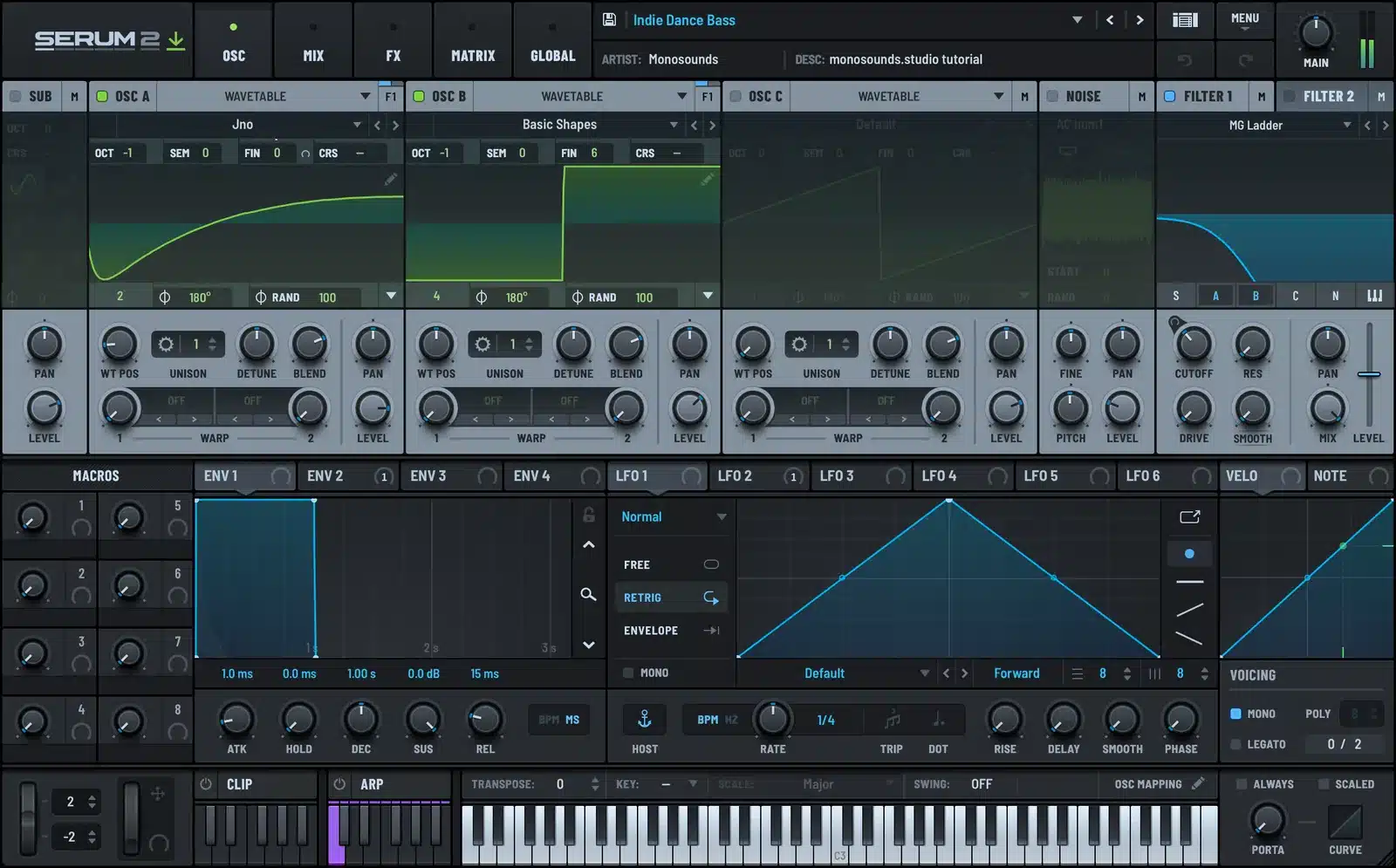
Take a saw or a square. Unison 1, mono. Then feed a little random modulation into oscillator pitch: an LFO on a slow random shape, depth of maybe 2 to 4 cents. Old hardware drifts like that; plugins usually don’t, and that’s the tell.
Lowpass with resonance near 35 percent, envelope into cutoff with 200 ms of decay. Now drive it. Put a tube-style saturator before the filter rather than after, so the filter gets to tame the harmonics the drive creates. The effects guide explains why rack order changes the outcome so dramatically.
Play it as a repeating eighth-note figure with the odd octave jump. Most indie dance basslines are four bars long and never change.
Chorused synths
Chorus is this genre’s uniform. Two detuned saws, unison 3, detune 10 percent, into a chorus running a slow rate with fairly high depth. Wet at around 40 percent, which is way beyond what you’d use anywhere else.
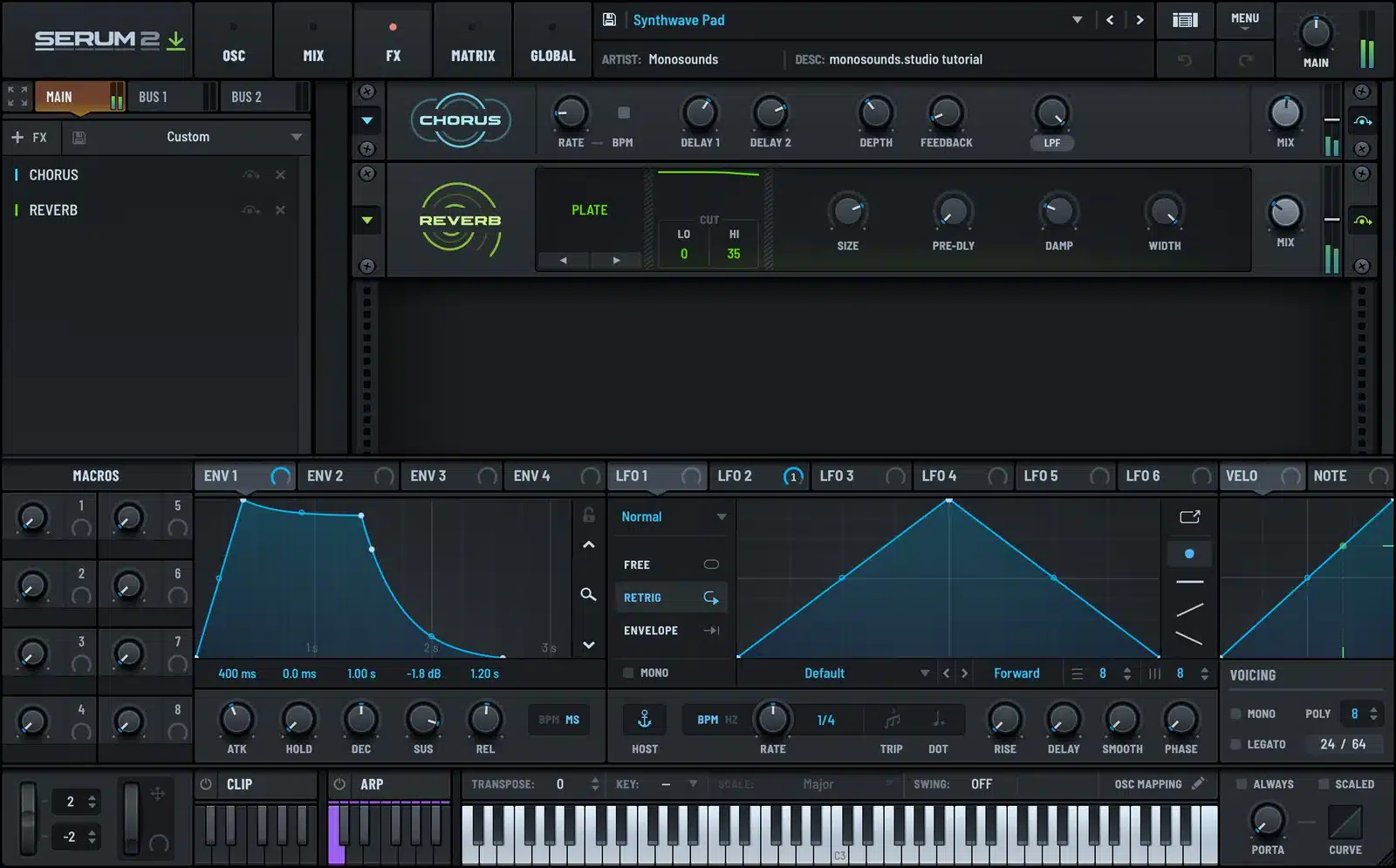
Give the amp envelope a 20 ms attack so the synth swells a little instead of stabbing. Behind that, a short plate reverb and a 1/8 delay with a darkened return.
Play held triads. House chords stay short; indie dance chords hold, and that hold is where the new-wave feel lives.
Neon arps
Set the arpeggiator to 1/16 with the gate near 40 percent so the notes stay separated. A square or pulse wavetable with pulse-width modulation from a slow LFO produces the classic hollow arp tone.
From there, automate a highpass on the arp channel: it enters thin and fills out over 16 bars. A dotted 1/8 ping-pong delay adds the width.
Both Serum 2’s arpeggiator and the CLIP tab do the job. Play the arp live, or drop in a MIDI clip and modulate around it.
FX and transitions
Noise oscillator, bandpass, sweep. Same recipe as every genre. What turns it into indie dance is what happens afterwards: heavy chorus, tape-style wobble, and a bitcrusher dialed low enough to add grit without announcing itself.
Reverse cymbals, tape stops, and a filtered white-noise wash under every transition. Slightly overuse them. The style can take it.
Tempo, groove and arrangement
110–120 BPM, with 116 as a solid default. At this speed every element is exposed, so a weak sound has nowhere to hide.
The groove stays straight with a light shuffle, and the kick frequently isn’t four-on-the-floor at all. Broken patterns and disco-style kick-and-clap arrangements show up everywhere. Drums that sound live, or at least drums with imperfect timing, carry a lot of the feel.
The arrangement habit worth stealing: write a song, not a DJ tool. Verse, chorus, bridge. Indie dance tracks typically run 4–6 minutes with genuine structure, often around a vocal.
Hold the bassline constant across the whole track and move everything else around it. That constancy is a signature of the genre.
Mixing notes for indie dance
Mono under 100 Hz. If you built the bass from a single oscillator, it’s mono already.
Sidechain lightly, 2 to 3 dB, more for groove than for space. Heavy pumping is other genres’ business.
Resist surgical carving. A bit of mud around 250 Hz belongs to the sound. Only cut where something is genuinely being masked.
Warm the master bus with tape saturation instead of leaning on a limiter. Indie dance masters land around -9 to -10 LUFS and are supposed to feel warm, not loud.
Roll off above 15 kHz and below 30 Hz. This music doesn’t live at the frequency extremes.
Common mistakes
Too clean. An indie dance track with a perfect mix sounds wrong. Saturation, chorus and a touch of pitch drift on everything.
Modern EDM structure. Build-drop-build-drop doesn’t belong here. Write verses and choruses.
Bass that is too wide. Chorus on the bass seduces you in solo and then vanishes in the mix. Keep the bass mono; the synths carry the width.
Skipping the arrangement. An eight-bar loop with filter automation isn’t a track. And if Serum 2 itself still feels unfamiliar, the beginner guide will clear the sound design hurdle faster.
When you outgrow the freebies
These 14 patches came out of the same design sessions as my Serum 2 preset bundles — whole genre collections for less than the packs cost one by one.
Want to dig further? Everything else in the Serum 2 catalog sits in one place. The oscillator types guide is worth a look for indie dance too, since the sample and granular oscillators are a shortcut to lo-fi character.
FAQ
Do these presets work in Serum 1?
No. They run on the Serum 2 engine. Serum 2 is a free update for existing Serum owners.
Are they royalty-free?
Yes. Releases, client work and tracks you sell, all without credit. The only thing you can’t do is resell the presets themselves.
What tempo is indie dance?
110–120 BPM, and 114 to 118 covers the bulk of releases. The slowness is deliberate; it isn’t house.
How do I make a plugin sound like old hardware?
Small random pitch drift, a low voice count, saturation before the filter, and more chorus than feels reasonable. Dirt and instability are what the ear hears as analogue.
My track sounds thin and small compared to references — what is wrong?
Almost always missing mid-range saturation. Push the synths and bass through a tape or tube stage, then examine 200 Hz to 2 kHz. Indie dance references are dense in that region, not in the sub or the highs.
I run Monosounds.studio and make the packs myself. Ten-plus years of producing, 97+ releases, 16,000+ downloads. Every Serum 2 preset we ship passes a CPU check on a mid-range laptop and gets used in a real track before release. If it does not survive a mix, it does not go in the pack.
More about Maxim & the studio →

