The sound palette makes or breaks Hard Techno. Pure industrial aggression: distorted basses parked right beside the kick, leads that scream like sirens, rave stabs. Loud everywhere, distortion everywhere, and the entire low end reserved for the kick.
Designing Serum 2 packs is my day job, and hard techno is where restraint applies to your frequency plan instead of your sounds. Push any patch as hard as you want, just cut the bottom out of it once you’re done.
Bass, leads, stabs and risers are covered below, followed by tempo, mixing, and the mistakes that turn hard techno harsh instead of heavy.
Start with the free pack
Grab the Free Serum 2 Hard Techno Presets — 6 bass · 4 leads · 3 synths · 1 drum · 1 other, every one with an audio demo, all royalty-free.
Installation is under a minute: unzip into the Serum 2 user preset folder and rescan. Fifteen patches, all designed on the assumption they’ll get driven hard and then high-passed.
Who’s it for: producers who already have a distorted kick working and now need everything else to stay alive next to it. Hard techno mixes forgive nothing, and patches built for that context spare you a lot of grief.
The sound, part by part
Bass
In hard techno the kick usually IS the bass. What gets called “the bass” is really a mid-range layer perched just above it, from roughly 150 Hz upward.
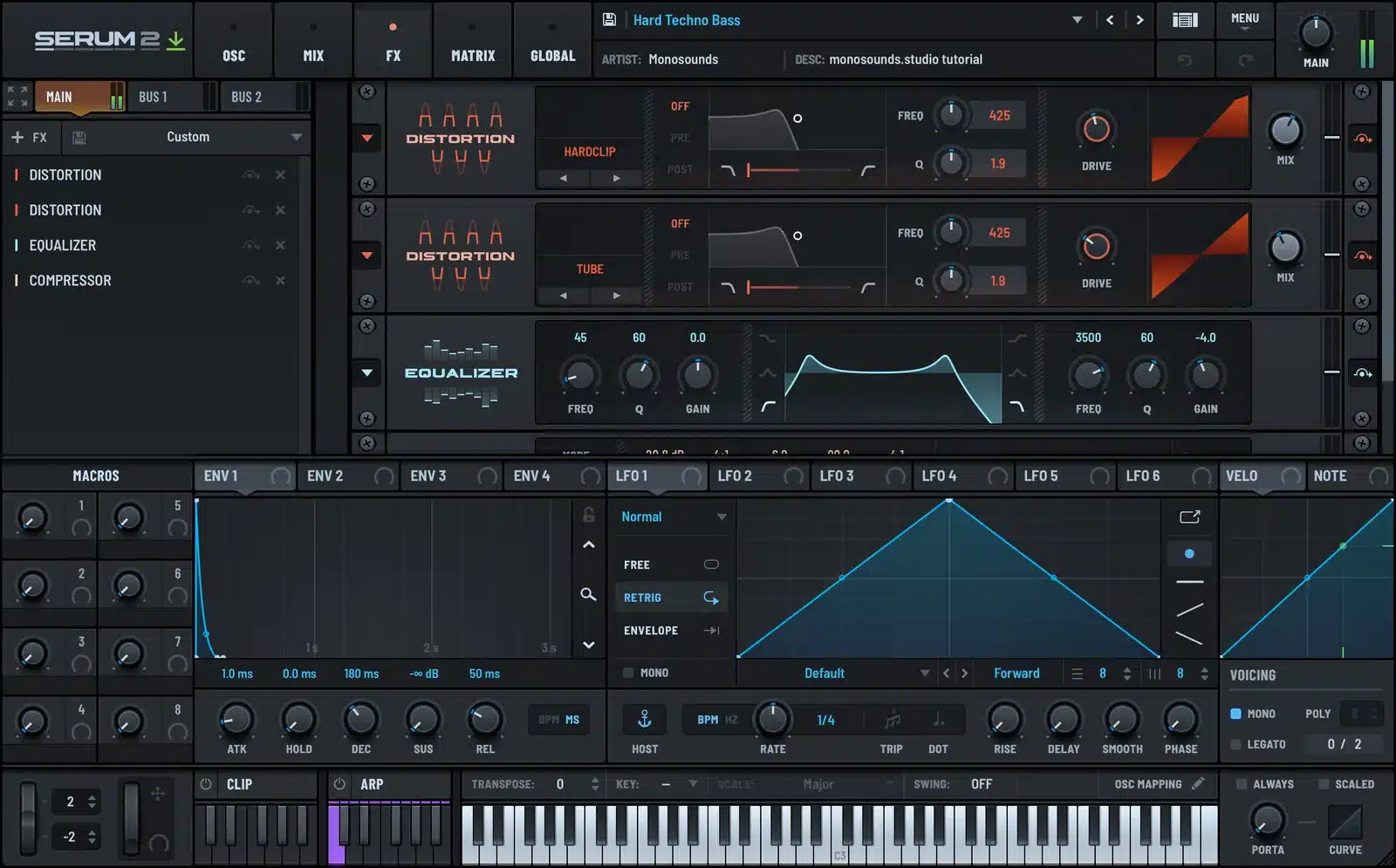
Start from a saw or an aggressive wavetable, mono, 2 unison voices, then hit it with heavy distortion and a high-pass at 120–150 Hz. The order matters: high-pass AFTER the distortion. Distort first, filter second: that’s how you keep the aggression and lose the mud.
Amp envelope: attack at zero, decay 150–250 ms, sustain kept low. The bass should be chopped up by the kick’s pattern, not droning away beneath it.
Siren leads
A siren is a saw or square with serious pitch movement. Send an LFO into oscillator pitch with a range of several semitones, or draw the pitch automation yourself across four bars.
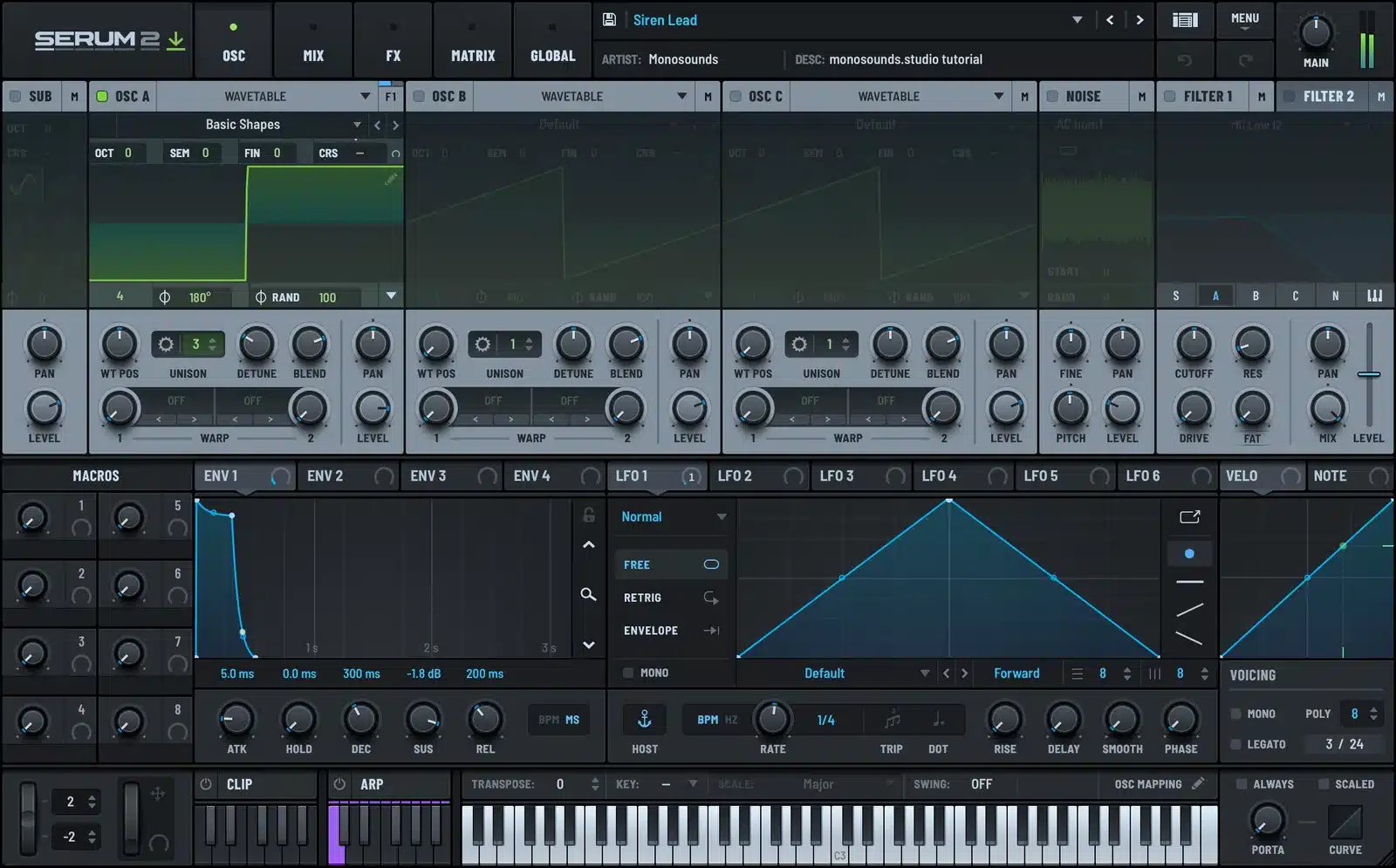
Then a resonant band-pass around 1–3 kHz, driven hard. High-pass at 300 Hz after that, because in this genre the aggression lives above 300, and anything underneath is headroom you’re stealing from the kick.
Add a synced delay plus a short reverb and it starts sounding like a room instead of a plugin.
Rave stabs
Rave stabs are short, dissonant, relentless. Hard wavetable, roughly 120 ms of decay, zero sustain, a resonant filter sitting mid-range, distortion behind it. Put them on offbeat sixteenths with a delay and leave the pattern running sixteen bars without touching it.
For that classic hoover-adjacent dissonance, detune two voices by a full semitone instead of by cents.
Risers and noise
Most transitions are handled by filtered noise through a band-pass that opens slowly, pitch climbing over eight bars. Serum 2’s own modules do the entire chain; the effects guide goes over which ones deserve your attention.
Tempo, groove and arrangement
Hard techno runs at 140–155 BPM. The fast end has normalized over the past few years, and 150 doesn’t raise eyebrows anymore.
The energy comes from the kick and from sheer relentlessness. Arrangement in the traditional sense barely exists: kick, mid bass, hats, a stab, a lead, and long stretches where nothing moves.
An arrangement habit that keeps paying off: work in sixteen-bar blocks and change exactly one thing per block. Bring the hats in. Drop the stab. Open up the lead filter. That restraint is why the changes that do happen hit so hard.
Mixing notes for hard techno
Mono under 150 Hz, and hand that entire range to the kick. Nothing else gets meaningful energy down there.
High-pass every element except the kick at 200–300 Hz. That single rule separates a hard techno mix that hits from one that dissolves into sludge.
Sidechain the mid bass and leads against the kick with a fast release, 20–40 ms, so the kick transient punches through clean every time.
Loudness here comes from clipping, not limiting. Soft clip the kick, clip the drum bus, and leave the master limiter with almost nothing to do. Keep an ear on resonant peaks around 2–4 kHz: that’s the zone where distortion stops being aggressive and starts being painful, and a narrow dynamic EQ cut there earns its keep. The filter model you distort through changes the outcome a lot too; the filter breakdown compares them.
Common mistakes
Bass below the kick. No room exists down there. Everything under 150 Hz belongs to the kick, and stacking a sub layer on top makes the track quieter, not heavier.
Distortion after the filter. Distort first, then filter. Reverse the order and you get harshness where the weight should be.
Changing every eight bars. This genre is hypnotic by design. Sixteen or thirty-two bars between changes is completely normal.
Mastering for loudness on the master bus. Unless the drums are already clipped and under control, a limiter just flattens the kick and murders the impact.
When you outgrow the freebies
These 15 patches came from the same design sessions as my Serum 2 preset bundles, full genre collections for a fraction of the per-pack price. If a whole bundle is overkill, every Serum 2 preset pack on the site is listed on its own with demos. One more thing: heavy distortion chains eat CPU fast, so give the CPU notes a read before a big session.
FAQ
Do these presets work in Serum 1?
No, they run on the Serum 2 engine. Serum 2 was a free update for existing Serum owners, so if you bought Serum 1 you already have it.
Are the presets really royalty-free?
Yes. Releases, client work, beats you sell, no credit needed. The only thing off the table is reselling the presets themselves.
Can I use them in any DAW?
Any DAW hosting Serum 2 as VST3 or AU: Ableton, FL Studio, Logic, Cubase, Studio One and so on. Serum 2 is native on Apple Silicon.
What BPM is hard techno?
Most current releases fall between 140 and 155 BPM. The older stuff hovered nearer 140; the recent wave frequently runs 148–155.
My hard techno mix sounds harsh and tiring rather than heavy — how do I fix it?
Take a narrow EQ cut and sweep it between 2 kHz and 5 kHz across the distorted elements until you find the resonance that hurts. Distortion spreads harmonics evenly, but one or two peaks always end up dominating. Pull those down 3–4 dB and you can drive the whole mix noticeably harder before it fatigues.

I run Monosounds.studio and make the packs myself. Ten-plus years of producing, 97+ releases, 16,000+ downloads. Every Serum 2 preset we ship passes a CPU check on a mid-range laptop and gets used in a real track before release. If it does not survive a mix, it does not go in the pack.
More about Maxim & the studio →

