Melodic Techno rises or falls on its sound palette — dark emotional power: cinematic pads, arpeggiated basslines, leads slicing through fog. Take techno’s tempo and drum weight, then bolt on harmony borrowed from somewhere far more romantic. That’s the genre.
Designing Serum 2 packs is my day job, and melodic techno is where I sink the most hours into slow modulation. Notes get held for ages in this style, so any static sound gets caught out fast.
What follows: the arp bass, the pads, the leads and the textures, then tempo, arrangement, mixing, and the habits that leave melodic techno tracks sounding smaller than they should.
Start with the free pack
Grab the Free Serum 2 Melodic Techno Presets: 5 synths · 3 drums · 3 fxs · 3 bass · 2 leads · 2 plucks · 2 chords, all royalty-free, every patch paired with an audio demo.
Installing is quick: unzip into Serum 2’s user preset folder, rescan, done in under a minute. Twenty patches with drums and FX included, enough to rough out an entire arrangement without leaving the plugin.
Who’s it for? Anyone who already has a techno kick doing its job and wants the emotional side of the track to sound as deliberate as the drums do.
This is the register — dark, wide, in no hurry:
The sound, part by part
Arpeggiated bass
The engine room of the whole genre. Start with a saw or a hollow wavetable, mono, unison off, decay near 200 ms, sustain low, then push it through Serum 2’s arpeggiator at eighths or sixteenths.
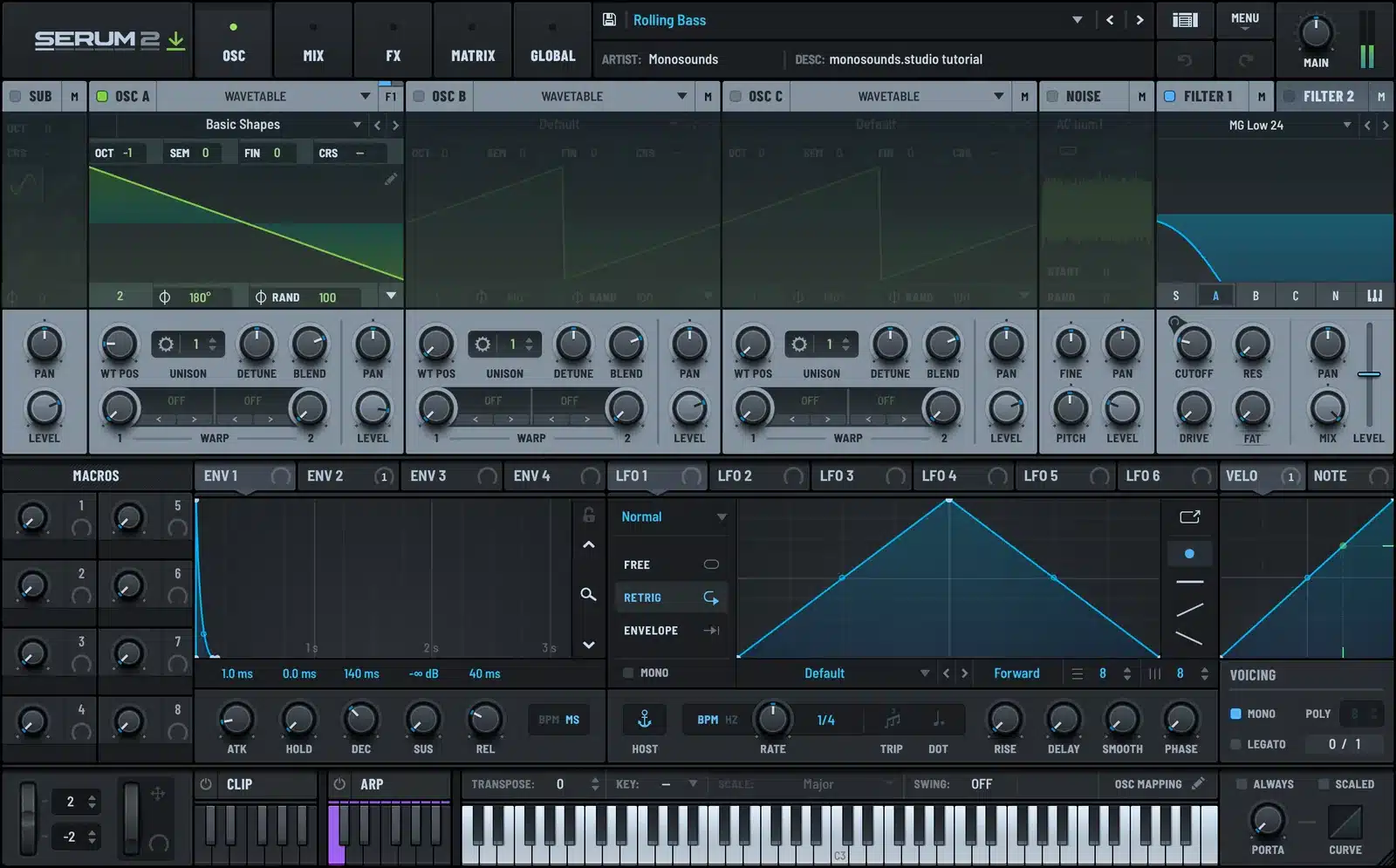
Put a resonant low-pass around 400 Hz on it and let an LFO sweep the cutoff once every four bars. The arp pattern itself can run unchanged for a full minute; the moving filter is what convinces the listener something is happening.
Underneath, keep a separate clean sine sub holding whole notes. Movement from the arp, weight from the sine. Split jobs.
Cinematic pads
Attack somewhere between 2 and 4 seconds, release at 4 or beyond, unison 5 to 7 detuned around 20–25%, and a low-pass sitting dark at 2–3 kHz.
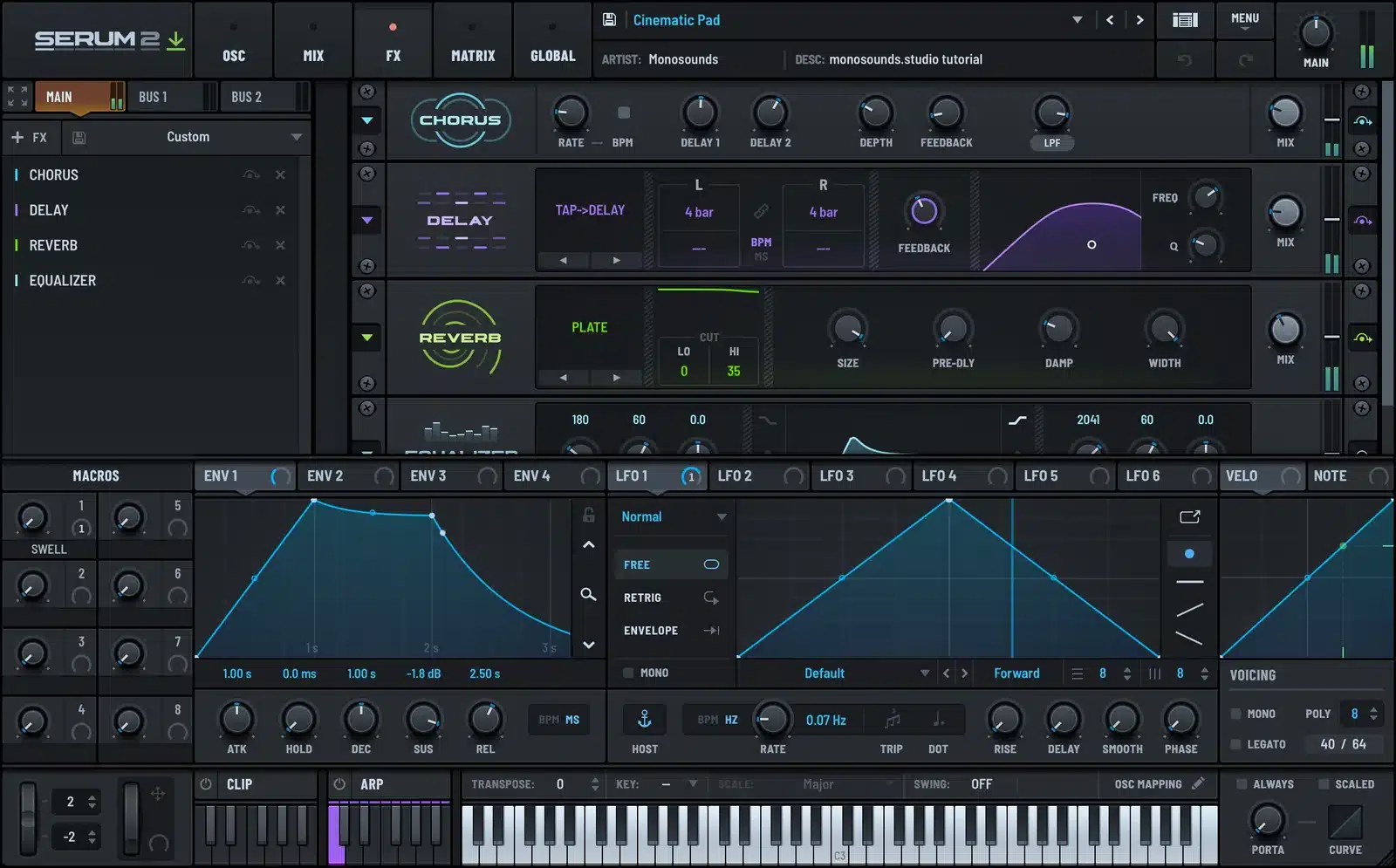
Now stack something inharmonic on top: filtered noise, a granular or spectral oscillator, a metallic wavetable kept quiet. That extra layer is the difference between “cinematic” and “string preset”. The oscillator guide covers how to pick between the oscillator modes.
Go long on the reverb (6 seconds minimum) and high-pass the return at 300 Hz so the low mids stay clear of fog.
Leads
Leads here are narrow and piercing, not wide. Two voices, barely any detune, a band-pass around 1–2 kHz, and a long synced delay behind it.
Write four or five notes per eight bars, no more. The restraint is exactly why it cuts through; pile on notes and the lead just becomes more fog.
Textures and FX
Transitions ride on risers, reverse hits and noise sweeps. Make them yourself: filtered noise, slow envelope, long reverb, then flip the render backwards. The atmospheres guide goes deeper on pad and atmosphere layering, and nearly all of it applies here too.
Tempo, groove and arrangement
Melodic techno lives at 122–126 BPM, deliberately slower than peak-time techno, because the harmony needs breathing room.
Energy is built by stacking and filtering over long stretches. Sections run sixteen bars at minimum, more often thirty-two. And the climax tends to be a breakdown rather than a drop: strip everything away except pad and lead, then let the kick come back.
A habit worth adopting: stretch your filter automation over sixteen bars instead of eight. Few genres reward patience like this one, and short automation moves make the track sound like house played at the wrong tempo. For another angle on all this, I also wrote a dedicated melodic techno walkthrough.
Mixing notes for melodic techno
Mono below 150 Hz. With everything above being so wide, the kick and sub have no choice but to be rock solid.
Sidechain the pads, the sub and the reverb returns against the kick, release in the 80–120 ms range. That breathing motion is a real part of why the genre feels hypnotic.
Be aggressive carving 250–500 Hz out of the pads. Long attacks plus heavy unison stack up energy in that band quicker than you’d think.
Every reverb and delay return gets high-passed around 300 Hz. Long tails sitting in the low mids are the number one reason these mixes collapse into mush.
Loudness should come from a clipped drum bus and a disciplined sub, not from leaning on the master limiter. Let the tracks keep their dynamics.
Common mistakes
Static pads. Thirty-two bars with nothing moving feels like forever. Slow LFO on cutoff, no exceptions.
Melody that is too busy. Four repeating notes will outperform six wandering ones every time. Cut it down.
Weak low end under all the atmosphere. Most “my track sounds small” problems disappear once a clean sine sub is holding everything up.
Rushing the arrangement. Lead showing up before the two-minute mark? Congratulations, you’ve made melodic house with a techno kick.
When you outgrow the freebies
These 20 patches were built in the same design sessions as my Serum 2 preset bundles, full genre collections for a fraction of the individual pack prices. If you’d rather pick packs one at a time, my Serum 2 preset catalog has everything listed with audio demos.
FAQ
Do these presets work in Serum 1?
No. They run on the Serum 2 engine. Serum 2 is a free update for anyone who owns Serum, so Serum 1 buyers already have it.
Are the presets really royalty-free?
Yes. Releases, client work, beats you sell, no credit needed. Reselling the preset files themselves is the only thing not allowed.
Can I use them in any DAW?
Any host that loads Serum 2 as VST3 or AU: Ableton, FL Studio, Logic, Cubase, Studio One and the rest. Serum 2 is native on Apple Silicon.
What key works best for melodic techno?
Minor keys: A minor, F minor and C minor come up most. Harmonic minor appears constantly too, because that raised seventh delivers the slightly Eastern tension the genre is famous for.
My track has great sounds but feels like it never goes anywhere — why?
Nine times out of ten, everything enters at once and nothing ever leaves. Take the finished loop, mute two elements for the opening sixty seconds, then reintroduce them one by one. And make sure at least one filter never stops moving; when all your automation jumps at section boundaries, the middle of every section goes dead.

I run Monosounds.studio and make the packs myself. Ten-plus years of producing, 97+ releases, 16,000+ downloads. Every Serum 2 preset we ship passes a CPU check on a mid-range laptop and gets used in a real track before release. If it does not survive a mix, it does not go in the pack.
More about Maxim & the studio →

