House and Techno as a single tag means crossover club tools: sounds with enough groove for a house set and enough muscle for a techno one. Solomun, &ME and Adam Ten operate in exactly that space, and a large chunk of the current club sound actually lives there.
Tempo runs 122–128 BPM, the overlap zone between the two genres. The real skill is designing sounds that survive across that entire range rather than clicking at only one tempo.
Below are the four parts of a crossover track (bass, chord stabs, plucks and lead) with my actual settings, plus the arrangement and mix calls that keep a record playable in either type of set.
Start with the free pack
Grab the Free Serum 2 House and Techno Presets — 4 basses, 4 synths, 4 plucks and 3 leads, each with its own audio demo, all royalty-free. Unzip into the Serum 2 user preset folder and rescan.
This is the pack I’d give anyone not ready to pick a genre yet. Every patch got tested at 122 and at 128 BPM, because that’s the honest exam for anything claiming to be crossover. A bass that collapses at either end of that range is a house bass or a techno bass, not both.
The sound, part by part
Bass
Crossover bass means a rounded saw with a quick filter envelope. One oscillator, unison 2, detune 4. Lowpass sitting near 300 Hz, resonance around 25 percent.
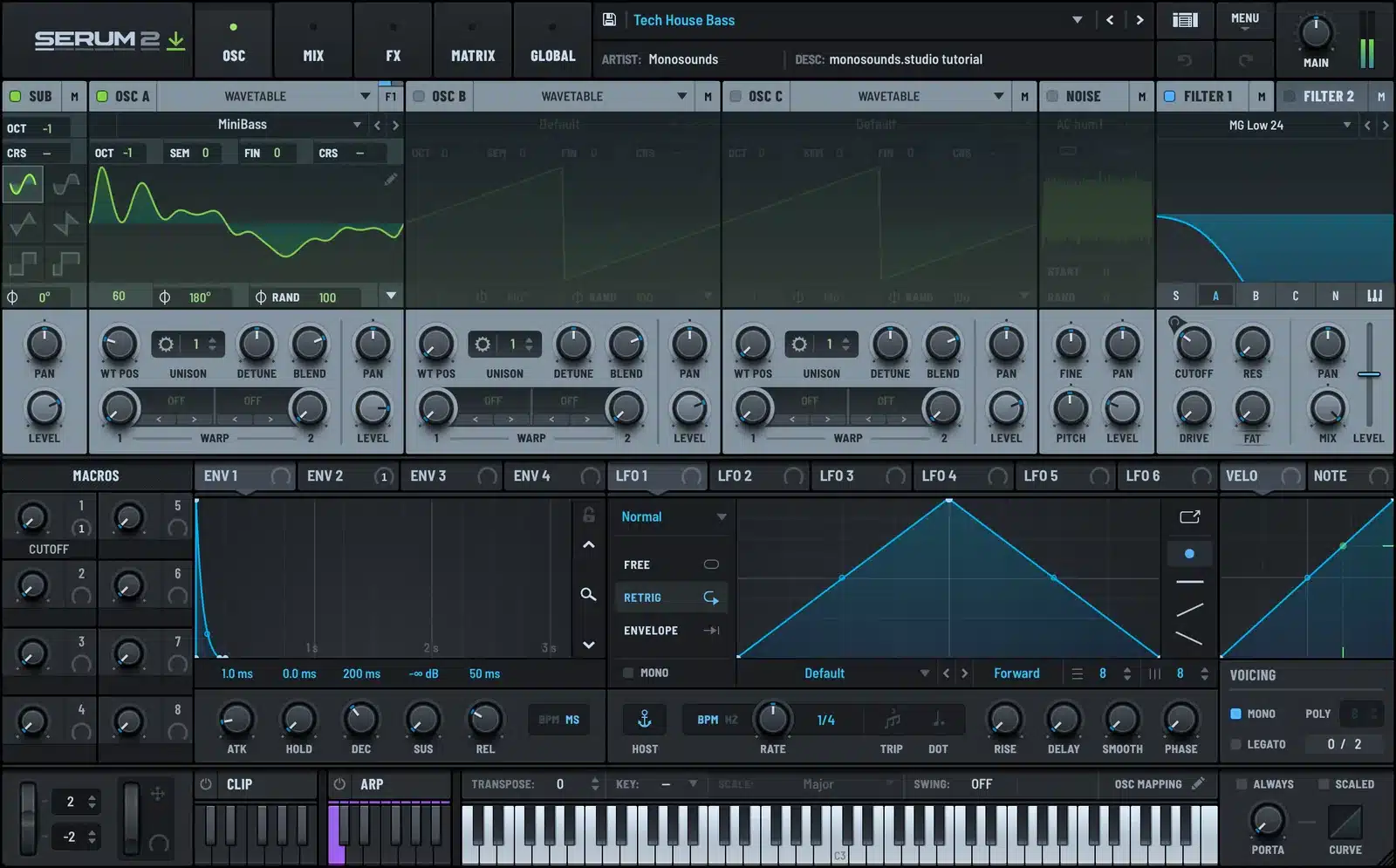
Envelope into cutoff: attack 0, decay 130 ms, sustain 20 percent. That’s enough motion to function as a groove element while staying short enough not to smear at 128.
Write the line as offbeat eighths with the occasional sixteenth double thrown in. That rhythmic ambiguity is precisely why a bassline works in both contexts. If you want the more percussive flavor of this, the tech house bass guide handles the shorter, punchier version.
Chord stabs
The chords come from house; techno insists they stay short. Two saws detuned by 8 cents, a minor seventh or sus4 voicing, amp envelope at 250 ms decay with sustain at zero.
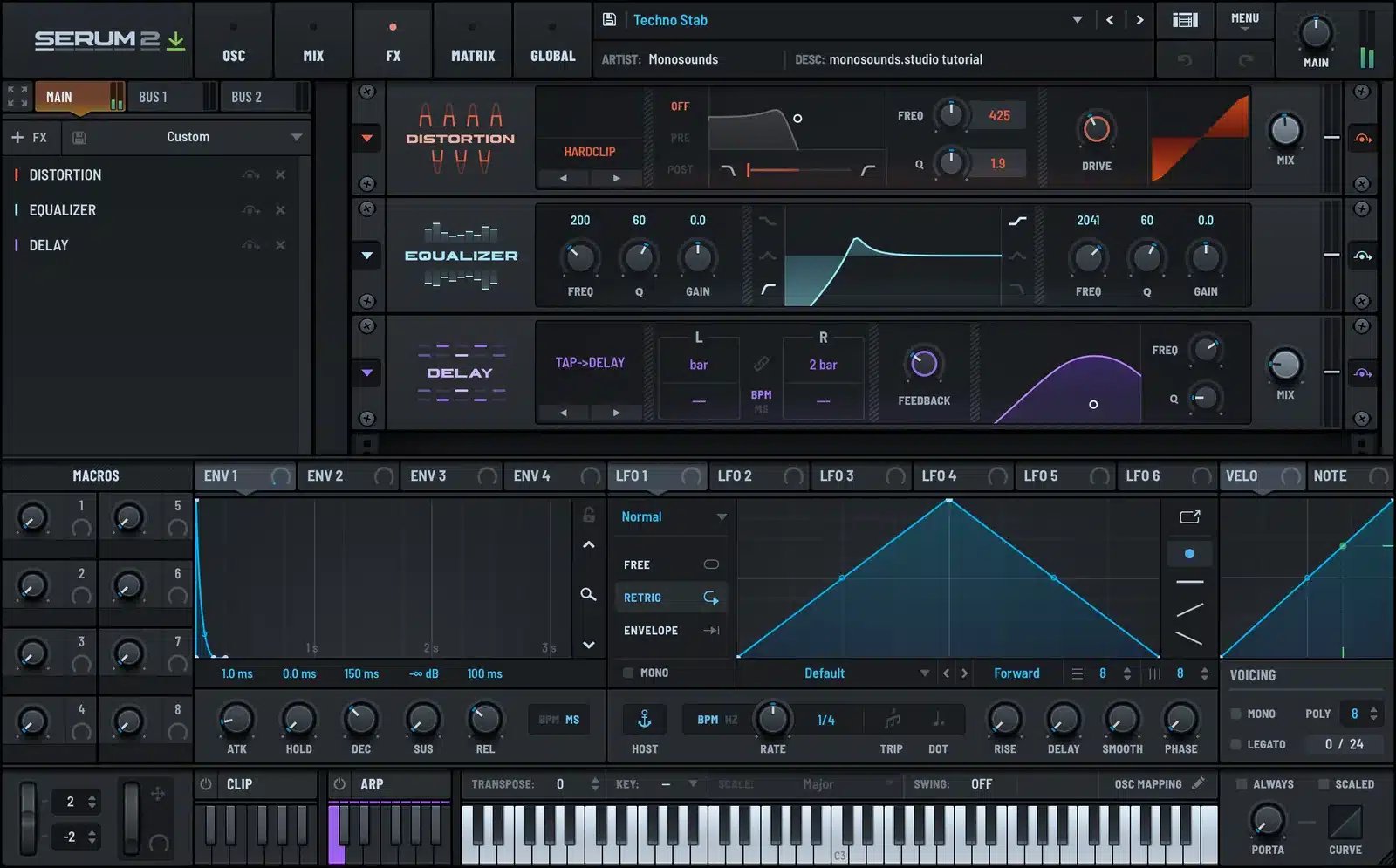
Then a bandpass filter, resonance near 30 percent, and a small envelope on the cutoff. Finish with a short room reverb, kept under 1 second, plus a subtle stereo delay at 1/8. The stab wants to sound like it was played in a room, not a cathedral.
Filter choice carries more weight here than people assume. Run the same chord through a ladder-style lowpass and then a state-variable bandpass and you get two entirely different characters. The filter guide goes through the options.
Plucks
Plucks live in the gap between bass and chords. One oscillator, decay around 200 ms, sustain off, and a dotted-eighth delay driving the pattern.
Route the amp envelope to wavetable position so the pluck’s timbre folds shut as it decays. That single routing separates a pluck that sounds synthetic from one that sounds struck.
Lead
Leads stay restrained in crossover. Unison 3 to 4, detune 12 percent, and a melody of at most four or five notes. You’re after a hook a DJ can pick out mid-mix, not a solo.
Keep the whole thing above 500 Hz and automate the highpass so the lead fades in gradually across eight bars.
Tempo, groove and arrangement
122–128 BPM, with 124 as the practical center. Write at 124, then check both ends: a groove that survives the trip is a track that will get played.
Put 10 to 15 percent swing on hats and percussion, and none on the kick or bass. That specific combination is what makes a record read house from the top and techno from the bottom.
An arrangement habit that keeps earning its place: once every 32 bars, pull the kick for two beats. Costs nothing, resets the listener’s attention, and hands DJs a mixing point.
Aim for 6–7 minutes with clean 32-bar intros and outros. Crossover records get spun by DJs from both camps, so DJ-friendly structure isn’t optional.
Mixing notes for house and techno
Mono under 120 Hz, and the sub content belongs to the bass and nothing else.
Sidechain the bass with a medium release around 120 ms. Long enough to swing like house, short enough to hold together like techno.
Take 250–350 Hz out of the chord stabs. That’s exactly where house chords and techno kicks crash into each other, and a 3 dB dip usually settles the dispute.
Lightly compress the percussion bus, 2 to 3 dB of gain reduction with a slow attack, and the hats and shakers fuse into one moving element instead of a pile of separate ones.
Loudness comes from the kick and the percussion bus working together. If the limiter is where your energy comes from, your groove isn’t pulling its weight.
Common mistakes
Committing to one tempo. Design everything at 128 and it’ll feel rushed at 122. Test both.
Swinging the bass. Swing on the low end makes a track feel drunk. Bass stays on the grid; the hats do the moving.
Chords that are too long. A held pad chord murders club momentum. Shorten it, and use a delay if you miss the space.
No DJ structure. Open with the full drop and your track is unmixable. Give it 32 bars of drums at each end. New to building full arrangements? The Serum 2 beginner guide is a sensible stop before the arrangement stage.
When you outgrow the freebies
These 15 patches came from the same design sessions as my Serum 2 preset bundles, which cover entire genres for less than the individual packs add up to.
Or work through my full Serum 2 preset library one style at a time.
FAQ
Do these presets work in Serum 1?
No. They depend on the Serum 2 engine. If you already own Serum 1, Serum 2 is a free update.
Are they royalty-free?
Yes. Releases, client work, tracks you sell: all fine, no credit required. The one thing off limits is reselling the presets themselves.
Can I use them in any DAW?
Any DAW hosting Serum 2 as VST3 or AU: Ableton, FL Studio, Logic, Cubase, Studio One, Bitwig, Reaper.
What actually separates house from techno in the sound design?
House bass carries a longer decay with more swing around it; techno bass runs shorter, darker, and rigidly gridded. Crossover splits the difference: short decay, but a groove built out of note placement.
My groove feels stiff even with swing turned on — how do I fix it?
Swing quantise typically only touches notes sitting on the grid. Push individual hats and percussion hits 5 to 15 ms late by hand and vary their velocities while you’re at it. Manual timing wins over a swing percentage nearly every time.

I run Monosounds.studio and make the packs myself. Ten-plus years of producing, 97+ releases, 16,000+ downloads. Every Serum 2 preset we ship passes a CPU check on a mid-range laptop and gets used in a real track before release. If it does not survive a mix, it does not go in the pack.
More about Maxim & the studio →

