Two detuned saw waves grinding against each other, a filter pulling them down, a clean sine sub underneath. That’s a reese bass, the entire recipe. It has powered drum and bass since the late 80s and does the same job in bass house today.
Below is how I build one in Serum 2, including the actual detune numbers I use and the two mistakes that wreck most first attempts.
Why it growls
Kevin Saunderson cut the original in 1988 under his Reese alias. Jungle producers sampled it, dropped the pitch, and it turned into the default DnB bass.
But the mechanism matters more than the history. Two oscillators slightly off from each other drift in and out of phase, and that drift produces a slow, chewing motion inside the sound. There’s no LFO adding movement here. The detune is the movement.
Old analog synths got this for free because their oscillators could never hold perfect tune. Here’s the character on genuine Minimoog hardware, so you know the target.
The basic patch
- Start from init, oscillator A on a plain saw.
- Switch on oscillator B, another saw.
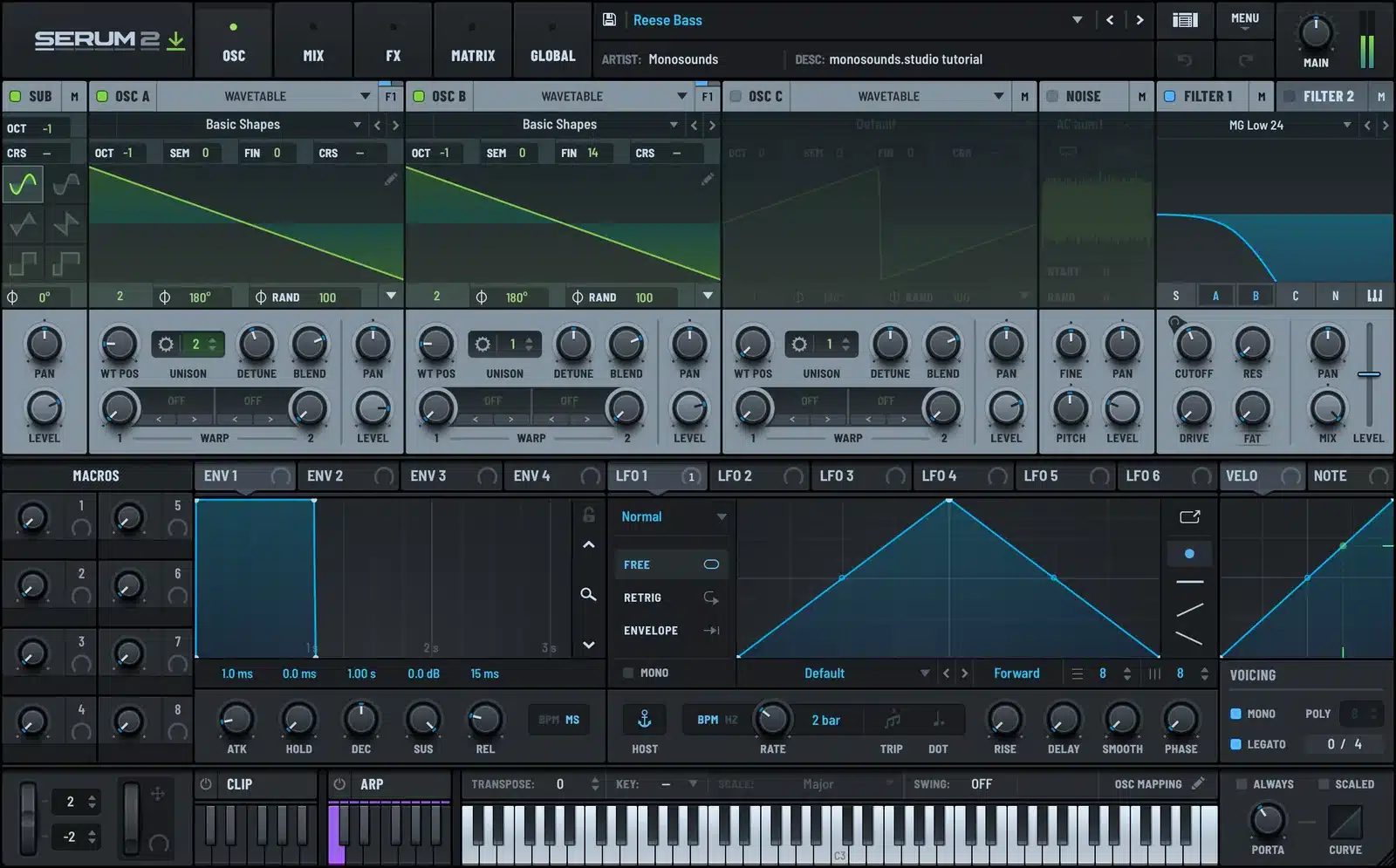
- Push B up by +15 to +25 cents and pull A down around -10, so the pair straddles the center pitch.
- Take both oscillators down an octave.
- Send them through a lowpass filter: cutoff somewhere in 300–800 Hz, resonance close to zero.
- Hold a note in the C1–E1 range and listen for that slow phasing growl.
The total detune spread controls how fast the growl chews, and most tutorials never mention this. Around 10 cents apart you get a lazy, slow wobble. Beyond 40–50 cents it goes choppy and seasick. My DnB patches usually sit between 20 and 35 cents of total spread.
Also worth knowing: detune speed tracks pitch. Play the same patch an octave up and it growls faster. So when a reese feels lifeless on low notes, don’t reach for more detune right away. Play it an octave higher and pitch the render down afterward. Jungle producers have used that trick forever, and it still holds up.
Unison vs two oscillators
The shortcut is one oscillator with unison at 2 and a bit of detune. It works, and it keeps things simple.
Two separate oscillators hand you more control, though. Independent wavetable position, independent pan, independent level for each. When I made the reese patches for our Elixir pack, nearly every one used two oscillators rather than unison — that let me shove oscillator B into a brighter wavetable frame and pull extra snarl out of the mids while leaving the fundamental alone.
This is roughly where that lands in a finished preset.
Keep the low end mono
Mistake number one, right here. Below roughly 100 Hz, detuned saws don’t come across as wide — they come across as weak. The same phasing that gives the mids their growl makes the lows cancel, and on a club rig running mono your bass simply vanishes.
The fix is splitting the signal:
- Highpass the detuned reese layer at 90–120 Hz.
- Bring in a third oscillator (or a separate patch) with a plain sine an octave down, no detune, dead center.
- Everything under 150 Hz stays mono. Verify by summing your master to mono for a few seconds. Weight drops? Something in the low band is still stereo.
Every bass patch we ship goes through this check. Ten seconds of effort, and it has caught real problems more often than I’d like to admit.
Filter movement
Across an eight-bar phrase, a static reese gets dull. Three moves I genuinely use:
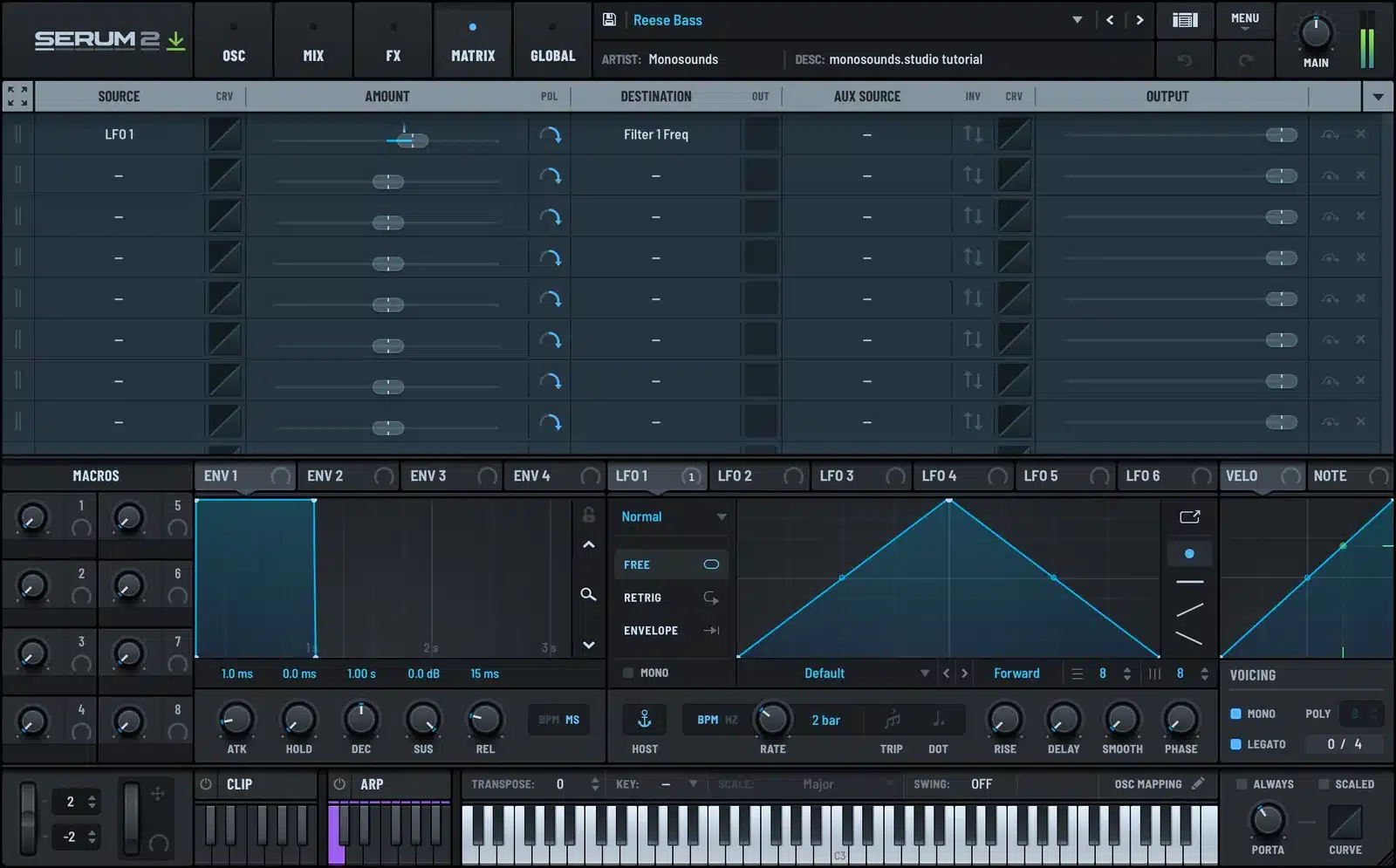
- A slow LFO, 4–8 bars long, nudging cutoff by a small amount. Subtle and constant.
- A notch filter sweeping the mids in place of a lowpass. That’s where the hollow, vowel-ish DnB tone comes from.
- Cutoff automation drawn by hand, section by section. Dark in the verse, open at the drop. Tedious to set up, reliable every time.
Then there’s the classic: resample. Print eight bars of the raw patch to audio and filter and distort the render. DnB producers have done it this way for decades: processed audio behaves differently from a live synth, particularly when distortion sits before the filter.
If tearing apart working patches suits you better than building from init, download our free Serum 2 bass house presets and open up the bass patches. One look at a finished reese’s mod matrix teaches more than any article.
Width without losing the punch
Chorus is the traditional widening tool, but place it after the highpass split so only the mids get touched. I run the rate slow and keep the mix below 50 percent. Any more and it smears the growl you just spent all that time dialing in. It’s the one setting I verify on every reese that goes into all my Serum 2 preset packs, because over-chorused mids are the most common way a good bass turns soft.
Some producers chase a wider, more modern flavor by stacking a detuned mid layer future-bass style. Different genre entirely, identical physics.
When the freebies stop being enough and you want a proper library of finished basses to study and use, the Serum 2 preset bundles give you the best per-preset value we sell. That’s just the math, not a sales pitch.
Going deeper on low end? Dubstep growls run the same detune ideas with much heavier modulation, and the 808 bass guide handles the sub-only side.
FAQ
How much detune for a reese bass?
Begin with 20–35 cents of total spread between the two saws. Under that it sounds static; well over it, choppy and out of tune.
Should a reese bass be stereo or mono?
Both at once. Everything below about 120 Hz stays mono; widen only the filtered mid layer using chorus or unison pan.
Why does my reese sound weak in the club?
Nearly always stereo lows cancelling when summed to mono. Highpass the detuned layer and sit a centered sine sub under it.
Can I make a reese with one oscillator?
Sure, a single saw with unison 2 gets close. Two oscillators simply give you independent wavetable position, pan and level.
And that’s the whole sound: two saws a little out of tune, a mono sub, a moving filter. Nail the detune spread and the mono low end, and the rest comes down to taste.

I run Monosounds.studio and make the packs myself. Ten-plus years of producing, 97+ releases, 16,000+ downloads. Every Serum 2 preset we ship passes a CPU check on a mid-range laptop and gets used in a real track before release. If it does not survive a mix, it does not go in the pack.
More about Maxim & the studio →

