At 174 BPM there’s simply nowhere for clutter to hide in drum and bass. A tune is drums, a sub, a reese or mid bass, perhaps a pad. Four elements carrying everything. The whole bass department fits inside Serum 2, and the bass department is where the genre lives or dies.
My build order goes like this: reese, then sub, then movement, with drums and arrangement wrapped around them.
Reese first
Two detuned saws, phases slowly grinding past each other: that queasy beating IS the sound of drum and bass. The basic construction:
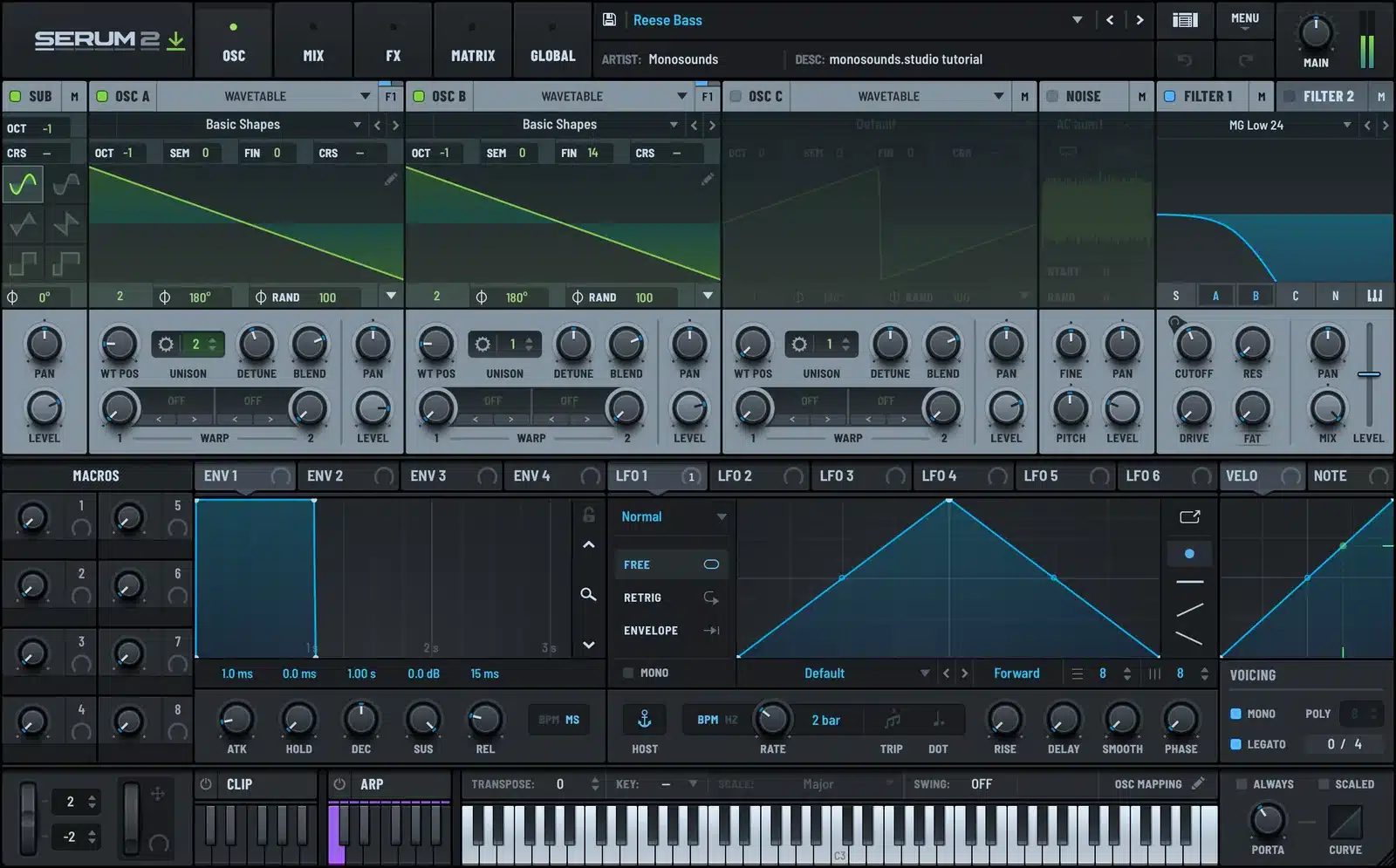
- Two saw oscillators sitting roughly 20–40 cents apart, played down low, in C1–C2 territory.
- A lowpass anywhere from 500 Hz to 2 kHz, chosen by how dark the tune wants to be.
- Some drive after the filter to fuse the two saws into a single growl.
How wide you detune decides how fast the wobble cycles: keep it narrow and it beats slow and heavy, spread it wide and it churns quick and mean. Match it to the mood of the track rather than chasing a number. For the complete treatment (phase tricks, stereo handling, movement), go read the reese bass guide.
Here’s what you’re aiming at, a raw reese out of our Elixir pack:
And its grandfather: Minimoog saws pulling the identical beating trick half a century back:
The sub is a separate instrument
Don’t ever hand the low end to the reese. Highpass it near 80–100 Hz, then run a bare sine below it (mono, zero detune, zero effects) tracking the same notes in a simplified line.
There’s physics behind this: detuned saws beat against one another, and once you’re under 100 Hz that beating becomes your entire low end wobbling in volume. Every muddy DnB mixdown that lands in my inbox has this one problem. Put a single dead-straight sine down there and everything snaps into place.
One note, moving filter
A classic DnB bassline uses one note, maybe two. What makes it feel alive is filter automation, not melody: sketch the lowpass cutoff rising and falling over 8 bars, sweep a notch through the mids so the bass talks, and that single note will say something new the whole way through.
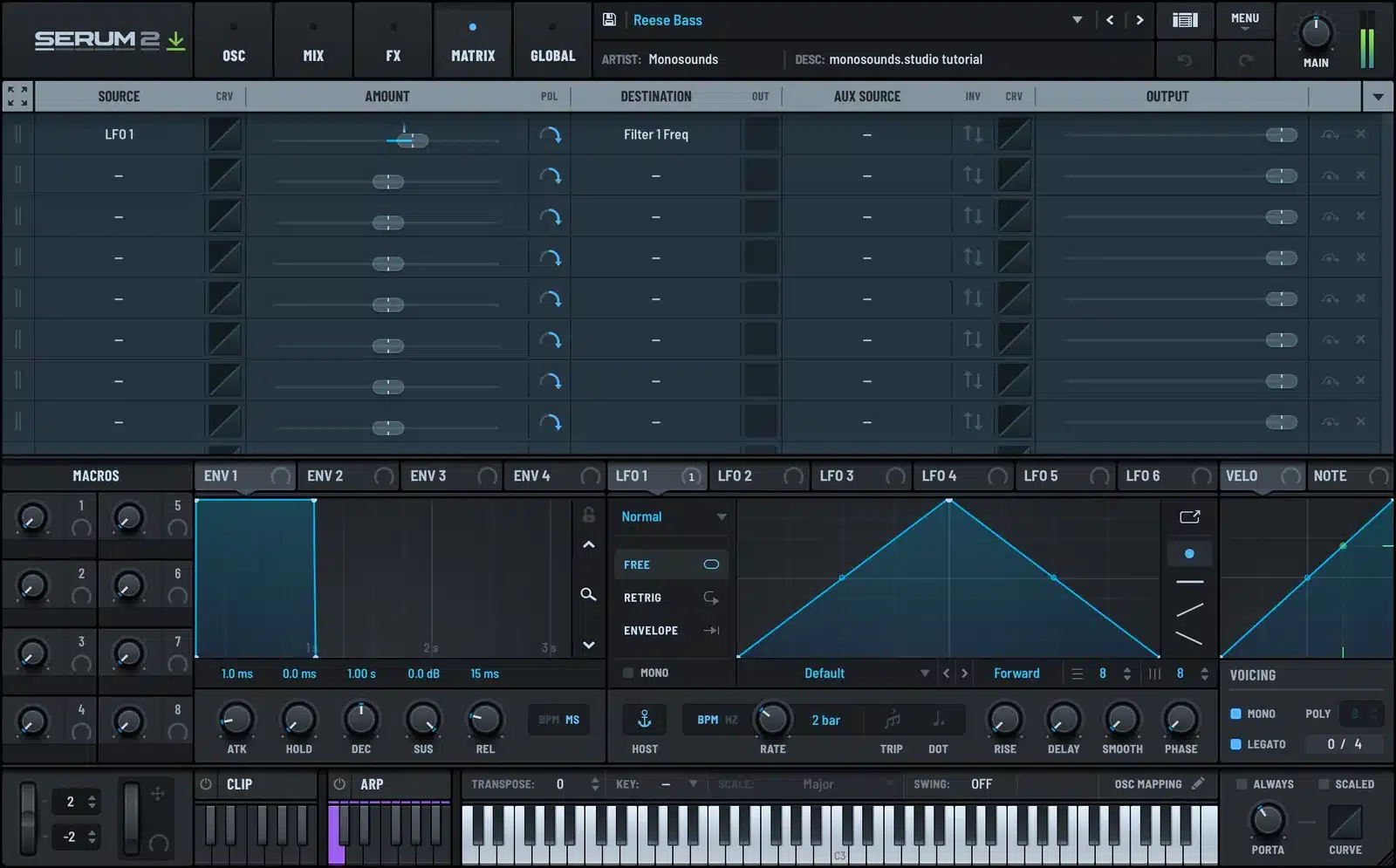
As for groove, it’s built from note lengths and the gaps between them; where the bass cuts out against the drums counts for more than which pitch it plays. Short offbeat stabs roll; long sustained notes flatten everything in their path. Get the rhythm down first and choose the pitch at the end.
When the midrange needs genuine aggression, that snarling modern sound, you’re into a different toolkit, which I unpacked in the neuro bass article. Same bones, sharper teeth. Grab the free Serum 2 bass house presets while you’re at it: the tempo differs but the bass anatomy doesn’t, and re-pitching a bass house patch up to 174 gets you a workable mid bass fast.
Drums at 174
Bones first: kick lands on beat 1, snares on 2 and 4. That plain two-step already rolls at 174. Then:
- Slide a classic break in underneath at low level for texture and ghost notes. Synthesizing breaks is an evening wasted, and sample packs exist precisely for this.
- Give the hats a slight shuffle while the kick and snare stay locked.
- Move the kick around every 4th or 8th bar to let the loop breathe.
Arrangement basics
Arranging DnB means building DJ furniture: an intro of 16–32 bars that mixes cleanly, the first drop landing around bar 33, drop sections of 32 bars with a switch-up at 16, then breakdown, then second drop. Managing energy is a subtraction game: yank the sub for the final 4 bars before a drop and the drop gets twice as big without costing you anything.
Mixdown notes
- Everything under roughly 100–120 Hz goes mono. Club systems tear wide subs apart.
- Neither sub nor kick gets to win; balance them, because beat 1 belongs to both of them hundreds of times per track.
- The reese mids should carry the bassline your ears perceive; the sub is for the chest, not the ears.
If 174 turns out to be home for you, the Serum 2 preset bundles are the smart purchase: multiple bass-heavy packs for less than their separate prices, and reese variants are precisely the sound you want twenty of.
FAQ
Why 174 BPM specifically?
That’s simply where the genre came to rest: quick enough to roll, with half-time elements landing at a comfortable 87. The 170 to 178 range all reads as DnB.
Can the reese and sub be one patch?
Split them. Each one gets different EQ, different saturation, different width treatment, and you want the crossover point in your own hands.
Why does my bass vanish on small speakers?
Because it’s sub and nothing else. A small speaker physically can’t produce 50 Hz; what phones and laptops actually reproduce is the driven reese midrange. So feed the mids. Handily, most bass patches across all my Serum 2 preset packs arrive with that split built in already, one less thing to set up.
How long should the intro be?
16 or 32 bars a DJ can mix over: drums plus atmosphere, hold the full bass. Your first distribution network is DJs; don’t make them work for it.
Reese, sine, filter automation, two-step drums. A short list on purpose — at this tempo, each element you leave out makes the surviving ones land harder.

I run Monosounds.studio and make the packs myself. Ten-plus years of producing, 97+ releases, 16,000+ downloads. Every Serum 2 preset we ship passes a CPU check on a mid-range laptop and gets used in a real track before release. If it does not survive a mix, it does not go in the pack.
More about Maxim & the studio →

