Classic neuro production meant resampling hell: design a sound, bounce it, mangle the audio, bounce again, until you’re five generations in and nobody remembers the original patch. Serum 2 cuts that loop way down. Between the sample oscillator and a proper FX section, 80% of the sound happens inside a single patch, and you only print once.
Here’s the patch structure I run, and where that one print belongs.
The core: FM into a moving notch
- Osc A: a wavetable with real midrange body, not some thin digital table.
- FM it from Osc B running a sine. The part that matters: put an envelope or LFO on the FM amount. Static FM is just a tone; FM in motion is a snarl.
- Filter: notch (comb works too), with the cutoff crawling slowly through the mids.
That “talking” character neuro is known for? Mostly a notch traveling through the 300 Hz–2 kHz zone. Not the distortion, not the wavetable choice. The moving hole in the spectrum. Hear it that way once and the genre loses most of its mystery.
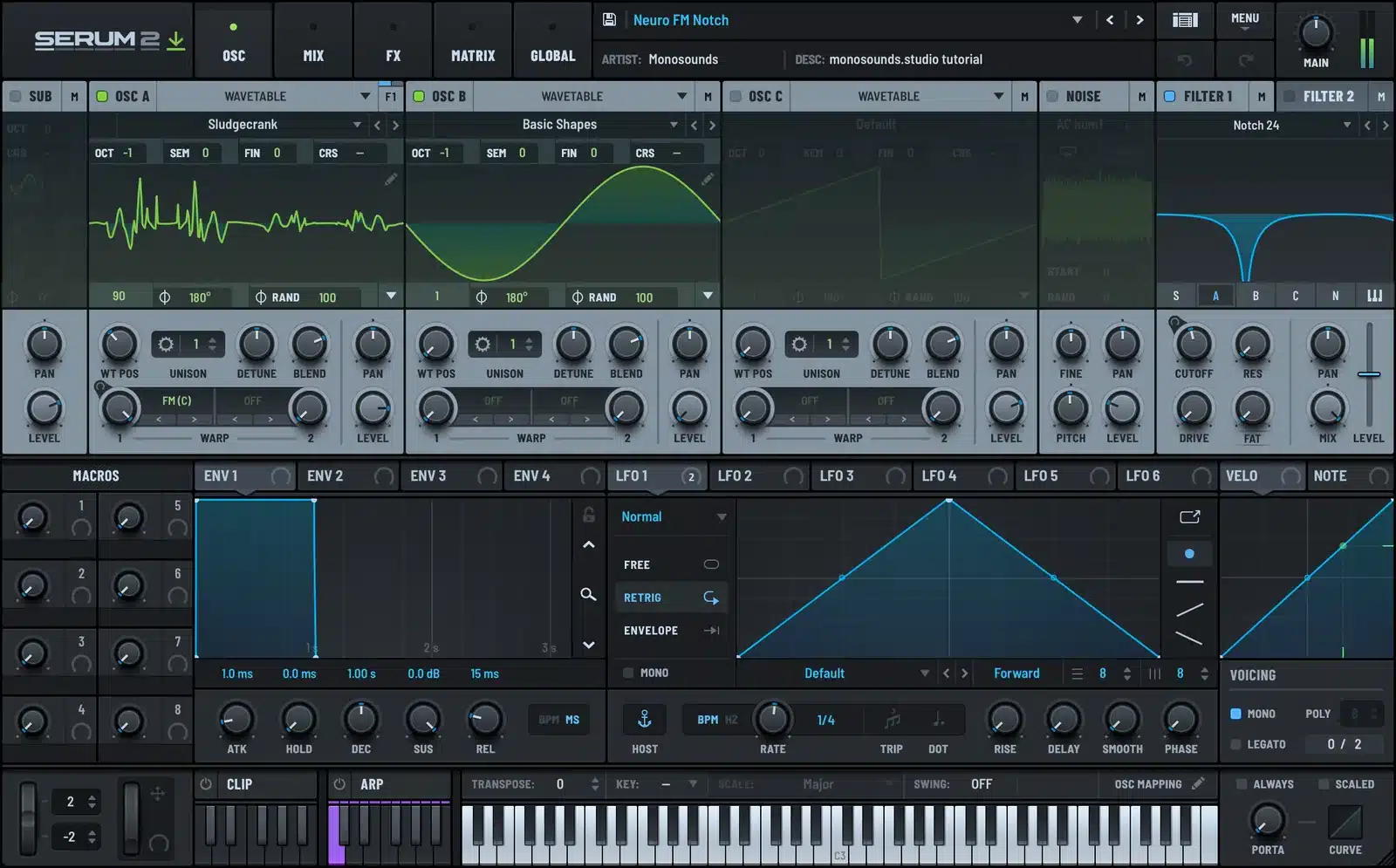
One habit worth building: run wavetable position and FM amount off the same LFO at different depths. Coupled motion reads as a creature; two unrelated LFOs read as a malfunction.
Distortion chains — order matters
Everything changes depending on where distortion sits relative to the filter:
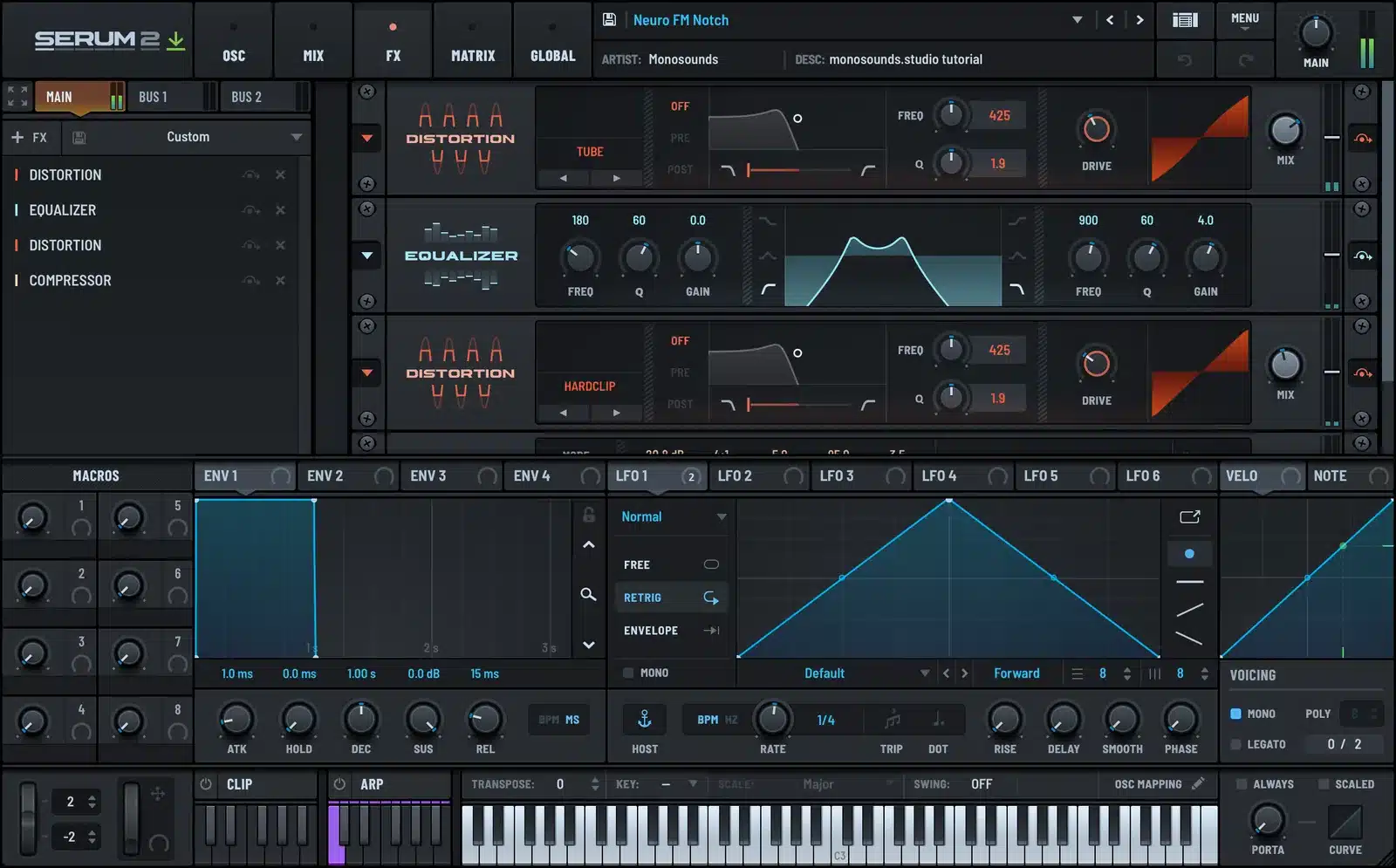
- Distortion before the filter: the notch cuts into a signal that’s already rich. Result: smoother, more vowel-like.
- Distortion after the filter: new harmonics grow back after the carving. Result: harsher, meaner.
Neuro generally wants both at once: drive feeding the notch, then a second distortion stage behind it. Two stages at moderate drive beat a single cranked one every time: you get density without the fizzy top end that drowns cheap neuro.
This is the flavor of mid-range aggression I’m describing, taken from our Skrillex-inspired pack:
Print once, not five times
Once the patch is nearly there, bounce 8 bars of it in motion to audio, then drop that audio directly into Serum 2’s sample oscillator. The whole evolving performance now lives in one oscillator, ready to be FM’d, filtered and distorted all over again from a fresh chain.
Those old five-generation resample chains only existed because Serum 1 couldn’t host long samples. With that limit gone, resampling means something different: commitment rather than capability. One print locks in your best 8 bars, everything after is shaping, and re-pitching or stretching happens inside the oscillator instead of through another bounce.
While the sound is printed, do the stuff a synth can’t: chop the audio up, flip chunks backward, stack a pitched-down copy underneath. Then stop. By generation four you’re just polishing noise.
Keep the sub separate
A snarling mid bass has zero business under about 90 Hz. Highpass it there and put a plain mono sine sub beneath it, playing the same notes. Blended in the mix they read as one enormous bass; printed as one file they’d be impossible to mix. That split is the skeleton of nearly every bass patch in the whole Serum 2 preset library, which makes them worth opening just to see where others set the crossover.
The discipline is identical to a reese — the genre’s entire low end depends on it, and the full layering breakdown lives in the reese bass guide. Here’s a raw reese for reference, neuro’s calmer ancestor:
Where to steal ideas
The FM-into-filter core of a neuro patch turns up across all of bass music. The free Serum 2 bass house presets serve a different genre, sure, but crack open any bass patch and the same skeleton is sitting there waiting to be re-routed at 174. For growl-specific moves like formant motion and vowel shapes, read the dubstep growls article; neuro is basically that toolkit with extra paranoia and less swagger.
And if bass design is your main lane, the Serum 2 preset bundles hand you several bass-heavy packs in one go. Dissecting twenty finished growls will teach you more than buying one and guessing.
FAQ
Do I still need to resample at all?
Once, usually, to lock your best movement into audio and reset the processing chain. Bouncing more than twice is a sign the patch wasn’t ready yet.
Why does my neuro bass sound thin?
Either it’s all mids with no sub, or the notch is parked too high. Add the dedicated sine layer and keep the notch doing its work below 2 kHz.
Notch or comb filter?
Notch produces vowels and speech; comb produces metal and robots. The neuro classics lean notch. Reach for comb when a drop should feel mechanical.
How do I make it actually “talk”?
Move two or three narrow cuts at the same time, driven by an LFO with drawn steps instead of a smooth sine. Speech is abrupt. Smooth LFOs come out sounding like yawns.
One patch, one print, finished. Every hour you don’t spend bouncing goes into writing the bassline — and at 174 BPM, that’s where the track actually happens.

I run Monosounds.studio and make the packs myself. Ten-plus years of producing, 97+ releases, 16,000+ downloads. Every Serum 2 preset we ship passes a CPU check on a mid-range laptop and gets used in a real track before release. If it does not survive a mix, it does not go in the pack.
More about Maxim & the studio →

