A wobble bass is nothing more than an LFO pushing a lowpass filter’s cutoff around in time with the track. One modulation route, and an entire genre grew out of it, which is why it’s still the first thing I show anyone learning sound design in Serum 2.
You can learn the basics in two minutes. What separates a beginner wobble from one you’d actually use lives in three settings most people never touch: the LFO shape, the retrigger mode, and what happens to the sub.
The two-minute wobble
- Init a patch and put a saw on oscillator A. A touch of unison adds thickness if you want it, but one voice is the right starting point.
- Take it down an octave, add a lowpass filter, park the cutoff near 200 Hz.
- Drag LFO 1 onto cutoff with a generous amount; the filter should travel from dark all the way to bright.
- Tempo-sync the LFO, rate 1/4.
- Hold a low note. There’s your wobble.
Now play with the rate: 1/4 gives you the slow dubstep lurch, 1/8 is the classic mid-tempo wub, 1/16 starts talking. Automate the rate through a phrase (1/4, then 1/8, then 1/16) and you’ve recreated the build pattern every dubstep drop leaned on for a solid decade.
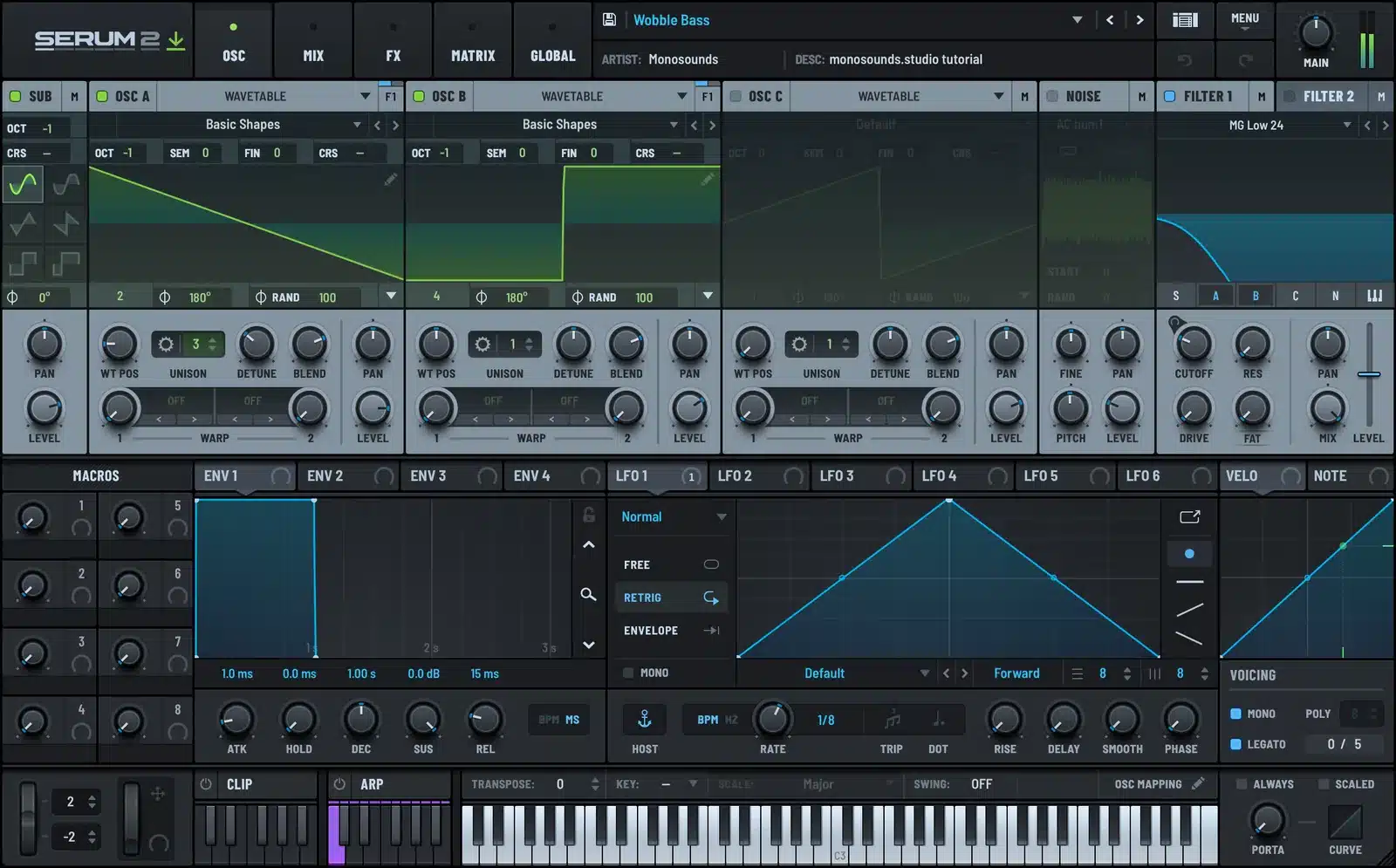
LFO shape decides the character
Here’s the detail that separates real presets from init patches. A straight sine or triangle wobble is polite. To fix that:
- Bend the curve so the LFO rises slower than it falls. The filter swells open and snaps closed. Instantly more vocal.
- Draw a small step or notch into the middle of the shape and each wub gets a stutter inside it.
- Don’t sweep the filter’s entire range. Map the LFO from roughly 150 Hz up to 1–2 kHz. A full-range sweep wastes half its time above 5 kHz where nothing useful happens.
Custom LFO shapes are honestly why Serum conquered bass music in the first place. Two minutes of drawing does what an hour of automation can’t.
Retrigger: note-on vs free-running
The trigger mode shapes the groove more than the rate ever will.
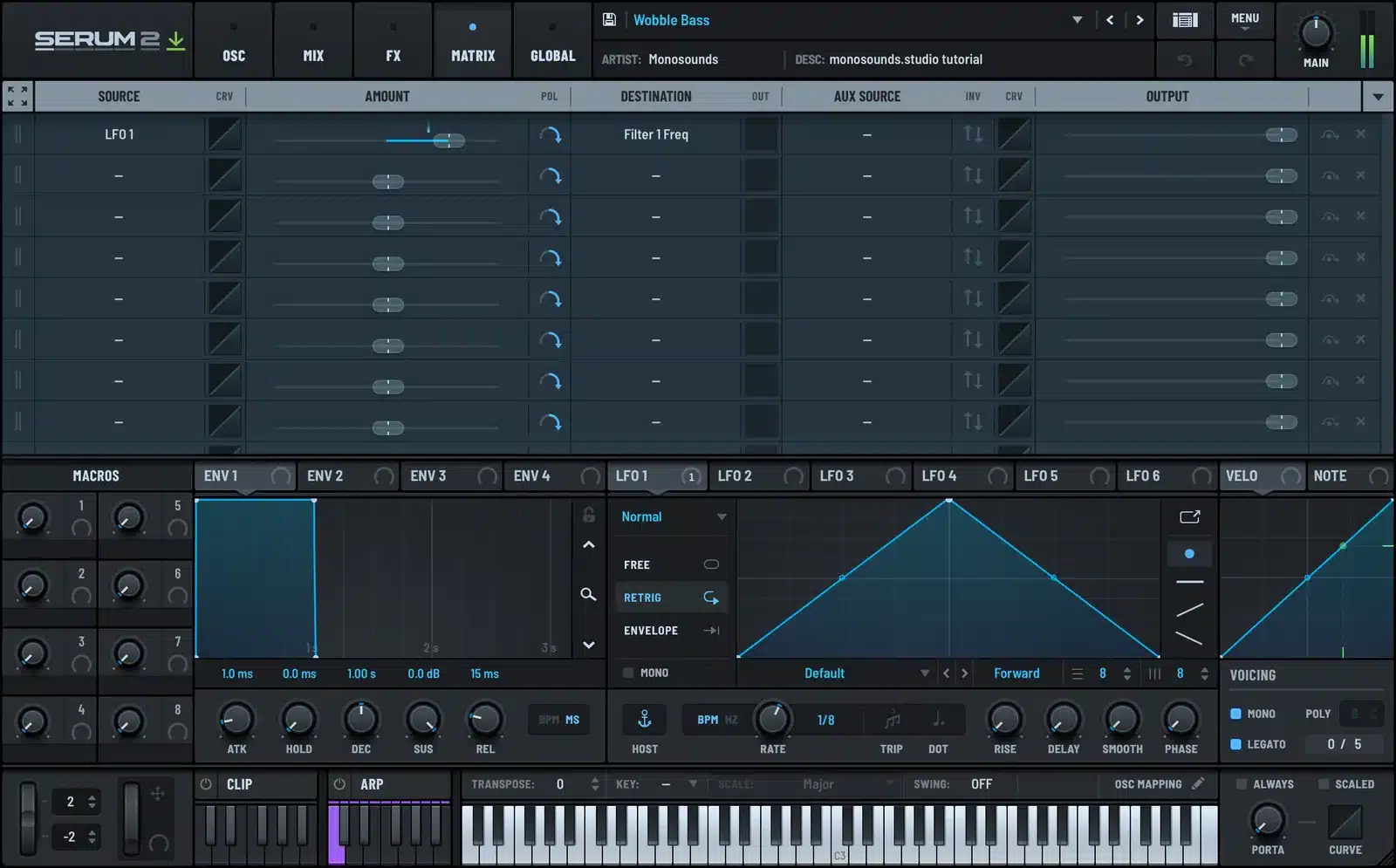
With retrigger on, every note restarts the wobble from the same point in the cycle. Predictable and punchy, right for riffs built from short notes.
Free-running (or synced to song position) means the wobble runs on its own clock, so each note lands somewhere different in the cycle. One held note turns into an evolving pattern, and it stays glued to the beat even when the bassline syncopates. My habit: free-running for long sustained wobbles, retrigger for choppy riddim-style stabs.
Grit: FM and distortion
A filtered saw wobble comes out clean, and bass music mostly doesn’t want clean. Two ways I dirty it up:
- FM from oscillator B. Put a sine on B an octave or two down, route it to frequency-modulate A, and raise the amount until the tone starts snarling. Then send the same LFO that runs the filter to the FM amount, so the grit breathes along with the wub.
- Distortion in the FX chain, sitting after the filter. Follow it with EQ inside the chain to control the harsh 3–5 kHz that distortion never fails to add.
Back when I built our Skrillex-inspired pack, almost every patch ran one LFO into two or three destinations simultaneously: cutoff, FM amount, wavetable position. One LFO, three targets. That’s the difference between a wobble that feels like a living thing and a filter on a timer.
Protect the sub
Here’s the textbook beginner mistake: the LFO wobbles the whole patch, sub and all, so the low end pumps in and out. Every time the filter closes, the track loses its floor.
The cure is a split. Run a plain sine sub an octave down, either a separate oscillator that bypasses the filter, or its own track entirely. The sub sits rock solid while the wobble lives in the mids, above roughly 100 Hz. Every professional bass house record is built this way, and it’s exactly why those drops manage to feel massive and stable at the same time.
Rather see the wiring than read about it? Download the free Serum 2 bass house presets, open any bass patch, and study what the LFO reaches — and, just as telling, what it deliberately leaves alone.
Making it fit a track
A wobble that’s massive on its own will usually swallow the whole mix. Three habits keep it in line:
- Sidechain the wobble layer to the kick, even gently. The lurch snaps into place.
- Pull a few dB around 300–500 Hz whenever the wub gets boxy against the drums.
- Write the wobble rhythm against the drums instead of on top of them. When kick and wub always hit together, the groove goes flat.
The same LFO-on-cutoff move powers slap house and bass house too, just faster, tighter, with heavier sidechain. One trick, different suit. If you want the whole family in one place, the bass house and slap house folders sit right beside the dubstep ones in my Serum 2 preset catalog.
Done with the free packs and after a proper library of finished basses across genres? The Serum 2 preset bundles are the cheapest route per preset. No countdown timer, just the better deal.
When you’re ready for heavier ground, the dubstep growls guide picks up where this one ends, and the modulation guide covers everything else an LFO can grab besides cutoff.
FAQ
What LFO rate for a wobble bass?
Tempo-synced: 1/4 for slow dubstep, 1/8 for the classic wub, 1/16 for fast talking basses. The standard move is automating between them over a phrase.
Should the LFO retrigger on every note?
Short choppy stabs want retrigger; held notes want free-running, so the pattern keeps evolving while staying locked to the grid.
Why does my low end disappear when it wobbles?
Because the LFO is filtering the sub together with the mids. Split them up: a steady sine sub under 100 Hz, wobble strictly above it.
How do I make a wobble sound aggressive, not clean?
FM from a sine oscillator, distortion after the filter, and the FM amount riding the same LFO as the cutoff.
An LFO, a filter, a hand-drawn shape and a sub left in peace. Fifteen years later that recipe still slaps — more than you can say for most production trends.

I run Monosounds.studio and make the packs myself. Ten-plus years of producing, 97+ releases, 16,000+ downloads. Every Serum 2 preset we ship passes a CPU check on a mid-range laptop and gets used in a real track before release. If it does not survive a mix, it does not go in the pack.
More about Maxim & the studio →

