Strip an acid bass down and you get one oscillator, a resonant lowpass, and an envelope chewing on the cutoff. That’s all the Roland TB-303 ever was, and the limitation IS the sound. Rebuilding it in Serum 2 takes maybe five minutes.
But the patch is the easy 50%. What actually makes a 303 feel like a 303 is the slides and accents, so I’ll show you how to fake those convincingly as well.
The core patch
- Start from init. One oscillator running a plain saw. The original also offered a square, so audition both. The saw bites harder, the square is rounder and more rubbery.
- Kill the unison. Single voice. Acid lines are thin on purpose; that thinness is why they slice through a crowded techno mix.
- Lowpass filter with the cutoff dragged low, somewhere around 200–400 Hz as a starting point.
- Resonance up high, roughly 60–80 percent. You want it whistling but stopping just before self-oscillation.
- Route an envelope to cutoff: attack fast, decay in the 150–300 ms range, sustain at zero. Give it a healthy amount.
Every note now squelches — the filter opens and slams shut. An entire genre lives inside that squelch.
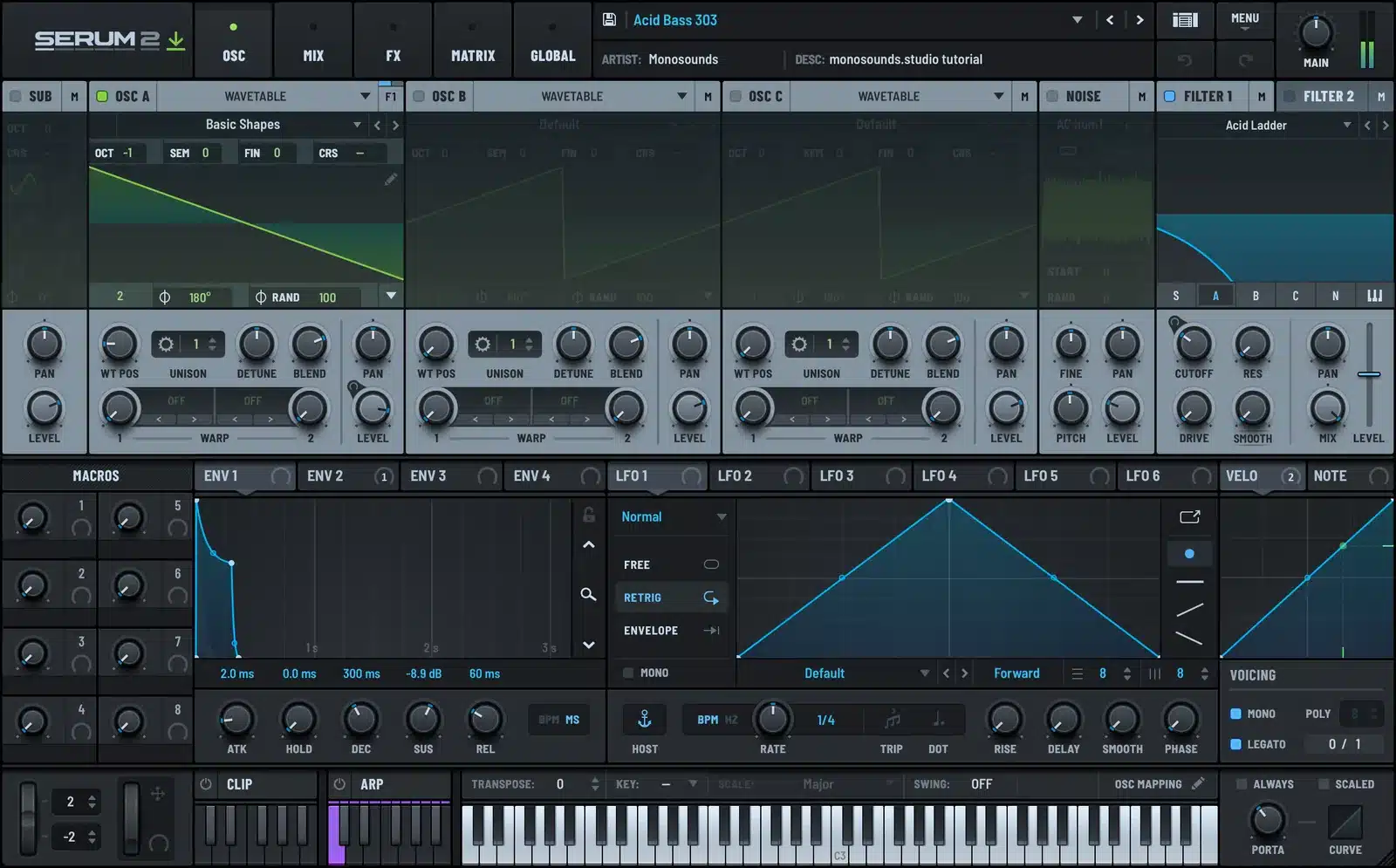
A detail most people miss: the 303 used a diode ladder filter that rolled off around 18 dB per octave, gentler than your standard 24 dB lowpass. So if your patch comes out sounding sterile, reach for a softer filter slope. The resonance peak loses its icy edge and the bottom end holds onto a little more weight.
Slides: the part everyone skips
Tied notes on a 303 glided into each other rather than retriggering. Two settings recreate that in Serum 2:
- Mono voicing with legato engaged, so notes that overlap don’t restart the envelopes.
- Portamento in the 60–100 ms range, configured to glide only when notes overlap.
From there, sliding becomes something you play, not something you dial in. Drag the tail of one note in your piano roll so it overlaps the next by a tick or two. Overlaps glide; gaps snap. Give every third or fourth note a slide and the line immediately sounds ten times more like acid than any amount of filter fiddling.
Accents: velocity into cutoff and volume
The 303’s single accent button did two jobs simultaneously: it made the note louder and it opened the filter. So in the mod matrix, send velocity to cutoff and velocity to volume. Then write most of your notes soft, around 60–70 velocity, and slam the accented ones up to 127.
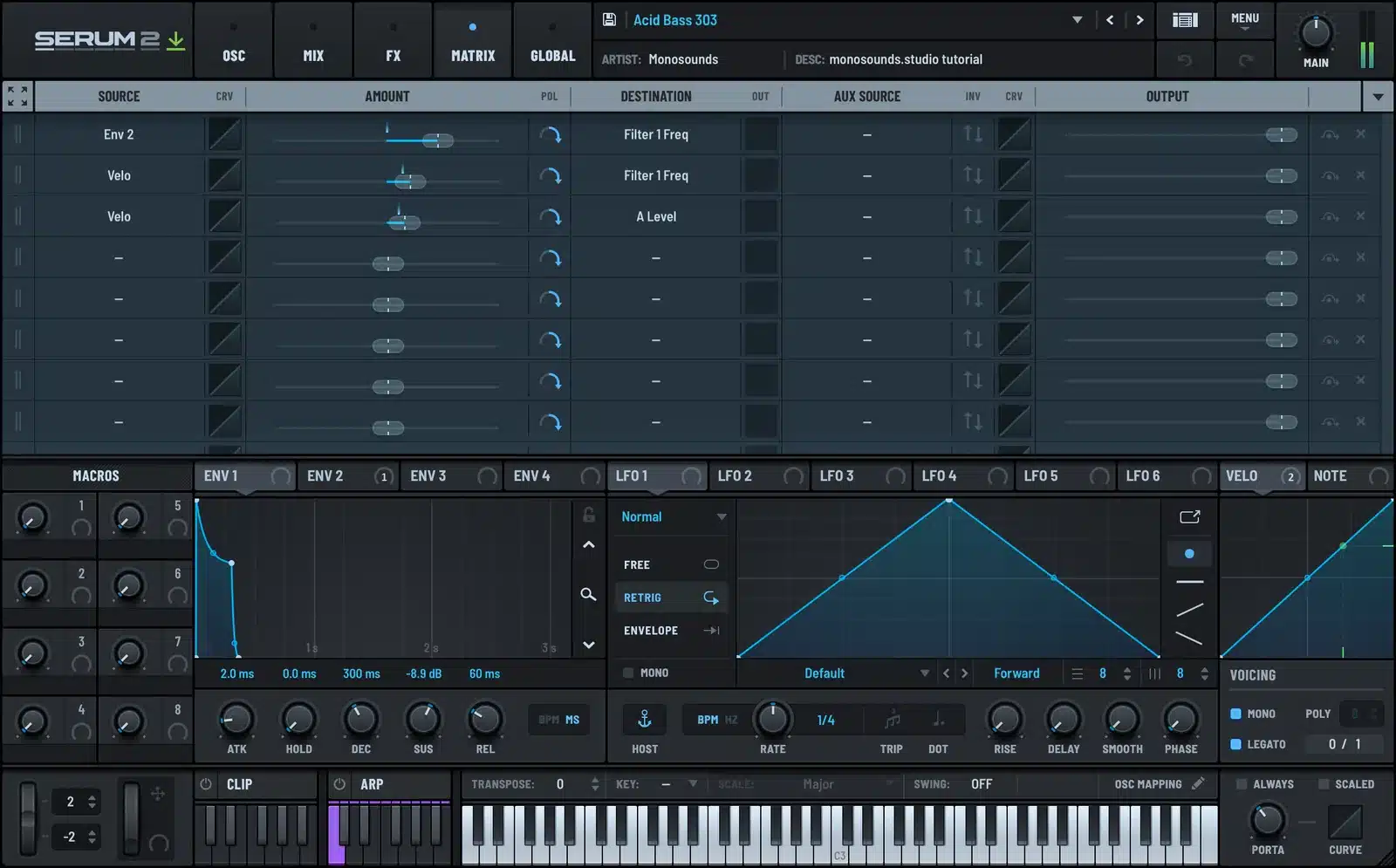
Where people go wrong is routing velocity to volume alone. You get dynamics, but no teeth. If the accent doesn’t crack the filter open, the ear won’t hear it as acid.
Here’s a squelchy tech house spin on the concept from one of our packs, assembled exactly this way: square wave, resonant filter, velocity pulling the strings.
Sequencing an acid line
The pattern beats the patch every time. My approach:
- Base grid of straight 16th notes, sticking mostly to one or two pitches.
- Jump the octave on a handful of steps. That up/down octave transpose on the 303 is the reason classic lines bounce around the way they do.
- Put accents on the off-beats rather than on the kick — that’s where the line starts leaning against the groove.
- Stay short. The real classics run one bar, two at most, evolving slowly through the filter rather than through new notes.
After that, ride cutoff and resonance automation across the full 16 or 32 bars. An acid track is essentially one pattern plus twenty minutes of filter movement, and I don’t mean that as an insult.
Dirt: distortion after the filter
There’s no such thing as clean acid. The records that defined the sound went through overdriven mixers and pedals. In Serum 2’s FX chain, place your distortion after the filter, never before it. Put drive in front and it squashes the resonance peak you just carved out. Put it behind and the peak slams into the distortion, giving you that screaming top.
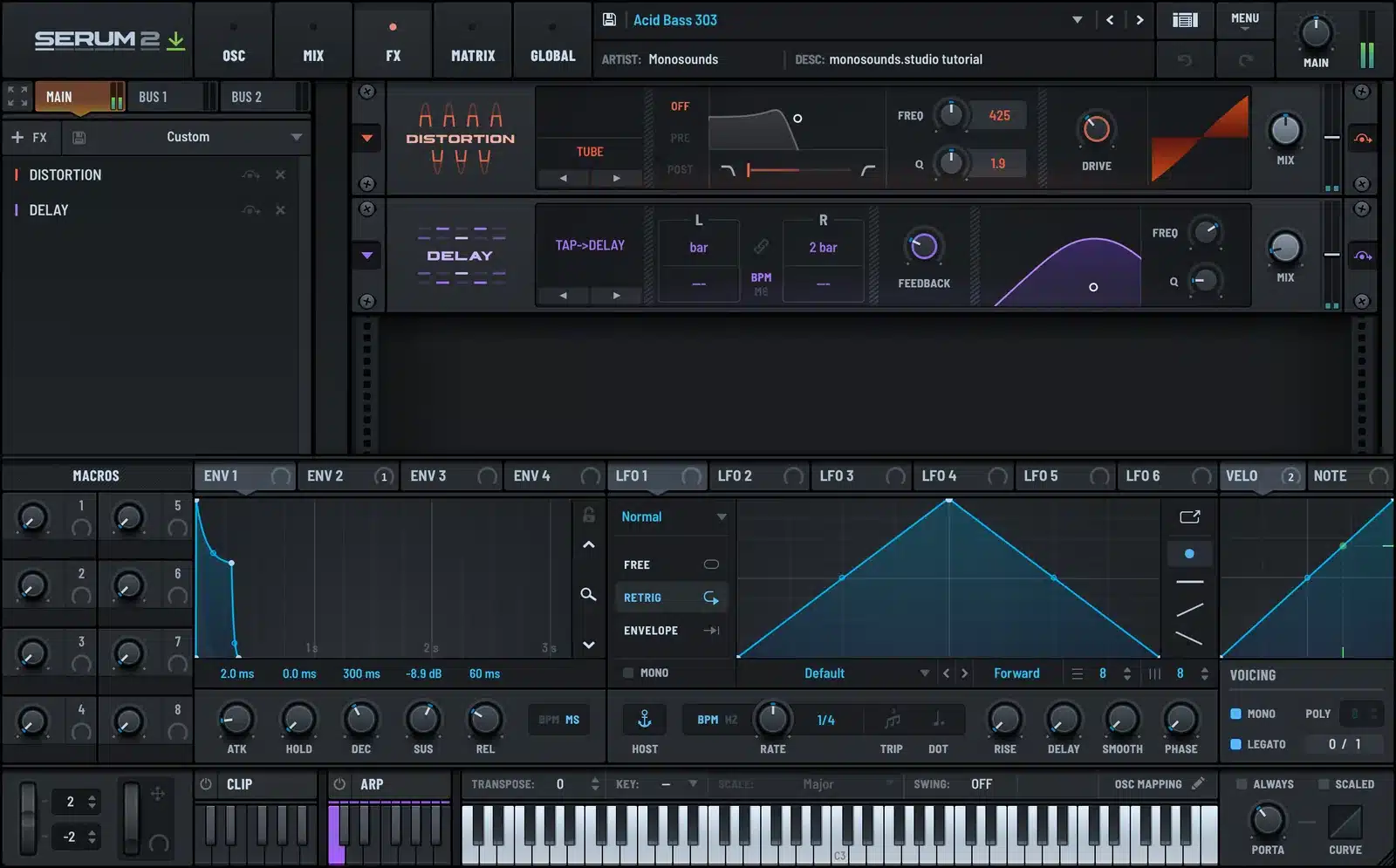
For house, soft clip or a tube-style drive at modest amounts; for techno, clip harder. When the line has to compete with a dense percussion bus I’ll also lift a small EQ boost around 1–2 kHz.
Rather start from something that already works than from init? Pull down the free Serum 2 techno presets and study how the acid-flavored patches wire up velocity in the mod matrix. Nothing teaches the accent setup faster than reverse-engineering one that’s done right.
Where it sits in techno today
In current techno the acid line tends to ride as a mid-range riff on top of a rumble bass rather than always taking the lead. Highpass it around 100 Hz and let a dedicated sub do the heavy lifting below. The 303 never produced much genuine low end to begin with, which is one reason it always layered so gracefully. I usually grab that sub from a techno pack instead of designing it a second time, and our Serum 2 presets sorted by genre turn that into a ten-second errand.
Here’s a harder, modern techno relative of the sound doing its job in context.
And once the free stuff runs out of road, the Serum 2 preset bundles gather our techno and house libraries at the cheapest per-preset price we do. That’s the reasonable next step, no countdown timer attached.
For the bigger low-end conversation, read tech house bass in Serum 2 and the complete techno in Serum 2 guide.
FAQ
Saw or square for acid bass?
Either one is legit. The saw runs brighter and angrier; the square comes out rounder and more hollow. Classic acid records used both — start with the square if there’s already a big sub underneath.
How do I make notes slide like a 303?
Mono legato voicing, then 60–100 ms of portamento that only fires on overlapping notes. From there, overlap notes in the piano roll wherever a slide belongs.
Why does my acid line sound flat?
Nine times out of ten, no accents. Send velocity to cutoff and to volume, write most notes soft, and punch a few up to maximum velocity.
Does resonance need to self-oscillate?
No. Park it just below self-oscillation, around 60–80 percent. Fully self-oscillating resonance adds a whistle that argues with the rest of the mix on most systems.
An oscillator, a filter, an envelope, and a pattern with the slides and accents where they belong. Fight the urge to stack a fourth layer. The empty space is the sound.

I run Monosounds.studio and make the packs myself. Ten-plus years of producing, 97+ releases, 16,000+ downloads. Every Serum 2 preset we ship passes a CPU check on a mid-range laptop and gets used in a real track before release. If it does not survive a mix, it does not go in the pack.
More about Maxim & the studio →

