If early 90s dance music has two sounds everyone recognizes, they’re the hoover and the rave stab, and both are enjoying a long second act in today’s hard techno and hard dance. Serum 2 does both convincingly, and building them teaches you two skills you’ll reuse forever: pitch-sweep detune and thinking in sampled chords.
Hoover first, since it’s the one people consistently get slightly wrong.
What a hoover actually is
The original lives on the Roland Alpha Juno in a patch named “WhatThe?”, built from that synth’s weird PWM-saw hybrid wave, with the onboard chorus doing half the heavy lifting. The “vacuum cleaner” quality everyone chases is really three layers: saw-ish waves detuned hard, pulse-width-style motion inside the wave itself, and a pitch sweep that glides up into every note.
Most recreations nail the detune and skip the sweep. The sweep is the sound.
Building the hoover
- Oscillator A: saw, unison 6–7, detune shoved harder and wider than good taste allows. Rudeness is the point of this patch.
- Oscillator B: a second saw or a PWM-style wavetable an octave lower, unison 3–4. Sweep the wavetable position slowly with an LFO to imitate the pulse-width churn.
- The pitch sweep: put an envelope on master pitch, starting near -12 semitones and climbing to zero across 60–120 ms, sustain at zero. Every note now swoops up into itself.
- Chorus: wide, obvious, unapologetic. The Juno’s chorus wasn’t subtle and yours shouldn’t be either.
- Optional: a sine sub an octave down, giving the detuned mess a solid floor to sit on.
Short notes turn the sweep into an aggressive attack transient. Held notes with the sweep stretched past 200 ms give you the doomy air-raid variant instead. One patch, two personalities, and the difference is a single envelope time.
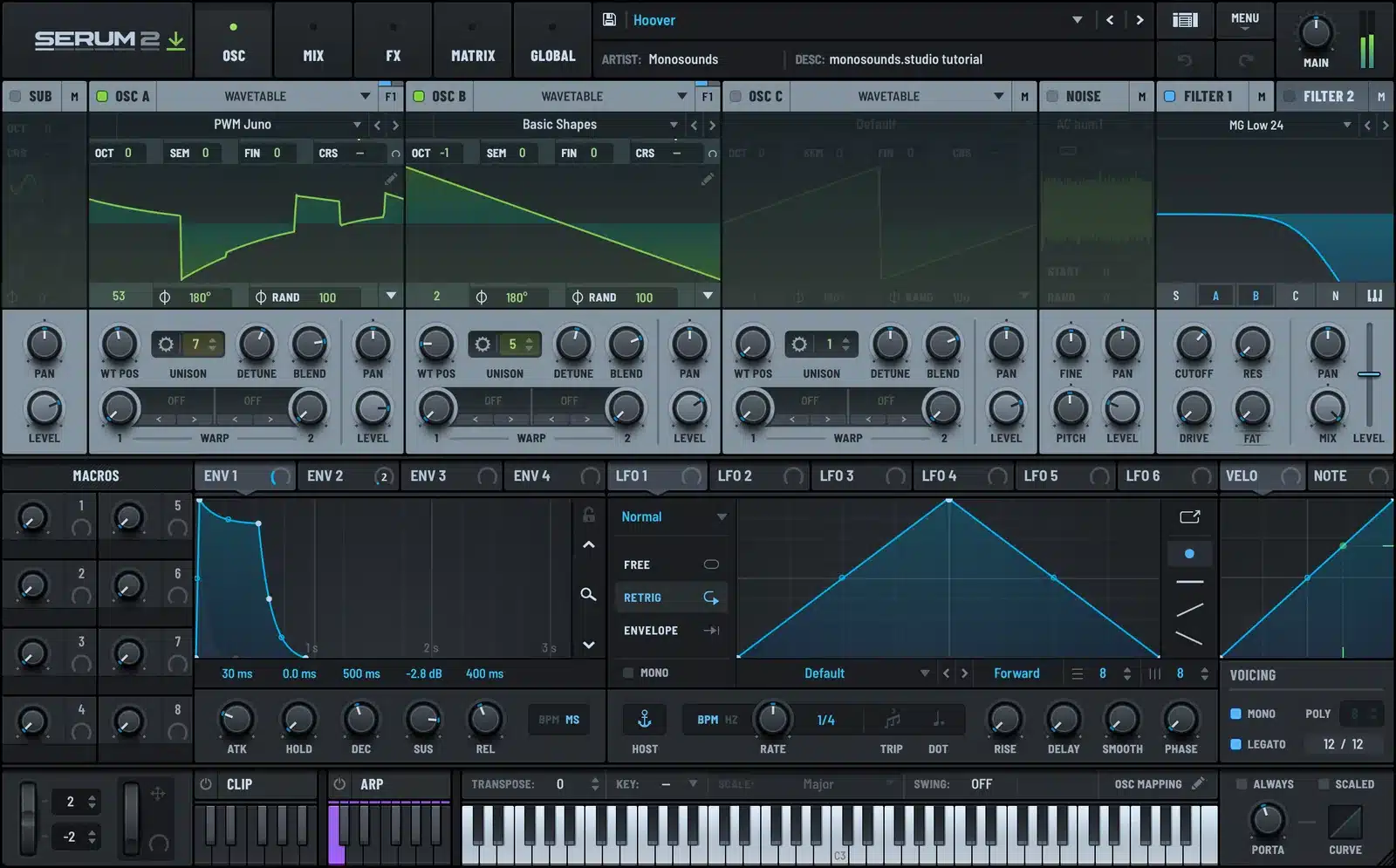
Today’s future rave leads are hoover offspring: the same detuned swarm, tuned tighter, filtered with more discipline. Here’s that bloodline in its current form.
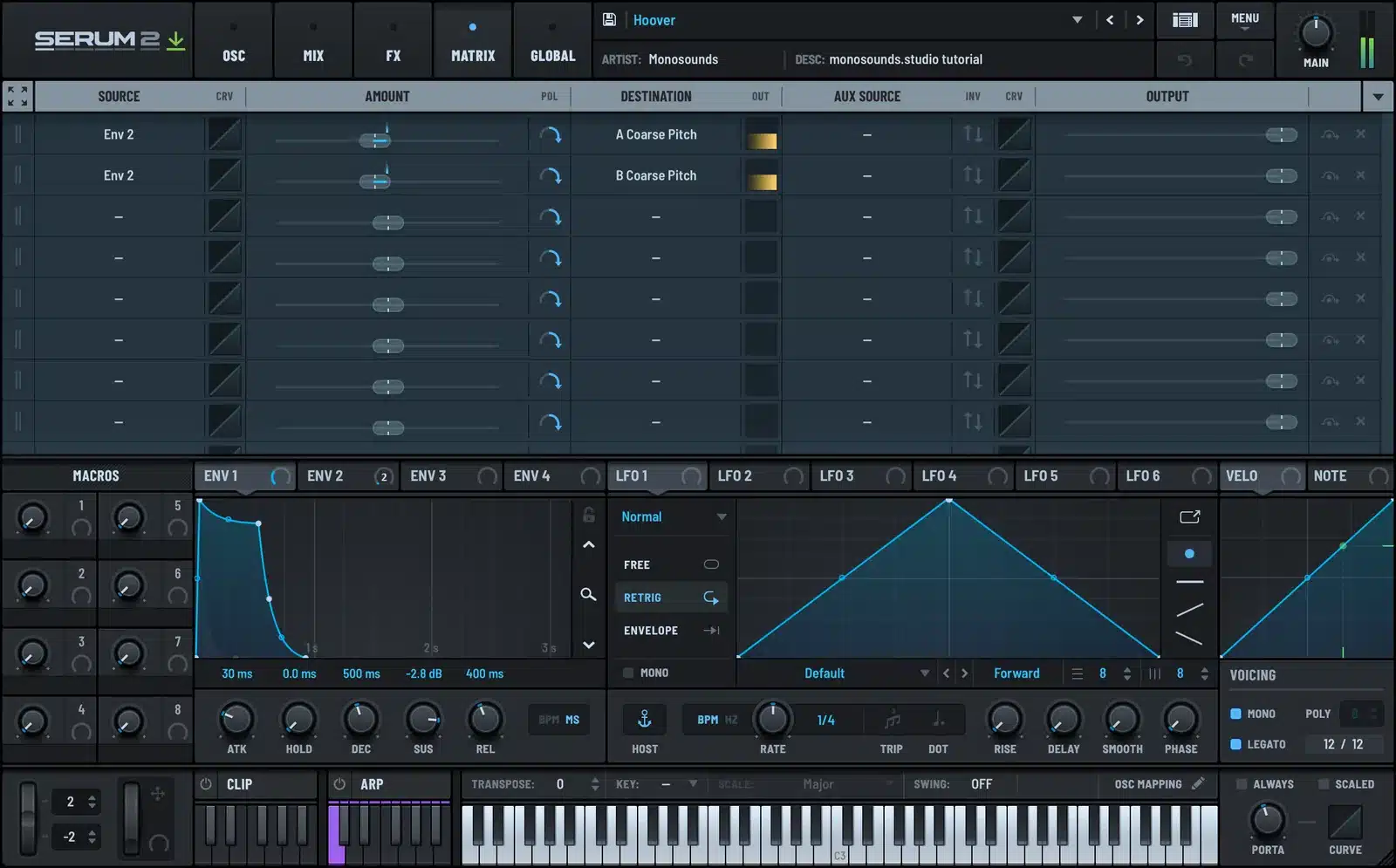
Rave stabs: think like a sampler
The classic rave stab (the M1-piano-organ hit and its descendants) hides a secret: it’s a whole chord sampled as one note. Producers captured a minor chord hit and played the sample chromatically. Trigger it around the keyboard and the entire chord transposes in parallel, which is harmonically “wrong” and precisely why it sounds like a rave.
Serum 2 gives you two routes to this:
- The synth way: make a bright percussive patch (saw plus square, quick filter decay, no sustain) and play actual chords: minor triads with a seventh or ninth on top for that bittersweet color. Cleaner and more flexible, but a touch too polite.
- The sampler way: bounce one chord hit from that patch, drop the render into Serum 2’s sample oscillator, and play it as single notes. Transposition now smears the chord exactly like 1992 did. This is the authentic flavor, and the sample oscillator turns it into a two-minute job.
Anything that needs to sound era-correct, I do the second way. Parallel-chord smear plus a short amp envelope reads as “warehouse” instantly, no processing required.
Processing: era-correct dirt
These stabs were born on 12-bit samplers, and that grit belongs to the genre. So in the FX chain: some downsampling or bitcrush-flavored distortion, a tight bright reverb with a short tail, and a highpass near 120 Hz so the stab jabs instead of booming. Then compress hard — the source material had no dynamics to begin with, and faking some sounds wrong.
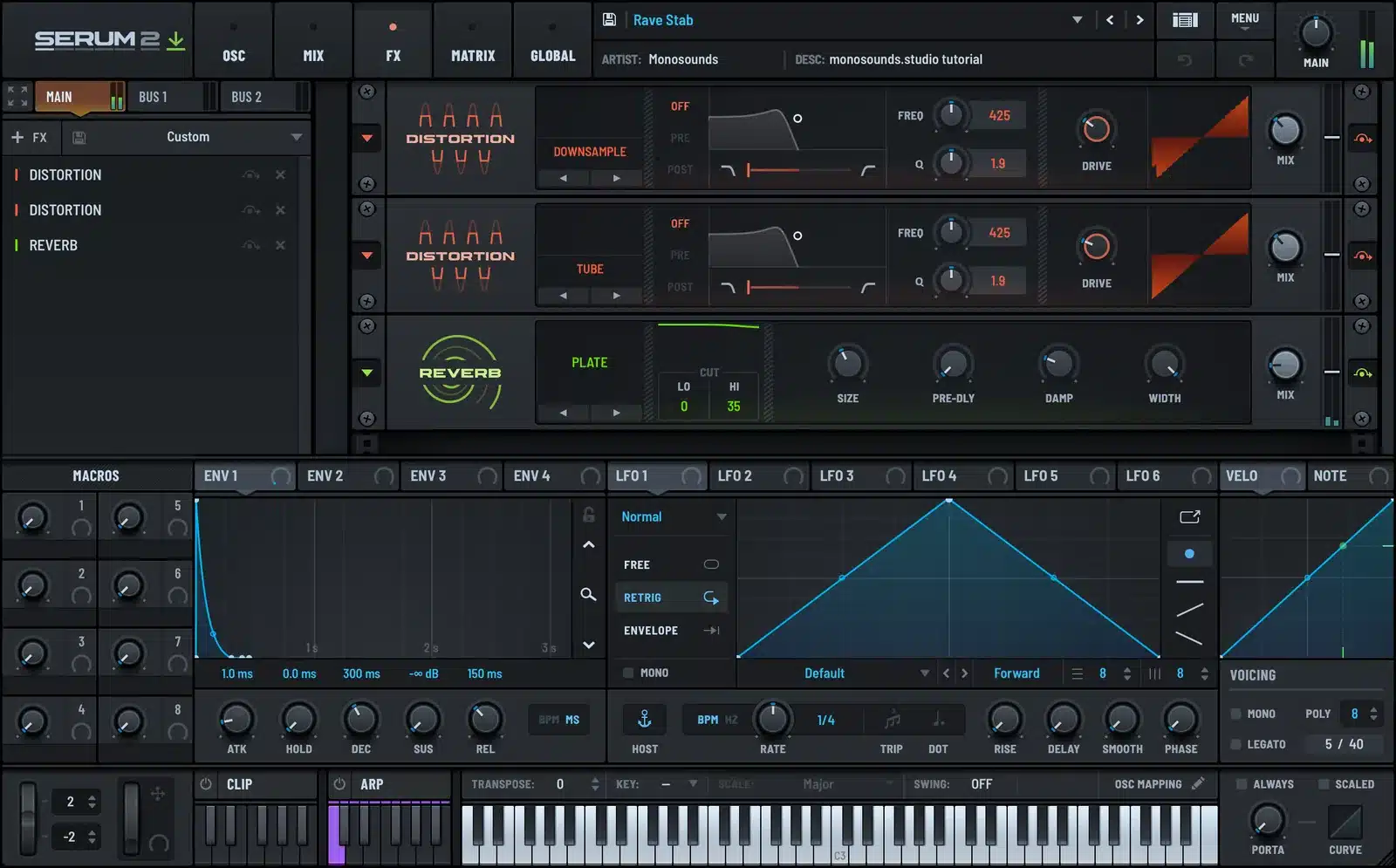
For hard techno, trade the bright reverb for a dark one, drop the stab an octave, and sidechain it against a rumble kick. The same M1-lineage chord that soundtracked breakfast raves in 1992 now pulls 150 BPM warehouse shifts, which genuinely amuses me.
Want ready-made material in this lane? Download the free Serum 2 techno presets and audition the stab-style patches over a hard kick; a couple of them were built on exactly the recipe above.
The eurodance connection
Hoovers and stabs didn’t stay in the underground. By the mid-90s they had become the melodic language of eurodance and happy hardcore, playing full riffs instead of single hits. Writing in that revival lane? The trick is committing to the melody: hooks moving in plain octaves and fifths, zero jazz voicings, and the hoover carrying the actual topline. Our full Serum 2 preset range includes a eurodance pack built around those exact riffs, if starting from a voiced hoover beats building your own.
Beyond the freebies, the Serum 2 preset bundles bundle our techno and rave-adjacent packs at the best per-preset price, which starts to matter once this era’s sounds take over your whole track.
Related guides: the full techno in Serum 2 walkthrough covers the rumble-kick context these stabs live in, and the supersaw guide is home to the hoover’s better-behaved children.
FAQ
What synth made the original hoover sound?
The Roland Alpha Juno, via a patch called “WhatThe?”, with the built-in chorus supplying much of the width. In Serum 2 you rebuild it from detuned saws, wavetable movement and a pitch sweep.
What’s the pitch envelope for a hoover?
Begin around -12 semitones and rise to zero over 60–120 ms, no sustain. Stretch it to 200 ms or more and you get the dramatic air-raid take.
Why do rave stabs sound detuned when played up the keyboard?
Because the originals were sampled chords played chromatically — the whole chord moves in parallel. To recreate it, load a single chord render into the sample oscillator.
Do these sounds work in modern techno?
Very much so. Tune them darker, sidechain them to the kick, swap the bright reverb for a dark one. Hard techno currently runs on 90s vocabulary.
Two patches with thirty-five years of dance music stretched between them. Build the hoover once, sample one stab of your own, and the entire rave revival lives in your user folder.

I run Monosounds.studio and make the packs myself. Ten-plus years of producing, 97+ releases, 16,000+ downloads. Every Serum 2 preset we ship passes a CPU check on a mid-range laptop and gets used in a real track before release. If it does not survive a mix, it does not go in the pack.
More about Maxim & the studio →

