The rumble is the dark, rolling floor under a Berlin-style techno kick — the thing that makes the kick sound like its tail goes on for a mile. It isn’t actually the kick at all. It’s its own layer: a sub bass, driven into distortion, drenched in reverb, then sidechained so brutally it only lives in the spaces between kick hits.
A lot of producers get there by processing the kick itself. I’d rather synthesize the layer in Serum 2, because then it has a pitch I own and I can perform it like an instrument. Here’s how I build mine.
What a rumble actually is
Three ingredients, and the order matters: a sub-heavy source, saturation to grow harmonics, reverb to smear everything into a wash. Sidechain compression then carves the kick’s silhouette into that wash. Most of the groove you’re hearing is the ducking, not the notes.
Flip the order and the sound changes completely. Reverb after distortion comes out smooth and deep. Distortion after reverb comes out trashy and gritty, also a valid flavor, but choose it deliberately.
The Serum 2 patch
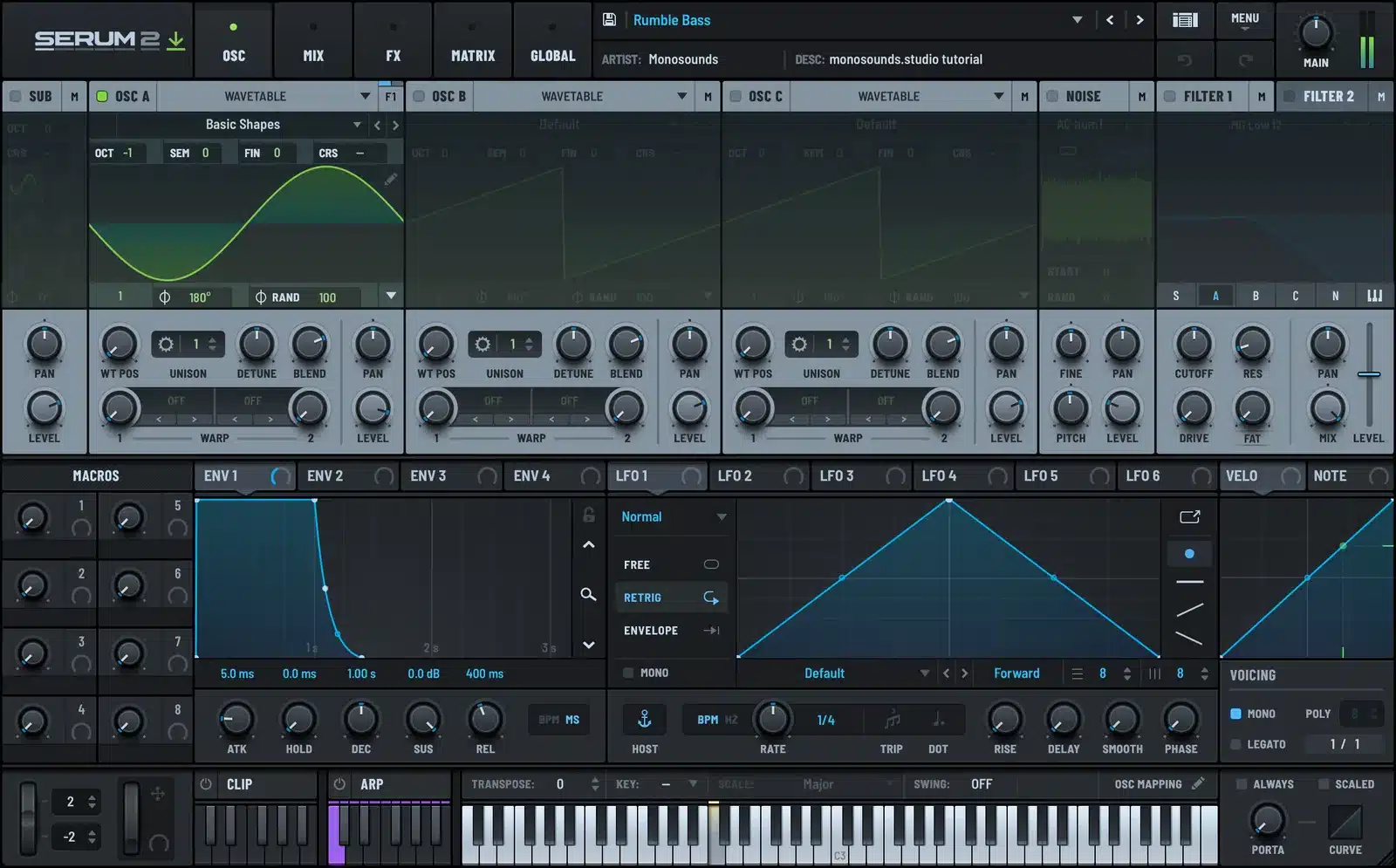
- Init preset. Oscillator A: a sine or triangle wavetable. One voice, no unison, no widening; this whole sound must stay mono.
- Play notes around F0 to A0, roughly 43–55 Hz. Match your kick’s fundamental: if the kick rings at F, the rumble sits on F. This is the detail that separates a tight rumble from mud.
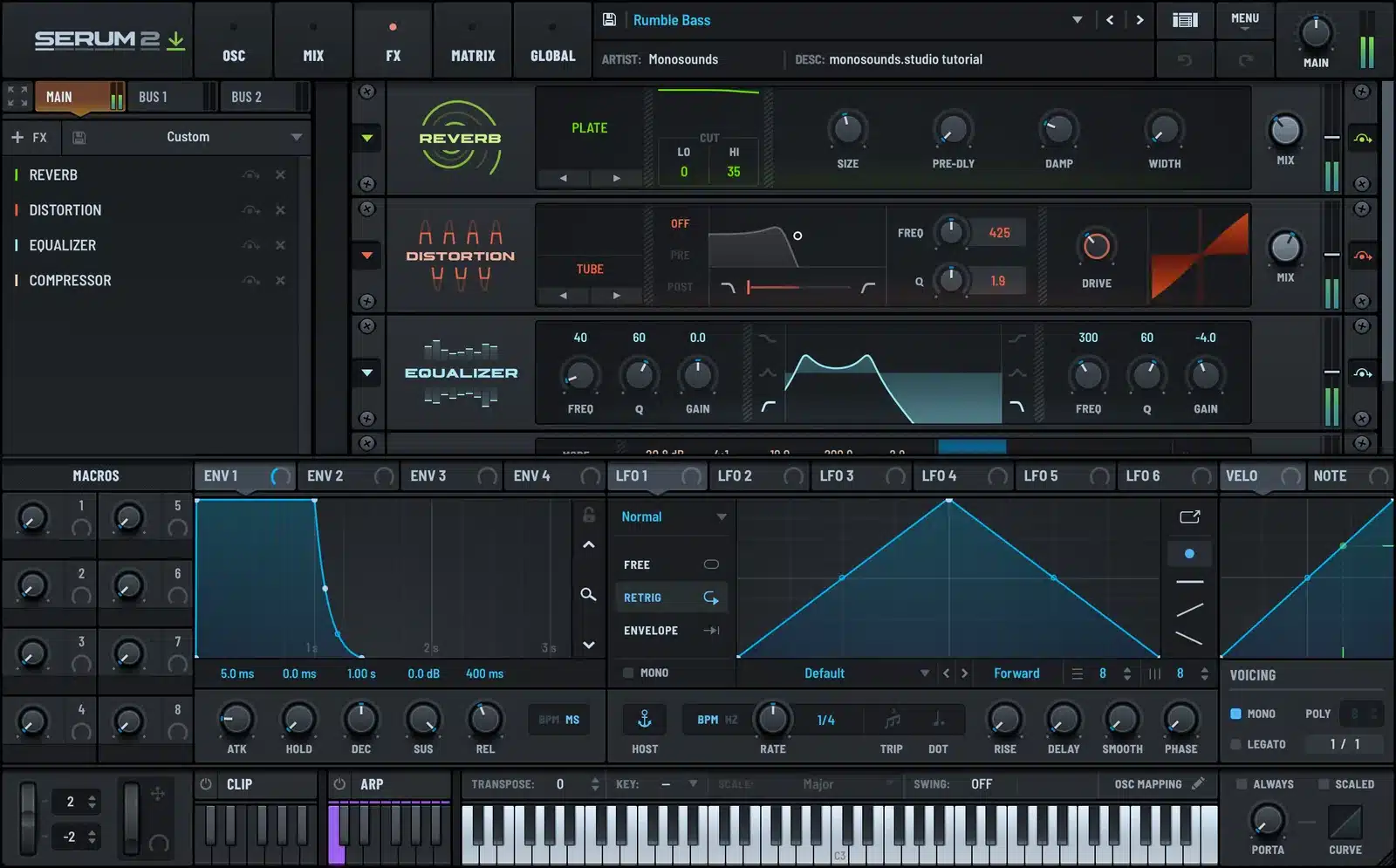
- In the FX chain: distortion first. Push the drive until the sub grows a voice of its own; soft clip or tube-style curves behave better down here than hard digital clipping.
- Reverb next, inside Serum. Big room or hall, decay around 3–6 seconds, mix turned up well past what feels reasonable: 40–60% wet.
- Low-pass filter after the reverb, cutoff around 100–150 Hz, trimming off the reverb’s splashy top until only weight remains.
Hold a note. It should sound like a dark ocean, and boring on its own. Boring means you did it right.
Sidechain is the instrument
Send the kick into a compressor on the rumble channel and duck without mercy: 6–10 dB or beyond. Attack fast. The release is where the music happens: dial it so the rumble swells back in just before the next kick lands. Around 130 BPM that usually means somewhere in the 100–200 ms zone, but set it by ear with the loop running.
Release too fast and the rumble pumps right in your face. Too slow and it never returns, leaving the low end hollow. The window where it actually grooves is maybe 30 ms wide — hunt for it.
The kick-versus-bass relationship gets a fuller treatment in my bass and kick mixing guide, and everything there counts double here, since rumble and kick occupy literally the same octave.
Keep it mono, keep it controlled
- Everything below 100 Hz in mono. A wide sub impresses on headphones and evaporates on a club system. If the reverb widened yours, collapse the low band with a stereo utility.
- Notch a couple of dB out of the rumble channel at the kick’s fundamental. Sidechain or not, they still overlap, and that one small cut sharpens the punch immediately.
- Level check: park the rumble around 6–10 dB under the kick. When unsure, err quiet; a rumble you only notice once you mute it is doing exactly its job.
Here’s a finished techno bass from our TechnoCraft pack, so you can hear where all this lands in a produced track.
Playing it: less is more
The classic approach: one note, held for 8 or 16 bars, with the sidechain supplying all the rhythm. Craving movement? Try offbeat 8ths with a short gate, though at that point you’re blurring into the rolling bassline territory from my techno in Serum 2 guide.
Rather skip the patching and dissect something that already works? Our free Serum 2 techno presets contain bass patches you can gut — swap in a sine oscillator, push the reverb mix, and a rumble starting point is yours inside a minute.
And if techno turns into your main lane, the Serum 2 preset bundles hand you our techno sounds plus the neighboring genres for less than the pack-by-pack price. That’s the honest math on them.
FAQ
Should the rumble be a separate track or part of the kick?
Separate, always. Independent sidechain, EQ and level control aren’t optional. A kick with a rumble baked in becomes a mixing nightmare two weeks down the line. Same reason nothing in all our Serum 2 preset packs ever ships a kick fused into the bass patch.
What key should the rumble be in?
Your track’s key, matched to the pitch of the kick’s tail. Let those two argue and no mixing move on earth repairs the low end.
Why does my rumble sound muddy?
Nearly always unfiltered reverb below 100 Hz, or a sub gone stereo. Low-pass after the reverb, fold to mono, notch out the kick’s fundamental.
Can I do the whole thing inside Serum 2?
Almost all of it. Distortion, reverb, filtering, yes. The sidechain compression against the kick stays in your DAW, because it needs the kick as its input.
Restraint is what the rumble repays. One note, heavy processing, brutal sidechain, conservative level. Nail those four and your kick suddenly sounds expensive.

I run Monosounds.studio and make the packs myself. Ten-plus years of producing, 97+ releases, 16,000+ downloads. Every Serum 2 preset we ship passes a CPU check on a mid-range laptop and gets used in a real track before release. If it does not survive a mix, it does not go in the pack.
More about Maxim & the studio →

