A classic psytrance bass isn’t some elaborate patch. One saw wave, a low-pass filter shut almost all the way, and an amp envelope quick enough that the note ends before your brain registers it. The pattern is where the actual magic lives: kick on the beat, three 16th notes of bass chasing it.
I’ll take you through everything: pattern, patch, filter, and locking it to the kick. Honestly, it’s about ten minutes of setup.
The pattern comes first
Don’t even open Serum 2 yet. Program the MIDI first. One bar of 4/4 at roughly 145 BPM. Kick hits every beat. Bass fills the three 16ths after each kick: slots 2, 3 and 4 in every group of four. The empty downbeat is the kick’s home.
Every note at the same pitch, usually somewhere from E1 to A1. Velocity identical across the board too. This bass is a machine, not a performance. Vary the velocity and it reads as sloppy rather than human.
People underestimate note length. Trim each note to around 60–70% of a 16th. Once notes start touching, the low end smears together and your roll is gone.
Building the patch
- Init patch. One oscillator with a plain saw wavetable. Unison off, a single voice. Stereo width is your enemy on this sound; it belongs dead center.
- Voicing goes to mono, retrigger on. Each note must fire its envelope from zero or the roll collapses into porridge.
- Zero out the release entirely. The gaps between notes are part of the sound.
- Amp envelope: attack at zero, decay in the 80–120 ms range, sustain at zero.
Run the pattern. Even with no filter it should bounce already.
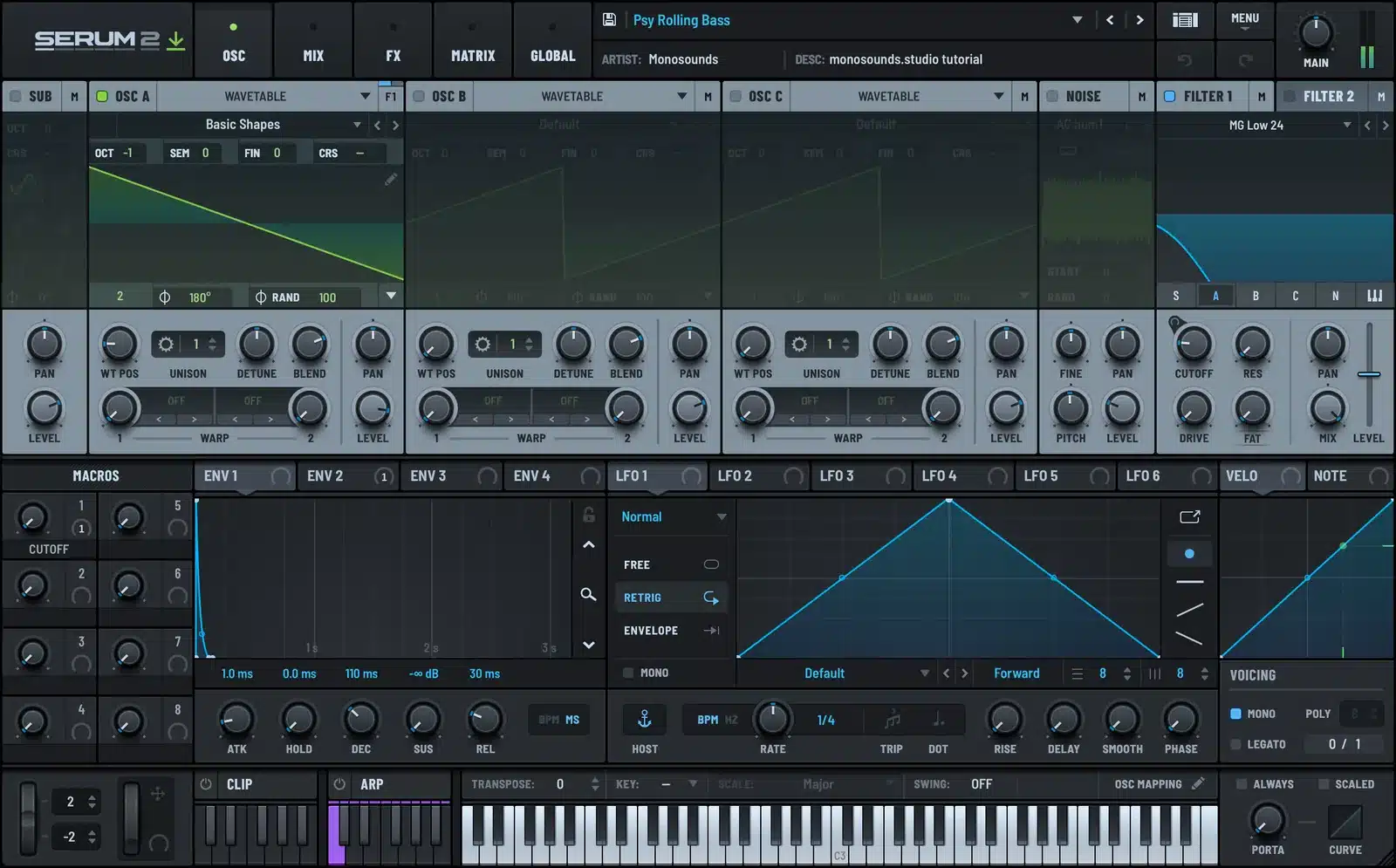
The filter does the talking
Drop in a 24 dB low-pass and drag the cutoff way down, 200–400 Hz or so. You want most of the saw’s buzz gone, leaving a round, woody thump with just a hint of edge up top.
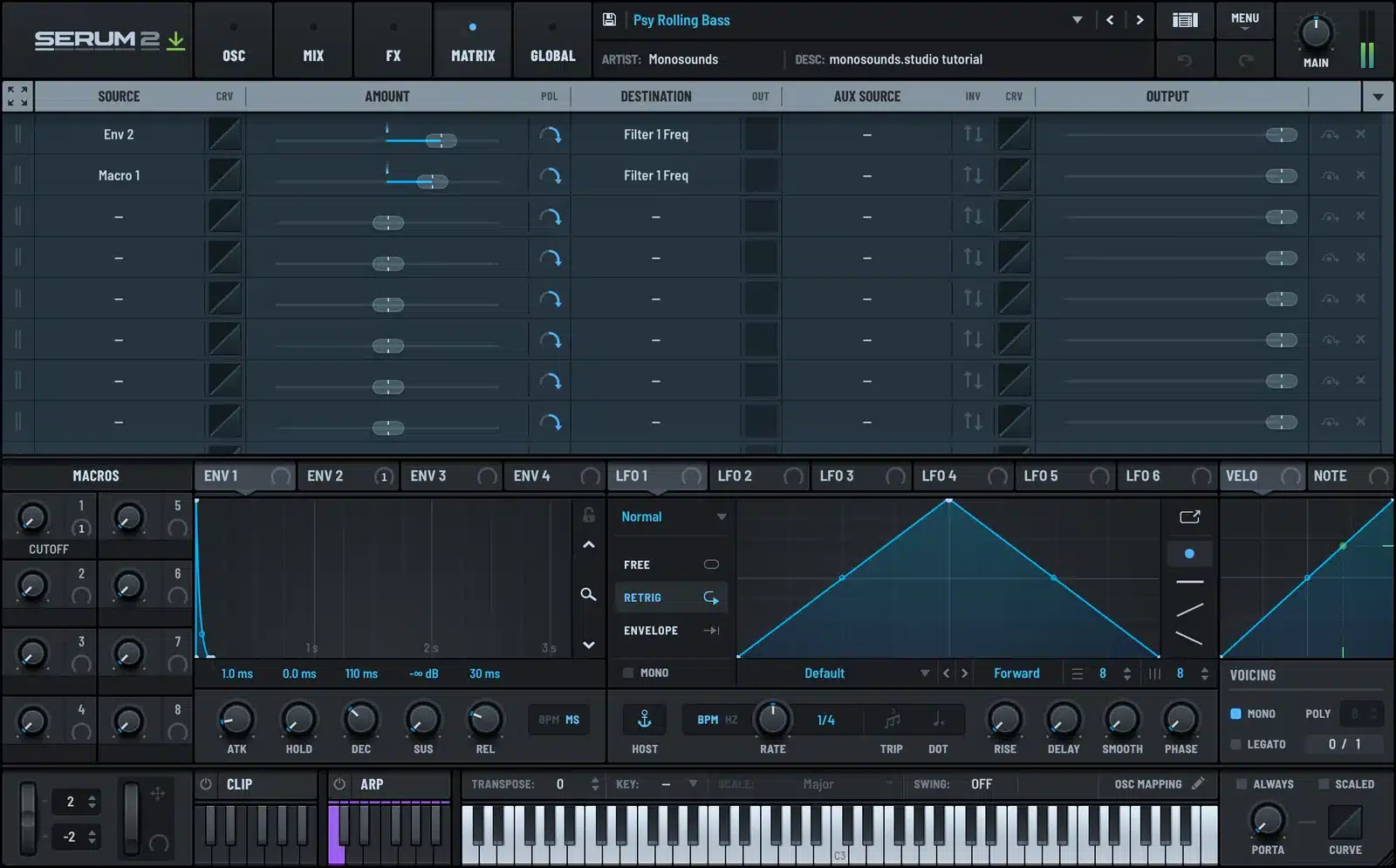
Next, route a filter envelope to cutoff: small amount, fast decay, roughly matching the amp envelope. Each note gets a tiny “wah” at its start, and that’s what makes the line roll rather than thud. Resonance stays low. A little gives bite; too much and the bass starts honking.
Here’s a check I never skip: sweep the cutoff with the loop running and park it where the bass keeps its attack but stops fighting the hi-hats. On my patches that spot sits lower than beginners guess.
Same DNA as a rolling techno bassline, by the way — just sped up. This one’s from our techno pack so you can hear the family resemblance.
Locking it to the kick
The pattern already keeps the kick and bass from stepping on each other, but two extra things weld them together.
Tuning first. A kick’s tail carries a pitch. Bass on F1? Then the kick tail needs to resolve to F as well. When the two disagree, the low end feels off and nobody in the room can explain why.
Then a light sidechain keyed from the kick: 2–3 dB of ducking, fast release. This isn’t the pumping EDM variety. Just enough of a dip on the first 16th to keep the kick’s transient clean.
Want a head start on basses like this? Pull apart our free Serum 2 techno presets; the envelope and filter moves are identical, only the tempo is slower.
Mistakes I see constantly
- Unison detune on the bass. Widens the low end, murders the punch. One voice, center.
- Any release above zero. At 145 BPM even 50 ms of release turns the roll to mud.
- Moving the bass note every bar. A psytrance riff sits on one root for 8 or 16 bars; the leads handle the movement.
- Heavy distortion. Some light saturation is fine, but the sub must stay clean or the whole thing falls apart on a big rig.
If this strict, pattern-driven way of working suits you, the acid bass approach is a near relative — the filter behaves differently, the discipline is the same. And the slower take on this exact groove lives in my techno in Serum 2 guide.
Once free patches stop cutting it and you want the full palette, the Serum 2 preset bundles are the best per-patch value in our shop: one purchase spans several genres rather than one.
FAQ
What note should a psytrance bass be?
E1 to A1, usually. Go below E1 and it turns flabby on most systems; above A1 it loses its weight. Choose your track’s root and don’t move.
Do I need sidechain if the bass avoids the downbeat?
Not strictly, the pattern carries most of the load. Still, 2–3 dB of gentle ducking tidies the kick transient and costs you nothing.
Why does my rolling bass sound uneven?
Nine times out of ten, envelope retrigger is off or your note lengths drift. Switch on mono retrigger, quantize hard, and make length and velocity identical on every note.
Saw or square for the oscillator?
Saw is the classic choice. A square sounds hollower and more hypnotic — try it, but keep the resonance in check because squares start honking sooner.
And that’s the entire recipe. One saw, one filter, one envelope, plus a pattern you leave alone. Save your creativity for the leads and the atmosphere; the bass only has to roll. Leads are where a deep library actually pays for itself, and that’s the half of my Serum 2 preset catalog I’d point a psytrance producer at first.

I run Monosounds.studio and make the packs myself. Ten-plus years of producing, 97+ releases, 16,000+ downloads. Every Serum 2 preset we ship passes a CPU check on a mid-range laptop and gets used in a real track before release. If it does not survive a mix, it does not go in the pack.
More about Maxim & the studio →

