Dub techno is really a single sound: a minor stab pushed through a bandpass filter, soaked in filtered delay and murky reverb, played so sparsely that the echoes handle the arrangement themselves. Basic Channel figured this out back in the 90s and nobody has meaningfully improved the recipe since.
One instance of Serum 2 covers the whole thing. Below: the patch, the effects chain, and the mistakes that show up most often.
Build the chord inside one oscillator
The idea is to play a single MIDI note and have the synth produce the chord. In Serum 2 you can stack an oscillator’s voices and spread them across intervals; pitch them into a minor shape: root, +3, +7, and I generally throw in +10 for the minor seventh. Prefer maximum simplicity? Use three oscillators tuned to root, +3 and +7.
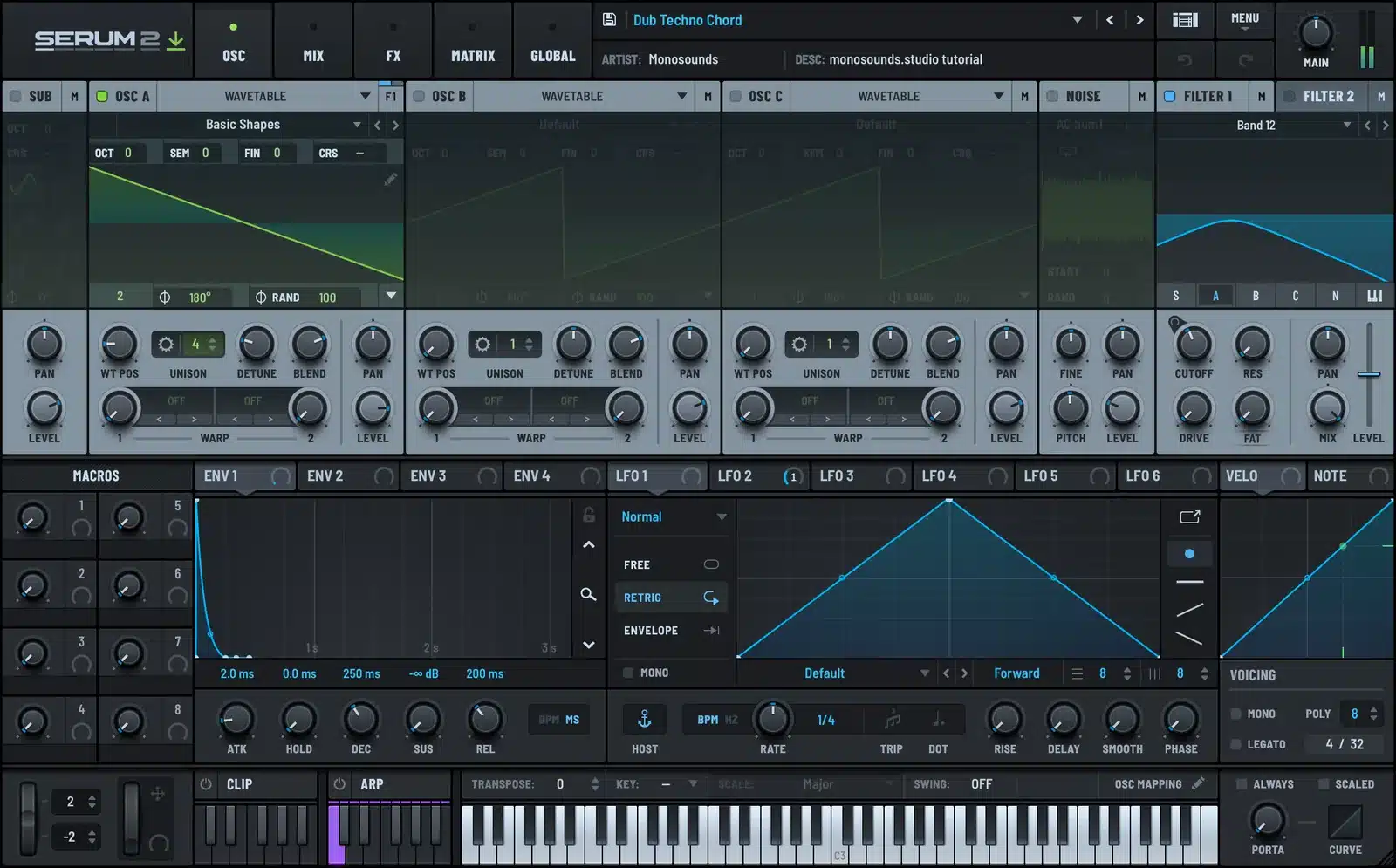
Why insist on one note? Because the entire genre moves by transposing that single note, which keeps every delay repeat in key. The moment you play actual chords, the feedback tail collapses into harmonic soup.
Keep the raw tone boring: a saw with the highs rolled away, only a whisper of detune. Character comes from the filter, never from the waveform.
The bandpass filter is the sound
Push the chord through a bandpass, cutoff parked somewhere in the 400 Hz to 1.5 kHz range. Give it a snappy filter envelope: fast attack, decay in the 150–400 ms zone, sustain at zero. Each stab should seem to duck away from you the instant it arrives.
Two details worth sweating:
- Resonance in moderation. Overdo it and you’ve accidentally written an acid line; underdo it and the stab loses its face.
- Nudge the cutoff a little on every hit; velocity or a random source works. Once each stab differs by a few percent, the loop quits sounding like a loop.
Delay: the feedback path is where the dub lives
The delay treatment IS the genre:
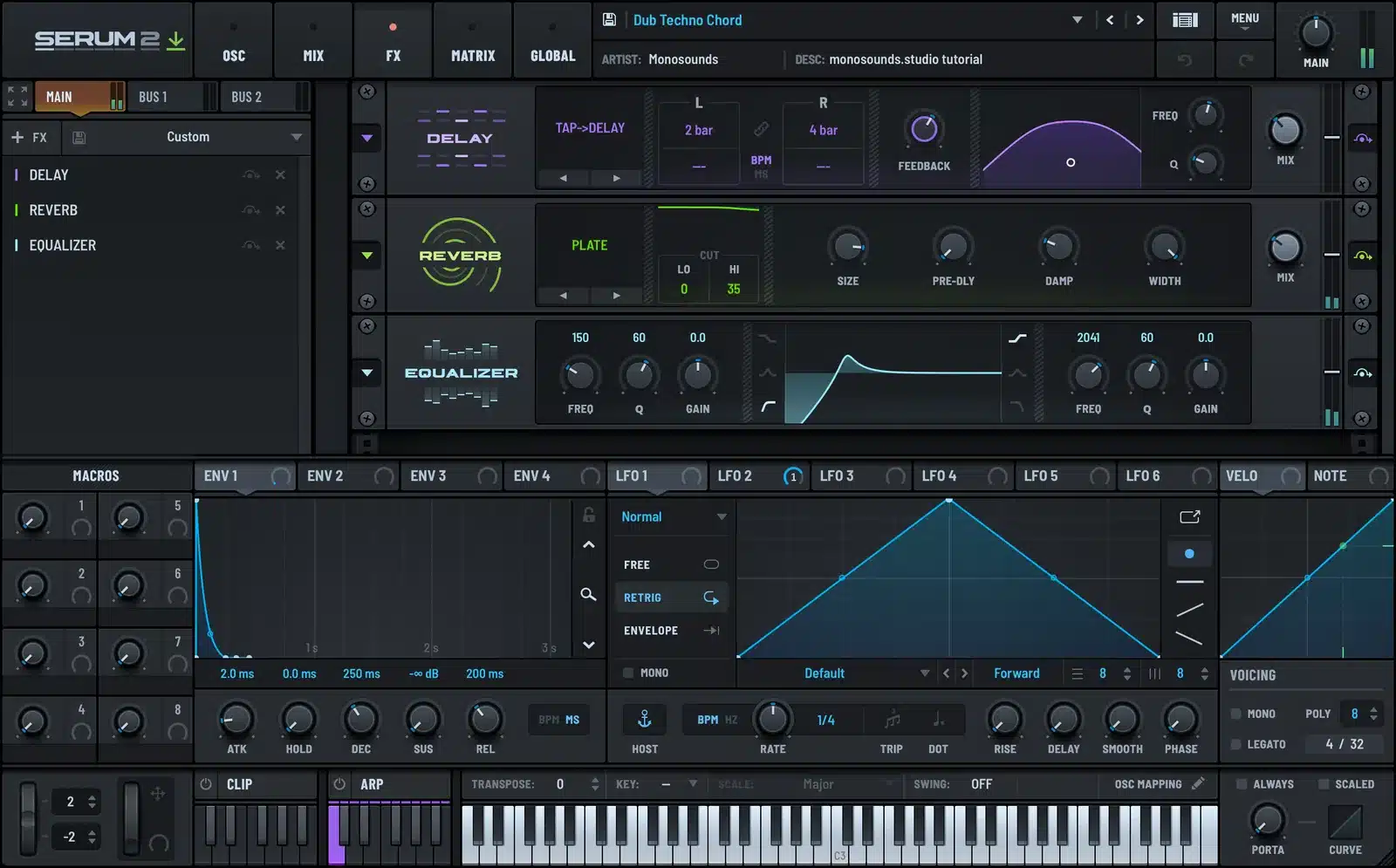
- Ping-pong at dotted-eighth time, feedback pushed high, 50–70%.
- A filter sitting inside the feedback path: lows trimmed around 300 Hz, highs around 4–5 kHz. Every repeat now returns darker and thinner than the one before.
That gradual darkening is the real dub sound. Skip the feedback filtering and all you’ve got is a loud echo; include it and each repeat backs further into the room. Watch out for delays that filter the wet output once rather than on every pass; the effect gets dramatically weaker, so check this before anything else.
Reverb: long, dark, behind everything
Go big on size, long on tail, modest on mix, and roll the highs off at the input so the tail reads as smoke rather than glass. What the reverb is there to do: melt the delay repeats into one unbroken atmosphere.
A small move that helps: gently duck the delay and reverb tails against the kick. The tail then breathes along with the four-on-the-floor and the mix stays legible, with nothing audibly pumping.
Drift makes it feel like hardware
The machines that made old dub techno couldn’t quite hold pitch, and that wobble is baked into the warmth. Two slow modulations fake it convincingly:
- An unsynced LFO near 0.1 Hz routed to fine tune, ±4–8 cents deep.
- A second slow LFO pushing the filter cutoff around by a few percent.
The free Serum 2 deep house presets contain chord and stab patches parked right next door to this territory. Download them, redirect the filter and delay, and most of the work is done.
Here’s that deep, chord-first language inside a full demo:
Arrangement: hit less than you want to
One stab per bar, maybe two, off the beat, with the repeats left to fill the room. Restraint turns out to be the hardest skill here — every single time I teach this patch, someone plays it like a piano and can’t figure out why it sounds crowded. For timing worth imitating, the deep house and dub-flavored patches throughout the full Serum 2 preset catalog are all written with exactly this sparseness.
Transitions? Ride the delay feedback upward until the thing nearly self-oscillates, then snap it back on the drop. That swell and release is the oldest build in dub techno, and it costs zero additional sounds.
This stab logic carries directly over into melodic techno when you want more energy, and the deep house guide handles the groove side. Should chords and stabs turn into your staple diet, the Serum 2 preset bundles beat buying genre packs one at a time.
FAQ
Why does my stab sound like trance?
Your detune is too wide and your filter too open. Tighten the unison, dull the source, and hand the microphone to the bandpass.
What delay time should I use?
Dotted-eighth, classically. When the groove feels too predictable, switch to 3/16; it tumbles against the kick in a satisfying way.
Do I need analog gear for this sound?
Not at all. Filtered feedback and slow pitch drift are where the character comes from, and Serum 2 programs both without breaking a sweat.
One note or real chords?
One note, moved around. Since the chord is built into the oscillator, the echoes hold their key wherever you transpose.
Twenty minutes to finish this patch, two hours of playing it afterwards. Get the delay right, strike the stab less often than your fingers want to, and the room takes care of everything else.
I run Monosounds.studio and make the packs myself. Ten-plus years of producing, 97+ releases, 16,000+ downloads. Every Serum 2 preset we ship passes a CPU check on a mid-range laptop and gets used in a real track before release. If it does not survive a mix, it does not go in the pack.
More about Maxim & the studio →

