Synth brass slices through a mix for exactly the reason real brass does: nearly all of its energy lives in the midrange, precisely where every speaker system is loudest. Design the patch with that fact at the center and it holds up. Treat it like a lead with a few extra saws and it’s gone the second the drums arrive.
Below is the Serum 2 recipe, including the single detail that makes a patch read as brass: the pitch blip on the attack.
What makes brass sound like brass
Three things, ranked by importance:
- A pitch overshoot at the front of every note. A trumpet player’s lips need a few dozen milliseconds to settle on the pitch, scooping up into it. That flaw is exactly what your ear uses to recognize the instrument.
- A filter that opens while the note unfolds. More air from the player means brighter brass.
- A tone weighted toward the mids with only modest low end. There’s surprisingly little bass in real brass.
Skip the first item and no pile of saws will rescue the patch. So that’s what gets built first.
The core patch
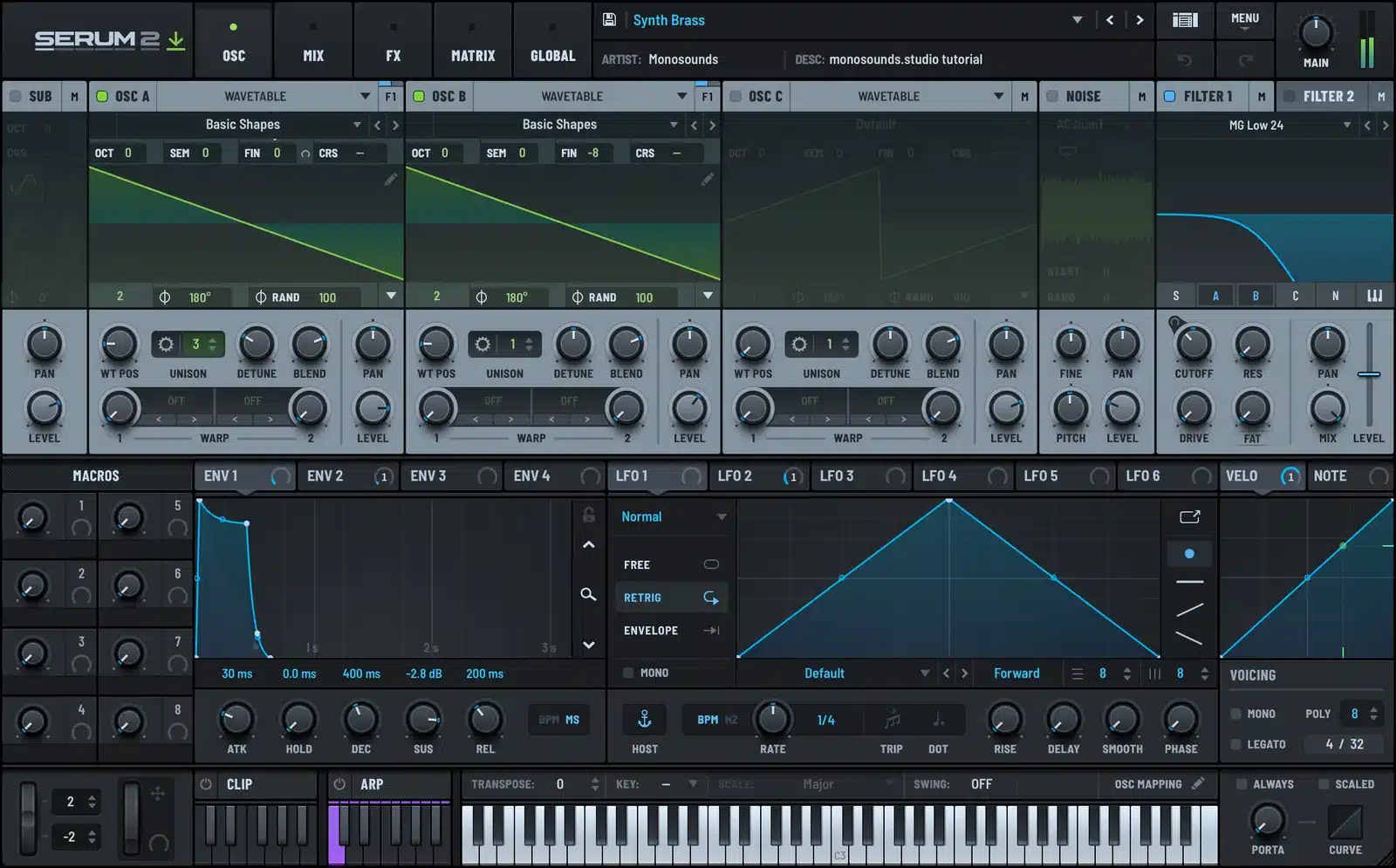
- Oscillator A: saw. Oscillator B: square at the same octave, sitting a few dB quieter. The square hollows out the saw a touch, landing closer to a brass bore than either wave manages alone.
- Unison: 2–3 voices with a small detune. You’re building a brass section, not a supersaw. Nothing kills brass character faster than heavy detune.
- The attack blip: route an envelope to master pitch at roughly -30 to -60 cents, decay 40–80 ms, sustain at zero. Every note begins a hair flat and scoops up to pitch. It barely registers as pitch to the ear; it registers as “brass”.
- Filter: lowpass with an envelope that opens across 50–150 ms. Snap it open for stabs, slow it down for swells.
- Amp envelope: attack near zero, sustain at full, release short at 100–200 ms.
Run the blip in both directions and compare. The scoop from below is the classic trumpet gesture; overshooting from above reads more like a trombone fall played backwards. Roughly 50 ms either way is the sweet spot; beyond 100 ms it quits being a transient and turns into a portamento effect.
Stabs vs sustained sections
Two different patches, one shared core.
Stabs: pull the amp decay in, drop sustain near 70 percent, snap the filter envelope, and play tight chords. That’s funk, French house filter-disco land, and any drop that wants a hit with some attitude. Velocity into filter cutoff is non-negotiable here; accents are what brass stabs live and die on.
Sustained sections: sustain at full, filter slowed down, plus a delayed vibrato: a small-amount LFO on pitch given its own 300–500 ms attack, so the wobble fades in once the note has landed. No real player opens a note with vibrato. That delay is exactly what sells it as human.
Here’s a big mid-forward stack from our Brass pack, sitting on this same saw-plus-square skeleton.
EQ: win the midrange, surrender the rest
The 800 Hz to 2 kHz zone is where brass earns its place in the mix. Concrete moves:
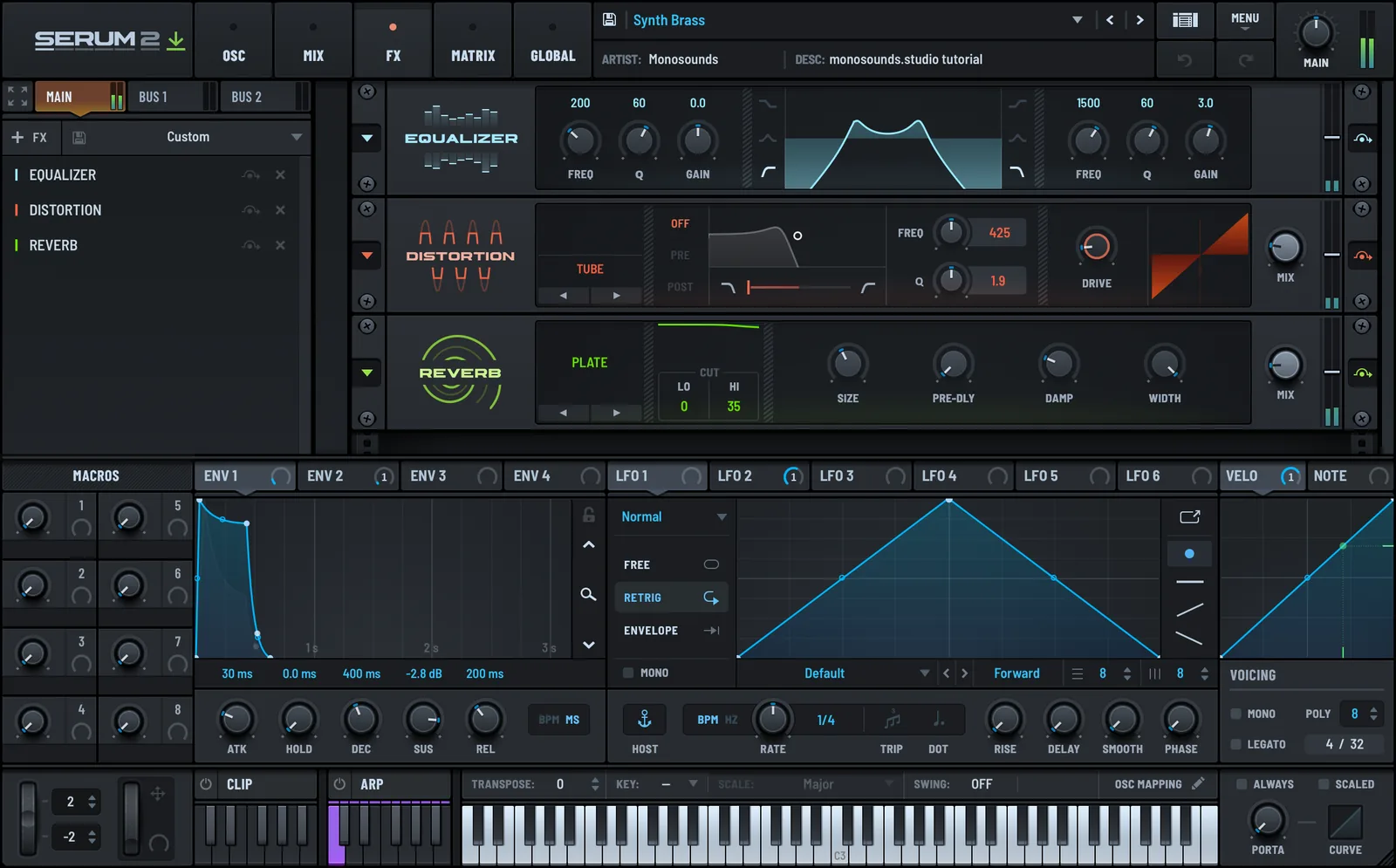
- Highpass at 100–150 Hz. Whatever low end you just deleted was picking a fight with your bass and contributing nothing.
- Honky? Take a narrow cut around 500–700 Hz. Buried? A wide boost around 1–1.5 kHz beats reaching for the fader.
- A gentle shelf down above 8 kHz stops saw fizz from screaming “cheap preset”.
One mixing habit worth adopting: brass and vocals crave the same frequencies. When the track carries a topline, write the brass into the gaps, answering phrases rather than padding underneath. People try to EQ their way out of what is really an arrangement problem.
Light saturation or a tube-style drive after the filter also does more than adding oscillators ever will. Real brass compresses and distorts the air it moves; a bit of harmonic grit reads as power rather than damage.
Prefer dissecting to building? The free Serum 2 presets download hands you working patches to open beside this article and check envelope times against.
Where synth brass works in 2026
Let’s be honest about scope: this patch handles synthwave hits, funk stabs, future rave hooks and big-room brass far better than it handles ballad trumpet solos. Solo realism demands phrasing, breath and articulation switching, and that’s sample-library territory. Section energy is where synthesis actually wins, and it automates beautifully: ride the filter, lean the drive into the final chorus.
When a single brass patch snowballs into wanting entire genre libraries, the Serum 2 preset bundles carry our best per-preset price, which is honestly the whole case for them.
Related reading: the supersaw guide is this patch’s maximalist cousin, and the effects guide digs further into the drive and EQ moves used here.
FAQ
What makes a synth patch sound like brass?
The attack pitch scoop — roughly -30 to -60 cents recovering across 40–80 ms — combined with a filter that opens as the note develops.
Saw or square for brass?
Both at once: the saw carries the body, the square sits a few dB below it for hollowness. Unison stays small at 2–3 voices.
Why do my brass stabs vanish in the mix?
The energy is in the wrong octave. Highpass at 100–150 Hz, add a wide boost near 1–1.5 kHz, and make sure the part isn’t sitting on top of the vocal.
How do I add vibrato that sounds real?
Pitch LFO with a 300–500 ms fade-in, so the vibrato shows up only after the note settles. Vibrato from the very first millisecond is the giveaway.
Blip, filter, midrange. Nail those three and a two-oscillator patch will cut harder than half the sample libraries on your drive. Rather begin from something finished? There’s a dedicated brass pack waiting in the full Serum 2 preset catalog next to everything else I’ve made.
I run Monosounds.studio and make the packs myself. Ten-plus years of producing, 97+ releases, 16,000+ downloads. Every Serum 2 preset we ship passes a CPU check on a mid-range laptop and gets used in a real track before release. If it does not survive a mix, it does not go in the pack.
More about Maxim & the studio →

