A convincing plucked-string sound is absolutely available in Serum 2, solid enough for hooks, lo-fi beats and pop toplines. A convincing strummed acoustic guitar is not, and I’ll tell you exactly when to give up and reach for a sample instead.
Both answers matter, so here they are without the sugar-coating.
Why plucks work and strums don’t
One plucked string is a flash of bright harmonics decaying quickly into something mellow. A synth handles that with ease, because it’s really an envelope problem. A strum, though, is six strings landing slightly apart in time, plus pick noise, fret buzz and body resonance. That’s a physics problem, and a wavetable synth can’t win it.
So point your efforts at single-note lines, arpeggios and melodic hooks. Synth guitar lives there.
The basic pluck patch
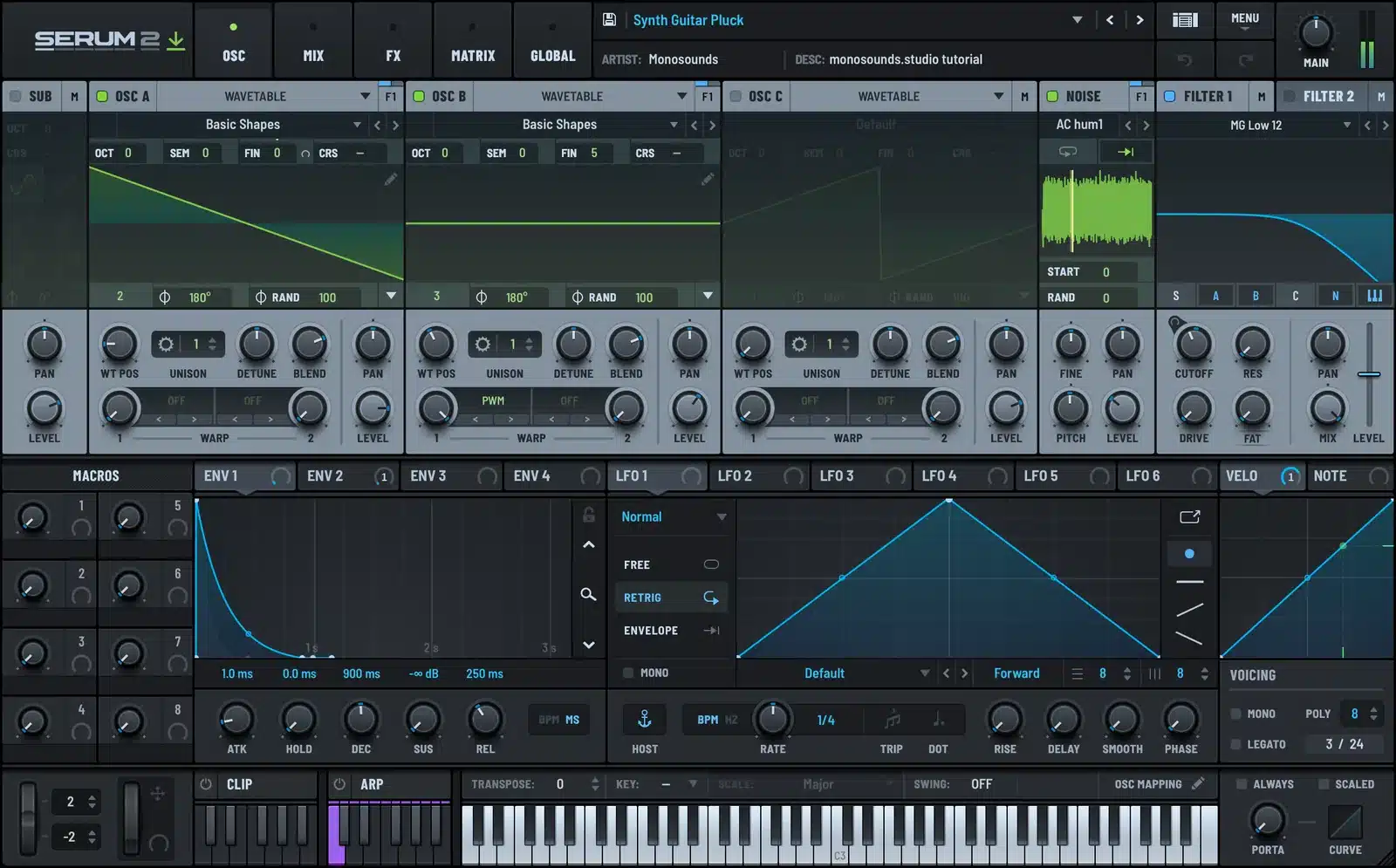
- Init a patch and choose a wavetable with reasonable harmonic content; a saw is fine to begin with.
- Unison off. Single voice. A guitar string is no supersaw, and detune is the quickest route to sounding synthetic here.
- Amp envelope: zero attack, decay in the 400–800 ms range, sustain at zero, release short.
- Lowpass filter with its own envelope: quick attack, decay around 150–300 ms, giving you a note that opens bright and darkens fast. That bright-to-dark motion is what a pluck is.
- Switch on filter keytracking so the high notes keep their brightness, the way a real string does.
Filter envelope decay doubles as your string selector. Around 150 ms of decay reads as a muted electric. Stretch it to 400 ms and beyond and it leans nylon-ish. Most of the range hides behind that one knob.
Three details that sell it
- The pick transient. Real notes begin with a click. Add a tiny pitch envelope: +2 to +5 semitones dropping to zero within 10–20 ms. Your ear registers it as attack rather than pitch. No single change upgrades a synth pluck more.
- Round-robin variation. No player ever strikes two identical notes. Send a touch of randomness to filter cutoff and level on each note, only a few percent. Perfectly repeated notes are what scream “MIDI”.
- Chorus, but gently. Low mix, slow rate, and you get the double-tracked sheen of a produced guitar part. Overdo it and you’ve wandered into 80s synth territory, which is a fine destination, just a different article.
Want distorted lead tones? Put distortion in the FX chain and high-pass everything below 150 Hz ahead of it, because distorted low end is just mud making more mud. Here’s a Serum-built distorted electric lead from our BUMPY pack, so you can judge how far the synth route actually reaches.
Muted low plucks: the useful workhorse
The most-used “guitar” patch in my template isn’t a lead at all. It’s a muted low pluck: identical recipe, filter decay tightened to 100–150 ms, played in the C2–C3 zone, a hint of saturation. In pop, afro house and lo-fi it does duty as a tight bass-adjacent layer, and since it sits in the background handling rhythm, nobody ever stops to ask if it’s a real guitar.
Put Serum’s delay behind it, dotted-eighth time at low mix, and a single pluck line starts to feel like an arrangement. For ready-made plucks to measure against, the free Serum 2 presets download includes pluck patches you can open and dissect right next to your own attempt.
When to just use a sample
The honest tradeoff: any part needing strums, chords, slides, hammer-ons or genuinely human phrasing goes to a recorded loop, and the margin is huge. Making synth presets is literally my job, and I still grab guitar loops whenever a track calls for an actual guitarist’s feel.
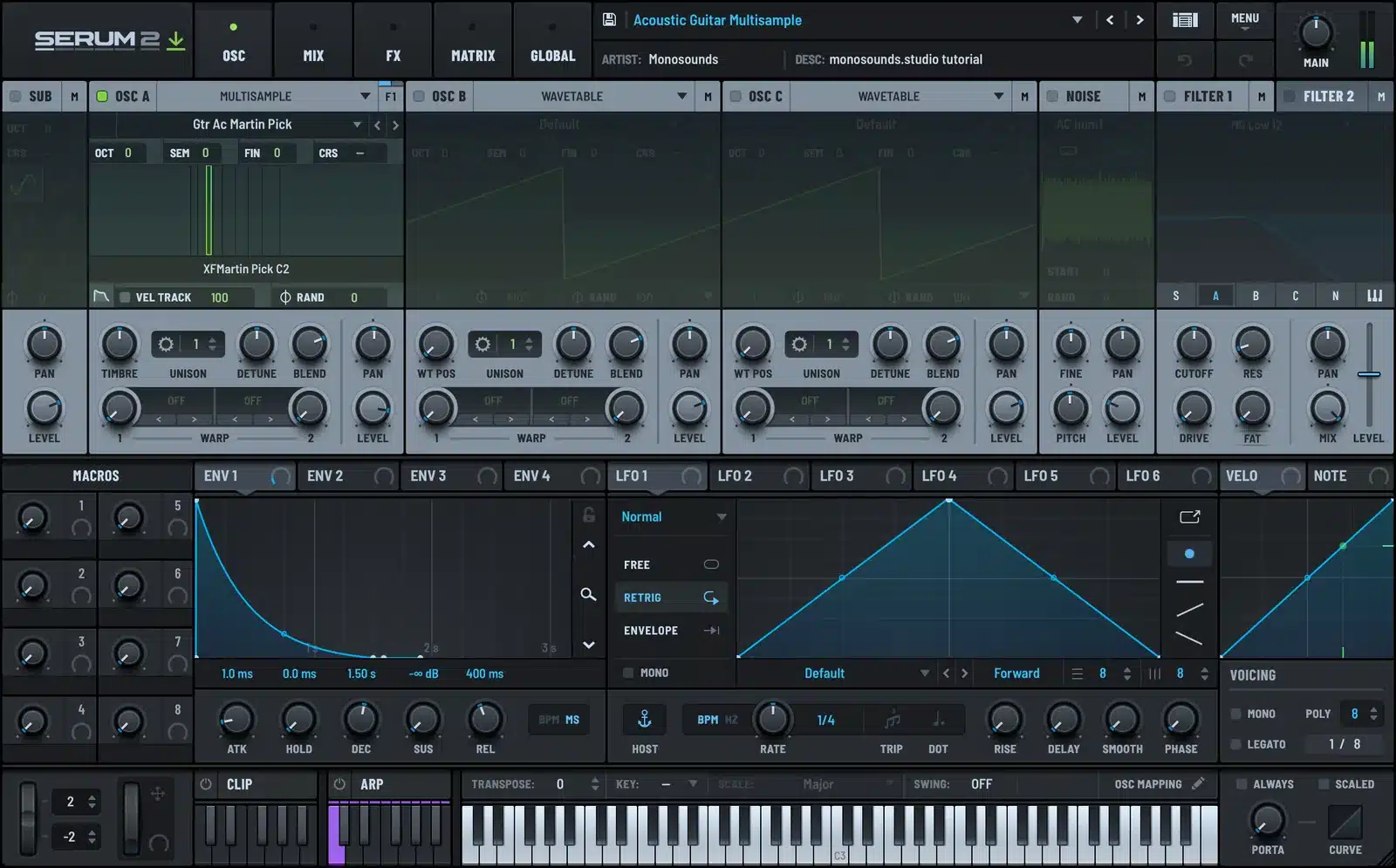
Serum 2 has an angle here too: load a one-shot guitar note into its sample oscillator and you get authentic pick texture with synth envelopes and filters layered on top. That hybrid approach, sampled attack plus synthetic sustain, is how plenty of modern “guitar” presets are really assembled. Several pluck patches across the whole Serum 2 catalog are constructed exactly that way, if you feel like opening one up.
For complete phrases though, recordings win. Here’s what a played phrase delivers that no synthesis can.
Where this fits in a track
A synth pluck belongs either right up front carrying the hook, or way in the back as texture soaked in delay. The middle distance is the danger zone, where the ear gets time to inspect it. Lo-fi and chillhop forgive synth guitar more than most genres, because the lo-fi treatment, tape wobble, bitcrush and filtering, hides precisely the artifacts that expose synthesis. Every lo-fi tutorial ending on a filtered pluck is no coincidence.
If plucks end up in several of your genres, the Serum 2 preset bundles gather our packs at the lowest per-preset price, which beats collecting them individually. That’s the entire pitch.
Related reading: vocal chops in Serum 2 runs on the same sample-oscillator hybrid concept, and the lo-fi Serum 2 tutorial demonstrates the processing that lets synth plucks pass for guitars.
FAQ
Can Serum 2 sound like a real guitar?
Single plucked notes and muted lines: yes, convincingly so. Strummed chords and human phrasing: no, go with a recorded loop or the sample oscillator.
What envelope settings for a guitar pluck?
Amp: attack at zero, 400–800 ms decay, sustain at zero. Filter: fast attack with 150–300 ms decay, so the ringing note grows darker.
Why does my synth guitar sound fake?
Three usual suspects: unison detune still engaged, no pick transient, and identical notes every time. One voice, a 10–20 ms pitch blip, and small per-note randomness cure most of it.
Should I use chorus on guitar patches?
Yes, kept to low mix and a slow rate, where it imitates double-tracking. Heavy chorus pushes the sound from “guitar” over to “synth”, which might be what you want and might not.
Master the pluck recipe, accept the strum limit, and both worlds are yours: synth parts you can reshape forever, and samples for the moments that demand real fingers on real strings.

I run Monosounds.studio and make the packs myself. Ten-plus years of producing, 97+ releases, 16,000+ downloads. Every Serum 2 preset we ship passes a CPU check on a mid-range laptop and gets used in a real track before release. If it does not survive a mix, it does not go in the pack.
More about Maxim & the studio →

