No acoustic-adjacent instrument is easier to synthesize than an organ, and there’s a reason: a tonewheel organ already was a synthesizer. A pile of sine waves at fixed harmonics, balanced with drawbars. Serum 2 can rebuild that in a few minutes.
Below: how drawbar thinking maps onto the synth, how to fake a rotary speaker, and the two organ sounds dance music genuinely runs on, the house organ bass and the church-style pad.
Think in drawbars
A Hammond drawbar is nothing more than a volume slider for a single harmonic. The essential three: 16′ sitting an octave under the note, 8′ at the note itself, 4′ an octave above. In between you find the quint at 5 1/3′, an overtone related to the fifth, plus higher drawbars for sparkle.
Serum 2 lets you rebuild that quite literally: sine wavetables on both oscillators and the sub oscillator, spread over octaves. Or take the wavetable route instead: plenty of stock tables are arranged so the early frames sit close to a sine and later frames pile on harmonics. Sweeping wavetable position then works like pulling drawbars out. One knob, the entire harmonic palette.
A basic full organ
- Oscillator A: a sine at the played pitch. This is your 8′.
- Sub oscillator: sine an octave below, a touch quieter. That’s the 16′.
- Oscillator B: sine an octave above, quieter still, playing the 4′.
- Amp envelope: attack at zero, sustain at full, release near zero. An organ is a switch, not a piano. Notes are either on or off.
- No velocity on volume. Real tonewheel organs don’t care how hard you press, and adding velocity here immediately drains the organ character.
That last item is the one everybody misses. Flat dynamics feel wrong to the person programming and right to the person listening. Want expression? Put it into rotary speed and drive, never into key velocity.
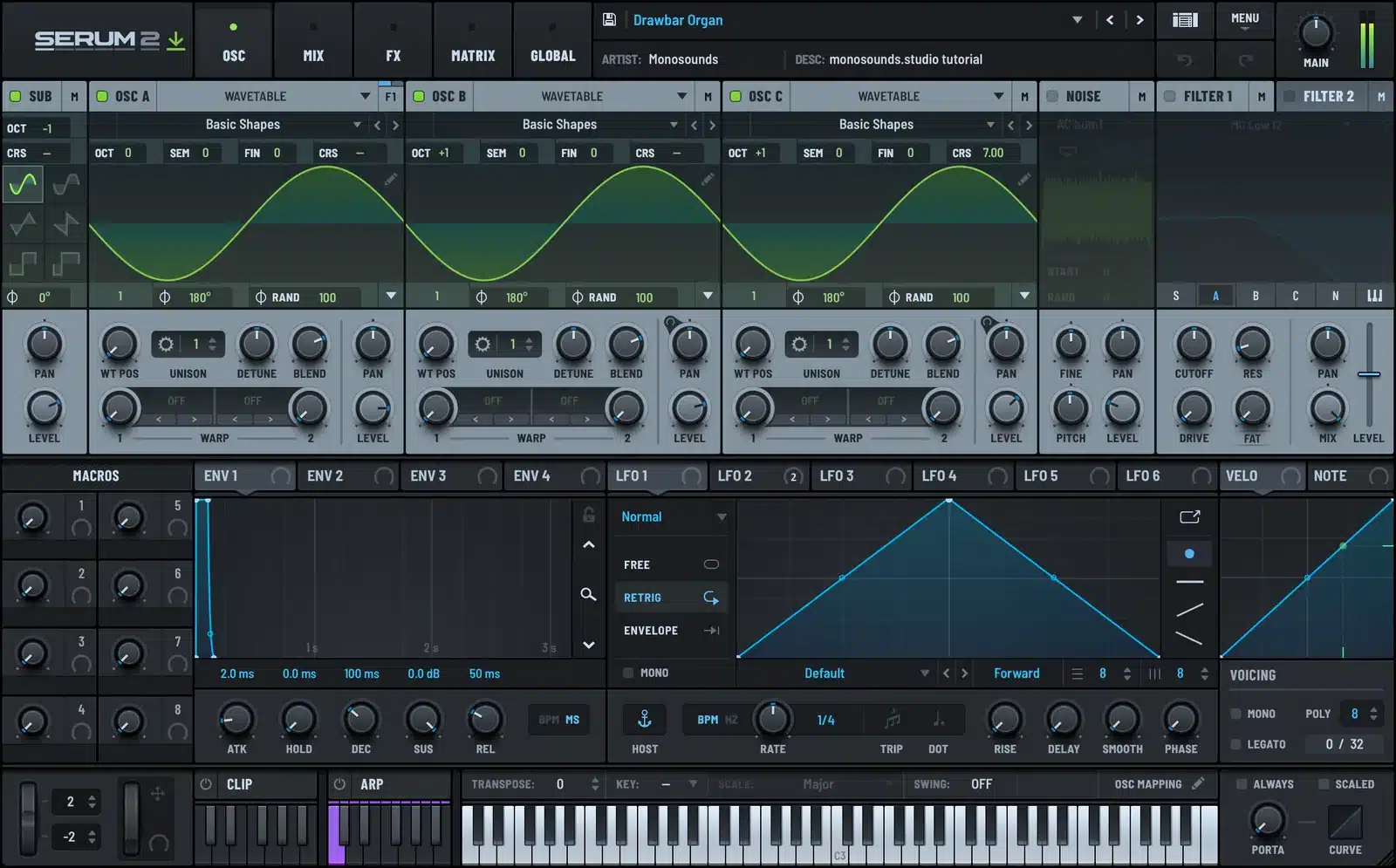
For that hollow, churchy color, replace the 4′ sine with a square one octave up. Squares carry only odd harmonics, which is a large part of the woody pipe flavor.
Faking the rotary speaker
Half of what gets called “organ sound” is really a Leslie cabinet: a speaker rotating inside a box, throwing vibrato and tremolo in every direction. Here’s the Serum 2 imitation:
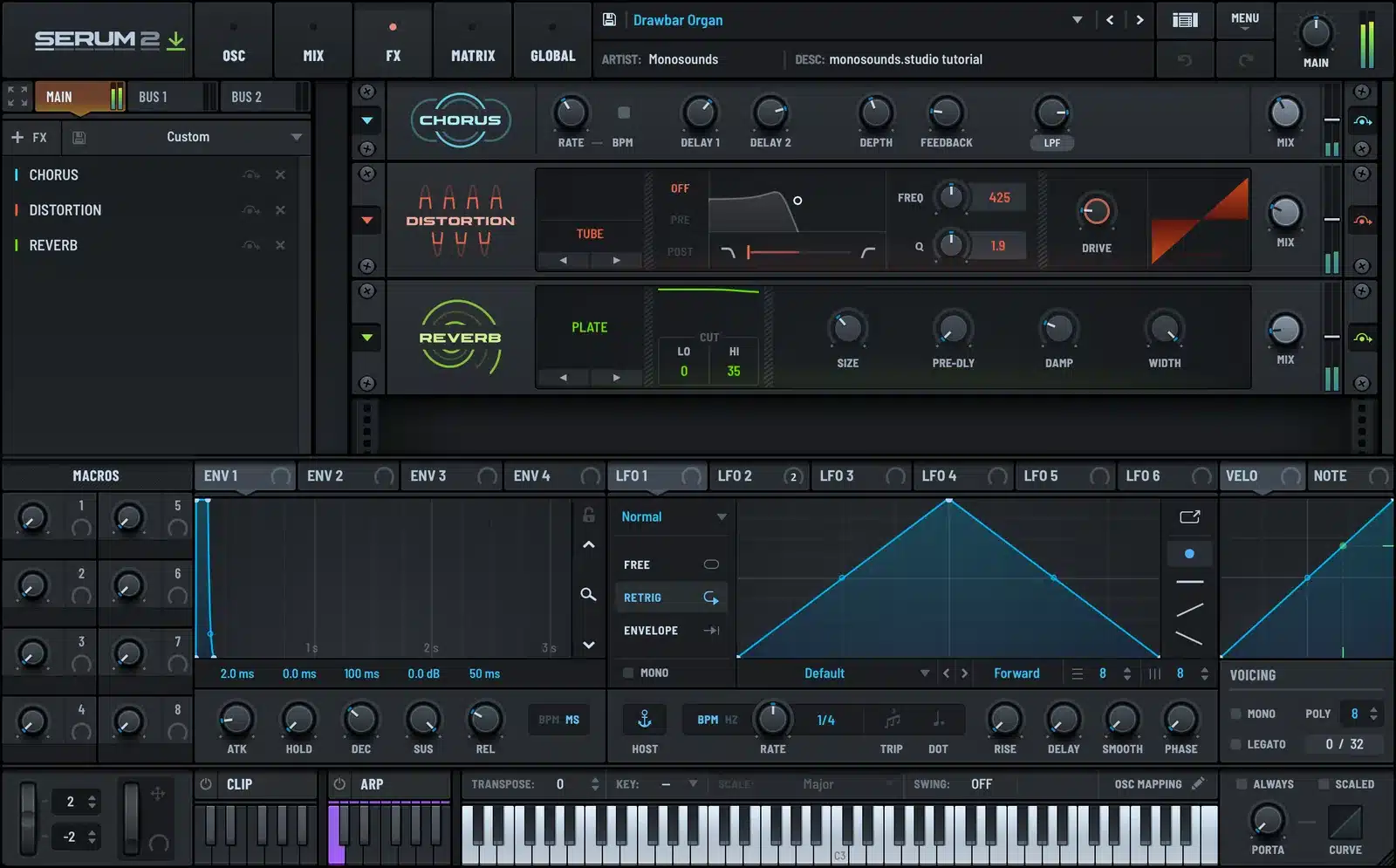
- Chorus at a slow rate for the underlying swirl.
- An LFO contributing a little pan movement plus a hint of pitch wobble.
- One macro that accelerates all of it together, because that slow-to-fast ramp when an organist kicks the Leslie into high gear is the single most expressive gesture the instrument owns.
Put chorus rate, LFO rate and a touch of drive on one macro and ride it while you record. An organist won’t be fooled. Everyone else will be.
Softer keys patches lean on the same sine-stack idea with gentler envelopes. Here’s an example from our free keys pack.
The house organ bass
This is 90s house in one sound, and half of piano house ever since: a percussive organ bass out of the M1-stab lineage. It’s built completely differently from the church patch:
- A sine plus a square one octave higher, with the square tucked low in the mix.
- Amp envelope: zero attack, decay somewhere around 200–400 ms, sustain low. Percussive, never held.
- The click: a tiny filter envelope that pops the cutoff open for the first 10–20 ms. That key-click transient is what gives an organ bass its bounce.
- Play staccato, hit the off-beats, and you’re in classic house bassline territory.
The click outranks the tone. Tonewheel organs made that noise as a defect, and house music promoted the defect into the groove. Take it away and the bassline turns into a limp sub; leave it in and the exact same notes start pumping.
If you’d rather begin with finished patches in this zone, download the free Serum 2 house presets, open the envelopes, and check them against the recipe above.
An organ bass rarely works alone. Its classic partner is piano-house chords over a bouncing bassline, which is essentially an entire genre inside one loop.
Church pads and the big sustained sound
For the cathedral treatment: spread the sine octaves wider, bring in the quint (a sine a twelfth over the root, mixed quietly), ease the attack out to 50–100 ms, and hang a long, large reverb after the whole thing. The quint is the trick. That fifth-flavored overtone is the difference between “a few sines” and “pipe organ”, and hardly anyone bothers with it. Prefer borrowing to building? The house and melodic packs inside our Serum 2 presets by genre are where the organ-leaning patches hide.
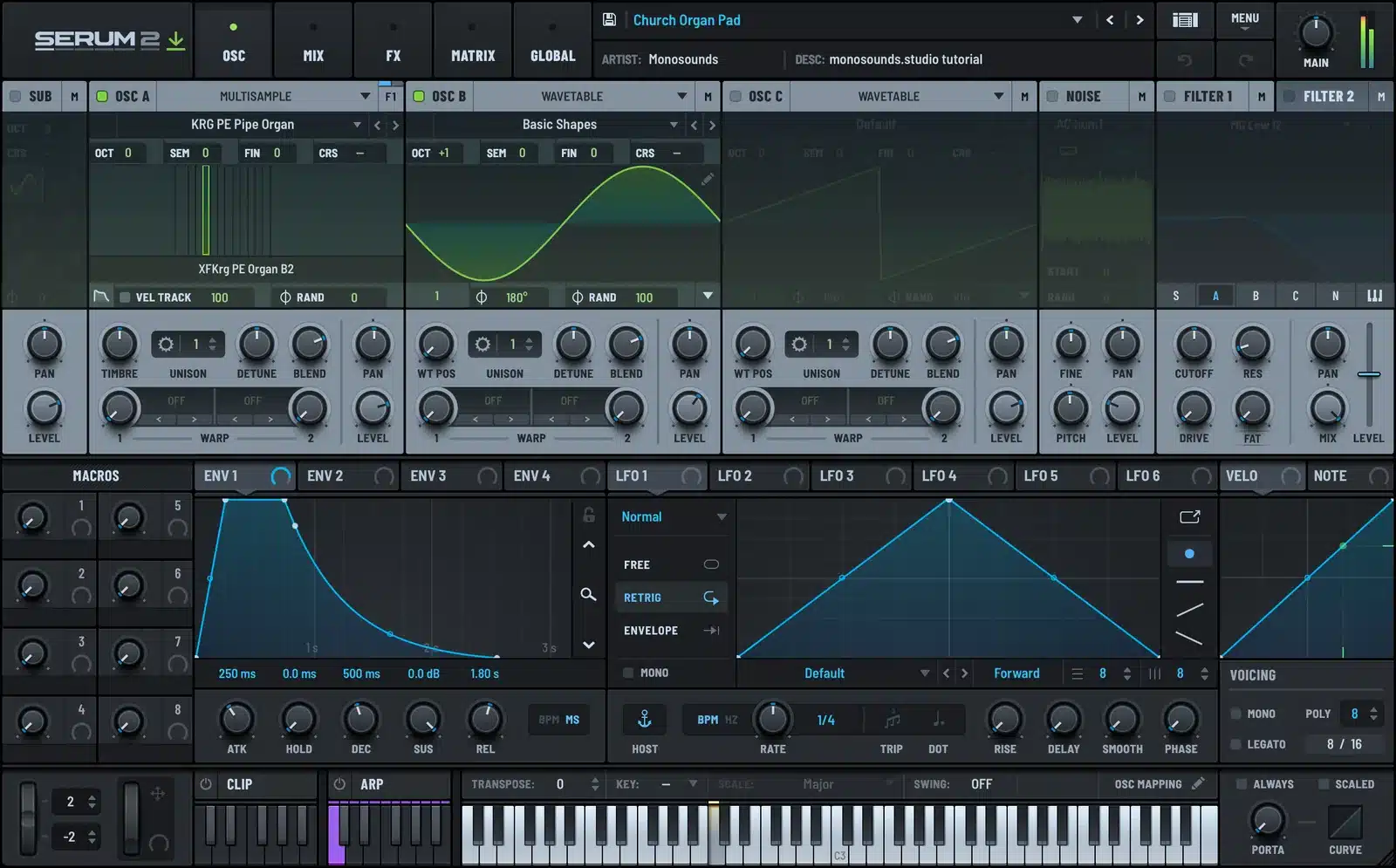
Pads like these fit melodic house breakdowns, gospel-tinted pop, and any spot where you’d normally grab choir samples. In a crowded mix, keep them highpassed around 100 Hz; those low octaves swallow space quickly.
And if organ patches become a habit across house, melodic techno and keys work, the Serum 2 preset bundles hand you our complete genre libraries at the best per-preset math. No pressure though, the free packs honestly cover the start.
Related reading: the full house in Serum 2 guide drops these basses into real arrangements, and pads and atmospheres carries on with the sustained-sound side of things.
FAQ
How do I make an organ sound in Serum 2?
Stack sines in octaves (sub, root, octave above), give it a zero-attack full-sustain envelope, map no velocity, and add chorus for the rotary swirl.
What makes a house organ bass punchy?
The key click, meaning a filter envelope that snaps open for the first 10–20 ms, paired with a short percussive amp decay around 200–400 ms.
Why does my organ patch sound like a cheap keyboard?
Nearly always velocity routed to volume plus a slow release. Real organs play at flat dynamics and cut off dead the instant the key comes up.
What is the quint drawbar and do I need it?
An overtone related to the fifth, sitting above the root. It supplies the recognizable growl in jazzy or church tones; clean house basses can go without it.
Octave sines, a click up front, swirl over the top. The organ has been a synthesizer since 1935, so this isn’t really imitation. It’s a family reunion.
I run Monosounds.studio and make the packs myself. Ten-plus years of producing, 97+ releases, 16,000+ downloads. Every Serum 2 preset we ship passes a CPU check on a mid-range laptop and gets used in a real track before release. If it does not survive a mix, it does not go in the pack.
More about Maxim & the studio →

