Synth strings don’t imitate an orchestra. They’re an instrument in their own right, the sound every string machine has made since the 70s, and they show up across disco, synthwave, melodic techno and today’s cinematic scores. Serum 2 handles them well for a simple reason: at heart they’re saws, detune and patience.
What follows is the ensemble recipe, the one EQ move that solves the harshness everybody battles, and the way I run these patches in melodic techno.
Why saws sound like strings
Bow a string and you get a bright, buzzy spectrum with every harmonic in it. A saw wave gives you the same thing. That’s the entire trick. A single saw reads as a synth; a violin section is dozens of players, each slightly off in tune and timing. Rebuild that spread and the ear hears “ensemble”.
Which means the patch really comes down to three flavors of blur: detune blur, time blur (slow attack), and space blur (chorus plus reverb).
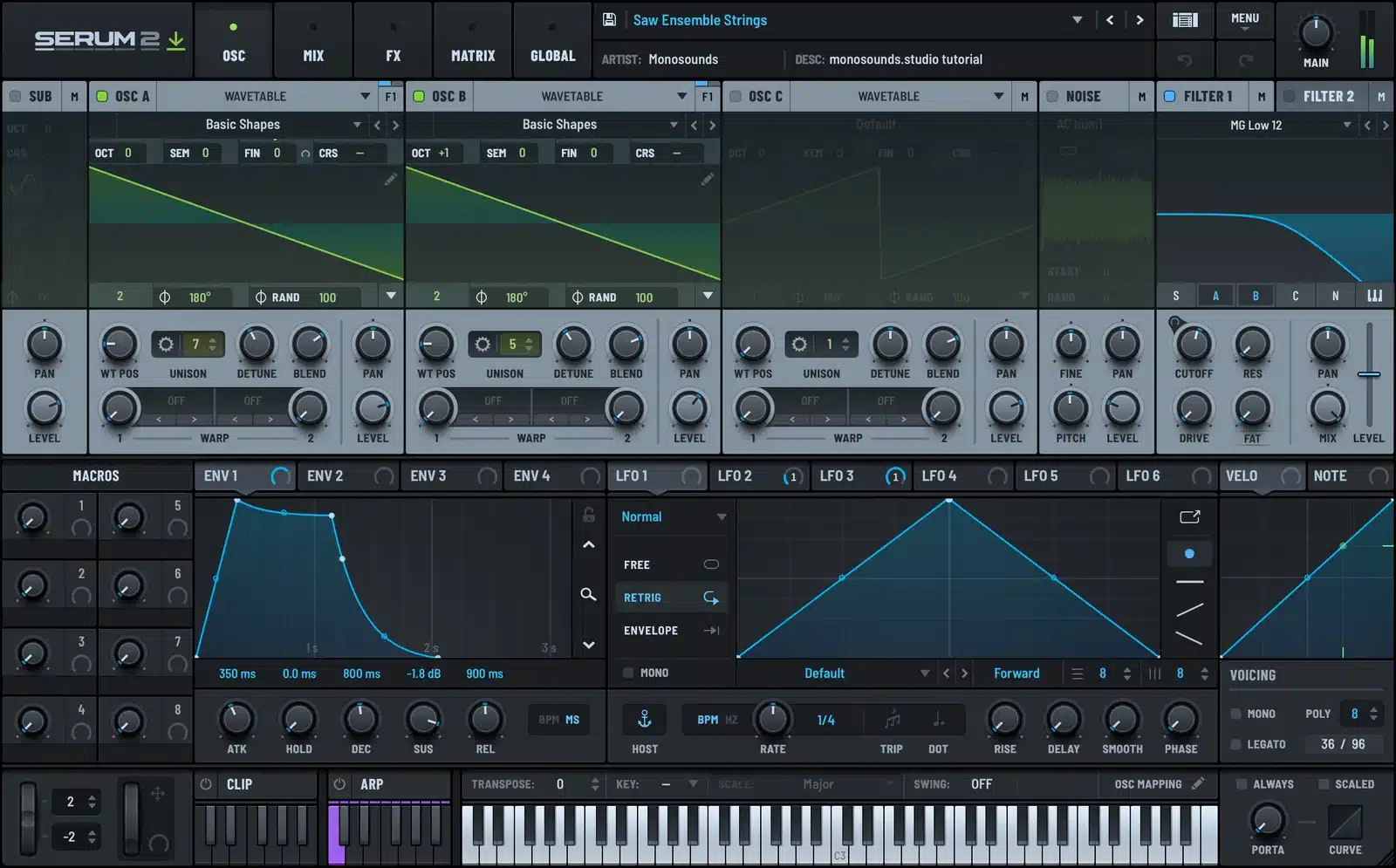
The ensemble patch
- Oscillator A: saw, unison 5–7 voices, moderate detune. The target is lush shimmer, not trance supersaw. If it starts sounding like a rave lead, pull the detune back.
- Oscillator B: a second saw an octave down, unison 3–4, at a lower level. Think of it as your cello and viola section.
- Amp envelope: attack 200–800 ms, sustain full, release anywhere from 500 ms to 1.5 s. Notes ought to overlap and blur into each other the way real bowing does.
- Lowpass filter somewhere around 6–10 kHz, purely to trim the fizz off the top.
- An ensemble-style chorus in the FX chain, wide and slow. Forty years of string-machine history live inside that single effect.
Two envelope details worth caring about. One: set the attack by feel relative to tempo, since fast stabby parts want 200 ms or the notes land late, while slow pads happily take a whole second. Two: the “wall” effect comes from long release combined with long attack, every chord blooming up out of the previous chord’s tail.
The 3 kHz problem
Stacks of detuned saws dump energy into the 2–4 kHz zone, which happens to be where hearing is most sensitive. Soloed, the patch impresses. Inside a mix it goes harsh and tiring, and beginners respond by pulling the strings down until they disappear entirely.
The actual fix: a wide EQ dip of 2–4 dB centered near 3 kHz, in Serum’s own EQ or on the channel, either works. Solo it’ll sound a touch dull, in context it sits perfectly. Nearly every string and supersaw patch we ship gets this treatment, and it’s the least glamorous, most dependable trick in the whole piece.
Since you’re in the EQ anyway: highpass the strings around 150–200 Hz any time there’s a bassline in the track. That octave-down oscillator exists to add weight in the breakdown, not to wrestle your sub.
Movement: the difference between strings and a drone
String chords that sit still become wallpaper quickly. Cheap ways of keeping them breathing:
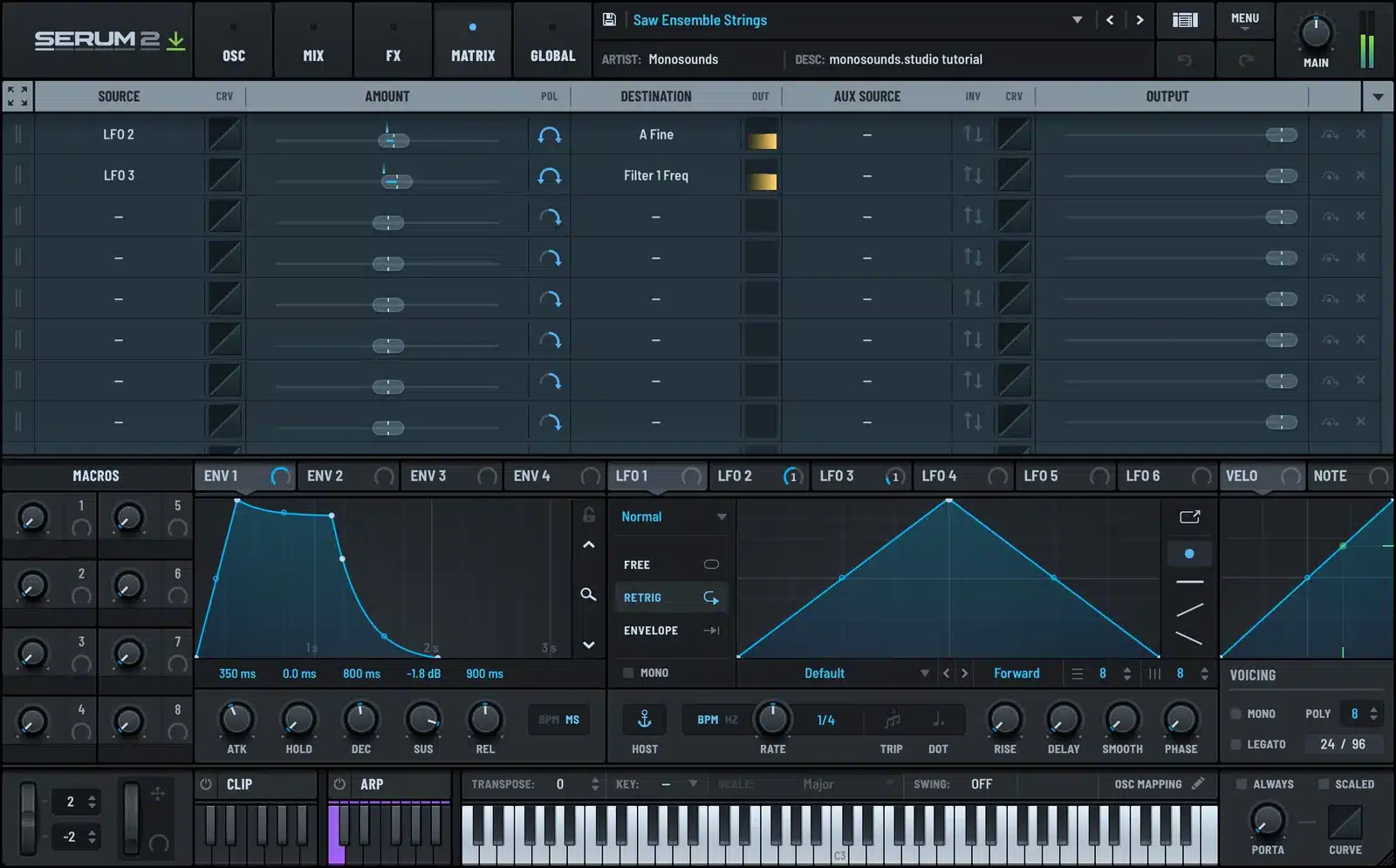
- A slow LFO nudging wavetable position or a gentle filter sweep, stretched over 8+ bars, barely there.
- A touch of LFO on pan, a different rate on each oscillator, letting the stereo image breathe.
- Velocity routed to filter cutoff, so the same chord stabs play soft-dark or hard-bright with no knob involved.
Here’s a lush, emotional stack from this same family, taken from our Harmonic Horizons pack. Future bass context, identical detuned-ensemble DNA.
Strings in melodic techno
For melodic techno, take the ensemble patch and apply stricter discipline: width closer to mono (narrow that unison spread), attack shortened to about 100–200 ms, and a sidechain to the kick so the held chords pump softly. That pumping handles the rhythmic job a real section would handle with bowing. The melodic techno and progressive packs inside our full Serum 2 preset range are stuffed with pads voiced this exact way, which saves you the dialing-in.
Here, voicing beats the patch itself. Stay in the octave around middle C, three or four notes per chord, and shift one voice at a time between changes. Giant ten-finger chords work as cinema in a breakdown and turn to mud everywhere else.
Want working patches as a starting point? The free Serum 2 melodic house presets contain string-adjacent pads built on this same unison-plus-slow-attack idea. Open them, read the envelope times, take the numbers.
The vocal-adjacent trick
Give a string patch a formant-ish wavetable, or lay it under real voice material, and it starts reading as choir. Film composers have exploited that ambiguity for decades. Blend synth strings with actual sung stacks and the synth handles the sustain while the voices bring the humanity. This is the sort of sung material I’m talking about.
If you’re gathering pads and strings across multiple genres, the Serum 2 preset bundles beat buying packs individually on pure math. And that’s all the sales pitch you’re getting.
Related: pads and atmospheres handles the ambient side of these patches, while melodic techno in Serum 2 places them inside complete arrangements.
FAQ
How many unison voices for synth strings?
5–7 on the main saw, 3–4 on the octave-down layer. Lots of voices with gentle detune comes out lusher than a handful of voices detuned hard.
Why do my synth strings sound harsh?
Saw stacks build up energy near 3 kHz. Take out 2–4 dB there with a wide EQ dip, and highpass under 150 Hz. Dull soloed, perfect in the mix.
What attack time for string pads?
200–800 ms, depending on the tempo and the part’s role. Stabby lines need the quick end or the notes show up late; ambient pads can stretch past a second.
Can Serum 2 replace orchestral string libraries?
For ensemble pads and long sustained beds, absolutely. For solo violin phrasing and realistic articulations, no, that stays sample-library territory.
Saws, detune, slow envelopes, a dip at 3 kHz. Fifty years on, the string machine recipe hasn’t changed, because it never had to.

I run Monosounds.studio and make the packs myself. Ten-plus years of producing, 97+ releases, 16,000+ downloads. Every Serum 2 preset we ship passes a CPU check on a mid-range laptop and gets used in a real track before release. If it does not survive a mix, it does not go in the pack.
More about Maxim & the studio →

