CamelCrusher has lived in my FX folder for more than ten years, and I still grab it regularly. It’s a free distortion and saturation plugin that does exactly one job well: it takes boring sounds and makes them feel alive. The download is right below, followed by an honest 2026 look at it and the settings I genuinely use.
CamelCrusher Download (v1.01, free)
- Version: 1.01, the final official build. Camel Audio closed in 2015, so there will be no newer one.
- Windows: 64-bit and 32-bit installers (.exe).
- Mac: .dmg installer. There is no native Apple Silicon build, see the Mac notes below.
- Size: one 7 MB zip with the three installers and a readme. Nothing else inside.
- Price: free, no signup, no email.
Download CamelCrusher v1.01 (Windows + Mac, zip)
On an M-series Mac, open your DAW under Rosetta if the plugin doesn’t show up. Some hosts load it that way, others won’t. The full story is further down.
What Is CamelCrusher?
CamelCrusher is a free “coloring” multi-effect from Camel Audio. Inside one small window you get two distinct distortion flavors, a compressor and a low-pass filter. The two distortion types can be blended against each other, and that blend is where most of the plugin’s character lives.
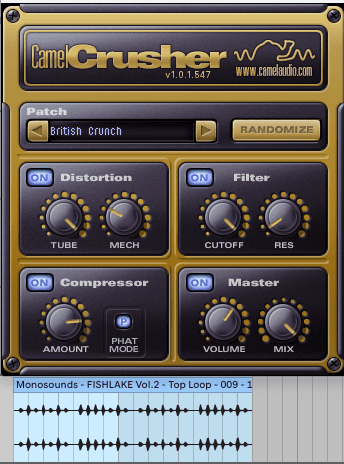
A bit of history, because it matters here: Apple acquired Camel Audio in 2015 and closed the company. CamelCrusher and its bigger sibling CamelPhat were discontinued and haven’t seen an update since. The plugin keeps working though, and producers keep passing it around because no free plugin has fully replaced its sound. Version 1.01 is the final official build, and that’s what’s linked below.
CamelCrusher Review: Still Good in 2026?
Short answer: yes, with one platform caveat coming up.
You’ll find CamelCrusher in the chains of massive artists. Skrillex leaned on it constantly for his early basses, and producers like Metro Boomin have been seen running it on 808s. It ended up as the free stand-in for CamelPhat, one of the most loved saturation plugins of its generation.
Four processing sections (Distortion, Compressor, Filter, Master), and that’s the entire feature list. No oversampling, no mid/side mode, no fancy meters. Honestly, that’s exactly why people love it. Ten seconds and you have a usable sound.
Let me correct something from the original version of this post: CamelCrusher is not CPU-heavy. It’s actually among the lightest distortion plugins around. Slap it on twenty channels and the CPU meter barely twitches. Curious how plugin loads really stack up in a modern project? My separate piece on CPU optimization names the actual offenders.
Pros
- Fast to use. A few knobs, zero menus. The result arrives before you’ve had a chance to overthink. Beginner-friendly, sure, but plenty of veterans keep it installed for the very same reason.
- Versatile for its size. Saturation, distortion, glue-flavored compression, tone shaping via the filter. Drums, synths, vocals, 808s, whole loops: it handles all of them.
- A sound of its own. Tube and Mech distortion feeding into the compressor produces a gritty, faintly analog character that a stock waveshaper struggles to imitate.
Cons
- Limited control. No drive curves to choose, no band splitting, no clever routing. When you need surgical distortion, look elsewhere.
- Abandoned since 2015. Zero updates, zero support, no native Apple Silicon build. Windows runs it fine as a 64-bit VST. Modern Macs are a coin flip: some hosts load it through Rosetta, others reject it outright.
- Few presets. The factory bank is tiny, so you’ll be turning knobs yourself, which, to be fair, takes about a minute.
How I Actually Use CamelCrusher
Concrete starting points, not vague advice:
- Drums: Mech at 20–30%, Tube at zero, compressor near 30%, master Mix pulled back to 40–50%. Punchier, dirtier drums with the transients still intact.
- Digital synths: Tube at 30–40% takes the sterility out of wavetable sounds. If the highs turn harsh, bring the low-pass down to roughly 8–10 kHz. I do this constantly on plucks and leads.
- Vocals: a small dose of Tube (10–15%) with the compressor on brings presence and grit. Keep it parallel with the Mix knob so the clean vocal stays underneath.
- 808s: the classic move. Tube at 25%, Phat mode engaged, Mix somewhere around 30–40%. Small speakers suddenly hear harmonics while the sub stays put. This is exactly what I run on the 808s from our Synopsis 808 presets for Serum 2, and the full technique is laid out in the Serum 2 808 bass guide.
For bass music it remains a quiet weapon. Put a CamelCrusher instance after the synth on a Skrillex-style growl and it glues the harmonics in a way stock clippers just don’t. If that’s your territory, see the dubstep growls tutorial and our Skrillex-inspired Serum 2 presets: patches designed with precisely this sort of post-processing in mind.
A Closer Look at the Interface
The strip along the top is called “Patch”.
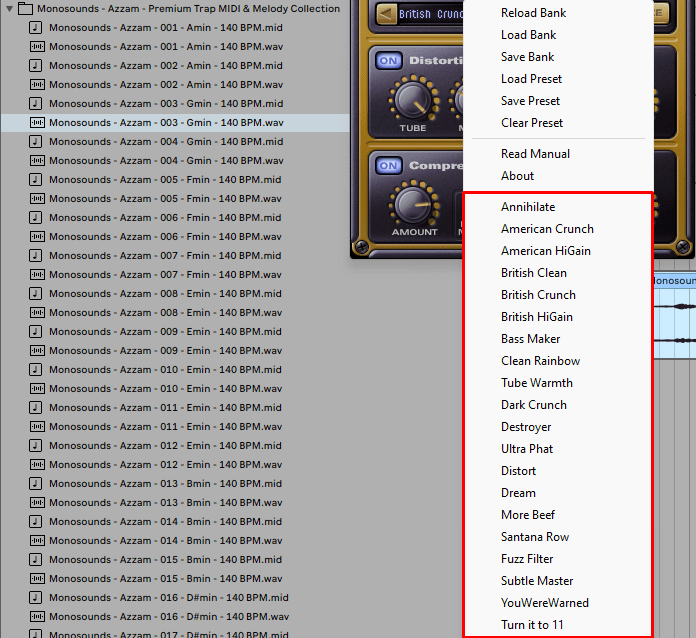
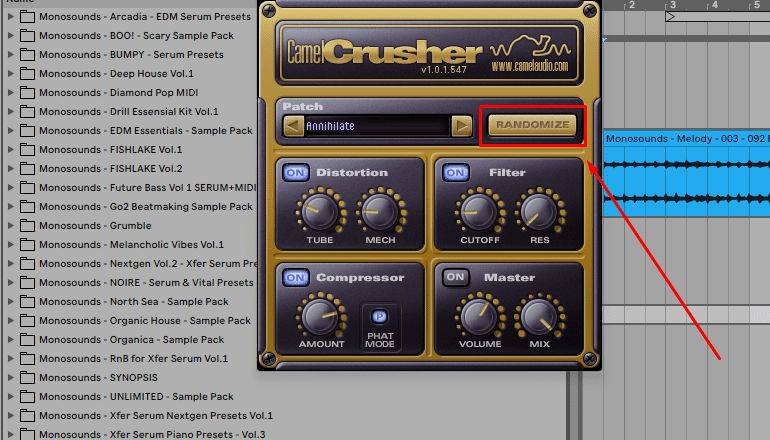
From here you load factory presets or save your own. There’s a Randomize button too, which rolls random settings. Treat it with respect: the output can spike very loud, loud enough to hurt your monitors or your ears. Drop your volume before clicking it.
CamelCrusher Distortion
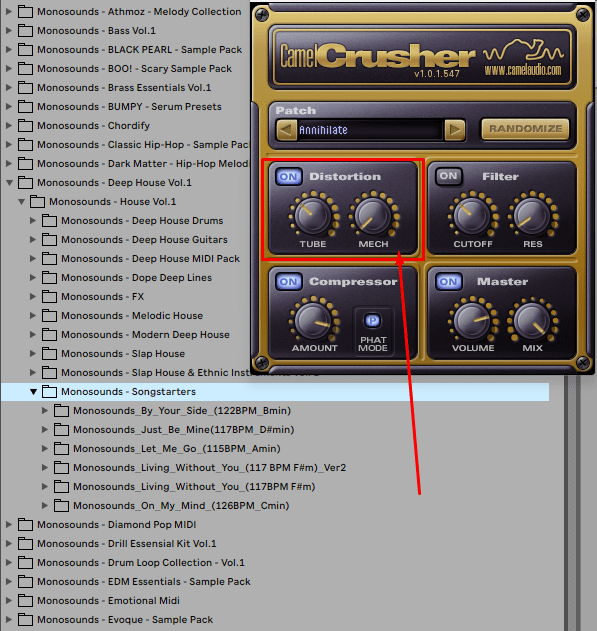
This section made the plugin famous. Two knobs, Tube and Mech, and they genuinely sound like different animals.
Tube favors the low end, laying on smooth, almost subliminal tube-style saturation. It’s the “warm it up” knob.
Mech is the mean one. You notice it instantly: fizzy, mechanical, right in your face. Brilliant on basses and drums, risky on anything bright.
The move is to blend the two, then use the Mix knob over in the Master section to fold the whole effect back into the dry signal. Parallel distortion from a single plugin, no routing required.
CamelCrusher Compressor
The compressor is a single knob, and it’s a character tool rather than a utility. It won’t stand in for a real channel compressor, but the density and slight pump it adds suit the distorted signal nicely.
Next to it sits the Phat Mode button, which drives the compression and overdrive harder. On 808s and basses it stays on for me nearly every time.
CamelCrusher Filter
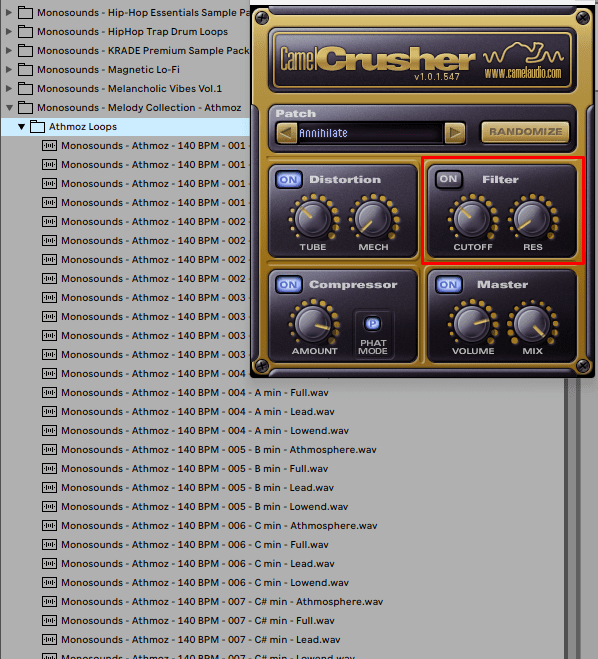
A basic resonant low-pass. Its role here is cleanup: distortion spawns new high harmonics, and the filter tames them so you never reach for an EQ. Close it until the harshness disappears, then add a touch of resonance if you want the cutoff to sing a little.
CamelCrusher Master
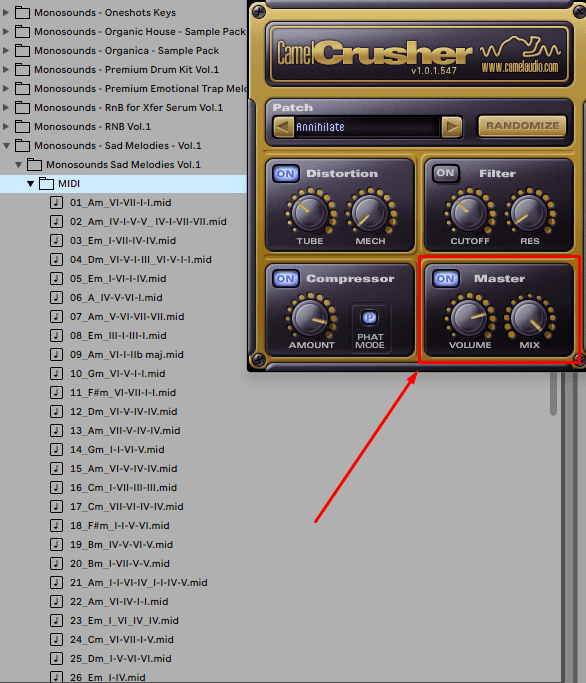
Volume, Mix, and an on/off switch. That Mix knob is the single most important control in the plugin. Nearly everything CamelCrusher does works better blended at 30–60% than fully wet. Dial in the sound, then back the Mix off until it sits naturally.
Do You Still Need It in 2026?
Depends what you’re running. On Windows: yes, without question. It’s free and still sounds great, go download it.
Mac is messier. An Apple Silicon version doesn’t exist and never will, so if it loads, treat that as a bonus rather than something to build a workflow around.
One more thing worth saying: Serum users are sitting on more distortion power than they may realize. Serum 2 (the free upgrade Xfer released in March 2025) brought flexible FX buses, meaning its distortion and multiband compression can run in parallel inside the synth itself. The whole chain is covered in my Serum 2 effects guide. A lot of what CamelCrusher used to do on my synth channels now happens directly in Serum 2. For ready-made starting points, take our free Serum 2 presets pack: 271 sounds, with plenty of the basses already carrying this style of saturation in the FX section.
Where Can I Download CamelCrusher?
With Camel Audio gone, there’s no official site anymore. The last version is available here: Camel Crusher (latest version). It’s the standard 1.01 build for both Windows and Mac.
Paid Alternatives to CamelCrusher
- Decapitator by Soundtoys – the reigning king of analog-style saturation. Five hardware-modeled styles, a Punish button, and everything it touches sounds expensive. If I kept only one paid saturation plugin, this would be it.
- Saturn 2 by FabFilter – multiband distortion with per-band control and serious modulation depth. Philosophically the anti-CamelCrusher: total control rather than two knobs. Perfect for sound design and mastering-grade saturation.
- Trash by iZotope – relaunched in 2023 on a new engine. Aggressive, creative, ideal for mangling sounds past recognition. The Lite version gets given away free fairly often, so keep an eye out.
And because CamelCrusher loves a big synth sound: we give away 271 free Serum 2 presets; feed them through it and you’ll understand what this plugin was built for.
FAQ: CamelCrusher
Is CamelCrusher still free?
Yes. It was free while Camel Audio existed and remains free today. The only change is there’s no official download source since Apple bought the company in 2015, so you’ll need an archive, like the one linked above.
Does CamelCrusher work on Apple Silicon Macs?
Not natively. No ARM build exists and none is coming. Some DAWs load the old AU/VST via Rosetta, others don’t see it at all. On an M-series Mac, test it, but have a fallback ready, like your DAW’s stock saturator or the distortion inside Serum 2.
Is CamelCrusher the same as CamelPhat?
No. CamelPhat was the paid sibling with extra filters, more distortion types and modulation. Both went away in 2015. And neither has anything to do with the DJ duo CamelPhat; they simply borrowed the name from the plugin.
What’s the best free alternative today?
Your DAW’s stock saturator plus a clipper gets you most of the way. For the nearest one-plugin equivalent, try the free tube/tape saturation plugins out there. Or, if you own Serum, use Serum 2’s FX section: the distortion module on an FX bus at 40% mix lands very close to the classic CamelCrusher parallel sound.
And that’s the whole story. Download CamelCrusher, drop it on an 808, roll the Mix back to 35%, and you’ll hear why a decade of abandonment couldn’t kill it. Want sounds with this kind of grit already built in? Our free Serum 2 preset pack is the easiest way in – 271 presets, no strings attached.

I run Monosounds.studio and make the packs myself. Ten-plus years of producing, 97+ releases, 16,000+ downloads. Every Serum 2 preset we ship passes a CPU check on a mid-range laptop and gets used in a real track before release. If it does not survive a mix, it does not go in the pack.
More about Maxim & the studio →

